2027 Berkeley MIDS vs. Washington Online MSIM Data Science Track: Cost, Curriculum, Admissions, and Format

Co-Founder and Chief Data Scientist
Berkeley's Master of Information and Data Science (MIDS) and the University of Washington's online Master of Science in Information Management (MSIM) Data Science track approach data work from different directions. One is a dedicated data science degree; the other places data science within information management.
For working professionals choosing between them, the useful questions are what you will study, what attendance requires, and what the full degree will cost - not which title sounds stronger. This comparison separates those established differences from details you should confirm before applying.
Key Things You Should Know
- Choose by curriculum fit: Berkeley MIDS centers the degree on applied data science; Washington's Data Science track sits within a broader information management degree. Check current required courses before assuming either provides more depth in a particular tool.
- Compare complete quotes, not advertised rates: Tuition, mandatory fees, travel requirements, and the credits you must take can change the price comparison. A current, comparable total for both programs should come from the universities.
- Test the schedule before committing: Confirm live-class times, any in-person requirements, track availability, and your expected completion plan. An online designation alone does not settle those questions.
How do Berkeley MIDS and Washington Online MSIM Data Science compare?
The clearest distinction is the degree's organizing purpose. Berkeley MIDS is built around using data science methods to analyze and solve problems. Washington's Data Science track applies those methods within an MSIM concerned more broadly with how organizations manage and use information. Neither description establishes that one program is universally more technical.
This comparison identifies what each option is designed to emphasize. Use the later sections to test the details that could change your decision.
| Decision criterion | Berkeley MIDS | Washington Online MSIM Data Science track |
| Degree identity | Dedicated Master of Information and Data Science | Master of Science in Information Management with a Data Science track |
| Likely strongest fit | Students who want data science to define the degree | Students who want data science alongside information-management practice |
| Most important curriculum check | Depth available in the technical subjects you want to pursue | How much of the degree can be devoted to data science rather than broader MSIM requirements |
| Most important practical check | Live attendance and any required travel | Track availability online and the schedule of courses needed to finish it |
What are the curriculum and data science courses in each program?
Berkeley MIDS emphasizes applied data science, including statistical reasoning, machine learning, working with data, and responsible use of analytical methods. Washington's Data Science track combines data-focused study with the MSIM's wider information-management perspective. For a prospective student, the decisive comparison is not whether both mention machine learning; it is which courses are required, which are electives, and whether the desired courses are available in the online schedule.
Compare current degree plans course by course, including prerequisites, project requirements, and elective restrictions. If building data pipelines is a career priority, check how much hands-on engineering appears in each program rather than treating an analytics course as equivalent; AI master's course options for data engineering offer a useful additional point of comparison. Course titles alone cannot show how much coding, modeling, or implementation a student will actually do.
How much do Berkeley MIDS and Washington Online MSIM cost?
A reliable 2026 total-price comparison requires each university's current tuition and fee schedule plus the number of credits or units in the student's approved plan. A comparable, verified all-in figure for both programs is not established here, so it would be misleading to name a cheaper winner. Ask both schools for a written estimate that separates tuition, mandatory program and university fees, course materials, and any required travel. Also ask whether the quoted rate can change while you are enrolled.
Apply the same assumptions to both estimates: your planned course load, expected time to completion, employer reimbursement, and any financing costs. If the resulting totals exceed your budget, compare budget-friendly data science master's degrees before borrowing. A low advertised per-credit price is not necessarily a low degree price when credit requirements and fees differ.
What are the admission requirements for each data science program?
Both are graduate programs, but applicants should use each program's current admissions page for the authoritative checklist and deadline. Do not assume identical rules for prior coursework, quantitative preparation, programming experience, test scores, recommendations, or English-language proficiency. Requirements and the evidence an admissions committee finds persuasive are not the same thing.
Before applying, identify where your transcript and work show programming, statistics, and analytical problem-solving. If your background is outside computing, ask each admissions office which preparation is required for admission and which is recommended for success; independent courses may strengthen readiness without formally satisfying a prerequisite. Applicants weighing a different technical direction can also consider a master's in AI after a non-CS bachelor's.
How do the online formats and schedules differ between the programs?
Both options are presented as online programs, but "online" does not tell you whether a required course meets live, when it meets, or whether travel is involved. Berkeley applicants should confirm current MIDS live-session expectations and any immersion requirement. Washington applicants should confirm that the Data Science track - not merely the general MSIM - is available online throughout their intended enrollment period, along with the meeting pattern for required track courses.
Request sample schedules for the next two terms and compare them in your own time zone. This matters especially if you work irregular hours: a course that fits this term does not establish that every required course will fit later. Also check how each program handles group projects, missed sessions, and breaks before treating either option as fully self-paced.
How long does each program take to complete?
Completion time depends on required coursework, course availability, and how many courses you take at once. Neither degree should be assigned a single personal graduation date without an approved study plan. Ask each adviser to map a realistic part-time sequence, including prerequisites and courses offered only in particular terms; then compare that sequence with the tuition estimate and your work commitments.
If finishing sooner is a major priority, examine shorter-duration master's degrees in data science as alternatives. A faster published pathway helps only if its actual class times and workload are sustainable for you.
What careers and job roles can each data science program support?
Berkeley MIDS is a direct curricular fit to investigate for data scientist, applied machine learning, and analytics roles. Washington's MSIM Data Science track is worth particular consideration when the target role also involves information strategy, data governance, or translating analysis into organizational decisions. Those are fit assessments, not placement claims: individual projects, prior experience, and the skills required by employers still matter.
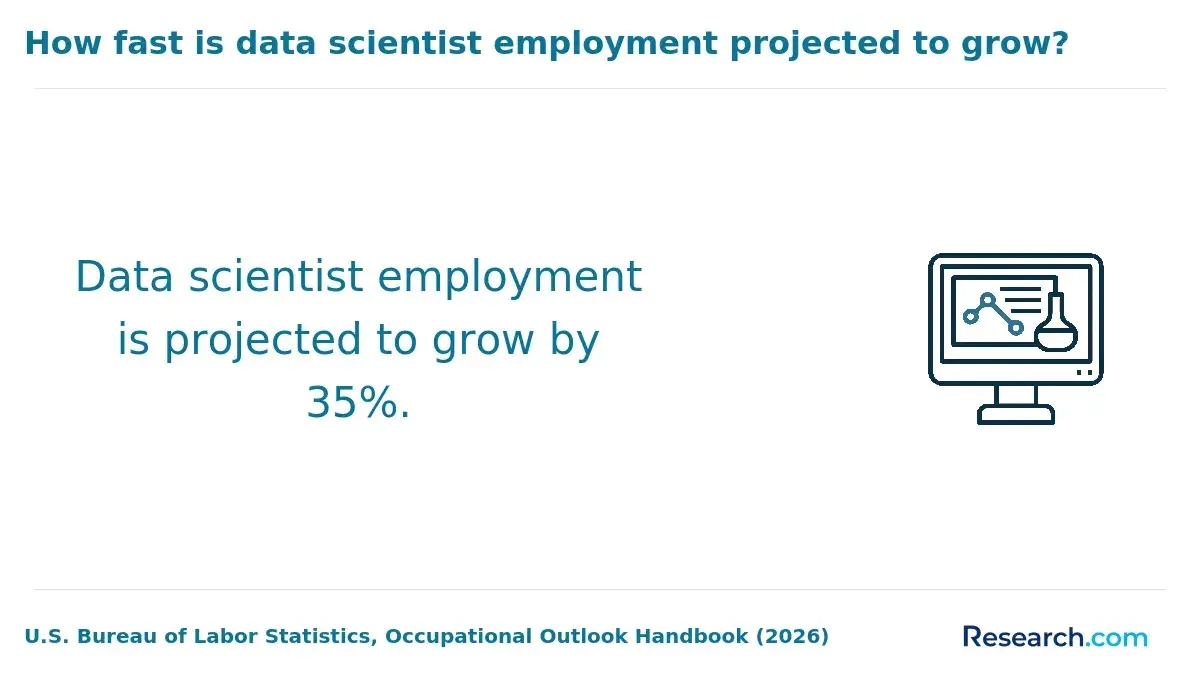
The U.S. Bureau of Labor Statistics projects 35% employment growth for data scientists from 2025 to 2035. That indicates a growing occupation, not that either degree secures a job. Compare recent postings for your target role with each program's required coursework and the projects you could show an employer.
What salaries can graduates expect after earning these degrees?
There is no defensible single salary to expect solely from completing either program. The Bureau of Labor Statistics reports a $120,230 median annual wage for U.S. data scientists in May 2025. This is an occupational median across workers, not an entry-level offer, a graduate outcome for either school, or the salary increase caused by a master's degree.
For a personal return-on-investment estimate, compare the full price of each degree with realistic job opportunities in your location and field. If a school provides graduate salary figures, check the survey year, response rate, graduates' prior experience, and whether the figure describes salary level or salary growth. Do not use a national median as a promised payoff for tuition.
Are Berkeley MIDS and Washington Online MSIM accredited degrees?
Yes. The University of California, Berkeley is institutionally accredited by the WASC Senior College and University Commission, and the University of Washington is institutionally accredited by the Northwest Commission on Colleges and Universities. These are university degrees, not short-course certificates. Institutional accreditation does not mean a specific track has separate programmatic accreditation or that credits will automatically transfer elsewhere.
If accreditation affects employer reimbursement, further study, or an application requirement, verify the university's current status with its accreditor and ask the receiving organization what it accepts. That is more useful than assuming the word "online" changes the degree's institutional accreditation.
Which program should prospective data science students choose?
Choose Berkeley MIDS if you want a degree organized around applied data science and its verified course plan, schedule, and full price meet your needs. Choose Washington's Online MSIM Data Science track if you want to connect data science with information management and can confirm that the online track includes enough of the technical coursework you want. Neither choice should rest on the degree title or a tuition rate viewed in isolation.
Before paying a deposit, obtain a current degree map, a written total-cost estimate, and answers about live attendance and travel from both programs. Compare those against several jobs you would genuinely pursue. If your objective is specifically AI-focused rather than broader data science or information management, planning an AI degree around professional objectives may help you decide whether either program is the right category of degree.
Other Things You Should Know About Data Science
Not automatically. Obtain your employer's permission and follow university rules on privacy, security, and approved datasets before using workplace information.
Ask the program to review the courses before enrolling. Transfer eligibility, credit limits, and whether a course satisfies a specific requirement are program decisions.
Ask an MSIM adviser about current track-change rules and course availability. A change may affect which requirements remain and when you can finish.
Generally, yes. Treat the applications separately: check each program's deadlines, required materials, decision dates, and deposit terms.
References
- School-Determined Requirements | 2024-2025 Federal Student Aid Handbook https://fsapartners.ed.gov/knowledge-center/fsa-handbook/2024-2025/vol1/ch1-school-determined-requirements
- Admission Criteria for Undergraduate Nursing Programs - PMC https://pmc.ncbi.nlm.nih.gov/articles/PMC12475341/
- Post-Secondary Employment Outcomes (PSEO) Data | U.S. Census Bureau https://lehd.ces.census.gov/data/pseo_experimental.html
- UW Master of Data Science Program Overview | Trends and Issues in Higher Ed https://www.washington.edu/datasciencemasters/
- MSIM - Tuition, Aid & Scholarships - UW Information School https://ischool.uw.edu/programs/msim/tuition-financial-aid
- Tuition & Financial Aid - UC Berkeley iSchool Online https://ischoolonline.berkeley.edu/admissions/tuition-financial-aid/
- Tuition & cost of attendance | UC Admissions https://admission.universityofcalifornia.edu/tuition-financial-aid/tuition-cost-of-attendance/