2027 Appointment No-Show Prediction Capstones: What to Look for in a Data Science Master's

Co-Founder and Chief Data Scientist
An appointment no-show prediction capstone can reveal whether a data science master's teaches more than model building. Students interested in healthcare analytics need a program that supports lawful data access, sound evaluation, clinical context, and a project they can explain to employers. This guide shows what a strong capstone would include - and which program features make it feasible - so you can compare degrees before committing.
Key Things You Should Know
- A strong capstone predicts missed appointments using information available before the appointment, then tests whether predictions could support a realistic intervention.
- Prioritize programs that offer capstone supervision, healthcare-relevant coursework, and a workable data-access plan; a healthcare elective alone does not establish those capabilities.
- Compare total program cost with project support and career fit, not the capstone topic alone. The U.S. Bureau of Labor Statistics reports a $120,230 median annual wage for data scientists in May 2025, not an expected salary for graduates.
What is an appointment no-show prediction capstone in data science?
It is a graduate project that estimates whether a scheduled healthcare appointment will be missed and examines how a clinic might use that estimate. The strongest version defines a prediction time - for example, before a reminder could be sent - and uses only information available by then. It treats the model as one part of an operational decision, not as a substitute for understanding why patients miss care.
A useful research question is: Can routinely available scheduling information identify appointments for which an additional reminder or outreach effort may be worthwhile? That framing keeps the project focused on a feasible response. Predicting a no-show is not the same as proving that a reminder, transportation assistance, or overbooking policy will improve attendance.
Program fit depends partly on the project's data route. A student may use an appropriately licensed, de-identified dataset, synthetic data, or data supplied through an approved organizational partnership. These routes offer different levels of realism; none guarantees access to patient records or permission to deploy a model.
How do data science master's programs prepare students for healthcare prediction projects?
A suitable program combines statistical modeling with data management, responsible research practices, and access to knowledgeable supervision. For this topic, look for evidence that students can complete a substantial project involving messy, time-dependent records - not merely a polished classroom dataset. A faculty member's healthcare research or an established partner may help, but ask what opportunities are actually available to master's students.
Program materials should clarify whether a capstone is required or optional, how topics and supervisors are assigned, and whether students can propose their own project. If your main goal is a healthcare-focused portfolio piece, choose a program with a documented path to an independent or team project. If that path is unclear, request recent anonymized project examples before applying.
Healthcare specialization can raise costs without necessarily improving project access. If you are weighing a broader technical degree against a healthcare-oriented option, an online AI degree affordability guide can provide another cost perspective; confirm separately that any program permits the kind of capstone you want.
What should an appointment no-show prediction capstone include?
A credible capstone makes the prediction task auditable and the proposed use proportionate to its evidence. These components distinguish a decision-ready project from a model that simply reports a high accuracy score:
- Defined outcome and timing: Specify what counts as a no-show, how cancellations and rescheduling are handled, and when a prediction would be made.
- Documented data rights: Explain the dataset's origin, permissions, privacy safeguards, and limits on sharing results or code.
- Leakage-resistant validation: Exclude information created after the prediction time and assess performance on later appointments when the data allows.
- Relevant evaluation: Compare against a simple baseline and report measures that reflect missed cases, unnecessary outreach, and the clinic's capacity - not accuracy alone.
- Fairness and operational review: Examine whether performance differs across relevant patient groups, where permitted, and discuss how an intervention could help or burden them.
- Reproducible deliverables: Record feature definitions, preprocessing, model comparisons, assumptions, and limitations so another analyst could review the work.
Common red flags are random record splitting when repeated patients or changing practices could distort results, using a post-appointment status as a predictor, and claiming that a risk score reduces missed visits without testing an intervention. A responsible final report can propose a pilot, but it should not present retrospective model performance as clinical impact.
Which courses support healthcare appointment prediction projects?
Course titles alone do not show whether students practice the work this capstone demands. Compare descriptions and assignments for the combination of methods below, then check whether those courses can be taken before the project begins.
Statistics and experimental design support uncertainty estimates, baseline comparisons, and evaluation of an eventual outreach pilot. Machine learning should cover classification, calibration, validation, and error analysis. Database and data-engineering coursework matters because appointment records may be revised, duplicated, or linked across systems. Healthcare informatics, ethics, or policy can help students interpret workflows and data-use constraints.
Choose elective depth according to your goal. Someone seeking healthcare operations roles may benefit more from informatics and evaluation than from an additional advanced modeling elective; a student targeting ML engineering may make the opposite choice while still needing privacy and evaluation competence. If cost shapes that trade-off, a comparison of ML master's degrees with tuition and fees below $20,000 offers alternatives to examine. Verify current charges and capstone options directly with each school.
What skills and tools are needed for no-show prediction research?
Students need SQL or equivalent database skills to construct an appointment-level dataset, Python or R for analysis, and version control to make changes traceable. They also need to define features from timestamps, handle missing values, select an appropriate validation strategy, and communicate errors and uncertainty to nontechnical stakeholders. Familiarity with a particular software package is less important than being able to justify each analytical choice.
The distinctive skill is working backward from the decision. If a clinic can make outreach calls only before a certain time, features and predictions must exist before that deadline. If staff cannot act on every alert, evaluation should consider a limited outreach capacity. These constraints are good questions to raise with a prospective capstone supervisor: they reveal whether the project will connect modeling to an actual workflow.
Do online data science master's programs offer strong capstone experiences?
They can, but delivery format does not establish project quality. An online program is a strong option when remote students receive accessible supervision, a clear project schedule, secure collaboration tools, and a feasible way to obtain approved data. Ask whether the capstone requires a sponsor, whether students may use public or synthetic data if a partnership falls through, and how team contributions are assessed.
What admission requirements apply to data science master's programs?
If you lack one foundation, identify it before applying. Clinical or scheduling experience can strengthen problem definition but does not replace the statistics and coding needed for validation. Conversely, a strong technical applicant may need to learn how appointment workflows and patient access affect the meaning of the data. Ask admissions which preparation satisfies any formal prerequisite and ask the program how students develop the remaining domain knowledge.
How much do data science master's programs cost and how long do they take?
There is no single price or timeline that describes these degrees. Published tuition may omit mandatory fees, software or equipment, travel, and any additional terms needed to finish a project. Before comparing offers, request a current estimate based on your residency, enrollment pace, and expected capstone schedule. Ask whether a delayed data agreement or unavailable supervisor could extend enrollment.
A lower-cost program may be the better choice if it supplies the supervision and project flexibility you need. A more expensive one needs a specific advantage - such as a verified healthcare project opportunity - that matters to your goal. If you are exploring alternatives, compare total charges with the capstone provisions rather than relying on a list price; the ML master's degrees with tuition and fees below $20,000 comparison is one starting point, but current school fee schedules should govern your decision.
Which careers and salaries can follow a healthcare data science capstone?
A well-executed project can provide evidence for applications to healthcare data analyst, operations analyst, data scientist, or machine-learning roles, depending on the student's other experience. It is especially useful when you can explain data construction, validation, stakeholder constraints, and what you would test before implementation. The project alone does not qualify someone for every clinical or senior technical position.
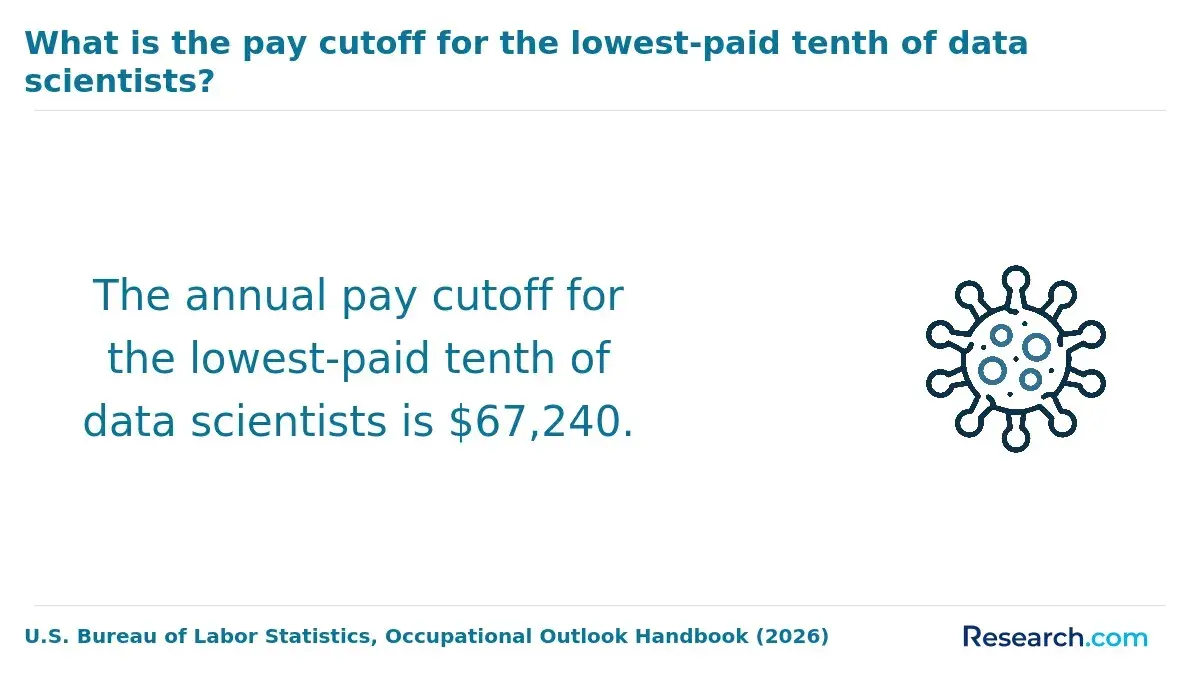
The U.S. Bureau of Labor Statistics reports a median annual wage of $120,230 for data scientists in May 2025 and projects 35% employment growth from 2025 to 2035. Those figures describe the occupation nationally, not healthcare-only jobs or salaries caused by a master's degree. For more context on how roles vary across sectors, consult salary comparisons for data science career sectors and assess openings against your experience, location, and target employers.
How can students evaluate an accredited data science master's program?
Confirm the institution's current accreditation through an official institutional or accreditor source, then evaluate the degree itself. Institutional accreditation is an important baseline, but it does not verify that a particular capstone, dataset, or healthcare mentor is available. A program's examples of past projects are useful evidence of possibilities, not a promise that you can repeat them.
Use a short, consistent set of questions with every program you are considering:
- Is a capstone required, optional, or unavailable, and may students propose an appointment prediction topic?
- Who supervises healthcare-related work, and what support is available if a proposed data partnership does not materialize?
- What permissions, review processes, and computing arrangements apply to sensitive data?
- Can students show employers a sanitized report or code repository, and what must remain private?
- What is the current total cost and realistic completion sequence for a student at my pace?
Choose the program whose answers give you a feasible route from question to defensible portfolio evidence. If career support is a deciding factor, compare its documented services and outcomes with discussions of online data science programs and employment pathways; do not treat a broad placement claim as proof of healthcare-specific opportunities.
Other Things You Should Know About Data Science
No. A careful comparison of established methods can be stronger than a novel model if the data, timing, evaluation, and proposed use are well justified.
Possibly. Publication depends on the dataset license, agreements, and institutional rules. Students can often demonstrate their methods without releasing restricted records, but they should obtain approval before posting code or outputs.
Neither is automatically better. For a team project, document your specific contributions and be ready to explain the full workflow without claiming work done by others.
There is no universal certification requirement for a data science capstone. Employer requirements differ; relevant technical skills, domain understanding, and evidence of responsible work usually matter more than an unrelated credential.
References
- Prediction of appointment no-shows using electronic health records - PMC https://pmc.ncbi.nlm.nih.gov/articles/PMC9041923/
- Privacy laws and policy guidance | hhs.gov https://telehealth.hhs.gov/providers/best-practice-guides/privacy-and-security-telehealth/privacy-laws-and-policy-guidance
- 3 - Baselines | ML@CMU https://blog.ml.cmu.edu/2020/08/31/3-baselines/
- MSDS Capstone Projects - College of Information Science https://infosci.arizona.edu/ms-data-science/capstone-projects
- What is Data Leakage in Machine Learning? | IBM https://www.ibm.com/think/topics/data-leakage-machine-learning
- Sinai Chicago No Show/Late Cancellation Policy https://www.sinaichicago.org/en/noshowpolicy/
- Nationwide Prediction of Missed and Cancelled Appointments Using Real-World EHR Data | medRxiv https://www.medrxiv.org/content/10.64898/2026.04.08.26349942v1.full-text
- Reducing Patient No-Shows | acaai.org https://education.acaai.org/patient-no-shows
- Medical Appointments No-Show | Mendeley Data https://data.mendeley.com/datasets/wm6w2fvkfj