
Best Universities in the World – 2026 Online Ranking (5th edition)

Co-Founder and Chief Data Scientist
On October 16, 2026, Research.com presents the 5th edition of its annual best universities in the world online ranking. This report examines universities worldwide based on research performance, scholarly influence, and academic recognition, offering students, researchers, and education professionals a data-driven perspective on higher education.
The 2026 ranking encompasses 2,000 universities across 88 countries, reflecting the international reach of research and higher education. The distribution of institutions highlights the substantial representation of countries with extensive research ecosystems, while also capturing contributions from a broad range of national academic communities. This geographic diversity offers a wider view of how research strength is distributed around the world.
The ranking is based on a systematic evaluation of university profiles using several research-related indicators. These include the consolidated H-index, the number of scientists associated with each institution, ranking positions, and awards. Together, these metrics provide a broad perspective on institutional research performance and scholarly impact.
By combining these indicators, this report presents a data-driven overview of universities worldwide. The ranking focuses on measurable academic achievements and research impact, helping readers compare universities based on the contributions and accomplishments of their researchers.
Latest discoveries in research
In October 2026, researchers at Seoul National University increased reaction selectivity from 16% to 97% by controlling acidity near electrodes. Published in the Journal of the American Chemical Society, the breakthrough could make chemical production more efficient while reducing reliance on added oxidants. It may benefit industries manufacturing plastics, medicines, and adhesives. The electrode-based method for improving chemical reaction selectivity highlights opportunities for cleaner industrial chemistry.
Meanwhile, researchers from the University of Oxford and the U.S. Department of Energy’s SLAC National Accelerator Laboratory used ultrafast X-ray technology to capture molecular changes during enzyme reactions. Published in Nature Communications and Nature Catalysis, the work produced detailed, time-resolved views of enzymes involved in penicillin production and biological processes relevant to cancer research. The use of ultrafast X-rays to observe enzyme reactions could support future drug development and antibiotic research.
The key findings from the world's best universities ranking
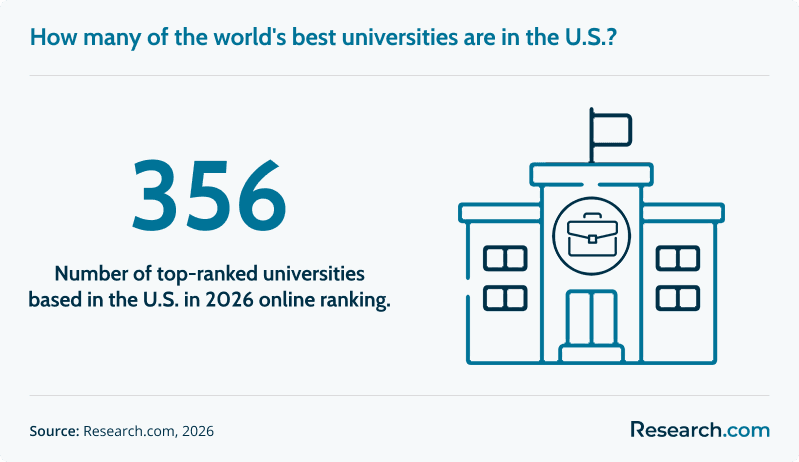
- The United States leads the 2026 ranking with 356 universities, followed by China with 250 and Japan with 155.
- Harvard University ranks first globally, with an aggregate H-index of 237,524, reflecting its substantial research influence.
- The top three universities are Harvard University, Stanford University, and the University of Oxford.
- Asia has the largest regional representation, with 727 universities, followed by Europe with 688 and North America with 416.
- California has the highest number of leading U.S. universities, with 33 institutions, followed by Texas with 29 and New York with 27.
- Harvard University leads in the number of top scientists, with 2,612, followed by Stanford University with 1,454.
The full ranking for the 2026 best universities in the world can be found here:
BEST UNIVERSITIES IN THE WORLD RANKING
Countries with the Highest Number of Leading Universities
The United States remains the leading country for top-ranked universities in 2026, with 356 institutions, followed by China with 250 and Japan with 155. The United Kingdom ranks fourth with 107 universities, while Germany rounds out the top five with 83. India follows closely with 82, ahead of France with 80 and Italy with 71. Spain and South Korea complete the top 10, with 58 and 51 universities, respectively.
Compared with 2025, the latest figures show lower counts across the leading countries. The United States declined from 608 universities in 2025 to 356 in 2026, while China fell from 334 to 250 and Japan from 254 to 155. India decreased from 236 to 82, and the United Kingdom from 133 to 107. France dropped from 117 to 80, while Germany declined from 114 to 83.
Regions with the Highest Number of Leading Universities
Asia leads the 2026 ranking with 727 universities, followed by Europe with 688 and North America with 416. Together, these three regions account for 91.6% of all institutions included in the ranking, highlighting their strong representation in global higher education.
South America ranks fourth with 76 universities, followed by Oceania with 48 and Africa with 45. Although Asia has the largest number of ranked institutions, these totals reflect the distribution of universities in the ranking rather than overall higher education capacity across each region.
Compared with the 2025 figures, the 2026 totals are lower across the regions reported in both years. Asia declined from 1,443 to 727 universities, Europe from 873 to 688, North America from 706 to 416, South America from 154 to 76, and Oceania from 56 to 48. Africa's count also decreased, from 123 to 45.
U.S. States with the Highest Number of Leading Universities
California leads the United States with 33 leading universities, followed by Texas with 29 and New York with 27. Massachusetts ranks fourth with 21 institutions, while Pennsylvania records 16. Illinois and Ohio follow with 15 and 14 universities, respectively. Virginia ranks eighth with 11, while Florida and Maryland complete the top ten, each hosting 10 leading universities. These figures highlight the concentration of prominent higher education institutions in major academic and economic centers.
Compared with 2025, California remains among the leading states, while New York, Texas, Pennsylvania, Massachusetts, Ohio, Illinois, Florida, Virginia, and North Carolina also featured prominently. Maryland enters the top ten, replacing North Carolina in the listed positions, although both states have 10 universities in 2026.
Online Universities Advance Distance Learning
Online universities are expanding access to higher education, allowing students to pursue degrees while balancing work and other responsibilities. According to the National Center for Education Statistics (NCES), 5.22 million students, or 26% of students enrolled at U.S. Title IV institutions, studied exclusively through distance education in fall 2024. Another 5.57 million students took some, but not all, courses remotely, demonstrating the continued role of flexible learning in higher education.
For academic research, online universities and distance-learning programs can broaden access to scholarly resources, digital libraries, research databases, and collaboration across institutions. The National Council for State Authorization Reciprocity Agreements reported that more than 1.7 million students attended out-of-state institutions exclusively through distance education in fall 2025, a 4% increase from fall 2024. These trends highlight how online education can connect learners with institutions beyond their home states, although research opportunities and facilities vary by institution and program.
H-index ranking—leaders, averages, and distribution
Harvard University is the world's and North America's top university, recording an aggregate H-index of 237,524. It is followed by Stanford University with 114,063, the University of Oxford with 89,336, the University of Michigan–Ann Arbor with 87,888, and the University of Pennsylvania with 85,940.
In Europe, the University of Oxford leads with an aggregate H-index of 89,336 and a global ranking of 3.
In Asia, the University of Tokyo in Japan is the leading institution, with an aggregate H-index of 51,637 and a global ranking of 25.
The University of Melbourne in Australia leads Oceania with an aggregate H-index of 45,873 and a global ranking of 33.
In South America, the Universidade de São Paulo in Brazil ranks first, with an aggregate H-index of 20,057 and a global ranking of 127.
In Africa, the University of Cape Town in South Africa leads with an aggregate H-index of 6,398 and a global ranking of 387.
Harvard University also leads in the number of top scientists, with 2,612. Stanford University follows with 1,454, ahead of the University of Michigan–Ann Arbor with 1,307, the University of Oxford with 1,213, and the University of Toronto with 1,208.
Across all 2,000 universities, the average aggregate H-index is 5,056. Among the top 1% of universities, equivalent to the 20 highest-ranked institutions, the average rises to 85,697.
About Research.com
All research was coordinated by Imed Bouchrika, Ph.D., a computer scientist with a well-established record of collaboration on a number of international research projects with different partners from the academic community. His role was to make sure all data remained unbiased, accurate, and up-to-date.
Research.com is the number one research portal for science and educational rankings. Our mission is to make it easier for professors, research fellows, and students to progress with their research and find the top experts in a wide range of scientific disciplines. Research.com is also a leading educational platform that helps students find the best colleges, academic opportunities, and career paths.
You can learn more about the methodology used to create the ranking here.


