2027 Temporary Social Work Roles vs Permanent Positions: Career Tradeoffs
Audited and Verified:
Our Editorial and Data Verification Process
Research.com uses government datasets, official education statistics and primary institutional information to support its career and degree guides. Our review process checks factual accuracy, occupational definitions, source dates and the requirements associated with the credentials discussed.
How This Article Was Fact-Checked
Our editorial team verifies salary estimates, employment projections, education requirements and program information against original data providers and official organizations. Salary figures are checked against the relevant occupational definitions and reporting periods. Information about licensure, accreditation and required in-person training is reviewed separately.
Fact-checked and verified on:

Co-Founder and Chief Data Scientist
A temporary social work offer may promise a higher hourly rate or a more flexible schedule, while a permanent position may provide steadier income, benefits, and mentorship. The better choice depends on the work you are authorized to do, the support you need, and the full value of the offer - not its job title. This guide is for students, new graduates, and experienced social workers comparing contract, per diem, grant-funded, and ongoing roles. It explains the financial and career tradeoffs and gives you a practical way to evaluate competing offers.
Key Things You Should Know
- Compare total compensation, not hourly pay alone: temporary roles may lack paid leave, employer-funded insurance, or paid time between assignments.
- Temporary status does not waive state licensing or supervision rules; confirm that the duties, supervisor, and records meet your licensing board's requirements before counting on experience toward a license.
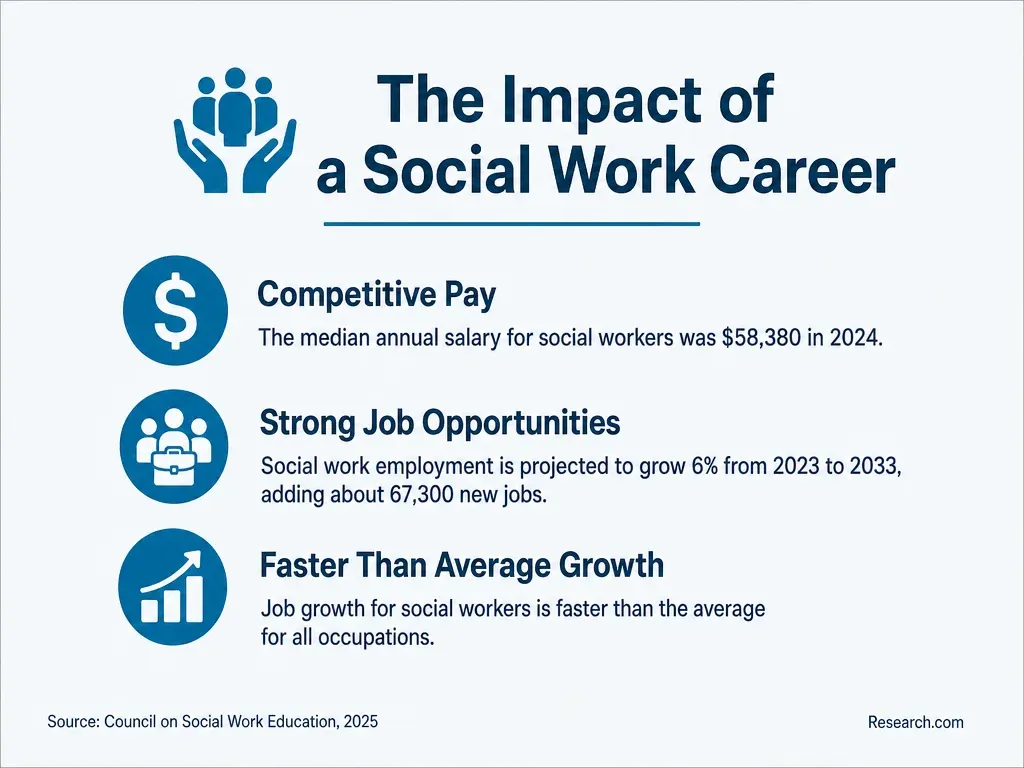
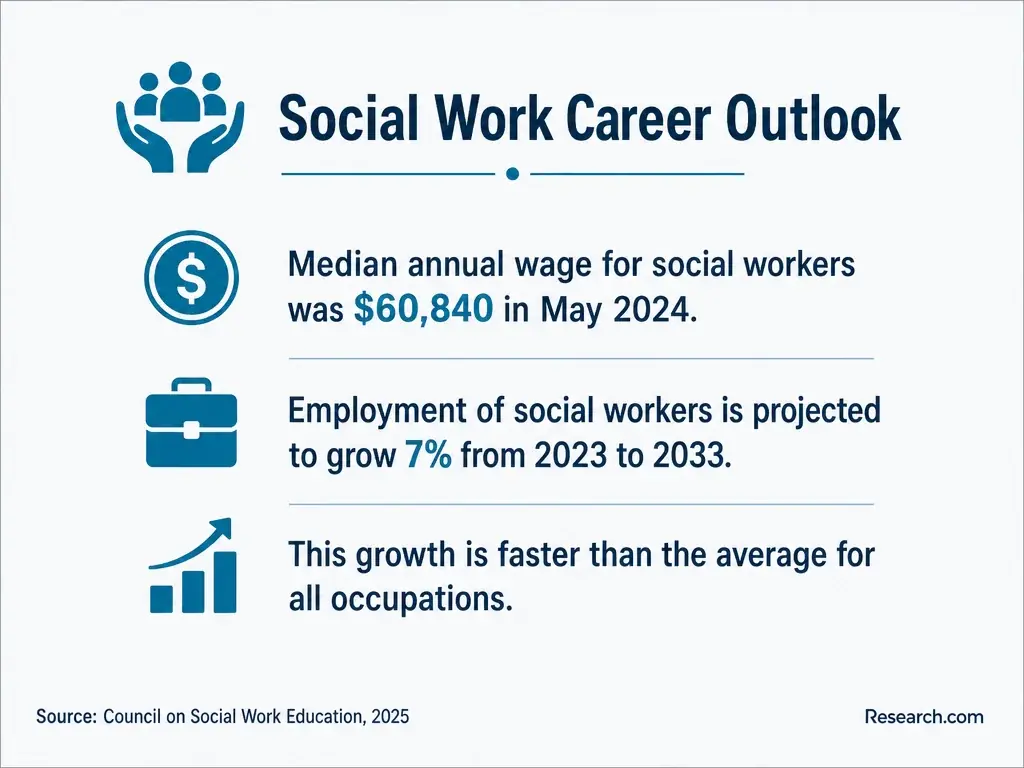
- For labor-market context, the U.S. Bureau of Labor Statistics reports a $61,780 median annual wage for social workers across specialties in May 2025 and projects 6% employment growth from 2025 to 2035; neither figure predicts the pay or availability of a particular contract.
How do temporary and permanent social work positions differ?
A temporary position has a defined end date, an assignment-based schedule, or hours that vary with demand. It may be a direct-hire contract, agency placement, per diem shift, or grant-funded appointment. A permanent position generally has no preset end date, but it is not a guarantee of continued employment. Either arrangement can be full-time or part-time.
The most important distinction is often who employs you and what work you will actually do. A staffing agency may employ and pay a social worker assigned to a hospital, while the hospital directs day-to-day work. A grant-funded nonprofit role may be called permanent even though its funding needs renewal. The table shows why contract labels alone are insufficient.
| Feature | Temporary or assignment-based role | Ongoing position |
| Duration | Set term, variable shifts, or funding-dependent assignment | No preset end date, subject to staffing and funding decisions |
| Work pattern | May involve rapid onboarding, coverage, or a defined project | More likely to include continuing caseloads and agency responsibilities |
| Support | Orientation and supervision vary by contract and site | May offer more sustained mentorship and internal training |
| Benefits | Depend on employer, hours, and worker classification | Often available to eligible employees, but plan terms vary |
Neither model determines professional scope. An MSW-qualified worker covering discharge planning, for example, may have different duties from a licensed clinician providing therapy. Use the actual job description alongside an overview of social work master's roles and employment settings to judge whether the assignment fits your preparation.
How do pay and benefits compare for temporary and permanent social workers?
Temporary roles can advertise a higher hourly rate, particularly when an employer needs immediate coverage. That rate may compensate for unpaid gaps, limited benefits, travel, or an assignment that ends quickly. Permanent employees may receive paid leave, insurance, retirement contributions, training, and predictable hours, though none should be assumed without an offer document.
Convert each offer to a comparable annual net-value estimate: expected paid hours multiplied by pay rate, plus employer-paid benefits and stipends, minus your insurance premiums, unreimbursed travel, licensing costs, and likely unpaid time. For a temporary assignment, calculate a second scenario with a gap between contracts. If you are considering further education to qualify for higher-paid roles, weigh its cost against realistic local earnings; social work master's education costs and career fit matter more than a single advertised wage.
For context, the U.S. Bureau of Labor Statistics reports a May 2025 median annual wage of $61,780 for social workers across specialties. This occupation-wide figure mixes employers, experience levels, and employment arrangements. It is not a temporary-worker rate, an MSW starting salary, or an offer benchmark for your location. Ask whether quoted pay includes only hours worked, whether orientation and documentation time are paid, and which organization provides benefits.
How do job security and flexibility differ between temporary and permanent roles?
Temporary work may let you select assignments, take breaks between contracts, or sample settings before committing. It can also mean variable hours, short-notice cancellations, and repeated onboarding. Permanent work generally makes household budgeting easier, but schedules may be less negotiable and caseload obligations continue through busy periods. Funding cuts and restructuring can affect either arrangement.
Judge control over your time, not just a posting's promise of flexibility. A per diem hospital role may require weekends and last-minute availability; a permanent community position may offer a dependable weekday schedule. If you are studying while working, compare shift expectations with live classes and field requirements. Even asynchronous MSW coursework and scheduling will not make an agency placement or required skills session self-paced.
Also consider continuity of care. Frequent assignment changes can limit follow-through with clients and referral partners, while an ongoing role can support longer-term work. A temporary role is a better fit when you can tolerate income gaps and the site provides enough orientation to work safely; permanence is more valuable when stable hours, sustained supervision, or continuing client relationships are priorities.
National projections indicate demand across social work specialties, but they do not separate temporary from permanent openings. The following U.S. Bureau of Labor Statistics figures pair May 2025 median annual wages with projected employment growth for 2025-2035. Use them to compare occupational markets, not to predict what an individual agency will offer.
| BLS occupation | May 2025 median annual wage | Projected growth, 2025-2035 |
| Social workers, all specialties | $61,780 | 6% |
| Child, family, and school social workers | $59,550 | 4% |
| Healthcare social workers | $67,880 | 8% |
| Mental health and substance abuse social workers | $60,280 | 10% |
Healthcare and mental health occupations show stronger projected growth than child, family, and school social work in these figures. Growth alone does not identify the easiest job to obtain: local funding, vacancies, credential requirements, and your experience still matter. For geographic comparisons, use MSW earnings and geographic career planning alongside current local postings. Do not assume a specialty's median wage applies to every MSW graduate or to a short-term assignment.
Temporary status creates no exception to state rules on protected titles, clinical duties, supervision, or practice across state lines. Before accepting an assignment, confirm your active license or permitted prelicensure status in the jurisdiction where services will be provided. A license in one state does not automatically authorize in-person or remote practice in another.
For a worker seeking independent clinical licensure, the decisive issue is whether the specific work arrangement meets the board's current requirements. Check the permitted duties, qualified supervisor, supervision frequency, eligible setting, and documentation process before starting. If a staffing agency is your legal employer but another organization supervises your work, clarify who can verify hours and sign records. A short assignment with inconsistent supervision may be useful experience yet contribute little to a required post-degree supervision pathway.
BSW or MSW field education is different from post-degree supervised practice. Neither an MSW diploma nor passing a required exam by itself grants independent clinical authority. Ask the applicable state board to resolve eligibility questions; for education-related checks, review social work master's licensure disclosure questions with the program before enrolling.
What should social workers review before accepting a temporary or permanent offer?
Request the full written terms and compare offers against the same workload and career goal. The following checks reveal differences that a headline rate or a "permanent" label can hide:
- Employment terms: Identify your legal employer, expected end date, guaranteed hours if any, cancellation terms, overtime rules, and whether travel, orientation, and documentation time are paid.
- Total compensation: Compare insurance eligibility and premiums, paid leave, retirement contributions, reimbursement, commuting costs, and realistic gaps between assignments.
- Practice support: Confirm caseload, population, safety procedures, record-system training, supervisor availability, and how concerns can be escalated.
- Credentials and supervision: Check required license status, permitted duties, who documents supervised experience, and whether the arrangement meets current board rules.
- Next step: Ask whether the role offers training, advancement, or a realistic route to an ongoing position - and what happens to your caseload when the assignment ends.
Choose the temporary offer when its verified compensation and schedule outweigh the risk of gaps and the site can support safe, authorized practice. Favor the ongoing offer when benefits, continuity, and supervision better serve your financial or licensing goals. If a job search reveals that an MSW is essential for your intended role, compare lower-tuition Master of Social Work pathways without assuming lower tuition means a workable field schedule or automatic license eligibility.
Other Things You Should Know About Social Work
Possibly. Eligibility depends on state unemployment rules, your earnings and employment classification, and why the assignment ended. Apply through the relevant state agency rather than assuming a contract's end date makes you ineligible.
The agency should have a handoff process for records, referrals, urgent needs, and client communication. Ask about that process early, and follow agency policy and applicable confidentiality rules rather than retaining client information for personal follow-up.
Often, but check each employer's outside-work policy, scheduling expectations, and potential conflicts of interest. Keep client records and access separate, and confirm that your duties at each site fit your license and competence.
Use a description that accurately identifies both your employer and work site when relevant, such as naming the staffing agency and noting the hospital assignment. Keep dates and duties consistent with records that an employer can verify.
- Section 3 Employee Benefits | U.S. Equal Employment Opportunity Commission https://www.eeoc.gov/laws/guidance/section-3-employee-benefits
- Fact Sheet #22: Hours Worked Under the Fair Labor Standards Act (FLSA) | U.S. Department of Labor https://www.dol.gov/agencies/whd/fact-sheets/22-flsa-hours-worked
- A Study of the Roles and Use of Licensed Social Workers in the United States | ASPE https://aspe.hhs.gov/study-roles-use-licensed-social-workers-united-states
- Temporary Agency Work and Well-Being - The Mediating Role of Job Insecurity - PMC https://pmc.ncbi.nlm.nih.gov/articles/PMC8583591/
- Temporary and Term Employment and Appointments | U.S. General Services Administration https://www.gsa.gov/directives-library/temporary-and-term-employment-and-appointments-2
- Licensed Clinical Social Worker | floridasmentalhealthprofessions.gov https://floridasmentalhealthprofessions.gov/licensed-clinical-social-worker/
- Elementor #2719 - North Carolina Social Work Certification and Licensure Board https://www.ncswboard.gov/elementor-2719/
- Pathway Social Work Licensure in CA | USC Suzanne Dworak-Peck School of Social Work https://dworakpeck.usc.edu/pathway-to-social-work-licensure
- Irregular Work Scheduling and Its Consequences | epi.org https://www.epi.org/publication/irregular-work-scheduling-and-its-consequences/
- Offering Benefits to Part Time Employees | adp.com https://www.adp.com/resources/articles-and-insights/articles/p/part-time-benefits