2027 Social Workers and Physical Therapists: Collaboration Around Function and Community Supports
Audited and Verified:
Our Editorial and Data Verification Process
Research.com uses government datasets, official education statistics and primary institutional information to support its career and degree guides. Our review process checks factual accuracy, occupational definitions, source dates and the requirements associated with the credentials discussed.
How This Article Was Fact-Checked
Our editorial team verifies salary estimates, employment projections, education requirements and program information against original data providers and official organizations. Salary figures are checked against the relevant occupational definitions and reporting periods. Information about licensure, accreditation and required in-person training is reviewed separately.
Fact-checked and verified on:

Co-Founder and Chief Data Scientist
A patient may be able to climb the stairs in therapy but still lack a safe way to get into an apartment, obtain equipment, or reach follow-up appointments. Physical therapists and social workers address different parts of that gap.
This guide explains how they coordinate around function and community supports, where their responsibilities differ, and what a student or early-career social worker should look for in rehabilitation-focused education and jobs. It also identifies the questions to settle before choosing a program or accepting a team-based role.
Key Things You Should Know
- Physical therapists assess movement and develop physical therapy plans; social workers address barriers such as housing, caregiving, benefits, and access to services. Neither role substitutes for the other's professional assessment.
- Effective discharge coordination connects a person's actual functional needs with confirmed community services, not merely a list of referrals.
- The U.S. Bureau of Labor Statistics reports a $67,880 median annual wage for healthcare social workers in May 2025 and projects 8% employment growth from 2025 to 2035; these occupation-wide figures do not predict a rehabilitation job offer.
How do social workers and physical therapists work together?
Social workers and physical therapists work together by building a shared, patient-centered plan for functioning in the setting where the person will actually live.
Function means more than performance in a therapy session: it includes whether someone can move through their home, participate in daily activities, and access necessary help. The team may also include occupational therapists, nurses, physicians, case managers, and the patient's chosen caregivers.
For example, a physical therapist may identify that a person needs assistance on stairs. A social worker can explore whether assistance is available, whether the home has usable access, and whether a different discharge arrangement needs discussion.
The team then checks the plan with the patient rather than assuming a caregiver can provide help. Goals and updates should be documented through approved team processes, with information shared only as permitted by consent, law, and agency policy.
Students interested in this work should look for practice with interdisciplinary communication, not just a rehabilitation course title. Online social work study and professional preparation can be compatible with that goal when the program also provides suitable skills practice and an approved field placement with team exposure.
What are their distinct roles in supporting patient function and mobility?
The professions contribute distinct assessments and interventions. The comparison below helps students identify which work they want to do and helps teams avoid assigning tasks by job title alone:
| Area | Physical therapist | Social worker |
| Primary focus | Movement, mobility, physical function, and rehabilitation goals | Person-in-environment needs, service access, coping, support networks, and social barriers |
| Typical contribution | Evaluates movement and designs or adjusts a physical therapy plan within professional scope | Assesses support needs, coordinates resources, advocates with the patient, and helps plan transitions |
| Shared decision | Whether the proposed destination and available support match the person's functional needs and preferences |
A social worker should not independently prescribe a mobility intervention or decide that a person is physically safe on stairs. A physical therapist should not assume that a benefits application, housing arrangement, or caregiver commitment is complete.
Where a social worker provides clinical mental health services, the applicable license and supervision requirements are a separate question; social work clinical experience counting and verification should not be confused with either MSW field education or routine rehabilitation teamwork.
How do social workers and physical therapists coordinate community supports after discharge?
Discharge coordination starts with the gap between what a patient can do and what the next setting requires. With the patient's participation, the team can compare mobility findings with the home layout, transportation, caregiver capacity, follow-up care, and available community services.
A referral is not a confirmed service: eligibility, cost, start date, accessibility, and who will follow up may still be unresolved.
A practical sequence makes those uncertainties visible before discharge:
- Confirm the patient's preferred destination, goals, and who may be involved in planning.
- Translate physical therapy findings into specific support needs, such as help entering the home or getting to appointments.
- Check proposed services and equipment with the responsible providers, payers, and agencies rather than assuming availability or coverage.
- Document unresolved barriers, the responsible team member, and the follow-up plan under agency policy.
Needs and service networks vary by community, so students benefit from placements that teach them to verify local resources rather than memorize a generic referral list. When comparing BSW preparation, social work bachelor's quality and career preparation should include the program's ability to support approved field learning in relevant service settings.
Physical therapists must meet their state's requirements for physical therapy licensure, including qualifying professional education and the applicable examination and application process.
Social work rules are separate: license categories, qualifying degrees, examinations where required, supervised experience, and permitted duties vary by state. Employers may impose additional qualifications for a particular rehabilitation position.
For social workers, graduation, eligibility to apply, license issuance, and independent clinical authority are different milestones. An MSW or a hospital placement does not independently authorize psychotherapy or other reserved clinical work.
Before selecting a program for a licensed role, use checking professional eligibility when choosing an MSW as a starting point, then confirm the current rules directly with the intended state board. A prospective physical therapist should likewise verify the relevant physical therapy board's requirements; social work and PT credentials are not interchangeable.
What are the salaries and job outlook for social workers and physical therapists?
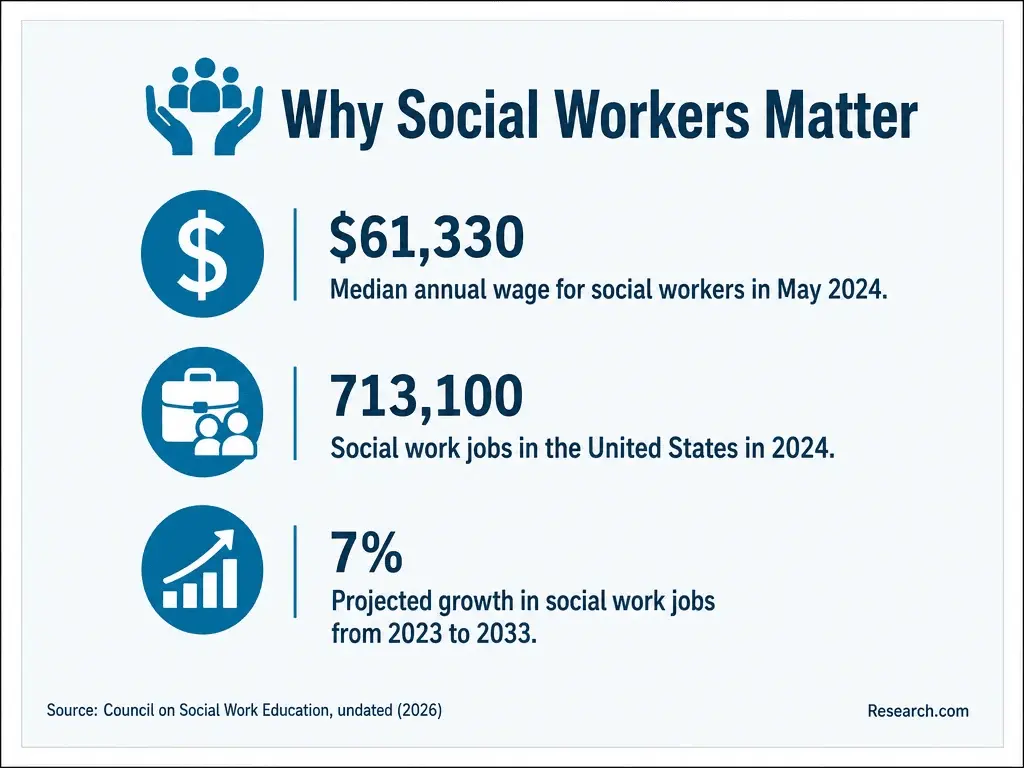
U.S. Bureau of Labor Statistics figures offer occupation-wide context, not rehabilitation-team pay scales. For May 2025, BLS reports a median annual wage of $67,880 for healthcare social workers and projects 8% employment growth for that occupation from 2025 to 2035.
Its broader social worker category has a $61,780 median and 6% projected growth over the same period. Actual offers vary by setting, region, experience, and job duties.
Physical therapists are a separate BLS occupation with a different educational and licensing pathway. Compare a prospective PT offer with the current BLS physical therapist occupation figures for the same wage year and projection period; do not use social work wages as a proxy.
For social workers considering where to practice, MSW compensation and relocation considerations should be weighed against local living costs, license eligibility, and the specific employer's offer.
Other Things You Should Know About Social Work
Hear each person's concerns without treating the caregiver's availability as guaranteed. The team should explain the functional and service options to the patient, assess decision-making and safety issues within each member's role, and follow applicable consent and agency procedures.
Clinical recommendations and payment decisions are different. The team should identify the appropriate evaluator or supplier and confirm coverage criteria, authorization, costs, and timing with the relevant payer or program.
Often. Occupational therapists commonly address performance of daily activities and may assess relevant equipment or environmental needs. Each discipline contributes its own evaluation to a coordinated plan.
Tell the team promptly, clarify the resulting support gap with the patient, explore feasible alternatives, and document the updated plan under agency policy. Do not record a referral as an active service until its availability is confirmed.
- Social Determinants of Health and Their Effects on Care - NCBI https://www.ncbi.nlm.nih.gov/books/NBK609335/
- Understanding Medicaid Home and Community Services | ASPE https://aspe.hhs.gov/reports/understanding-medicaid-home-community-services-primer-0
- NASW Standards for Social Work Case Management | nycourts.gov https://www.nycourts.gov/reporter/webdocs/nasw_standards_socialwork_casemgt.htm
- Addressing Social Needs in Health Care Settings - PMC - NIH https://pmc.ncbi.nlm.nih.gov/articles/PMC8240195/
- Unpacking the black box of interprofessional collaboration within healthcare networks: a scoping review | BMJ Open https://bmjopen.bmj.com/content/15/6/e101702
- Occupational Therapy vs Physical Therapy | UCLA Medical School https://medschool.ucla.edu/news-article/occupational-therapy-vs-physical-therapy
- Social Work Role | Center for Health Interprofessional Practice and Education https://healthipe.utexas.edu/social-work-role
- NASW Standards for Social Work Practice in Health Care Settings | socialworkers.org https://www.socialworkers.org/Practice/NASW-Practice-Standards-Guidelines/NASW-Standards-for-Social-Work-Practice-in-Health-Care-Settings