2027 Humanistic Theory in Social Work: Meaning, Growth, and Helping Relationships
Audited and Verified:
Our Editorial and Data Verification Process
Research.com uses government datasets, official education statistics and primary institutional information to support its career and degree guides. Our review process checks factual accuracy, occupational definitions, source dates and the requirements associated with the credentials discussed.
How This Article Was Fact-Checked
Our editorial team verifies salary estimates, employment projections, education requirements and program information against original data providers and official organizations. Salary figures are checked against the relevant occupational definitions and reporting periods. Information about licensure, accreditation and required in-person training is reviewed separately.
Fact-checked and verified on:

Co-Founder and Chief Data Scientist
Humanistic theory can make social work sound simple: listen carefully, respect clients, and support growth. In practice, a worker must also address housing barriers, safety concerns, agency rules, and the limits of a client's choices.
This guide is for students and early-career social workers who want to understand what the theory explains, how it changes everyday interactions, and where it falls short. It also shows what to look for in coursework, field education, and career preparation if building effective helping relationships is your goal.
Key Things You Should Know
- Humanistic theory emphasizes a person's lived experience, capacity for growth, and right to participate in decisions; it is a practice perspective, not a diagnosis or a treatment with guaranteed results.
- Empathy, genuine communication, and collaborative goals can strengthen helping relationships, but workers must also account for structural barriers, safety, and legal duties.
- Look for observed skills practice and supervised field learning - not a program's theoretical label alone. A BSW and an MSW serve different roles, and neither degree automatically grants a license.
What is humanistic theory in social work?
Humanistic theory is a way of understanding people that centers subjective experience, dignity, choice, and the possibility of growth. Associated particularly with Carl Rogers's person-centered approach and Abraham Maslow's writing on human needs, it asks workers to see more than symptoms, deficits, or a service category. A person seeking housing assistance, for example, also has preferences, relationships, abilities, and an account of what a workable home would mean to them.
In social work, this perspective fits the profession's commitment to self-determination, but it is not the same as the whole profession. Person-in-environment assessment also examines income, discrimination, family relationships, policy, and access to services. Humanistic theory helps explain how to relate to a person; it does not replace that broader assessment or supply a complete intervention plan.
Students comparing social work degree options and program formats should look beyond whether a course description says "person-centered." Ask where the program teaches engagement, permits feedback on interviewing, and assesses those skills in field education.
How does humanistic theory explain personal growth and self-determination?
Humanistic approaches treat growth as more likely when people can examine their experience without being reduced to a label or judged for their circumstances. Rogers emphasized empathy, genuineness, and accepting regard in a helping relationship. Maslow described human needs, including basic security and belonging, as relevant to development. Neither idea means growth follows a fixed schedule or that someone must satisfy a rigid hierarchy before they can make meaningful choices.
Self-determination means supporting a client's informed participation in goals and decisions - not assuming the worker knows what a good life looks like for them. In a benefits appointment, a worker might explain available options and their consequences, then ask which immediate goal the client wants to prioritize.
Choice may still be constrained by eligibility rules, coercion, poverty, or safety concerns. Workers should name those constraints rather than presenting a limited menu as unrestricted freedom.
Learning to support choice takes more than reading theory. For students considering social work master's progression after different bachelor's degrees, the relevant question is how each eligible route builds foundational engagement skills before expecting students to apply them in specialized practice. Advanced standing generally requires a qualifying BSW and the individual program's approval; another bachelor's degree does not ordinarily substitute for it.
How does humanistic theory shape helping relationships in social work?
A humanistic helping relationship is collaborative rather than emotionally detached or directive by default. The worker tries to understand what an experience means to the client, communicates honestly about the worker's role, and avoids making acceptance conditional on agreement. That stance can make it easier to discuss sensitive goals or correct a worker's mistaken assumption.
Empathy is not agreement, and genuineness is not unlimited self-disclosure. A social worker can acknowledge a parent's frustration with an agency while accurately explaining a reporting duty or service limit. Professional boundaries, confidentiality, informed consent, and clear records remain essential. When an immediate safety concern or legal obligation affects choices, the worker should explain applicable limits within their role and follow current agency and jurisdictional requirements.
Field education is where students can test whether respectful intentions become observable skills. In comparing MSW practicum placement assistance, ask how a program arranges appropriate sites, prepares field instructors, and helps students receive feedback on engagement - not just whether it advertises a large placement network.
Humanistic theory gives workers a useful check against treating clients as cases to be managed rather than people with interpretations and preferences. It can improve the quality of engagement and make goals more responsive to what the client values. Its limits matter just as much when selecting an approach.
The comparison below separates what the perspective contributes from what a worker must address through other knowledge, resources, or duties.
| Strength | Limitation or needed complement |
| Centers the client's account and participation. | Choice can be constrained by poverty, discrimination, eligibility rules, or involuntary involvement; assessment must include those conditions. |
| Encourages empathy and a strong working relationship. | A good relationship alone does not establish that a particular treatment or service improves outcomes. |
| Resists defining people solely by problems. | Workers still need accurate risk assessment, documentation, referrals, and action within their scope. |
A useful test is whether a worker can honor a person's account and respond to the conditions shaping it. If a client wants stable housing, respectful listening should accompany practical service coordination or advocacy where the role allows. Students evaluating the value of lower-cost MSW programs should examine opportunities to learn both relational and systems-level practice; a low tuition figure does not establish either.

What careers, salaries, and job prospects are available to social workers?
Humanistic skills apply across social work roles, but job duties and qualifications differ. A child and family social worker may coordinate services and work within protective-services requirements; a healthcare social worker may help patients plan for care transitions; a mental health social worker's clinical activities depend on training, supervision, and state scope rules. Community advocacy and program roles may emphasize participation and systems change rather than individual counseling.
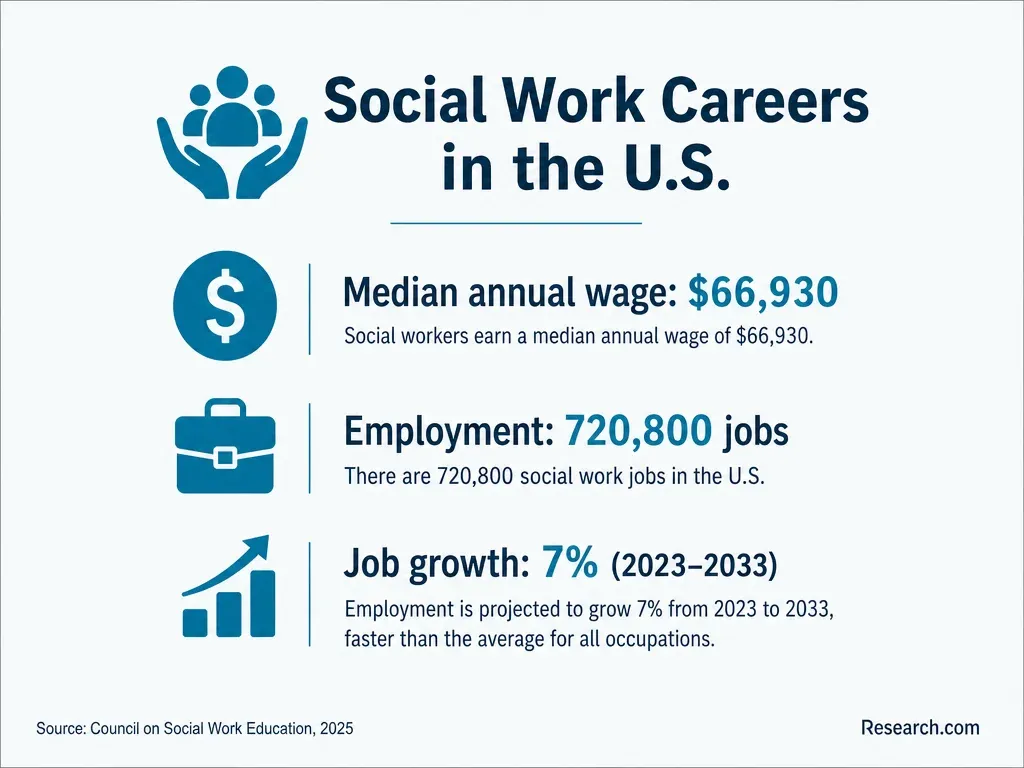
The US Bureau of Labor Statistics reports the following May 2025 occupational median annual wages and projected employment changes for 2025-2035. These are broad occupation measures - not starting salaries, MSW graduate outcomes, or forecasts for a particular agency.
| BLS occupation | Median annual wage, May 2025 | Projected employment change, 2025-2035 |
| Child, family, and school social workers | $59,550 | +4% |
| Healthcare social workers | $67,880 | +8% |
| Mental health and substance abuse social workers | $60,280 | +10% |
Use the category closest to your intended duties, then check local job postings for degree, license, supervision, schedule, and caseload expectations. If you want to explore MSW career directions beyond a single job title, compare what the work actually involves before selecting a specialization. Strong relational skills matter in every setting, but they do not substitute for a required credential or adequate agency support.
Other Things You Should Know About Social Work
No. The worker should make room for the client's own values while being clear about professional boundaries and any limits imposed by law or the service setting.
No. It takes a person's experience and potential seriously without requiring optimism or denying distress, discrimination, or material hardship.
Yes. Even a short encounter can include a clear explanation of the worker's role, a question about the person's priority, and a check that the worker understood the answer. The appointment's purpose still determines what else must be done.
Ask a field instructor or skills-lab evaluator for feedback on observable behaviors, such as whether questions invite the person's perspective and whether reflections are checked for accuracy. Avoid treating a client's agreement as the sole measure of skill.
- NASW Standards for Social Work Case Management | nycourts.gov https://www.nycourts.gov/reporter/webdocs/nasw_standards_socialwork_casemgt.htm
- Person-Centered Therapy (Rogerian Therapy) - NCBI - NIH https://www.ncbi.nlm.nih.gov/books/NBK589708/
- A renaissance for humanistic psychology | apa.org https://www.apa.org/monitor/sep02/renaissance
- Cultural Humility & Cultural Competence in Social Work | du.edu https://socialwork.du.edu/news/cultural-humility-cultural-competence-social-work
- What's a Strength-Based Approach in Social Work? | Virginia Commonwealth University https://onlinesocialwork.vcu.edu/blog/strength-based-approach-in-social-work/
- Carl Rogers Humanistic Theory | Simply Psychology https://www.simplypsychology.org/carl-rogers.html
- Carl Rogers' Core Conditions | Counselling Tutor https://counsellingtutor.com/counselling-approaches/person-centred-approach-to-counselling/carl-rogers-core-conditions/