2027 Social Workers and Community Advisory Members: Sharing Decision-Making in Program Design
Audited and Verified:
Our Editorial and Data Verification Process
Research.com uses government datasets, official education statistics and primary institutional information to support its career and degree guides. Our review process checks factual accuracy, occupational definitions, source dates and the requirements associated with the credentials discussed.
How This Article Was Fact-Checked
Our editorial team verifies salary estimates, employment projections, education requirements and program information against original data providers and official organizations. Salary figures are checked against the relevant occupational definitions and reporting periods. Information about licensure, accreditation and required in-person training is reviewed separately.
Fact-checked and verified on:

Co-Founder and Chief Data Scientist
A social work program may invite community members to an advisory meeting without giving them much say in what students learn or where they train. That distinction matters to prospective students, field partners, and practitioners who want education shaped by the people and organizations it serves.
This guide explains what shared decision-making looks like in curriculum and field education, what accreditation does and does not require, and how to evaluate a program's evidence of community influence. It also puts degree, cost, licensure, and career considerations in perspective so you can choose the preparation your goal actually requires.
Key Things You Should Know
- Meaningful shared decision-making gives community advisors a defined role before decisions are finalized, records how their input is used, and reports back when a recommendation is declined.
- CSWE-accredited BSW and MSW programs must meet educational standards, but accreditation alone does not establish that community advisors hold voting seats or control curriculum and placement.
- Ask for a recent example of an advisor-informed change and its results. For career context, the BLS reports a $61,780 median annual wage for social workers across specialties in May 2025, not a promised salary for community-program designers.
What does shared decision-making mean in social work program design?
Shared decision-making means social work faculty, students, field partners, and people with relevant community experience help identify priorities, weigh options, and review results. Community advisors may include service users, family advocates, neighborhood organizers, and representatives of agencies serving the population.
They should not be treated as interchangeable: an agency executive can explain placement capacity, while a person who has used services may identify barriers the agency has not recognized.
Sharing a decision does not mean every participant has identical legal or academic authority. Faculty and university leaders remain responsible for academic requirements; field agencies decide whether they can safely host students.
The practical test is whether advisors can shape a decision before it is settled and receive an explanation of the outcome afterward. Programs that describe themselves as community-engaged should make that process visible when students are understanding online social work degree choices, not rely on the label alone.
For example, if advisors report that a proposed outreach course overlooks language access, meaningful participation could lead to revised learning objectives, an accessible teaching partnership, and a later check on whether students can apply what they learned. Inviting advisors only to endorse the finished syllabus is consultation, not shared design.
How do social workers and community advisors make decisions about curriculum and field placements?
A workable process starts with a specific decision: which community needs should appear in a course, what students should practice, or what makes a field site suitable. Faculty bring educational standards and assessment evidence; social workers and agency partners bring supervision capacity and practice realities; community advisors bring experience of access, trust, and unintended effects. A program can then document proposals, constraints, the decision maker, and a date for review.
For field placements, advisor input can reveal that a site offers valuable services yet is difficult to reach by public transit or does not offer appropriate language access. That feedback can inform site selection and learning activities, but the school must still approve placements and ensure appropriate instruction, supervision, safety, and competency assessment.
Students comparing schools can use a social work master's placement support comparison guide to frame questions about who finds sites and supports field partners.
A strong decision record distinguishes three outcomes: a recommendation adopted, one modified to meet academic or agency constraints, and one declined with a stated reason. Closing that loop helps prevent advisors from repeatedly contributing unpaid time without seeing whether it mattered.
How can students tell whether community advisors have meaningful influence over a program?
Ask for evidence of a decision, not just evidence of a committee. A program should be able to describe who participated, when advisors were involved, what changed, and how it checked the result. It may need to protect confidential meeting details, but it can still explain its process.
These questions help distinguish an active partnership from a ceremonial advisory group:
- Can the program describe a recent curriculum or field-policy change prompted by community advisors, including what was not adopted and why?
- Do people directly affected by services participate alongside agency leaders, and are accessible meeting formats, interpretation, or compensation available where appropriate?
- Are advisors invited before proposals are finalized, and do they receive follow-up on decisions and student-learning results?
- For an online program, can advisors and field partners participate across locations and schedules rather than only at a campus meeting?
Online coursework may be asynchronous while advisory work, skills practice, and placement activities happen at fixed times. Compare the program's actual meeting and field expectations with information on asynchronous MSW coursework and scheduling; convenience for students does not, by itself, make participation accessible to community members.
The Council on Social Work Education (CSWE) accredits BSW and MSW programs against its Educational Policy and Accreditation Standards (EPAS). Those standards address program mission, curriculum, field education, resources, and assessment of student competence.
They make engagement with people and communities central to social work learning. CSWE accreditation is not a guarantee of any particular advisory-board structure, voting arrangement, or level of community control.
Check the exact BSW or MSW program and its accreditation status for the cohort you would enter; institutional accreditation is a different matter. Then ask the program how it involves community members and field partners in reviewing curriculum and outcomes. A prospective BSW student can use an online BSW accreditation and learning format guide as a starting point, while confirming status and policies directly with CSWE and the school.
Accreditation answers whether a program meets applicable educational standards. The stronger, separate question for this article is whether the program can show that community perspectives affected a real decision.
Choose preparation by the work you intend to do, not by degree prestige. The table separates broad educational purposes; individual programs differ in concentrations, partnerships, and field opportunities.
| Pathway | Most relevant preparation | When to consider it |
| BSW | Generalist practice, policy, research literacy, and supervised field learning | You want entry-level social work preparation and a basis for community or agency work. |
| Traditional MSW | Foundation and specialized study with field education | You hold a non-BSW bachelor's degree or want advanced preparation for a qualifying role. |
| Advanced-standing MSW | Specialized MSW study building on a qualifying BSW | You meet the individual program's prior social work education requirements. |
| Adjacent route | Public health, public administration, evaluation, or nonprofit-management skills | Your target job centers on program operations or policy and does not require a social work degree or title. |
A macro or community-focused MSW can be useful when you need advanced social work practice and an approved field setting with genuine community collaboration. It is not necessary for every program-design job.
If you already have a BSW, compare the school's actual eligibility and curriculum when choosing between two MSW study pathways; another bachelor's degree or relevant employment alone does not establish advanced-standing eligibility.
Campus programs may draw on nearby agencies and in-person meetings; online programs may involve partners across several regions through video meetings and locally arranged placements.
Neither format inherently gives community members more influence. Compare who selects advisors, whether people with lived experience can participate accessibly, and whether a student's placement region is represented in feedback to the program.
Ask how the school supports field partners outside its home area, who resolves a placement problem, and whether community-advisor meetings occur at times those advisors can attend. A compressed schedule can make sustained consultation harder if decisions and placements must be settled quickly.
When considering shorter graduate pathways in social work, request the actual calendar for field learning, live activities, and partner input rather than assuming that a shorter program is equally flexible.
Look for courses in community practice, policy, research or program evaluation, organizational practice, and social work ethics that require students to work with, not merely write about, stakeholders. Useful assignments might include an accessible meeting plan, a needs-assessment proposal, or an evaluation plan that states whose priorities define success. A classroom exercise demonstrates learning; it is not evidence that a community approved a real intervention.
In field education, ask whether students can observe or participate in supervised planning meetings, learn how an agency responds to community feedback, and receive feedback on their own collaboration. The school must approve the site and learning agreement.
Employment, volunteering, and previously completed projects do not automatically count as field education. Placement travel and reduced paid-work hours can also affect feasibility; a guide to affordable online MSW study is most useful when compared with the school's complete field schedule and costs.
BSW admission may involve entry to the university followed by separate admission to the social work major. Traditional MSW programs can admit applicants with bachelor's degrees in other fields, subject to program criteria; advanced-standing applicants generally need a qualifying social work degree and must meet the school's additional rules.
Requirements for grades, references, experience, and prerequisites vary. Applicants whose community work has been outside a conventional employer relationship should check who may provide a recommendation; online MSW programs with alternative reference policies offer one comparison point, not a substitute for checking current admission rules.
For a realistic budget, obtain the program's tuition and fee schedule, required course sequence, field calendar, and placement policies. Add books, technology, screening, travel, possible campus visits, and earnings lost when field hours conflict with paid work.
Ask whether a proposed employment-based placement is permitted and how its educational tasks would differ from ordinary duties. Published tuition alone cannot tell you the total cost or whether a program's community-engagement opportunities fit your schedule.
What careers, salaries, and job prospects are available in community-focused social work?
Relevant roles include community social worker, program coordinator, field-education partner, outreach manager, policy advocate, and program evaluator. Duties can span resident engagement, referral-system improvement, staff coordination, budgeting, and assessing whether services are accessible.
Hiring requirements differ: some employers require a BSW or MSW, while others accept public health, human services, or administrative experience. Ask how much decision authority the job actually gives community members and whether staff have time and resources to act on their feedback.
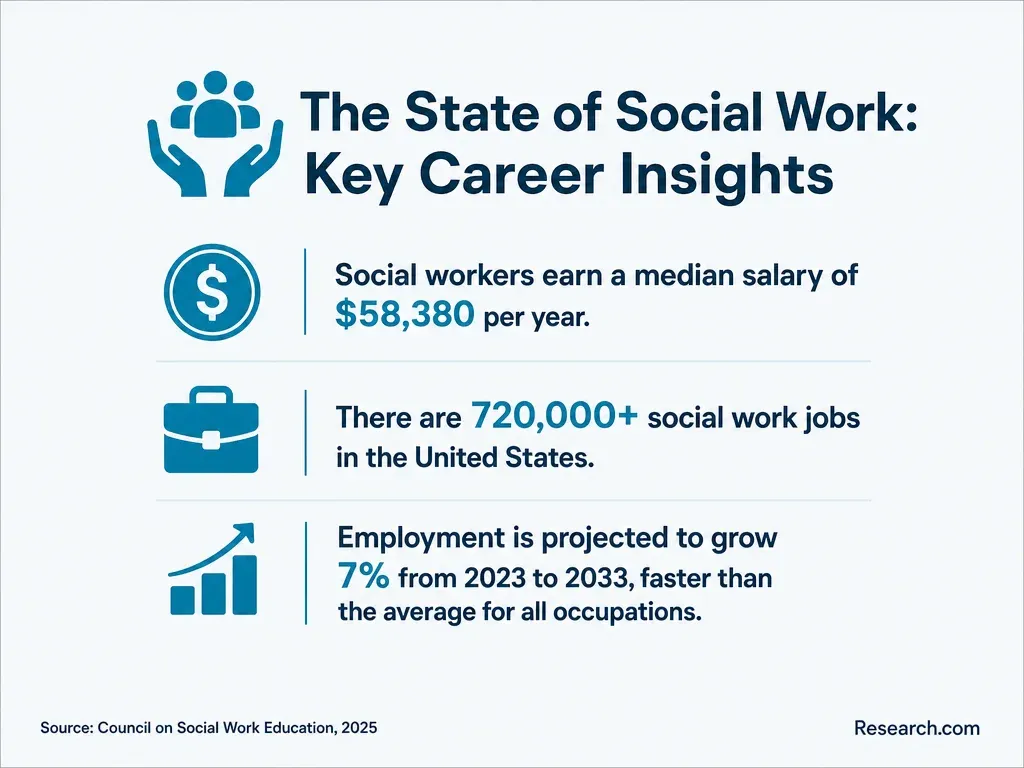
For labor-market context, the U.S. Bureau of Labor Statistics reports a $61,780 median annual wage for social workers across specialties in May 2025 and projects 6% employment growth from 2025 to 2035. Those figures cover a broad occupation, not the distinct title "community program designer."
They do not predict a graduate's pay or the outlook for every nonprofit or public agency. Local postings and social work master's earnings across states can add geographic context, but compare them with the duties, degree requirements, and public-sector pay structure of the jobs you want.
Other Things You Should Know About Social Work Programs
Compensation can reduce a barrier to participation, especially for people contributing lived expertise rather than representing an employer as part of a paid job. Programs should clarify payment, reimbursement, and any benefits implications before asking people to serve.
Disagreement should be recorded rather than presented as a single "community view." The program can explain whose perspectives were sought, what trade-offs were considered, and who made the final decision.
Not by default. Programs and agencies must follow applicable consent, confidentiality, records, and supervision rules. De-identified or hypothetical materials may be more appropriate, subject to the relevant policies.
Often, if the program invites alumni participation. Graduates should ask whether the group includes people who have used local services as well as professionals; alumni experience adds value but does not replace those perspectives.
- Public Participation Guide: Citizen Advisory Boards | US EPA https://www.epa.gov/international-cooperation/public-participation-guide-citizen-advisory-boards
- CDC Program Evaluation Framework, 2024 | MMWR https://www.cdc.gov/mmwr/volumes/73/rr/rr7306a1.htm
- Community Advisory Boards in Community-Based... - PMC https://pmc.ncbi.nlm.nih.gov/articles/PMC3103575/
- Participatory Research and Evaluation Methods | Promising Futures https://promising.futureswithoutviolence.org/participatory-research-and-evaluation-methods/