2027 Social Work with People Experiencing Problem Gambling: Training and Referral Networks
Audited and Verified:
Our Editorial and Data Verification Process
Research.com uses government datasets, official education statistics and primary institutional information to support its career and degree guides. Our review process checks factual accuracy, occupational definitions, source dates and the requirements associated with the credentials discussed.
How This Article Was Fact-Checked
Our editorial team verifies salary estimates, employment projections, education requirements and program information against original data providers and official organizations. Salary figures are checked against the relevant occupational definitions and reporting periods. Information about licensure, accreditation and required in-person training is reviewed separately.
Fact-checked and verified on:

Co-Founder and Chief Data Scientist
Problem gambling can appear in social work settings as debt, family conflict, anxiety, housing instability, or a crisis rather than as a stated gambling concern. Social workers need to recognize possible harm without assuming every client needs a diagnosis or specialized treatment.
This guide is for students, early-career social workers, and human services professionals deciding what training they need and whom they can safely refer to. It explains practical screening and referral workflows, the qualifications different roles require, and how to judge whether a degree, placement, or shorter training route fits the work you want to do.
Key Things You Should Know
- Use brief, nonjudgmental questions to identify gambling-related harm, then assess immediate needs and refer for specialized evaluation when indicated; a screening result is not a diagnosis.
- A useful referral network includes gambling-specific care, crisis support, financial and legal assistance, and family services—not just a directory of therapists.
- For clinical treatment, verify state licensure and supervision requirements. A BSW or MSW, field placement, or voluntary gambling credential does not independently authorize psychotherapy.
How do social workers help people experiencing problem gambling?
Problem gambling describes gambling that causes harm or loss of control; gambling disorder is a clinical diagnosis made through an appropriate assessment. Social workers may encounter either concern in behavioral health, healthcare, schools, housing, justice, and family services. Their first contribution is often to make the concern discussable: ask about gambling without blame, explore its effects on daily life, and identify what the person wants help with.
Within their role and training, social workers can screen, assess social and practical needs, coordinate care, support family members, and address barriers such as transportation or insurance. They should attend to debt and relationship strain without assuming gambling explains every problem. If there are signs of suicide risk, threats, abuse, or unmet basic needs, the response must follow applicable safety duties, law, supervision, and agency policy rather than wait for a routine gambling referral.
Licensed clinicians with appropriate competence may provide treatment for gambling disorder. Case managers and generalist practitioners may instead focus on engagement and service coordination. Those distinctions matter when exploring and understanding work opportunities associated with an MSW: the degree expands potential pathways, but the actual duties still depend on license, experience, employer, and jurisdiction.
What degrees prepare social workers to support people experiencing problem gambling?
A social work degree provides a foundation in assessment, ethics, person-in-environment practice, and service systems. Gambling-specific competence usually requires additional learning and supervised experience; a program need not advertise a gambling concentration to be useful. The right degree depends chiefly on whether the intended job involves generalist support, clinical treatment, or program leadership.
The comparison below identifies each route's likely contribution—not a promise that a graduate can perform every associated task.
| Route | Best fit for this work | Important limit |
| BSW | Generalist service coordination, outreach, and supervised field learning | Does not itself confer independent clinical authority |
| Traditional MSW | Advanced practice preparation for someone with a qualifying bachelor's degree in another field | Includes foundation study; graduation is separate from licensure |
| Advanced-standing MSW | Advanced study for applicants whose prior social work education meets program rules | Not generally available on the basis of a psychology or human services degree alone |
| DSW or PhD | Practice leadership and improvement, or research and scholarship, depending on the program | Usually unnecessary for screening, referral, or entry into clinical practice |
For an already-qualified practitioner seeking to improve an agency's referral system, targeted continuing education may be more direct than another degree. A DSW may fit a larger practice leadership project, but compare its requirements and opportunity costs before treating condensed DSW course and capstone schedules as a shortcut to specialty or clinical authority.
What licensing and certifications apply to problem gambling social work?
There is no single US social work license for gambling services. State social work boards determine license categories, permitted activities, examinations where required, and post-degree clinical supervision. An MSW can be an educational step toward clinical licensure; it is not an independent psychotherapy license. Before choosing a program for clinical work, check MSW licensure alignment before enrollment against the current rules of the state where you intend to practice.
Gambling-specific certifications are separate from state social work licensure. A credentialing body may require specified training, experience, supervision, assessment, and renewal; employers may value a credential without requiring it for every referral or outreach job. Verify the exact designation and its current rules with its issuer, and ask employers whether they require it, will support the supervised experience, and recognize its continuing education. Neither a specialty certificate nor a clinical concentration enlarges a state-defined scope of practice.
Useful training combines gambling literacy with observed practice: how gambling products and access affect risk, how to ask permission to discuss gambling, how to respond to a positive screen, and when to consult or refer. Brief tools such as the Brief Biosocial Gambling Screen or Problem Gambling Severity Index can structure a conversation when appropriate to the setting and population. Neither tool, by itself, establishes a diagnosis.
Look for instruction that includes role-play and feedback, suicide-risk and co-occurring-concern pathways, culturally responsive engagement, documentation, confidentiality, and a current map of local resources. Supervisors should observe how learners explain a screen and handle a referral - not count course attendance as proof of competence. Existing social services staff may be able to gain these skills through employer training and continuing education without enrolling in another degree.
If an MSW is necessary for the target role but admission is a concern, compare the actual entry criteria and field capacity of MSW entry options beyond highly selective programs. Easier admission does not remove field learning, licensing requirements, or the need for gambling-specific training.
What are the salary and job outlook for social workers in this field?
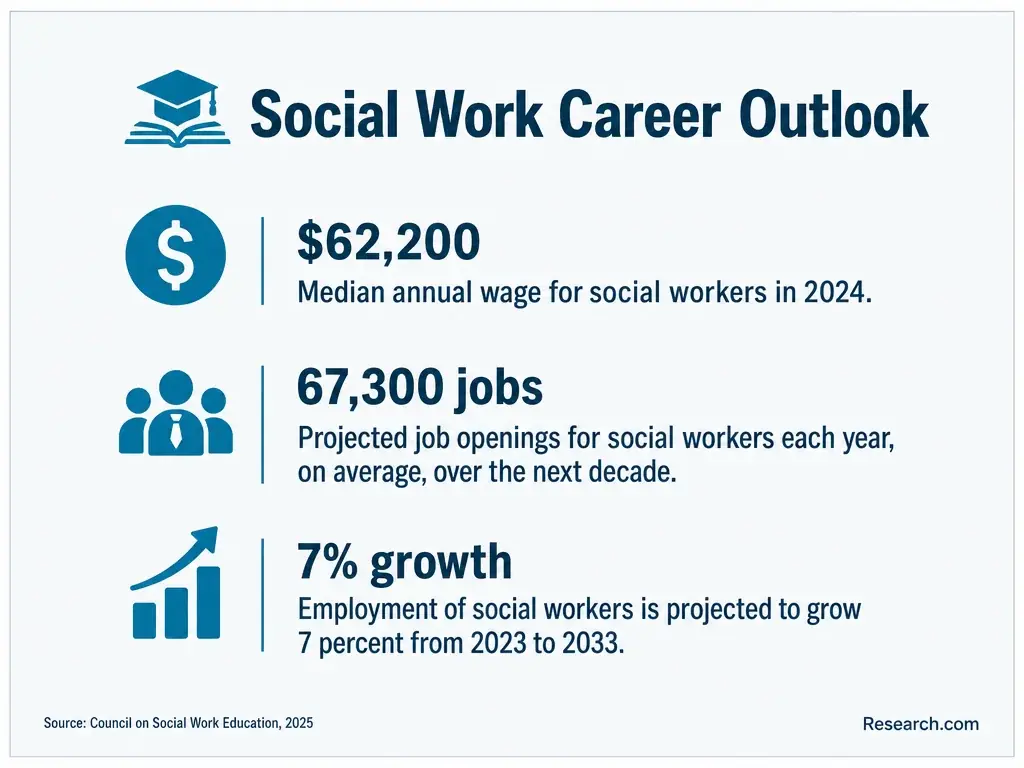
The US Bureau of Labor Statistics does not publish a separate wage or growth series for problem gambling social workers. Mental health and substance abuse social workers are a relevant comparison for many clinical and behavioral health jobs, but not for every helpline, prevention, or case-management position.
These BLS occupation-wide figures provide context for career planning, not expected pay for a particular gambling services job, degree, or license.
| US occupation | Median annual pay, May 2025 | Projected employment growth, 2025-2035 |
| Mental health and substance abuse social workers | $60,280 | 10% |
| Social workers, all specialties | $61,780 | 6% |
Actual offers depend on geography, employer funding, responsibilities, and experience. Use local job postings and pay ranges to judge a prospective role; MSW earnings and geographic career planning can add location context, but a broad wage figure cannot establish the return on a specific degree or predict a gambling services salary.
Other Things You Should Know About Social Work
It may be appropriate when gambling could relate to the presenting concern and the question fits the worker's role. Explain why you are asking, allow the client to decline, and avoid treating a response as a diagnosis.
Yes. Family members can seek support for their own stress, safety, and financial or practical concerns. A worker should respect the gambling person's confidentiality and avoid promising that family involvement will change that person's behavior.
No. Self-exclusion may help limit access to participating gambling venues or platforms, subject to program rules, but it does not address every source of harm. Clients can consider it alongside other support that fits their goals.
Follow the setting's crisis procedures and seek emergency help for immediate danger. In the US, the 988 Suicide & Crisis Lifeline offers crisis support; routine referral follow-up should not delay an urgent safety response.
- Tips for making trauma-informed warm referrals | mass.gov https://www.mass.gov/info-details/tips-for-making-trauma-informed-warm-referrals
- Tools for identification and assessment of harmful gambling | nih.gov https://www.ncbi.nlm.nih.gov/books/NBK612767/
- Structural gaps in referral and treatment pathways for... - PMC https://pmc.ncbi.nlm.nih.gov/articles/PMC13328000/
- Warm Handoffs for Improving Client Receipt of Services | Johns Hopkins University https://pure.johnshopkins.edu/en/publications/warm-handoffs-for-improving-client-receipt-of-services-a-systemat/
- Gambling Harm Screening Tool: information for health professionals and community workers | South Western Sydney PHN https://swsphn.com.au/primary-care-resources/gambling-harm-screening-tool-information-for-health-professionals/
- Screening Tools | SBIRT Toolkit https://kmb.camh.ca/ggtu/sbirt-toolkit/screening/
- Skills for Problem Gambling Integration | naadac.org https://www.naadac.org/skills-for-problem-gambling-integration
- NASW Standards for Social Work Practice in Health Care Settings | socialworkers.org https://www.socialworkers.org/Practice/NASW-Practice-Standards-Guidelines/NASW-Standards-for-Social-Work-Practice-in-Health-Care-Settings