
2027 Social Work with Families Affected by Substance Use: Service Settings and Team Roles
Audited and Verified:
Our Editorial and Data Verification Process
Research.com uses government datasets, official education statistics and primary institutional information to support its career and degree guides. Our review process checks factual accuracy, occupational definitions, source dates and the requirements associated with the credentials discussed.
How This Article Was Fact-Checked
Our editorial team verifies salary estimates, employment projections, education requirements and program information against original data providers and official organizations. Salary figures are checked against the relevant occupational definitions and reporting periods. Information about licensure, accreditation and required in-person training is reviewed separately.
Fact-checked and verified on:

Co-Founder and Chief Data Scientist
Families affected by substance use may need treatment access, housing support, help navigating child welfare, and a safe way to discuss what each person needs. Social workers often connect those services, but their responsibilities differ sharply between a community agency, hospital, treatment program, and clinical practice.
This guide explains the settings and team roles, then shows students and early-career professionals how to evaluate degrees, field placements, licensing requirements, and job opportunities against the work they want to do.
Key Things You Should Know
- Social workers may coordinate services, support caregivers and children, advocate for resources, or provide treatment when their training and license permit; one job rarely includes every function.
- Setting determines the team: child welfare emphasizes safety and family services, while treatment programs coordinate clinical care, recovery support, and referrals.
- For a career decision, compare actual duties and supervision before choosing a degree. The U.S. Bureau of Labor Statistics reports a $60,280 median annual wage for mental health and substance abuse social workers in May 2025, not a guaranteed salary for any particular role.
How do social workers help families affected by substance use?
Social workers look beyond an individual's substance use to its effects on relationships, caregiving, health, income, housing, and access to help. Their first task is usually to understand the family's priorities and immediate needs without assuming that every family member wants, or is ready for, the same service.
Depending on the role, a social worker may assess social needs and strengths, help a caregiver obtain benefits or transportation, connect children with appropriate supports, coordinate referrals, or facilitate a family meeting.
A properly licensed clinical social worker may also provide psychotherapy or other clinical services within their scope. Case management and therapy are different jobs; neither should be inferred from the title "substance use social worker" alone.
Effective support respects self-determination while taking safety seriously. A worker should explain the limits of confidentiality and follow applicable reporting law and agency policy, rather than promising secrecy or assuming that substance use alone determines a safeguarding outcome.
For someone comparing direct-service and clinical roles, MSW education and career pathway connections can help clarify which duties require additional preparation.
Where do social workers serve families affected by substance use?
The setting shapes whose needs lead the work, who employs the social worker, and which partners are available. This comparison is a starting point for evaluating placements or jobs, not a claim that every agency assigns identical duties:
| Setting | Common family-facing work | Key consideration for an applicant |
| Outpatient or residential treatment | Care coordination, family engagement, discharge planning, and referrals | Ask whether family work is educational, case-management, or licensed clinical practice. |
| Hospitals and integrated healthcare | Discharge planning, access to treatment, and coordination with medical teams | Expect time-sensitive decisions and handoffs across organizations. |
| Child welfare and family services | Safety-focused assessment, service planning, and caregiver support | Understand statutory duties and the distinction between providing services and making legal decisions. |
| Schools and community organizations | Support for children, prevention, resource navigation, and family referrals | Check school-specific qualifications or agency requirements before assuming a social work license is required. |
| Housing, justice, and recovery organizations | Practical stabilization, advocacy, reentry support, and connection to treatment | Examine caseloads, outreach expectations, and the strength of local referral networks. |
For students, an agency's population and learning tasks matter more than its name. A placement in a treatment center may offer little family contact, while a family-services placement may offer extensive substance use-related coordination.
Students considering a BSW can review online BSW curriculum and field education options, then ask each school which local settings can support its required competencies.
How do social workers collaborate with substance use treatment teams?
Collaboration works best when each professional's contribution is explicit. Prescribers and other medical professionals manage care within their medical scope; substance use counselors and clinicians provide services within their credentials; peer specialists contribute lived-experience-based support; and social workers may address family needs, service access, care transitions, or clinical treatment if authorized. A social worker should not present a referral or a team discussion as permission to perform another profession's duties.
Consider a planned transition from treatment to home. With appropriate consent and information-sharing authority, a social worker might identify transportation and childcare barriers, ask the family which supports they want involved, and coordinate a follow-up appointment.
The treating clinician remains responsible for clinical decisions within their role. Substance use treatment records can have additional federal confidentiality protections, including 42 CFR Part 2; teams must check the rules applicable to the program and disclosure, not rely on a general assumption that all providers can see the same record.
If team-based psychotherapy is the intended job, compare clinical social work coursework and field training with the employer's duties and the state board's license requirements. If the goal is navigation and family advocacy, strong supervision and knowledge of local services may matter more than a clinical concentration.
There is no single nationwide "substance use social worker" license. Requirements depend on the state, protected professional title, employer, and tasks.
Some coordination or outreach jobs accept a BSW or another qualification; clinical assessment and psychotherapy may require a particular social work license, supervision, and ultimately independent clinical licensure. State rules also differ on license categories, examinations, and what an associate or provisional license holder may do.
Substance use counselor credentials are separate from social work licenses, and a voluntary specialty certificate does not expand legal scope. Before accepting a role or enrolling in an MSW, compare the job posting with the state social work board's current education, application, supervision, and practice rules.
An online student should also confirm where the school can enroll them and arrange field education. Guidance on online social work master's programs and state board requirements can organize those questions, but the board makes licensing decisions.
What are the salary and job outlook for substance use social workers?
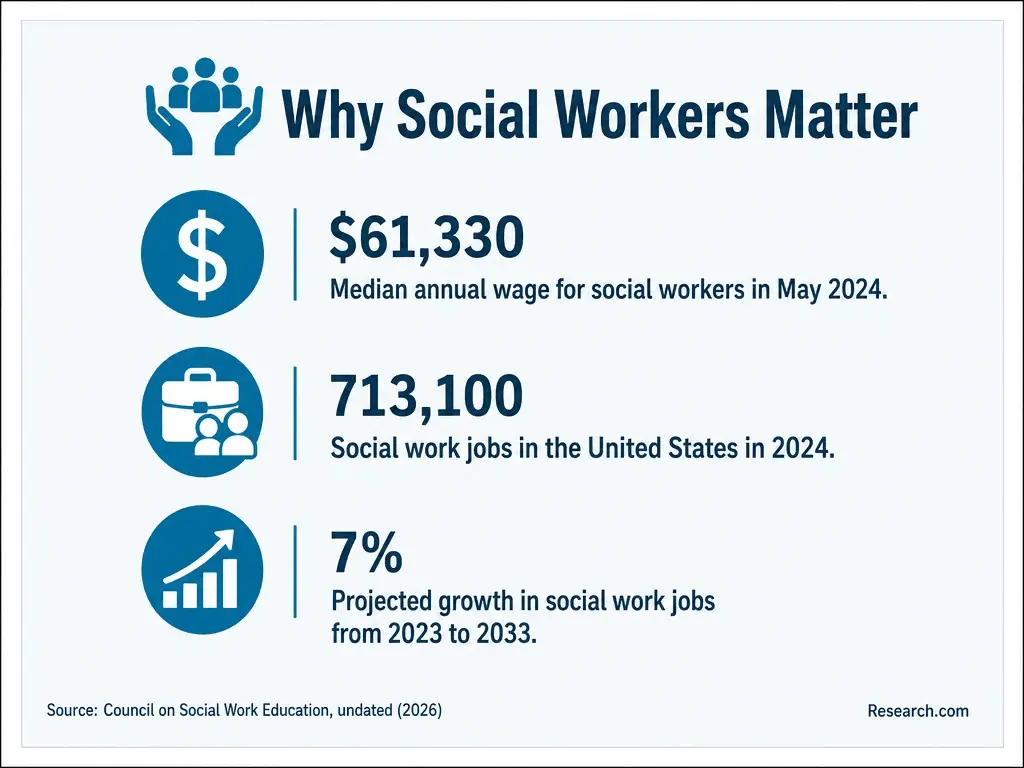
The closest broad U.S. Bureau of Labor Statistics category is mental health and substance abuse social workers. Its May 2025 median annual wage was $60,280, with employment projected to grow 10% from 2025 to 2035.
For comparison, child, family, and school social workers had a $59,550 median and 4% projected growth; healthcare social workers had a $67,880 median and 8% projected growth.
Those categories describe occupations, not a family-services job title, starting pay, an MSW salary, or the return on a particular program. A child welfare job involving parental substance use may fall in a different category from a treatment-center clinical role.
Compare actual postings by setting, location, license requirement, caseload, supervision, and benefits; exploring regional pay patterns for MSW careers can provide context without replacing local offers.
Other Things You Should Know About Social Work
Yes. They can ask a qualified provider or community organization for support with their own stress, safety, caregiving, and practical needs. The relative's decision not to participate does not prevent family members from seeking help for themselves.
No. Child welfare decisions depend on applicable law and a specific assessment of child safety, not substance use alone. Social workers should not promise a particular outcome or make a legal determination outside their role.
Use local emergency services for an immediate threat. For non-immediate concerns, contact an appropriate healthcare, crisis, or safeguarding service and follow local guidance; an educational article cannot assess an individual situation.
Not necessarily. A provider may need the patient's valid consent or another legal basis before sharing information, and substance use treatment records may have additional protections. Relatives can still give the team information and ask what general resources are available to them.
- Casework Practice | Child Welfare Information Gateway https://www.childwelfare.gov/topics/casework-practice
- For Social Workers: Facilitating MOUD Within Other Healthcare Settings | SAMHSA https://www.samhsa.gov/substance-use/treatment/integrating-sud-services/social-workers
- The duty of confidentiality during family involvement - PMC - NIH https://pmc.ncbi.nlm.nih.gov/articles/PMC9764492/
- Trauma-Informed Care: A Sociocultural Perspective - NCBI https://www.ncbi.nlm.nih.gov/books/NBK207195/
- The Role of Social Workers in Treating Substance Use Disorder | Adelphi University Online https://online.adelphi.edu/social-work/articles/role-of-substance-abuse-social-workers/
- Substance Abuse and Behavioral Disorder Counselors | onetonline.org https://www.onetonline.org/link/summary/21-1011.00
- Family-Centered Approach to Treating Substance Use Disorder | Casey Family Programs https://www.casey.org/family-centered-substance-use-treatment/
- NASW Standards for Social Work Practice with Clients with Substance Use Disorders | socialworkers.org https://www.socialworkers.org/Practice/NASW-Practice-Standards-Guidelines/NASW-Standards-for-Social-Work-Practice-with-Clients-with-Substance-Use-Disorders


