
2027 Social Work Succession Planning: Developing Future Supervisors and Managers
Audited and Verified:
Our Editorial and Data Verification Process
Research.com uses government datasets, official education statistics and primary institutional information to support its career and degree guides. Our review process checks factual accuracy, occupational definitions, source dates and the requirements associated with the credentials discussed.
How This Article Was Fact-Checked
Our editorial team verifies salary estimates, employment projections, education requirements and program information against original data providers and official organizations. Salary figures are checked against the relevant occupational definitions and reporting periods. Information about licensure, accreditation and required in-person training is reviewed separately.
Fact-checked and verified on:

Co-Founder and Chief Data Scientist
When an experienced social work supervisor leaves, an agency can lose more than a manager: staff may lose clinical consultation, community relationships, and a reliable path for resolving difficult cases. Succession planning prepares qualified people to take on those responsibilities before a vacancy disrupts services. This guide is for agency leaders building a leadership pipeline and social workers considering promotion.
It explains how to identify and develop candidates, where degrees and licenses matter, and how to weigh further education against targeted training and supervised leadership experience.
Key Things You Should Know
- Build a pipeline for distinct roles: supervising staff, providing board-qualifying clinical supervision, and managing programs can require different credentials and experience.
- Use observed performance, mentored assignments, and written readiness criteria; seniority or a new degree alone does not establish supervisory competence.
- For context, the U.S. Bureau of Labor Statistics reports a $61,780 median annual wage for social workers in May 2025 and 6% projected employment growth from 2025 to 2035; neither figure describes social work manager pay or openings specifically.
What is succession planning in social work?
Social work succession planning is an agency's process for identifying essential leadership responsibilities, preparing more than one potential successor, and maintaining service continuity when a supervisor or manager leaves. It covers planned retirements as well as unexpected departures, growth, and internal promotions.
The first step is to define the position rather than nominate a person. A team supervisor might oversee case consultation, staff development, documentation quality, and workload safety. A program manager might also control budgets, contracts, hiring, and partnerships. Clinical supervision toward licensure is a separate function governed by state rules. Reviewing MSW job families and professional development can help staff distinguish these paths before pursuing promotion.
A useful plan names an interim decision-maker, records critical procedures without exposing confidential client information, and identifies what each candidate must learn. It also protects against a common failure: promoting the strongest direct-service practitioner without preparing them to coach staff, address inequitable workloads, or manage agency resources.
How do social workers become supervisors or managers?
Most move from reliable practice into progressively broader responsibility: mentoring a new colleague, coordinating a team project, serving as a lead worker, and then applying for a formal supervisory or management role. The steps are not interchangeable. Excellent casework demonstrates practice competence; supervising others also requires feedback, personnel judgment, and accountability for systems.
For an early-career social worker, a practical next move is to ask a manager for a bounded assignment with feedback - for example, leading an approved workflow improvement or facilitating a case-review meeting. An experienced nonprofit or public-sector professional may already bring budgeting or people-management skills but need training in social work ethics, service systems, and any qualifications attached to the target post.
Compare actual job descriptions before enrolling in another degree. Some program-management posts accept related human services or public administration experience; others specify an MSW or license. If an MSW is required, exploring less competitive MSW admission pathways may help applicants build a realistic school list, but admission does not establish fitness for a supervisory job.
What degrees prepare social workers for leadership roles?
The right education depends on the work the leader will oversee. The comparison below separates foundational social work preparation from advanced practice, administration, and research; none of these awards automatically qualifies a graduate to provide clinical supervision.
| Pathway | Leadership relevance | When to consider it |
| BSW | Generalist practice and supervised field learning | Entry into social work roles and, where employer rules permit, a future team-lead pathway |
| Traditional or advanced-standing MSW | Advanced practice, field learning, and potentially administrative or macro coursework | Roles requiring an MSW or broader social work practice preparation |
| DSW | Practice-focused leadership, teaching, or applied improvement, depending on the program | Experienced professionals with a defined advanced practice or organizational goal |
| PhD | Research design, scholarship, and research leadership | Research-intensive or academic careers rather than a routine supervisory promotion |
| MPA, MPH, or targeted training | Public administration, population health, budgeting, or specific management skills | Management posts that do not require a social work degree or license |
Advanced-standing MSW admission generally requires a qualifying social work bachelor's degree and the program's other criteria; an unrelated bachelor's degree usually points to a traditional MSW. Comparing MSW credits across entry tracks helps candidates avoid assuming that prior management experience replaces foundation coursework or field education. Already-qualified social workers may gain more from protected leadership assignments and focused training than from another degree.
Supervisors need to develop people and protect service quality at the same time. That calls for reflective consultation, constructive feedback, workload and safety decisions, ethical escalation, culturally responsive supervision, and familiarity with documentation and confidentiality rules. Managers add hiring, budgets, contracts, program evaluation, and change management.
Training should match the responsibility a candidate is about to assume. A prospective team lead may need coached practice conducting feedback conversations; a future program manager may need to interpret a budget and report service measures responsibly. Neither should be given unsupervised access to personnel matters or identifiable client records merely as a development exercise.
If an MSW is necessary for the intended role, online social work master's programs by duration can provide an initial scheduling comparison. A shorter advertised timeline is not a substitute for checking live classes, field requirements, and whether the employee can sustain the workload while continuing to serve clients.
What are the salary and job outlook for social work managers?
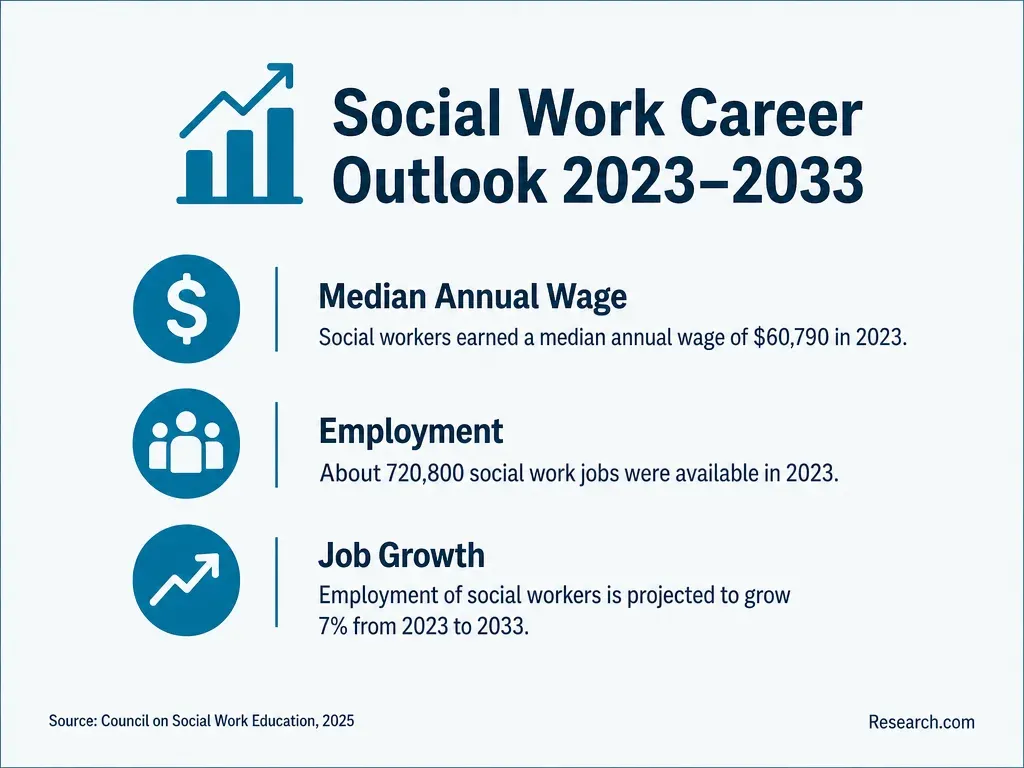
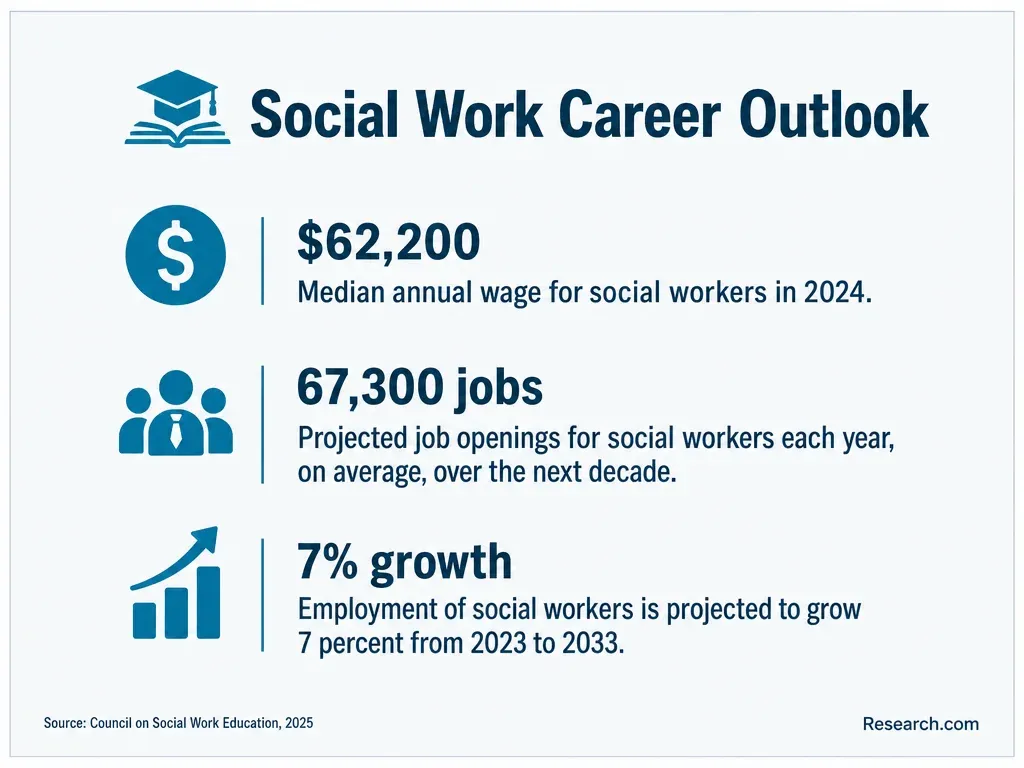
A social work manager's pay depends on the actual occupation and duties, employer, location, funding, and level of responsibility. The U.S. Bureau of Labor Statistics reports a May 2025 median annual wage of $61,780 for social workers across specialties and projects 6% employment growth from 2025 to 2035. Those are social worker figures - not a manager salary estimate or a forecast of supervisory vacancies.
Manager positions may instead fall under a management occupation, so compare the exact job description and local salary range before judging a promotion or degree's financial return. Public-sector candidates should also check civil-service grades and whether a supervisory appointment changes overtime eligibility or other benefits. State-level salary context for MSW careers can add geographic perspective, but it cannot replace a verified offer or employer pay scale.
Other Things You Should Know About Social Work
Usually not. Preparing several employees for different responsibilities gives the agency options if someone declines a promotion, leaves, or is not yet ready for a particular role.
Use a short written development plan, protected mentoring time, and a limited project with feedback. Partner with another organization for training when internal expertise is unavailable.
Share eligibility and selection criteria, invite expressions of interest, use consistent evidence of performance, and document development opportunities and decisions.
Activate the interim coverage plan, identify who holds decision-making authority, protect continuity of staff consultation, and verify that any clinical or field supervision remains with a qualified person.
- Enablers and barriers to effective clinical supervision in... - PMC https://pmc.ncbi.nlm.nih.gov/articles/PMC8479981/
- Succession Planning Desk Guide | U.S. Geological Survey https://www.usgs.gov/human-capital/succession-planning-desk-guide-0
- Board Policies and Guidelines (Social Workers) | mass.gov https://www.mass.gov/policy-advisory/board-policies-and-guidelines-social-workers
- Understanding the 9 Core Competencies of Social Work | Tulane School of Social Work https://tssw.tulane.edu/news/understanding-9-core-competencies-social-work
- Train your managers to promote health and well-being | apa.org https://www.apa.org/topics/healthy-workplaces/mental-health/train-managers
- Assessing Performance, Potential, and Readiness | umn.edu https://hr.umn.edu/supervising/resources/Assessing-Performance-Potential-and-Readiness
- Barriers to Licensure - IU Indianapolis https://journals.indianapolis.iu.edu/index.php/advancesinsocialwork/article/download/28548/26166/61418
- The Role of a Social Work Supervisor | Regis College Online https://online.regiscollege.edu/blog/learn-career-social-work-supervisor
- The Role of the Manager/Supervisor in Well-being | ucdavis.edu https://hr.ucdavis.edu/departments/worklife-wellness/managers/wbeing-toolkit/roles
- 11 Strategies to Make You a More Effective Supervisor | umn.edu https://ccaps.umn.edu/story/11-strategies-make-you-more-effective-supervisor


