2027 Social Work Student Assessment: Rubrics, Feedback, and Professional Growth
Audited and Verified:
Our Editorial and Data Verification Process
Research.com uses government datasets, official education statistics and primary institutional information to support its career and degree guides. Our review process checks factual accuracy, occupational definitions, source dates and the requirements associated with the credentials discussed.
How This Article Was Fact-Checked
Our editorial team verifies salary estimates, employment projections, education requirements and program information against original data providers and official organizations. Salary figures are checked against the relevant occupational definitions and reporting periods. Information about licensure, accreditation and required in-person training is reviewed separately.
Fact-checked and verified on:

Co-Founder and Chief Data Scientist
A strong paper does not necessarily mean a student is ready to engage a client, and one difficult field evaluation does not necessarily mean they cannot become a social worker. Social work programs assess both what students know and how they apply it under supervision. For BSW and MSW students, understanding the rubrics, feedback, and field evaluations behind those judgments makes it easier to improve - and to spot a program that will support that improvement. This guide explains what is assessed, how to respond to concerns, and which assessment practices to examine before enrolling.
Key Things You Should Know
- Accredited BSW and MSW programs assess performance against nine CSWE generalist competencies, but schools choose their own assignments, rubric scales, and field evaluation procedures.
- A useful field evaluation identifies observed behavior, supervision needs, and progress on learning-agreement goals; logged hours alone do not demonstrate competence.
- Ask prospective programs for sample rubrics, field evaluation forms, feedback timelines, and remediation policies before comparing their support for student growth.
How are social work students assessed in degree programs?
Social work student assessment combines academic evidence - such as papers, policy analyses, research critiques, and exams - with demonstrated practice in role-plays, skills exercises, and supervised field education. A student might explain confidentiality accurately on an exam yet need more practice describing its limits clearly in a simulated intake.
Programs use different evidence because knowing a principle and applying it are different achievements. Course assessments usually carry grades.
Field assessments may include a learning agreement, supervision discussions, reflective writing, documented hours, and midterm or final evaluations; a school's policy determines how these affect progression. Students entering after earlier college study should also distinguish assessment within the BSW from a receiving school's review of previous credits. For that separate decision, see planning a social work bachelor's after an associate degree.
How do social work assessment rubrics measure student performance?
A rubric translates a learning outcome into observable criteria and performance levels. Instead of scoring "professionalism" as a vague impression, it might examine whether a student prepares for supervision, communicates within their role, protects confidential information, and follows through on agreed tasks. Strong rubrics distinguish a developing student from one who performs consistently, rather than rewarding confidence or writing style alone.
The example below shows how the same competency area can be assessed through different evidence. These are illustrations, not a universal CSWE scoring scale.
| Criterion | Possible evidence | What a meaningful rating distinguishes |
| Ethical reasoning | Case analysis or supervision discussion | Recognizing an ethical issue versus explaining a defensible response and when to consult |
| Engagement | Observed role-play or approved field observation | Using a technique versus adapting it to the person's goals and feedback |
| Documentation | Approved, de-identified exercise or agency-reviewed work | Including facts versus writing accurate, relevant notes within policy |
Read the rubric before an assignment or observation. Check whether it describes the expected level of independence, how evidence is gathered, and who rates it. When comparing schools through a social work program selection guide, request the actual course and field rubrics: similar competency language can conceal meaningful differences in feedback quality.
How do students use feedback to improve their social work skills?
Useful feedback names a behavior, explains its effect, and gives the student a chance to try again. "Improve engagement" is less actionable than "You asked several questions before checking whether the person wanted to discuss that topic." Students should also ask what was observed directly and what was inferred, particularly when an assessment concerns communication across cultural or language differences.
A short feedback cycle turns a rating into a learning plan:
- Identify one rubric criterion and the specific example behind the rating.
- Ask the instructor or field instructor what stronger performance would look like at your current level.
- Practice a bounded skill in a simulation or approved field task, with supervision where needed.
- Request another observation, document what changed, and revisit the criterion at the next check-in.
Reflective writing can help students examine assumptions without placing identifiable client information in a class submission or personal portfolio. Feedback received in university-funded assistant roles for MSW students may build related skills, but an assistantship review is not a substitute for a program's required practice or field assessment.
Field evaluation should connect the student's approved learning agreement to tasks the agency can actually offer. A field instructor observes or reviews work, discusses performance in supervision, and typically contributes to formal evaluations.
A task supervisor may oversee day-to-day activities when that person is different from the field instructor. The university's faculty liaison helps connect the agency's assessment to program requirements and addresses concerns under school policy.
Evaluation may draw on observed interactions, supervision discussions, approved documentation, projects, and progress toward competency goals. Hours establish participation, not proficiency.
Ask how ratings work when a placement offers limited opportunities to demonstrate a competency, how students receive feedback before a final decision, and who approves any change to learning tasks.An online MSW field coordination models comparison can help frame questions about site matching and support, but each school must explain its own evaluation responsibilities.
An unsatisfactory rating may lead to a meeting, a written improvement plan, closer observation, a repeated assignment, a delayed field sequence, or dismissal, depending on the concern and the program's published policies. It is not automatically a final judgment about the student's career. Serious safety, boundary, or ethical concerns may require immediate action rather than another routine assessment cycle.
Request the written evaluation and applicable progression and appeal policies promptly. Ask which behaviors were observed, which standards were not met, what evidence would demonstrate improvement, who will assess it, and when the decision will be reviewed.
If the problem involves inadequate access to learning opportunities or unclear supervision, document that too and involve the faculty liaison through the school's process. A delayed or repeated placement can affect tuition, aid, work schedules, and graduation timing; MSW affordability and career value considerations should account for those possibilities rather than assuming every student finishes on the advertised schedule.
BSW assessment centers on generalist preparation. Traditional MSW students build on foundation learning before demonstrating more advanced or specialized application; advanced-standing MSW students enter through a qualifying prior social work education route and are assessed against their program's graduate expectations.
Schools set their own assignments and progression standards, so an MSW label alone does not specify a single rubric or field sequence. The difference is usually clearest in the complexity of judgment expected. A BSW student may demonstrate an accurate assessment and appropriate referral under supervision.
An MSW student might also be asked to justify a specialized approach, evaluate its fit, and explain the limits of the evidence - all within the student's authorized field role. Neither degree's academic field evaluation should be confused with post-degree board-approved experience. For that separate process, review social work clinical hours and approval questions against the relevant state board's rules.
How do assessments prepare social work students for careers and licensure?
Well-designed assessments give students evidence of strengths and limits they can discuss in interviews and address during onboarding: engaging people respectfully, using supervision, documenting accurately, evaluating interventions, and working within agency policy. A field evaluation can also reveal whether someone needs more supported practice in a particular setting before taking on similar duties as an employee.
Graduation, exam eligibility where an exam is required, license issuance, and independent clinical authority are separate milestones. Employers may impose further training and supervision requirements.
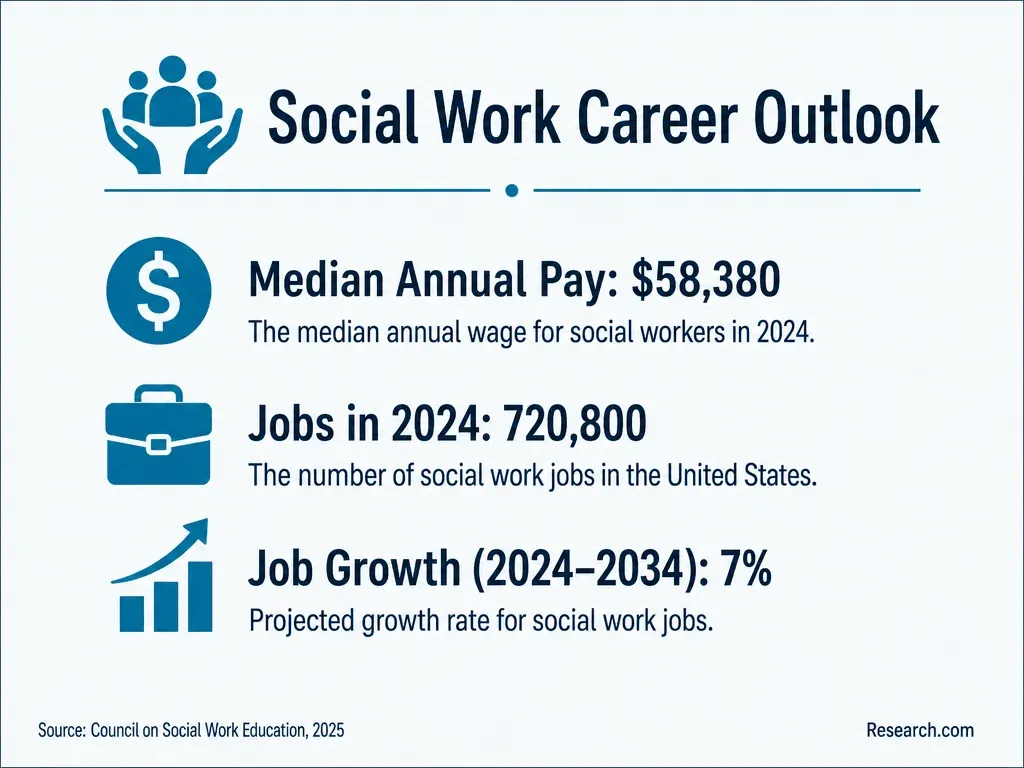
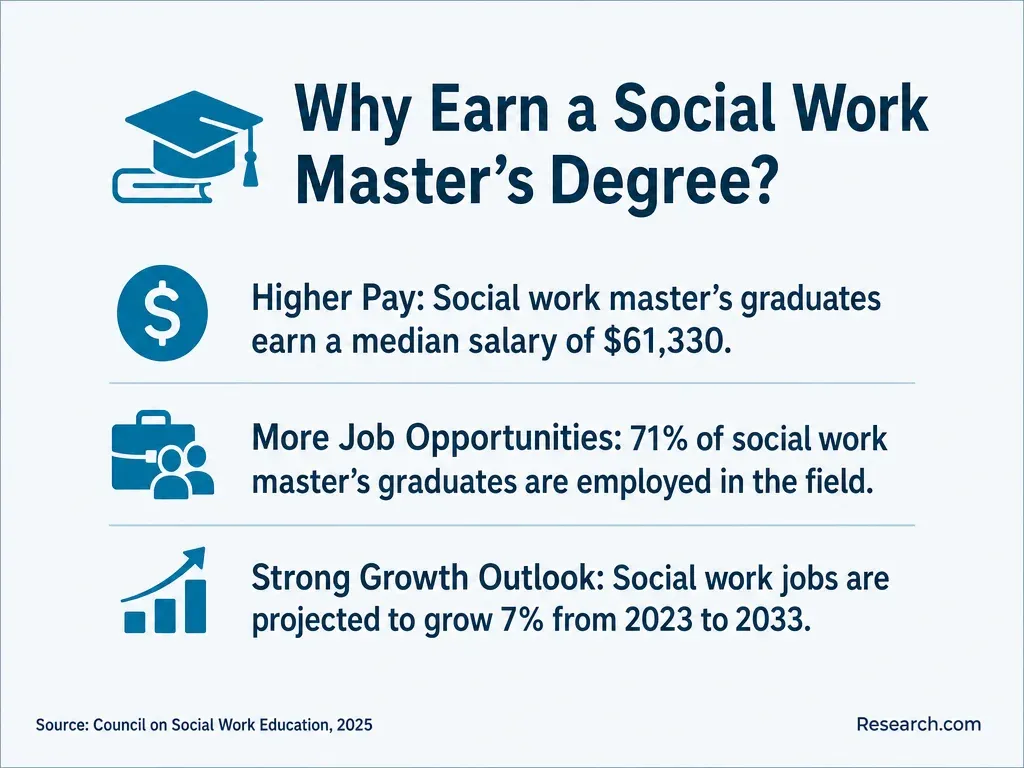
Assessment results help guide a student's next learning decision; they are not a license or a guarantee of employment or earnings. When comparing roles, social worker earnings and location considerations provide career context, not a predicted salary based on a student's rubric scores.
Other Things You Should Know About Social Work
Only if agency and school rules permit it. Remove identifying and confidential information, obtain any required approvals, and use a newly written description of your contribution when the original work product cannot be shared.
Follow the course's AI policy and the agency's data rules. Do not enter client or agency-confidential information into an unapproved tool, and verify any claims or citations you submit as your work.
Yes. Contact the school's disability or accessibility office to discuss the applicable process and assessment requirements. Raise scheduling or technology barriers early so the school can determine an appropriate arrangement.
Keep permitted rubrics, evaluations, and learning plans for your own development, subject to school and agency rules. Store them securely and exclude client-identifying or agency-confidential material.
- Wisconsin Pupil Services Evaluation System: School Social Worker | Department of Public Instruction https://dpi.wi.gov/sspw/pupil-services/performance-evaluation-tools/school-social-work-evaluation
- A Review of Strategies for Designing, Administering, and Using Student Ratings of Instruction - PMC https://pmc.ncbi.nlm.nih.gov/articles/PMC6630867/
- Educational Outcomes | syr.edu https://answers.atlassian.syr.edu/wiki/spaces/SOE/pages/166036364/Educational+Outcomes
- Assessing Student Performance in Field Education | Applied Learning in Social Work Education Journal https://alswe.simmons.edu/article/assessing-student-performance-in-field-education/
- Frequent and Targeted Feedback: Evidence-based Teaching | indiana.edu https://citl.indiana.edu/teaching-resources/evidence-based/targeted-feedback.html
- Aligning Courses | Portland State University https://www.pdx.edu/institutional-assessment-council/aligning-courses
- Feedback for Learning | columbia.edu https://ctl.columbia.edu/resources-and-technology/resources/feedback-for-learning/
- Setting Clear Expectations with Rubrics - Learning Innovations | Washington State University https://li.wsu.edu/2018/09/07/setting-clear-expectations-with-rubrics/
- Creating Effective Rubrics | Illinois State https://prodev.illinoisstate.edu/instructional-resources/feedback/rubrics/