2027 Social Work Policy Analyst: Responsibilities, Education, and Career Fit
Audited and Verified:
Our Editorial and Data Verification Process
Research.com uses government datasets, official education statistics and primary institutional information to support its career and degree guides. Our review process checks factual accuracy, occupational definitions, source dates and the requirements associated with the credentials discussed.
How This Article Was Fact-Checked
Our editorial team verifies salary estimates, employment projections, education requirements and program information against original data providers and official organizations. Salary figures are checked against the relevant occupational definitions and reporting periods. Information about licensure, accreditation and required in-person training is reviewed separately.
Fact-checked and verified on:

Co-Founder and Chief Data Scientist
A social work policy analyst studies how laws, budgets, and agency rules affect people's access to services and recommends changes grounded in evidence and practice. The role can appeal to social work students, frontline professionals, and career changers who want to address problems beyond an individual caseload. But "policy analyst" is a job function, not a license or a single degree pathway.
This guide explains the work, compares realistic education routes, puts salary data in context, and helps you decide whether additional schooling or targeted experience is the better next step.
Key Things You Should Know
- Policy analysts research service problems, assess policy options, and brief decision-makers; many positions accept qualifications other than a social work degree.
- An MSW can strengthen practice-informed policy work, but an MPA, MPH, or relevant bachelor's degree plus analytical experience may be more direct for some jobs.
- The Bureau of Labor Statistics reports a $61,780 median annual wage for social workers in May 2025, but that figure is not a policy analyst salary estimate.
What does a social work policy analyst do?
A social work policy analyst examines how a proposed or existing policy affects people, service providers, and public resources. The work may concern child welfare, housing, Medicaid access, behavioral health, disability services, or another social-service system. Rather than delivering therapy or managing an individual caseload, analysts usually turn research, administrative data, community input, and frontline experience into recommendations that leaders can use.
A typical assignment might be to assess whether a change in benefits eligibility could improve access without creating new paperwork barriers. The analyst would define the problem, review the governing rules and available evidence, consult affected communities and staff, compare options, estimate implementation considerations, and write a brief that makes uncertainties clear. They may later help evaluate whether the adopted change worked.
Good analysis asks not only whether an average outcome improves, but who benefits, who may be excluded, and whether agencies can implement the proposal. Analysts must handle client or administrative information under applicable privacy rules and agency approvals; access to sensitive records is never automatic.
Students who want to test this work through an evaluation or advocacy placement should ask how an online program arranges local opportunities and supervision. Comparing online MSW field coordination models can help frame those questions.
What degree do you need to become a social work policy analyst?
There is no universal degree requirement for a job called "social work policy analyst." Employers set qualifications according to the work: an entry-level research assistant opening may accept a bachelor's degree, while a senior legislative or evaluation role may require graduate study and substantial experience. Read the actual posting before enrolling in another program.
The routes below differ most in the perspective and skills they develop. None guarantees a policy job.
| Route | Potential advantage for policy work | When to consider another route |
| BSW or related bachelor's degree | Builds a foundation for service-system research, advocacy, and entry-level support roles. | The target employer requires advanced quantitative analysis or a graduate credential. |
| Traditional MSW | Combines social work practice and field education with opportunities for macro, policy, or evaluation study. | You chiefly want budgeting or statistical policy analysis and do not need social work preparation. |
| Advanced-standing MSW | Offers a shorter MSW route for applicants with a qualifying BSW, subject to program rules. | Your prior bachelor's degree is outside social work or does not meet the program's eligibility criteria. |
| MPA, MPP, MPH, or related graduate degree | May offer more concentrated training in public administration, policy methods, or population health. | The intended role explicitly values social work practice knowledge or requires an MSW. |
| DSW or PhD | May fit advanced practice leadership or original research, depending on the program. | You are seeking a first policy analyst position; a doctorate is rarely the necessary starting point. |
For a career changer, the lowest-friction route may be to build on existing government, nonprofit, research, or community-service experience and add statistics, policy writing, or evaluation training. If an MSW is necessary for your target jobs, compare total cost and field feasibility when reviewing cost-focused online MSW program choices.
How much do social work policy analysts earn, and what is the job outlook?
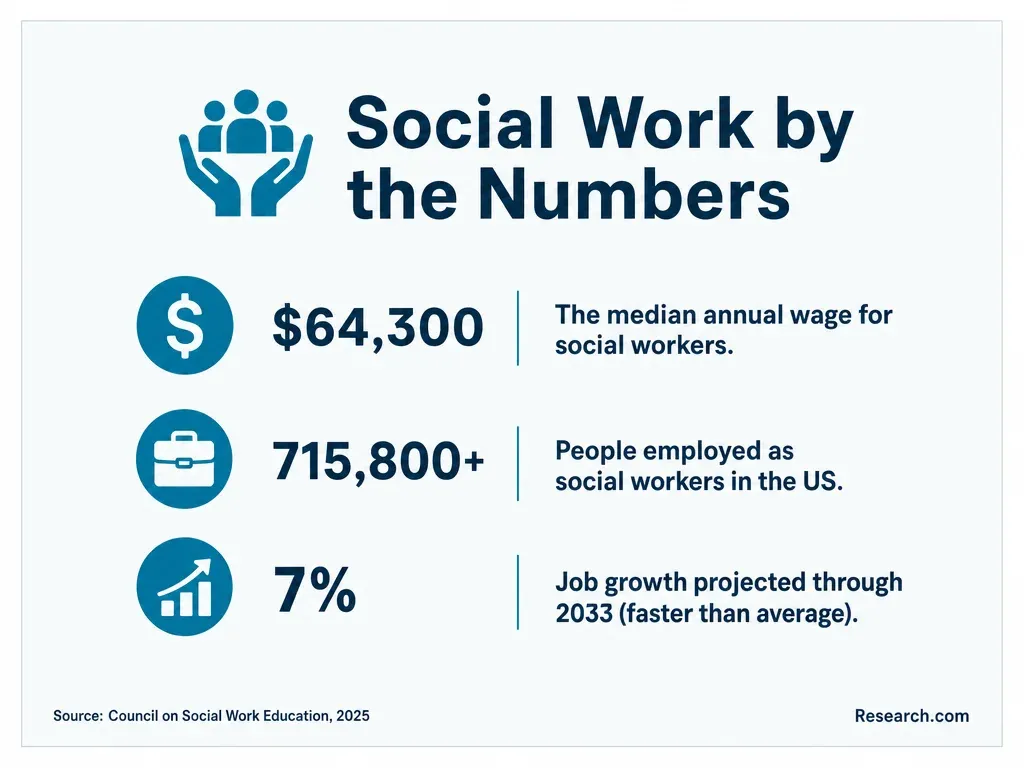
There is no single Bureau of Labor Statistics (BLS) wage or growth series for the job title "social work policy analyst." Employers may classify analysts under policy research, government, program evaluation, or management roles. A salary quoted for all social workers therefore should not be presented as what policy analysts earn.
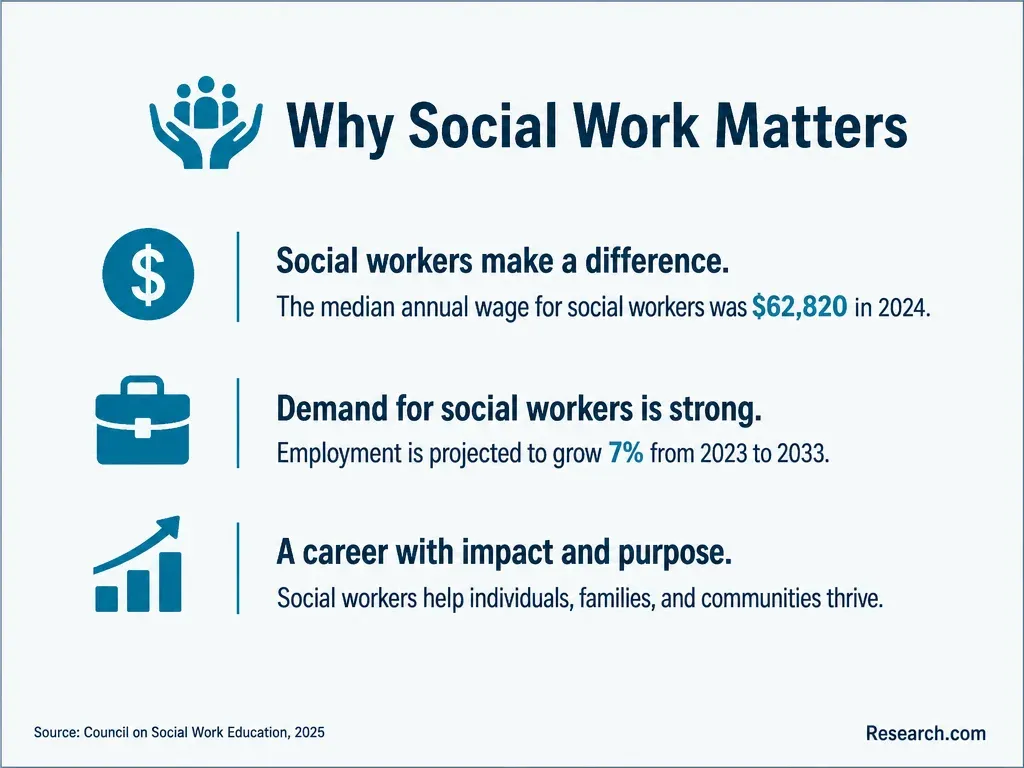
For context only, BLS reports a May 2025 median annual wage of $61,780 for social workers across specialties and projects 6% employment growth from 2025 to 2035 for that occupation. Those figures describe social workers, not policy analyst openings or the return on an MSW. Analyst compensation depends heavily on employer, location, civil-service grade, research skills, and responsibility for budgets or staff.
For a realistic estimate, compare posted salary ranges for the exact analyst titles and locations you would pursue. In public agencies, check the pay grade and promotion rules; in nonprofits, examine whether a role is grant-funded. Information about social work master's pay and geographic differences can provide additional context, but it should not replace job-specific ranges.
Analysts work in state and local government, legislative offices, advocacy organizations, research institutes, foundations, healthcare systems, and social-service nonprofits. Their assignments differ: a government analyst may examine implementation and fiscal constraints; an advocacy analyst may develop recommendations for lawmakers; an agency evaluator may study whether a service reaches its intended population.
Search beyond one job title. Relevant postings may use policy associate, legislative analyst, program evaluator, research analyst, government affairs specialist, or social services program analyst. Compare the duties, not just the title: some positions primarily coordinate stakeholders, while others require advanced statistical work or legislative drafting.
For MSW graduates considering nearby paths, exploring roles for master's-prepared social workers can clarify whether analysis, administration, or direct service better matches their goals.
Public-sector applicants should also check civil-service classifications. A role's stated minimum education, required experience, and pay grade may matter more for eligibility than a preferred concentration on a transcript.
Is a social work policy analyst career a good fit for you?
This career may fit if you enjoy turning complex evidence into usable recommendations, can listen to people affected by a policy, and are comfortable when budgets, legal constraints, and political priorities limit the available options. It may be less satisfying if your main goal is sustained one-to-one client contact or independent clinical practice. Expect substantial reading, writing, revision, meetings, and careful explanation of what the evidence cannot establish.
Before committing to a degree, collect several job postings from employers you would realistically join. Identify their minimum credentials, preferred methods, writing expectations, and required policy-area experience. Then compare those gaps with your existing skills. A frontline social worker might need stronger data and budgeting skills; a researcher entering social services might need deeper knowledge of benefits systems and community engagement.
If an MSW is the best bridge, verify how its field obligations fit your work and household schedule before choosing among online MSW timelines for working students. A faster advertised sequence is useful only if you can complete its actual coursework and placement commitments.
Other Things You Should Know About Social Work Programs
Include a short policy brief, evaluation plan, or public-data analysis that shows your reasoning and writing. Explain your contribution to group work, and remove confidential or identifying information.
No. Analysis evaluates evidence and options; lobbying seeks to influence a government decision. One job can involve both, but applicable lobbying rules and employer policies may differ.
Some can, depending on the employer and duties. Check expectations for legislative sessions, community meetings, secure-data access, travel, and in-office work before relying on a remote designation.
Ask whether your employer has an approved quality-improvement, public-comment, or program-evaluation project. Define your role, obtain the necessary permissions, and focus on a deliverable you can describe without disclosing protected information.
- The Current State of Evidence-Based Practice in Social Work | nih.gov https://pmc.ncbi.nlm.nih.gov/articles/PMC2943634/
- Career Map: Budget Analyst | Energy.gov https://www.energy.gov/cmei/fuels/career-map-budget-analyst
- How to Become a Social Worker - MSW | Syracuse University Online Master's Programs https://onlinegrad.syracuse.edu/social-work/msw/become-a-social-worker/
- 10 Careers You Can Pursue With a Bachelor's in Social Work | UMass Global https://www.umassglobal.edu/blog-news/careers-for-social-work-majors
- How to Become a Budget Analyst in Government | Ohio University https://www.ohio.edu/voinovich-school/graduate/mpa/resources/budget-analyst
- What do social workers do? Responsibilities and skills | Capella University https://www.capella.edu/blog/social-work-and-human-services/what-do-social-workers-do/
- Policy Analysis | sagepub.com https://methods.sagepub.com/hnbk/edvol/the-handbook-of-social-work-research-methods-2e/chpt/policy-analysis
- Policy Advocacy and Practice in Social Work | Tulane University https://online.tulane.edu/social-work/blog/policy-advocacy
- How to Become an Education Policy Analyst | Goodwin College of Professional Studies https://drexel.edu/soe/resources/career-path/education-policy-analyst/
- Become a Public Policy Analyst - SPP Blog | Attain Your MPP Degree at Pepperdine School of Public Policy https://publicpolicy.pepperdine.edu/blog/posts/become-a-public-policy-analyst.htm