2027 Social Work Jobs with Home Visits: Travel Time, Mileage, Safety, and Team Support
Audited and Verified:
Our Editorial and Data Verification Process
Research.com uses government datasets, official education statistics and primary institutional information to support its career and degree guides. Our review process checks factual accuracy, occupational definitions, source dates and the requirements associated with the credentials discussed.
How This Article Was Fact-Checked
Our editorial team verifies salary estimates, employment projections, education requirements and program information against original data providers and official organizations. Salary figures are checked against the relevant occupational definitions and reporting periods. Information about licensure, accreditation and required in-person training is reviewed separately.
Fact-checked and verified on:

Co-Founder and Chief Data Scientist
A home-visit social work job can look manageable on paper until driving, documentation, cancellations, and safety planning fill the day. For students, new graduates, and social services professionals comparing roles, those details matter as much as the job title.
This guide explains which jobs involve home visits, how travel time and mileage are handled, what employer support should look like, and how pay and qualifications differ. Use it to assess the whole workday, not just the number of scheduled visits, before choosing a position or education path.
Key Things You Should Know
- Travel between client sites is generally work time for employees covered by federal overtime rules; an ordinary home-to-work commute generally is not. Confirm your classification and the employer's timekeeping policy.
- The IRS mileage rate is a reimbursement benchmark, not a universal employer payment requirement. Compare the written rate with your likely business miles, parking costs, and vehicle expenses.
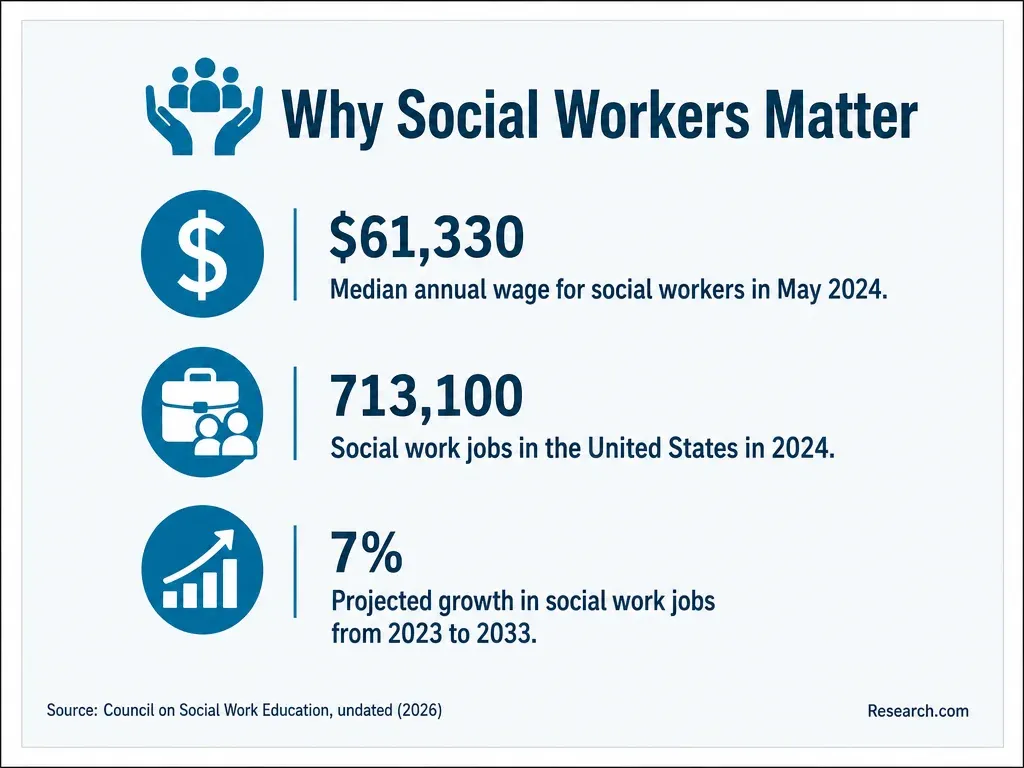
- Recent BLS figures put median annual pay at $59,550 for child, family, and school social workers and $67,880 for healthcare social workers; neither figure predicts pay for a particular home-visit position.
Which social work jobs involve home visits, and what do they do?
Home visits bring assessment and service coordination into a person's living environment. Duties vary: a worker may check whether services are accessible, assess family needs, coordinate care, or provide an intervention permitted by their role. A visit is not automatically psychotherapy or an investigation.
The comparison below shows why the setting and employer matter more than the phrase "home-visit social worker" in a job ad.
| Setting | Common visit purpose | Work to clarify before applying |
| Child and family services | Family engagement, safety-related assessment within agency authority, service planning | Reporting duties, caseload geography, court work, and after-hours expectations |
| Home health or hospice | Psychosocial assessment, caregiver support, resource coordination | Visit territory, interdisciplinary meetings, and documentation deadlines |
| Aging, disability, or community services | Assessing support needs, connecting clients with benefits and services | Eligibility rules, accessibility needs, and whether the role requires a social work credential |
| Community behavioral health | Outreach, care coordination, or authorized clinical services | Clinical scope, crisis responsibilities, supervision, and team visits |
Some outreach and case-management jobs accept human services qualifications rather than a social work degree. If you are considering child and family work through a BSW, compare employers' requirements with accredited online BSW programs before assuming a degree is necessary for every visiting role.
How much travel do home-visit social workers do, and is travel time paid?
There is no standard number of daily visits or miles. A compact urban territory may involve short trips but difficult parking; a rural territory may mean fewer visits and much longer drives.
Ask for the service-area map, expected visits per day, average drive time, documentation targets, and how cancellations affect the schedule. A four-visit day can become a much longer workday if the employer budgets only for face-to-face time.
Under federal wage-and-hour rules, travel between job sites during the workday generally counts as hours worked for a nonexempt employee. An ordinary commute between home and the first regular work location generally does not.
Travel from home to an unusually distant assignment, overnight travel, state rules, and employer policies can change the analysis. Salaried or exempt status also affects overtime eligibility, not whether driving consumes time. Request a written explanation of how to record travel, overtime, on-call work, and late documentation.
If you are comparing study with employment, check MSW program flexibility before enrollment: online coursework does not remove in-person field schedules or travel to an approved placement.
How does mileage reimbursement work for social workers making home visits?
Employers may pay a per-mile rate, provide a vehicle, use a car allowance, or set another expense policy. The IRS standard business mileage rate is often a reference point, but it is not a universal requirement to reimburse employees at that rate.
State law, contracts, and wage rules may impose additional obligations; for employees covered by federal minimum-wage and overtime rules, unreimbursed work expenses cannot bring pay below applicable required levels.
Before accepting an offer, get the policy for eligible trips, the starting location used to calculate miles, parking and tolls, claim deadlines, and required records. Ask whether the employer requires a personal vehicle and particular insurance coverage. Keep an accurate contemporaneous mileage log rather than assuming every mile driven on a workday qualifies.
Small rate differences accumulate: at 5,000 eligible business miles, a reimbursement difference of 10 cents per mile equals $500. That is a comparison example, not an estimate of a typical caseload. Students should also budget for placement travel, which may not be reimbursed; social work master's education costs and career fit should account for travel as well as tuition.
Home visiting is a work arrangement, not a separate Bureau of Labor Statistics occupation. These U.S. occupation-wide figures provide context for three settings where visits may occur, plus the overall social worker category.
| BLS occupation | May 2025 median annual pay | Projected employment growth, 2025-2035 |
| Child, family, and school social workers | $59,550 | 4% |
| Healthcare social workers | $67,880 | 8% |
| Mental health and substance abuse social workers | $60,280 | 10% |
| Social workers, all specialties | $61,780 | 6% |
The overall figure includes specialties rather than representing another home-visit job. Neither medians nor growth projections isolate traveling staff, entry-level hires, or a particular degree.
Compare actual offers using salary, paid driving and documentation time, mileage policy, benefits, caseload, and schedule together. For location context, see social work master's pay and geographic differences, then check local postings for the role you want.
How can you choose a CSWE-accredited social work program?
First, verify the exact BSW or MSW program and its accreditation status in the Council on Social Work Education's directory for the cohort you expect to join. Institutional accreditation is separate from social work programmatic accreditation. Then check the licensing board in the state where you intend to practice; the school, accreditor, and board answer different questions.
For a home-visit career, ask each field office which local agencies it works with, who arranges placements, how field instructors are qualified, and what happens if a site cannot meet supervision or safety expectations. Confirm whether the program can enroll and place you in your state, and request the full schedule and cost estimate before committing.
If licensure is a goal, investigate MSW licensure alignment before enrollment; a program's accreditation alone does not grant a license.
Other Things You Should Know About Social Work Programs
Do not bring an unapproved person. Client privacy, consent, agency policy, and insurance rules apply. Ask your supervisor about an authorized coworker or another approved meeting arrangement instead.
Follow the agency's contact and documentation procedure. Do not assume a missed appointment permits entry or an immediate welfare conclusion; escalate concerns through the appropriate supervisor or required response process.
Not necessarily. Employers and programs may count remote contacts differently from in-person visits, and service or payer rules may apply. Confirm how the appointment is classified before recording it.
Sometimes. Depending on the role and agency approval, a visit may take place in temporary housing or another community location. Confirm privacy, safety, accessibility, and how the contact must be documented.
- NASW Standards for Social Work Case Management | nycourts.gov https://www.nycourts.gov/reporter/webdocs/nasw_standards_socialwork_casemgt.htm
- The Role of Social Workers in Interprofessional Primary... - PMC https://pmc.ncbi.nlm.nih.gov/articles/PMC7435073/
- DOL Workplace Violence Program https://www.dol.gov/agencies/oasam/centers-offices/human-resources-center/policies/workplace-violence-program
- Publication 463 (2025), Travel, Gift, and Car Expenses | Internal Revenue Service https://www.irs.gov/publications/p463
- Mental and Behavioral Health | Child Welfare Information Gateway https://www.childwelfare.gov/topics/well-being/mental-and-behavioral-health
- Caseload and Workload Management | akleg.gov https://www.akleg.gov/basis/get_documents.asp
- Types of Social Work | socialworkers.org https://www.socialworkers.org/News/Facts/Types-of-Social-Work