2027 Social Work in International NGOs: Context, Preparation, and Role Questions
Audited and Verified:
Our Editorial and Data Verification Process
Research.com uses government datasets, official education statistics and primary institutional information to support its career and degree guides. Our review process checks factual accuracy, occupational definitions, source dates and the requirements associated with the credentials discussed.
How This Article Was Fact-Checked
Our editorial team verifies salary estimates, employment projections, education requirements and program information against original data providers and official organizations. Salary figures are checked against the relevant occupational definitions and reporting periods. Information about licensure, accreditation and required in-person training is reviewed separately.
Fact-checked and verified on:

Co-Founder and Chief Data Scientist
International NGOs hire people to coordinate services, protect vulnerable communities, manage programs, and evaluate results - but "social worker" does not describe one universal job or credential. For US students and early-career professionals, the best preparation depends on whether the target role involves direct service, clinical practice, or program operations, and where the work takes place.
This guide connects NGO duties to education, licensure, field experience, and hiring requirements so you can identify a realistic entry route without assuming that an MSW - or an overseas placement - is always necessary.
Key Things You Should Know
- International NGO roles range from case management to program evaluation; the employer, location, and actual duties determine whether a BSW, MSW, license, or another qualification is useful.
- A U.S. social work degree does not authorize clinical practice abroad. Verify local rules, employer requirements, and - if studying in the US - your program's CSWE status and placement policies separately.
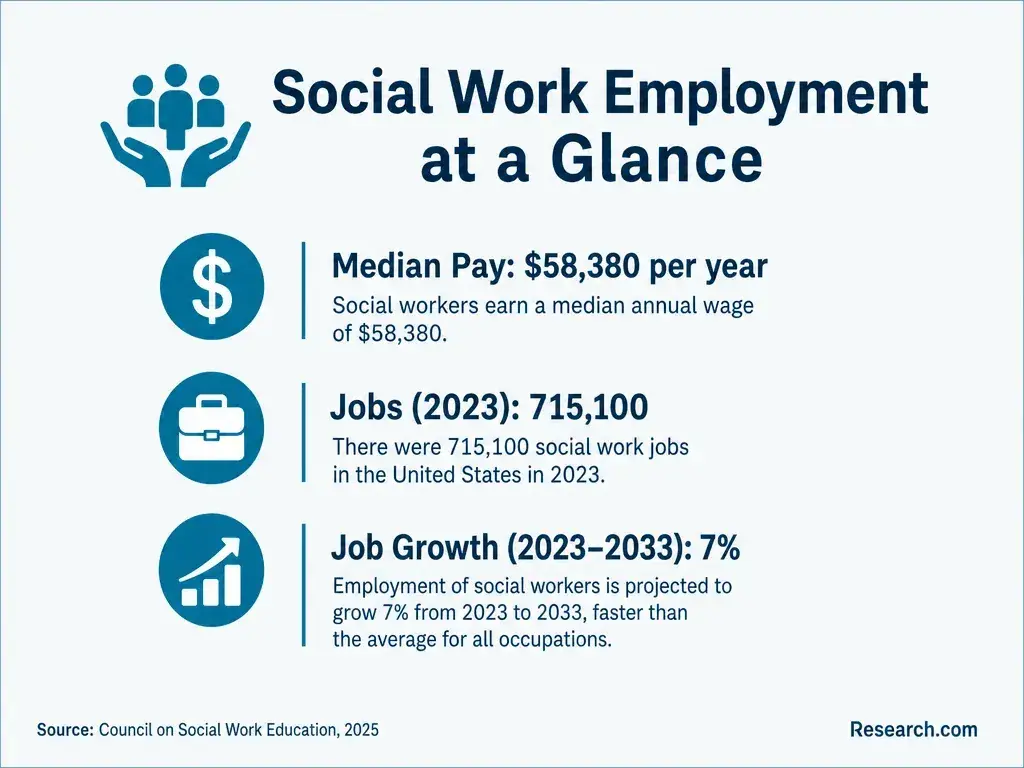
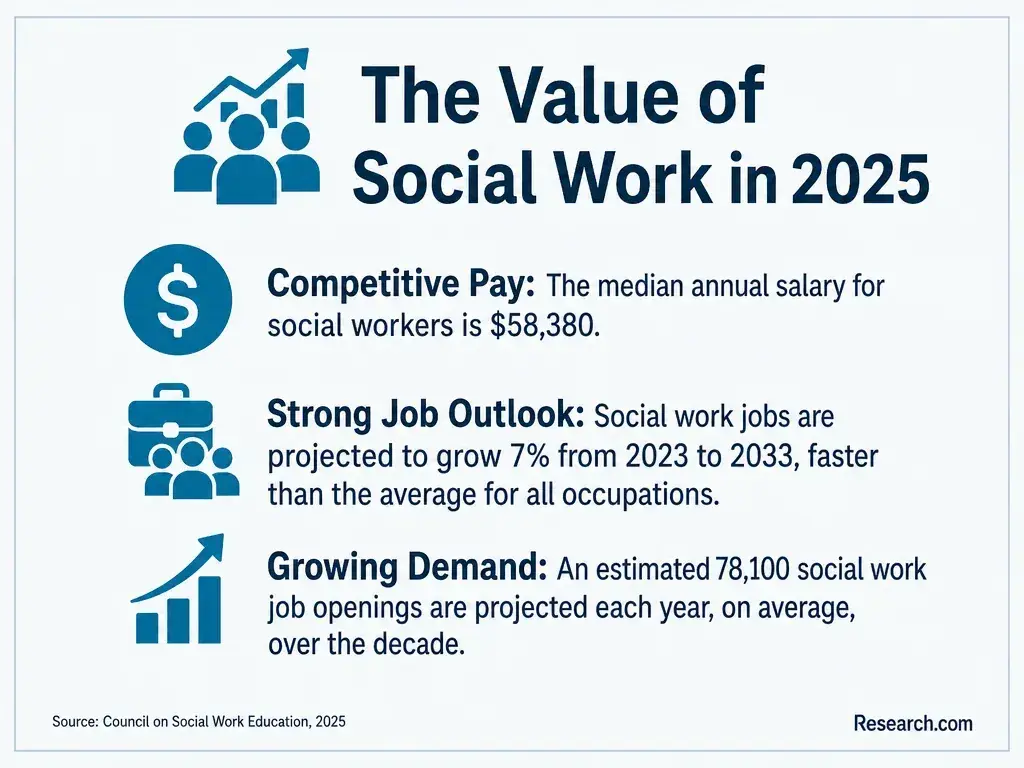
- US social workers had a May 2025 median annual wage of $61,780, with employment projected to grow 6% from 2025 to 2035; those occupation-wide figures do not predict international NGO pay or hiring.
What do social workers do in international NGOs?
An international nongovernmental organization (NGO) is an organization operating across national borders outside government. Its social work-related activities may include supporting displaced families, coordinating child protection services, improving access to disability or health services, and helping local partners strengthen referral systems. Work can be based in the US, overseas, or across several locations.
A direct-service worker might assess needs, explain available options, arrange referrals, document follow-up, and consult a supervisor about safety concerns. A program officer might train partners, monitor service quality, manage reporting requirements, or examine whether a project reaches its intended population. Both need cultural humility and sound boundaries, but they are different jobs: a program title does not authorize psychotherapy or override local safeguarding procedures.
Consider whether you want continuing client relationships or systems-level work. For a broader view of how those interests translate into jobs, see MSW careers across different practice settings.
What degree do you need for social work in an international NGO?
There is no single degree requirement for international NGO work. Start with representative vacancies for the function and country you want, then compare their required qualifications with your existing education and experience. Some coordination and operations jobs accept public health, human services, international development, or related backgrounds; positions explicitly requiring a qualified social worker may have narrower rules.
The routes below differ most in the kind of work they prepare you to perform - not simply in seniority.
| Route | Potential fit | Important limit |
| BSW | Generalist service coordination, community outreach, and entry-level social work roles where recognized | Does not itself confer a license or advanced clinical authority |
| Traditional or foundation MSW | Advanced practice or program roles for applicants with a bachelor's degree in any qualifying discipline | Includes foundational social work study and field education; admission is program-specific |
| Advanced-standing MSW | A shorter MSW route for applicants whose qualifying BSW meets the school's criteria | A psychology, human services, or other non-BSW degree does not ordinarily qualify |
| MPH, MPA, or targeted experience | Public health programming, operations, grants, policy, or evaluation without a social work credential requirement | May not meet requirements for social worker positions or regulated practice |
If you already hold a BSW, compare the school's eligibility and field sequence before assuming a shorter route is available; the MSW entry pathway comparison guide can help frame that decision. A DSW or PhD is generally unnecessary for entry-level NGO work; consider doctoral study for a defined leadership, teaching, or research objective, not as a default hiring credential.
Do social workers in international NGOs need a license?
Not for every NGO job. Program management, outreach, and some case-management positions may not require a US social work license. A role involving protected professional titles, diagnosis, psychotherapy, or other regulated activities may require authorization in the jurisdiction where the service is delivered. An NGO can also impose qualifications stricter than the law requires.
US licenses are issued under state-specific rules; an MSW, field placement, or license from one state does not automatically permit independent clinical practice elsewhere. Overseas practice is governed by applicable local law and employer policy, not by CSWE accreditation or a US license alone. Remote services can raise requirements in more than one jurisdiction. Before accepting a role, ask which activities you would perform, where clients would be located, which authority regulates those activities, and what supervision the employer provides.
For US-based plans, use graduate social work education and license pathway planning as a starting point, then confirm eligibility with the relevant licensing board.
Possibly, but only with advance program approval. Online coursework does not make field education location-independent. A school must determine whether the proposed agency offers appropriate learning tasks, qualified field instruction, supervision, safety procedures, evaluation, and compliance with applicable local and university requirements. Some programs do not permit overseas placements at all.
Ask the field office who finds sites, whether your proposed country is eligible, how supervision and faculty contact work across time zones, and what happens if the placement closes or travel becomes unsafe. Confirm language expectations, insurance, safeguarding training, and any visa or work-authorization implications.
Do not book travel or assume volunteer or paid hours will count before receiving written approval. Even when planning online MSW study around employment, account for agency operating hours, live supervision, and field seminar requirements.
Social policy, human behavior in the social environment, research methods, and practice courses provide a foundation. For international NGO roles, add learning that matches the work: community practice and program evaluation for project roles; safeguarding, case management, and trauma-informed engagement for service roles; and language study or regional expertise where employers request it. None replaces orientation to a specific community, legal system, or agency protocol.
The most useful evidence of readiness is supervised performance: collaborating with local partners, documenting decisions without exposing private information, recognizing referral limits, and responding to feedback. A US-based placement with refugees or other internationally connected communities can build relevant skills without requiring overseas travel.
Research or program-support work may also help; a guide to MSW graduate assistantship roles offers another way to assess opportunities to develop evaluation or administrative skills. Describe what you actually did rather than presenting coursework as independent practice experience.
BSW applicants generally begin with university undergraduate admission and may face a separate application to the social work major. Traditional MSW programs admit applicants with qualifying bachelor's degrees from various disciplines; they may review transcripts, academic performance, essays, recommendations, relevant experience, and program-specific prerequisites. Advanced-standing MSW admission requires a qualifying social work degree under the school's rules, often with additional recency or performance criteria.
For a career changer, document transferable work - such as advocacy, education, health services, or program administration - while identifying gaps in social work ethics, practice, and field learning. An international applicant should ask about credential evaluation, English-language requirements when applicable, enrollment eligibility, field-site approval, and financing. Neither online enrollment nor admission creates US immigration or employment authorization. If speed matters, investigate eligibility and placement capacity before comparing accelerated graduate social work programs; a compressed classroom schedule does not eliminate field requirements.
A BSW graduate may be competitive for generalist case management, outreach, service coordination, or partner-support roles when the employer accepts the credential. MSW graduates may pursue specialized case management, protection-program support, technical advising, supervision, or evaluation roles, subject to experience and local requirements. Job titles vary widely: "protection officer" or "program manager" may describe work that does not require a social work degree, while a clinical post may require credentials beyond an MSW.
Read vacancies for their duties, not just titles. Compare required language ability, regional knowledge, field experience, travel expectations, safeguarding responsibilities, reporting burden, supervision, and whether the employer hires locally or sponsors international staff. For many applicants, relevant local practice followed by a move into NGO partnerships is more realistic than expecting a degree alone to secure an overseas posting.
Before paying for graduate study, compare likely roles and advancement requirements against online MSW costs and career outcomes; if your target is grants or operations and postings accept other degrees, an MSW may not be the most direct investment.
What are the salary prospects and job outlook for international NGO social workers?
The US Bureau of Labor Statistics reports a May 2025 median annual wage of $61,780 for social workers across specialties and projects 6% employment growth from 2025 to 2035. For context, its healthcare social worker category had a $67,880 median and projected 8% growth. These are US occupation-wide measures, not international NGO pay scales, MSW graduate outcomes, or forecasts for overseas vacancies.
NGO compensation depends on the job's location, funding, contract type, seniority, and benefits. Compare an actual offer's salary with health coverage, travel or relocation support, contract duration, and the cost of living; do not infer pay from a social work job title alone.
For US comparisons, social worker earnings and location considerations can provide context, while the employer's written offer remains the relevant figure for your decision.
Other Things You Should Know About Social Work
It depends on the posting. Some roles specify professional fluency; others rely on multilingual teams. Check the required proficiency and whether you must communicate directly with clients or partners.
Do not assume so. Entry, employment, and residency rules depend on the destination and assignment. Ask the employer who arranges authorization before accepting an offer or traveling.
No. NGOs also run longer-term health, education, disability, family support, and community programs. These roles may offer a better fit if your experience is in sustained service delivery rather than emergency response.
Ask about onboarding, supervision, caseload or workload, safety procedures, time off, and access to consultation after difficult cases. Specific answers matter more than a general promise of staff well-being.
- The involvement of non-governmental organisations in... - PMC https://pmc.ncbi.nlm.nih.gov/articles/PMC11781716/
- NASW Standards for Social Work Case Management | nycourts.gov https://www.nycourts.gov/reporter/webdocs/nasw_standards_socialwork_casemgt.htm
- 8 Community Health Issues Social Workers Help Solve | Walden University https://www.waldenu.edu/online-masters-programs/master-of-social-work/resource/community-health-issues-social-workers-are-helping-to-solve
- Social Workers in International Relief and Development | southern.edu https://knowledge.e.southern.edu/cgi/viewcontent.cgi
- What Is Social Work Program Design and Evaluation? | Tulane University https://online.tulane.edu/social-work/blog/what-is-social-work-program-design-and-evaluation
- The Role of Social Work in Public Health - Online M.S.W. | Virginia Commonwealth University https://onlinesocialwork.vcu.edu/blog/role-of-social-work-in-public-health/
- Essential Skills and Traits for Social Workers - UB School of Social Work https://socialwork.buffalo.edu/admissions/is-social-work-right-career-for-me/list-of-essential-skills-in-social-work.html
- How International Social Workers Make an Impact Around the Globe | Florida State University College of Social Work https://onlinemsw.fsu.edu/blog/around-globe-how-social-workers-make-international-impact
- NASW Standards for Social Work Case Management | socialworkers.org https://www.socialworkers.org/Practice/NASW-Practice-Standards-Guidelines/NASW-Standards-for-Social-Work-Case-Management
- Effective and ethical working environments for social work | International Federation of Social Workers https://www.ifsw.org/effective-and-ethical-working-environments-for-social-work-the-responsibilities-of-employers-of-social-workers-2/