2027 Social Work Focus Groups for Program Planning: Learning and Facilitation Needs
Audited and Verified:
Our Editorial and Data Verification Process
Research.com uses government datasets, official education statistics and primary institutional information to support its career and degree guides. Our review process checks factual accuracy, occupational definitions, source dates and the requirements associated with the credentials discussed.
How This Article Was Fact-Checked
Our editorial team verifies salary estimates, employment projections, education requirements and program information against original data providers and official organizations. Salary figures are checked against the relevant occupational definitions and reporting periods. Information about licensure, accreditation and required in-person training is reviewed separately.
Fact-checked and verified on:

Co-Founder and Chief Data Scientist
A social work program can look sound on paper yet miss what students, field instructors, or community members need to succeed. Focus groups can uncover those gaps before leaders revise coursework, placements, or services - but only if the right people can speak candidly and their feedback leads to a decision.
This guide is for social work educators, students, and human services professionals planning or facilitating groups. It explains whom to invite, what to ask, how to manage ethical risks, and how to turn discussion into feasible improvements.
Key Things You Should Know
- Focus groups reveal how participants experience a program and why barriers arise; they do not establish how common a problem is across all students or clients.
- Separate groups when authority or grading relationships could silence participants, and explain consent, recording, privacy limits, and intended uses before discussion begins.
- Plan the decision before collecting feedback: pair recurring themes with other evidence, assign an owner to each proposed change, and report back on what changed or why it did not.
What are social work focus groups, and how do they inform program planning?
A focus group is a guided discussion among people with relevant experience. Unlike a survey, it lets participants build on or challenge one another's observations. A social work school might ask students and field instructors where classroom preparation falls short; a community agency might ask service users about barriers to an outreach program. In either setting, the purpose is to inform a defined planning decision, not to collect testimonials.
Start with a decision such as whether to add a group-facilitation lab, change placement orientation, or redesign referral hours. Then identify whose experience can test the proposed change and what other evidence - course evaluations, placement reports, service-use records, or an accessible survey - will help interpret the discussion. People exploring MSW career options for prospective graduate students should also distinguish program-planning work from clinical practice: both may involve groups, but their aims and qualifications differ.
Key limit: Focus groups produce contextual, qualitative evidence. A vivid account can identify an urgent problem, but it cannot show that most participants share it. Do not report a theme as a prevalence rate.
How can focus groups identify social work students' learning needs?
Ask students to describe a task they were expected to perform, what preparation they received, and where they needed more support. Comparing accounts across coursework, simulation, field orientation, and supervised practice can distinguish a knowledge gap from a placement or scheduling problem. For example, students who understand collaborative assessment in class but struggle to document it during field education may need observed practice and feedback - not another lecture.
Include field instructors in a separate discussion when possible. Their observations can test whether a reported gap appears in supervised performance, while students can explain barriers they may hesitate to raise in front of evaluators. A focus group cannot itself establish competence; use approved learning agreements and field evaluations for that purpose. When placement support is the issue, comparing MSW practicum placement assistance can help prospective students ask who finds sites, resolves disruptions, and supports field instructors.
Analyze needs by task and learning stage. BSW students beginning generalist fieldwork, traditional MSW students learning foundational practice, and advanced-standing students entering a specialized sequence may need different preparation. Avoid interpreting a complaint about limited agency access as proof that a student lacks skill.
What skills do social work focus group facilitators need?
A facilitator needs qualitative interviewing skills and social work judgment: asking neutral follow-ups, drawing out quieter voices, noticing power imbalances, and keeping discussion focused without turning it into instruction or counseling. They should understand the service setting well enough to clarify terminology, but not be so invested in a proposed change that they defend it during the session.
A useful test is whether the facilitator can ask, "Can you describe a time that process did not work?" without implying the participant is at fault. They must also be ready to redirect identifying details about clients, respond within agency procedures if a safety concern arises, and avoid promising secrecy they cannot guarantee. A separate note-taker can track participation and context while the facilitator listens.
Facilitating a planning discussion is not facilitating therapy. Someone considering clinical social work master's curriculum options should check for the specific group-practice and supervised skills they want; clinical coursework alone does not establish competence in program evaluation, and leading a focus group does not authorize psychotherapy.
Use open questions tied to a decision participants can reasonably inform. Ask for experiences before suggestions, probe for differing experiences, and end by checking what the group thinks planners most need to understand. These adaptable prompts can guide a discussion about learning and facilitation needs:
- "Think of a recent course, placement, or service-planning task: what were you asked to do, and what preparation helped or was missing?"
- "Where did the process work differently for people with different schedules, access needs, roles, or community connections?"
- "What support would have made it easier to lead or participate in a group discussion, and who would need to provide it?"
- "Which proposed change would matter most in practice, and what might make it difficult to implement?"
Replace assumptions with neutral wording. "What made the placement orientation confusing?" presumes confusion; "How did the orientation prepare you?" allows favorable and unfavorable answers. If comparing learning needs across MSW entry routes, first understand comparing MSW credits across entry tracks: students in traditional and advanced-standing sequences do not necessarily encounter the same foundational coursework.
Before recruitment, establish who will see recordings or notes, where they will be stored, when they will be deleted, and whether quotations may appear in a report. Explain the purpose, voluntary nature, recording choice, and any limits to confidentiality in language participants can understand. Ask everyone not to repeat others' comments, while acknowledging that a facilitator cannot guarantee what fellow participants will disclose afterward.
Do not request identifiable client stories to make a point about teaching or services. If sensitive information emerges, redirect toward the process rather than gathering unnecessary details. Agency policy and applicable law - not a general confidentiality promise - govern records, reporting, and responses to safety concerns. Professional ethical guidance also informs respectful practice but does not replace those requirements.
Cultural inclusion requires more than a diverse invitation list. Offer accessible formats and interpretation when feasible, allow participants to decline a question, and check whether prompts assume one family structure, language, or service experience. A facilitator's social work license, if any, does not remove these obligations; readers weighing a clinical route can separately review licensure-focused MSW program selection questions with the relevant state board and school.
Neither format is inherently more inclusive. Choose based on participants' privacy, accessibility, technology, travel, and scheduling needs - not organizer convenience alone. The comparison below shows the trade-offs that matter most when selecting a format.
| Consideration | Online group | In-person group |
| Access | Removes travel but requires a usable device, connection, and suitable space. | May ease participation for people with limited connectivity but requires travel and an accessible venue. |
| Privacy | Others may overhear at home; platform settings and recording permissions matter. | A private room is easier to arrange, but participants may recognize one another on arrival. |
| Interaction | Chat and captions may help; interruptions and missed cues can complicate discussion. | Turn-taking and nonverbal cues may be easier to observe; travel can reduce attendance. |
Offer a clear participation option for people who cannot use the chosen format, such as an accessible interview or written feedback. Online education also has separate scheduling constraints: readers comparing online BSW entry routes before applying should verify live meetings and field requirements rather than assuming that online study - or an online focus group - fits every work or caregiving schedule.
What social work careers use focus groups, and what do they pay?
Community program coordinators, agency evaluators, school or healthcare social workers, policy staff, and social work educators may use focus groups to learn about services or training. Leading one is usually a task within a broader job, not a distinct licensed occupation. Qualifications depend on the role: an evaluator may come from social work, public health, or another research background, while a position providing regulated social work services may require a qualifying degree and state license.
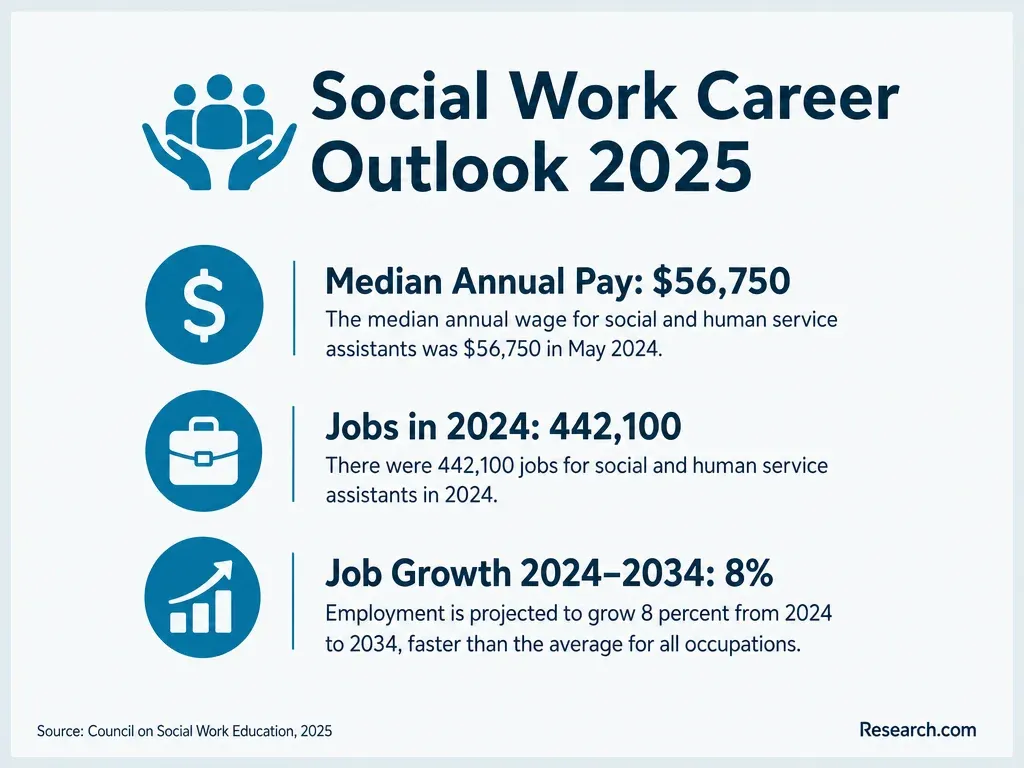
The U.S. Bureau of Labor Statistics reports a May 2025 median annual wage of $61,780 for social workers overall and projects 6% employment growth from 2025 to 2035. Its May 2025 medians for healthcare social workers and child, family, and school social workers are $67,880 and $59,550, respectively. These occupation-wide figures describe different mixes of duties and employers; none is a salary estimate for a focus group facilitator, program evaluator, or particular graduate.
Before pursuing a role, read job postings for required evaluation methods, community partnerships, degree, license, supervision, and reporting responsibilities. Location also affects pay: MSW salary comparisons by state can provide geographic context, but local postings and the actual occupational category are better guides to a specific opportunity.
Other Things You Should Know About Social Work
There is no universal number. Plan enough separate discussions to hear relevant perspectives without putting people in groups where they cannot speak freely. If new groups continue to reveal important differences, more inquiry may be warranted; document whose views are still missing.
A modest incentive may recognize participants' time or reduce participation barriers. Check school, agency, and funder rules, and avoid an amount or condition that pressures clients or students to participate. Explain that declining will not affect services or grades.
Do not decide that based only on whether the project is called "program evaluation." Ask the school's research-oversight office and agency contact whether review or another approval is required before recruitment, particularly if findings may be used beyond internal improvement.
Preserve the disagreement in the findings. Check whether experiences differ by role, placement, or access need, then use other evidence to assess options. A report should not turn a lively discussion into a claim of consensus that participants did not reach.
- Principles for doing trauma-informed research and program evaluation | Australian Institute of Family Studies https://aifs.gov.au/resources/practice-guides/principles-doing-trauma-informed-research-and-program-evaluation
- Collecting and Analyzing Qualitative Data | Field Epi Manual https://www.cdc.gov/field-epi-manual/php/chapters/qualitative-data.html
- The Limits of Confidentiality: Informed Consent and... - PMC https://pmc.ncbi.nlm.nih.gov/articles/PMC6493245/
- ICJIA | A Guide to Conducting Focus Groups https://icjia.illinois.gov/researchhub/articles/a-guide-to-conducting-focus-groups/
- Focus Groups - Community Economic Development https://economicdevelopment.extension.wisc.edu/articles/focus-groups/
- Section 6. Conducting Focus Groups - Community Tool Box https://ctb.ku.edu/en/table-of-contents/assessment/assessing-community-needs-and-resources/conduct-focus-groups/main
- Sharing Results for Engaged Research | harvard.edu https://catalyst.harvard.edu/community-engagement/sharing-results/
- Guidelines to Incorporate Trauma-Informed Care Strategies in Qualitative Research | Urban Institute https://www.urban.org/urban-wire/guidelines-incorporate-trauma-informed-care-strategies-qualitative-research
- 13.4 Focus groups - Scientific Inquiry in Social Work https://viva.pressbooks.pub/scientificinquiryinsocialwork/chapter/13-4-focus-groups/
- Best Practices in Research & Evaluation - Focus Groups https://www.etr.org/ebi/f/best-practices-focus-groups/