2027 Social Work Communication Across Literacy Levels: Plain Language and Understanding
Audited and Verified:
Our Editorial and Data Verification Process
Research.com uses government datasets, official education statistics and primary institutional information to support its career and degree guides. Our review process checks factual accuracy, occupational definitions, source dates and the requirements associated with the credentials discussed.
How This Article Was Fact-Checked
Our editorial team verifies salary estimates, employment projections, education requirements and program information against original data providers and official organizations. Salary figures are checked against the relevant occupational definitions and reporting periods. Information about licensure, accreditation and required in-person training is reviewed separately.
Fact-checked and verified on:

Co-Founder and Chief Data Scientist
A client may agree to a service plan yet leave unsure which form to submit, when to call, or what will happen next. Social workers need to make information usable without talking down to people or assuming that reading ability is the problem. This guide is for students, new social workers, and human services professionals who explain options, rights, and next steps.
It covers plain language, teach-back, language access, and accessibility, then shows how to judge whether an education program will help you practice those skills.
Key Things You Should Know
- Use familiar words, one clear action at a time, and materials clients can use; do not infer a person's literacy from their education, speech, or appearance.
- Check understanding with a nonjudgmental teach-back invitation, then explain differently if needed. A signed form or a client's "yes" does not establish understanding.
- Communication competence takes observed practice and feedback. There is no universal reading-grade target that makes every social work document appropriate for every client.
What is plain language in social work, and why does literacy matter?
Plain language makes information understandable and usable for its intended audience. In social work, that means a client can identify their options, ask questions, and know what to do next - not merely recognize the words on a page. Literacy needs may differ across reading, numbers, digital forms, and unfamiliar service systems. Stress, illness, limited time, and complex eligibility rules can make an otherwise readable message hard to use.
Plain language is not the same as omitting important qualifications. A benefits explanation, for example, should state what the client can do now while accurately identifying deadlines and uncertainty. Avoid guessing someone's reading level. Ask how they prefer to receive information and test whether the explanation works.
Students considering accredited bachelor's pathways into social work can look beyond course titles for opportunities to practice explaining service information in everyday language. Neither a degree label nor a readability score proves that a graduate can communicate effectively with a particular client.
How can social workers use plain language with clients?
Start with the decision the client needs to make. Replace agency shorthand with familiar terms, separate required steps from optional ones, and keep spoken explanations brief enough to invite questions. When a technical or legal term matters, name it and explain it rather than silently changing its meaning.
A useful sequence for an appointment or follow-up message is:
- Ask what the client already knows and what they most need to resolve.
- Explain the next action in everyday words, including who will do it and when.
- Show the relevant part of a form or message instead of reading a long document aloud.
- Pause for questions and check whether the next step is workable given transportation, phone access, cost, or other barriers.
For example, "Send proof of residency" may be less useful than "The office needs a document showing where you live. Let's check which documents it accepts and how you can submit one." This does not authorize a worker to promise eligibility or waive a rule.
In clinical settings, clear explanations also support informed choices, but communication skill is separate from permission to provide psychotherapy; readers comparing social work clinical experience expectations should distinguish education and field learning from board-approved post-degree supervision.
How can social workers check client understanding using teach-back?
Teach-back asks a client to describe a plan in their own words so the worker can check the explanation - not grade the client. It is especially useful before a deadline, referral, safety-related instruction, or complicated consent decision. A respectful prompt is: "I want to make sure I explained this clearly. What will you do first when you get home?"
If the response differs from the intended plan, acknowledge that the explanation may have been unclear. Rephrase the point, use an example or visual aid, and ask again. Do not use a rehearsed response as proof of informed consent or assume the client can carry out a plan simply because they can repeat it. Ask about practical obstacles, and document according to agency policy.
When evaluating planning a shorter MSW pathway, ask how often students receive observed feedback on skills such as teach-back. A condensed schedule is attractive only if it leaves enough time to practice, receive correction, and apply the skill in approved field learning.
BSW generalist preparation commonly connects engagement, interviewing, documentation, ethics, and work with individuals, families, groups, and communities. An MSW adds advanced or specialized practice learning, but its emphasis varies by program.
Classroom discussion and simulated interviews provide a place to make mistakes; approved field education lets an instructor assess performance in a real service setting. Neither replaces later employer onboarding or, when required, post-degree clinical supervision.
Ask a program for a sample learning agreement or skills-assessment rubric. Look for observed practice in explaining rights and services, adapting materials, working with interpreters, and responding when a client does not understand. Ask who gives feedback in field placement and how students improve after an unsuccessful interaction.
Entry route also affects what training a student completes. A non-BSW graduate generally applies to a traditional or foundation MSW rather than assuming eligibility for advanced standing. A guide to choosing an MSW entry track can help frame questions about qualifying prior education, the course sequence, and field learning; the individual program decides admission and placement requirements.
Check the exact BSW or MSW program and its accreditation status in the Council on Social Work Education's directory, including whether the status applies to your anticipated cohort. Separately verify the institution's accreditation. Then ask the program whether it can enroll and place you in your location, and consult the licensing board in the state where you intend to practice about its current education, examination, and supervised-experience rules.
These checks answer different questions: accreditation concerns the educational program; a school's ability to support a placement concerns where you can study; and a state board decides licensing eligibility. Graduation does not issue a license, and an MSW alone does not authorize independent clinical practice.
For online study, checking MSW program authorization and professional eligibility is particularly important if your field placement or intended practice state differs from the school's location.
What are social worker salaries and job outlook?
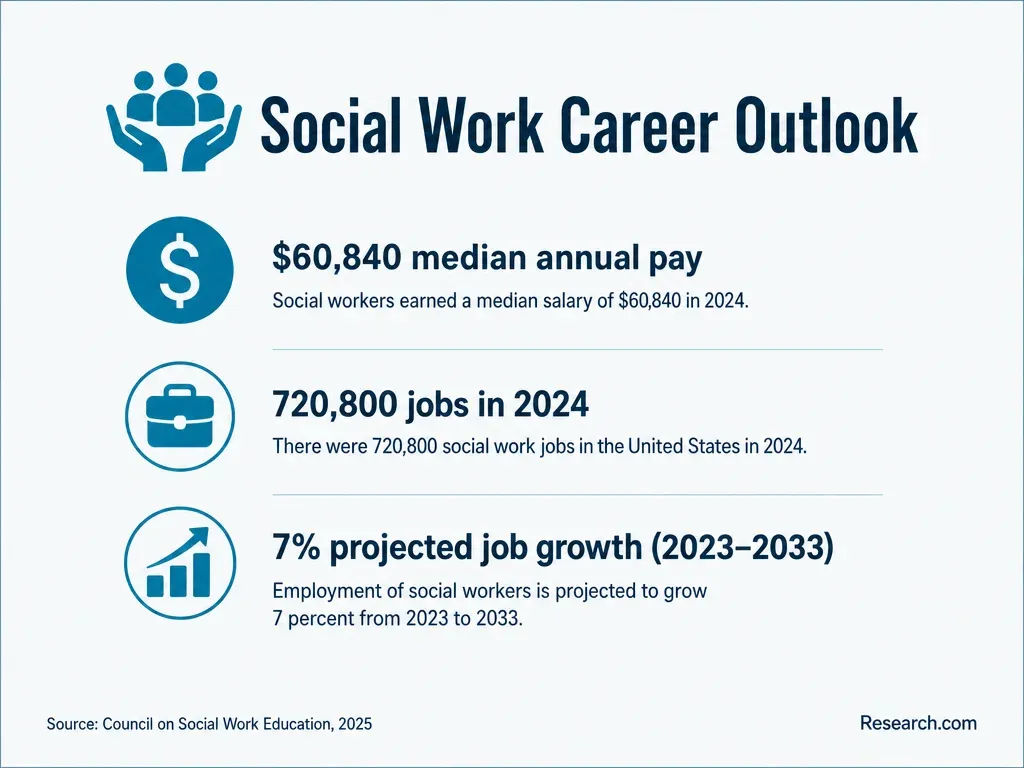
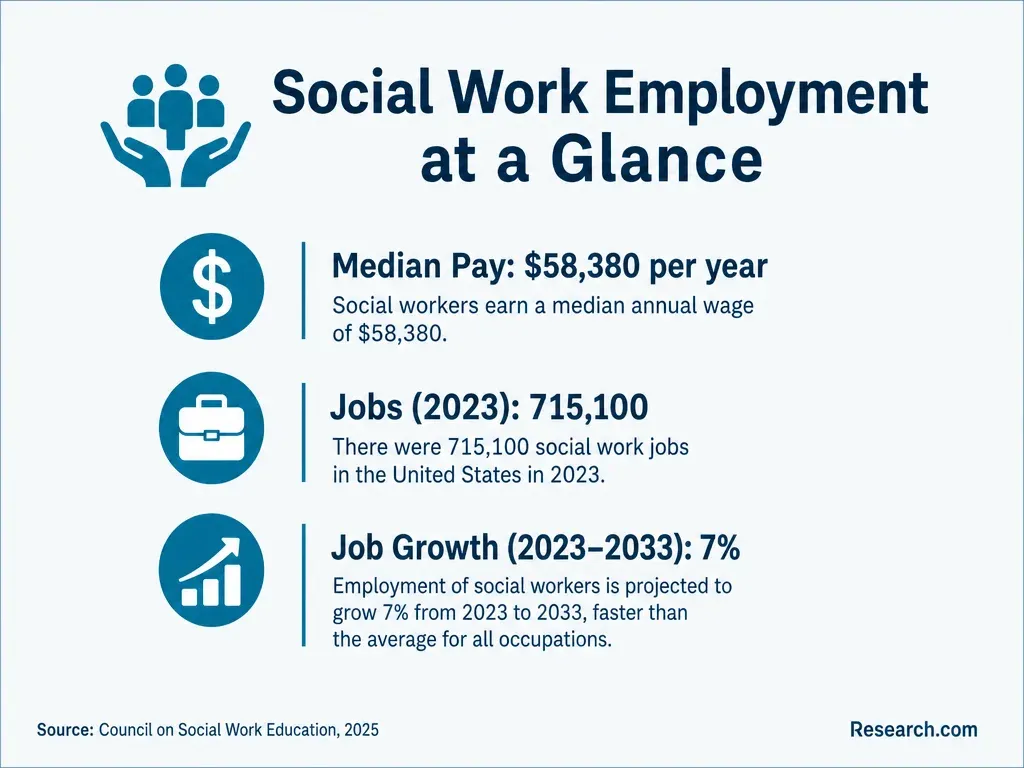
U.S. Bureau of Labor Statistics figures supplied for May 2025 place the median annual wage for social workers across specialties at $61,780, with employment projected to grow 6% from 2025 to 2035. The specialty figures below are more informative when a reader has a particular setting in mind.
| BLS occupation | May 2025 median annual wage | Projected growth, 2025-2035 |
| Child, family, and school social workers | $59,550 | 4% |
| Healthcare social workers | $67,880 | 8% |
| Mental health and substance abuse social workers | $60,280 | 10% |
These are occupation-wide U.S. medians and projections, not entry-level offers or a return promised by a BSW or MSW. Location, employer, experience, and required licensure can change the comparison. Use MSW salary comparisons by state alongside actual local job postings, then check whether those jobs require the degree and license you plan to pursue.
Other Things You Should Know About Social Work
Avoid unsupported labels. Record the communication support provided and information relevant to service planning, using respectful, factual language and your agency's documentation rules.
Sometimes assistance is appropriate, but first consider the client's wishes, privacy, consent, and the form's rules. Do not assume a relative has authority to decide or sign on the client's behalf.
No. A score cannot show whether instructions are accurate, culturally appropriate, accessible, or actionable. Review the material with its intended audience and follow agency approval requirements.
Ask what format works better and provide available alternatives while respecting any requirement to give written notices. A preference for spoken information does not mean the client lacks decision-making ability.
- Language and Literacy - Healthy People 2030 https://odphp.health.gov/healthypeople/priority-areas/social-determinants-health/literature-summaries/language-and-literacy
- Communicating Effectively with People with Disabilities | ADA.gov https://www.ada.gov/topics/effective-communication/
- Integrating Literacy, Culture, and Language to Improve Health Care Quality for Diverse Populations - PMC https://pmc.ncbi.nlm.nih.gov/articles/PMC5091931/
- Use the Teach-Back Method: Tool 5 | Agency for Healthcare Research and Quality https://www.ahrq.gov/health-literacy/improve/precautions/tool5.html
- Plain Language Materials & Resources | Health Literacy https://www.cdc.gov/health-literacy/php/develop-materials/plain-language.html
- Plain Language | U.S. Office of Personnel Management https://www.opm.gov/information-management/plain-language/
- Limited English Proficiency (LEP) | hhs.gov https://www.hhs.gov/civil-rights/for-individuals/special-topics/limited-english-proficiency/index.html
- Informed Consent - StatPearls - NCBI Bookshelf - NIH https://www.ncbi.nlm.nih.gov/books/NBK430827/
- Understanding the 9 Core Competencies of Social Work | Tulane School of Social Work https://tssw.tulane.edu/news/understanding-9-core-competencies-social-work
- Cultural Humility & Cultural Competence in Social Work | du.edu https://socialwork.du.edu/news/cultural-humility-cultural-competence-social-work