2027 Questions to Ask Before Accepting an Intensive Care Social Worker Position
Audited and Verified:
Our Editorial and Data Verification Process
Research.com uses government datasets, official education statistics and primary institutional information to support its career and degree guides. Our review process checks factual accuracy, occupational definitions, source dates and the requirements associated with the credentials discussed.
How This Article Was Fact-Checked
Our editorial team verifies salary estimates, employment projections, education requirements and program information against original data providers and official organizations. Salary figures are checked against the relevant occupational definitions and reporting periods. Information about licensure, accreditation and required in-person training is reviewed separately.
Fact-checked and verified on:

Co-Founder and Chief Data Scientist
An intensive care unit can offer meaningful social work, but the job description rarely shows how many patients you will cover, who responds after hours, or what support is available when families face life-changing decisions. If you are considering an ICU offer—especially as a new graduate or a social worker moving from another setting—those details matter as much as the title and salary. The questions below will help you test whether the role matches your qualifications, provides workable staffing and supervision, and gives you the resources to practice responsibly.
Key Things You Should Know
- Ask which ICUs and shifts you will cover, how assignments are prioritized, and who handles urgent needs when you are unavailable; a bed count alone does not describe the workload.
- Compare the offer with the U.S. Bureau of Labor Statistics' $67,880 median annual wage for healthcare social workers in May 2025, not as a promised ICU salary but as an occupation-wide reference point.
- Confirm the hospital's exact degree and license requirements, clinical supervision arrangements, orientation, escalation procedures, and on-call pay before accepting.
What does an intensive care social worker do?
An intensive care social worker helps patients and families navigate the practical and emotional consequences of critical illness. Depending on the hospital, the role may include psychosocial assessment, crisis support, discharge planning, referrals, benefits or housing coordination, and communication with the care team. Some hospitals assign a social worker to a specific ICU; others use a shared hospital-wide pool.
Ask the hiring manager: "Which tasks belong to social work here, which belong to nurse case managers or other staff, and what takes priority when several needs arise at once?" The answer should clarify whether the position centers on bedside family support, complex transitions of care, or both. A social work graduate career pathway overview can provide context for comparing ICU work with other MSW-level settings, but the hospital's actual assignment defines this job.
What caseload and staffing levels should you expect in the ICU?
There is no single patient-to-social-worker ratio that describes every ICU job. Patient turnover, multiple units, family needs, discharge complexity, and whether another team handles routine referrals all change the workload. Ask for the usual daily assignment and coverage model, not just the number of ICU beds.
Useful follow-up questions include: "How many units does one social worker cover on a typical day? What happens during vacancies, surges, or time off? Who triages simultaneous family crises and discharge deadlines?" Ask to speak with a prospective colleague about time available for documentation and follow-up. A staffing plan is more credible when it identifies backup coverage rather than assuming one person can absorb every absence.
If you are still exploring ICU work through an MSW placement, a social work master's placement support comparison guide can help you evaluate how programs arrange and support hospital learning. A student placement, however, is not evidence that the same unit offers a manageable employee caseload.
How much do ICU social workers earn, and what benefits are offered?
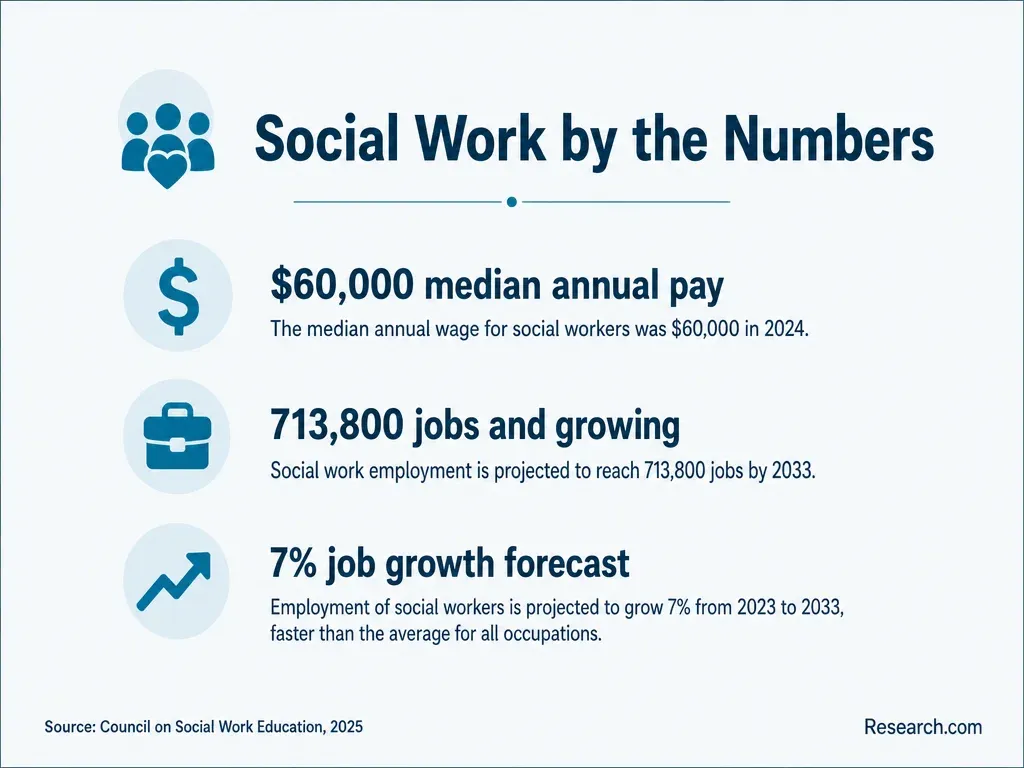
ICU-specific national pay figures are not established by these broader occupational categories. The following U.S. Bureau of Labor Statistics figures offer context for evaluating an offer, not a prediction of what one hospital will pay:
| Occupation | May 2025 median annual wage | Projected employment growth, 2025-2035 |
| Healthcare social workers | $67,880 | 8% |
| Social workers, all specialties | $61,780 | 6% |
Healthcare social workers are the closer comparison, but their median includes jobs outside intensive care and does not account for your city, experience, license, or shift. For local context, compare postings with similar qualifications and consult MSW earnings and geographic career planning.
Request the pay range and a written explanation of evening, weekend, holiday, and on-call compensation. Compare health insurance, retirement contributions, paid leave, continuing-education funds, license-fee reimbursement, and tuition assistance alongside base pay. A higher salary may be less attractive if the position requires frequent unpaid calls or provides little time for required training.
"Full time" does not tell you whether the job includes rotating weekends, overnight calls, holiday coverage, or staying late for an urgent family meeting. Ask for a sample schedule and the written call policy: frequency, expected response time, remote versus on-site duties, compensation, and who takes over after your shift. Clarify whether breaks and planned leave have dependable coverage.
If you are completing an MSW while working, compare the proposed shifts with classes, skills sessions, and field placement hours. Flexible-paced online Master of Social Work pathways may help with coursework scheduling, but online study does not eliminate placement or live-learning commitments. A workable employment offer must accommodate the obligations you actually have.
Ask who will orient you to ICU workflows, electronic records, family meetings, discharge resources, and the hospital's escalation procedures. For a new hospital social worker, a useful orientation includes opportunities to observe experienced staff and receive feedback before managing the full assignment alone. Clarify whether regular case consultation continues after orientation and who is available when the usual supervisor is absent.
If you need post-degree hours toward clinical licensure, ask separately whether the hospital provides a board-qualified supervisor, protected meeting time, and the documentation your state requires. Employment, MSW field education, and board-approved post-degree supervision are not interchangeable. Try understanding which social work hours may count, then verify the arrangement with your licensing board before relying on the job for licensure progress. Ask which continuing-education expenses and work hours the employer covers.
An MSW can build skills in assessment, crisis response, ethics, documentation, and working across service systems. Hospital field education can add supervised experience with real care-team workflows, although an ICU placement is not guaranteed. For either online or campus study, verify the specific program's CSWE accreditation status, field placement process, qualified field instruction, and whether hospital sites are available where you can attend in person.
Applicants with a qualifying BSW may be eligible for an advanced-standing sequence under a program's rules; applicants with other bachelor's degrees generally consider a traditional or foundation MSW. Advanced standing and traditional MSW completion planning can help compare those routes. Neither sequence replaces hospital onboarding, an active license when required, or post-degree supervised practice for independent clinical authority. If you already meet the position's requirements, targeted ICU orientation may be more useful than another degree.
What career advancement opportunities and job prospects exist for ICU social workers?
ICU experience may support a move into hospital social work leadership, palliative care, transplant services, clinical practice, or complex care coordination, subject to each role's experience and license requirements. Ask whether the hospital has senior positions, mentorship, internal posting rules, and support for specialty training. A promotion path is more persuasive when the employer can describe its qualifications and recent examples rather than promise advancement.
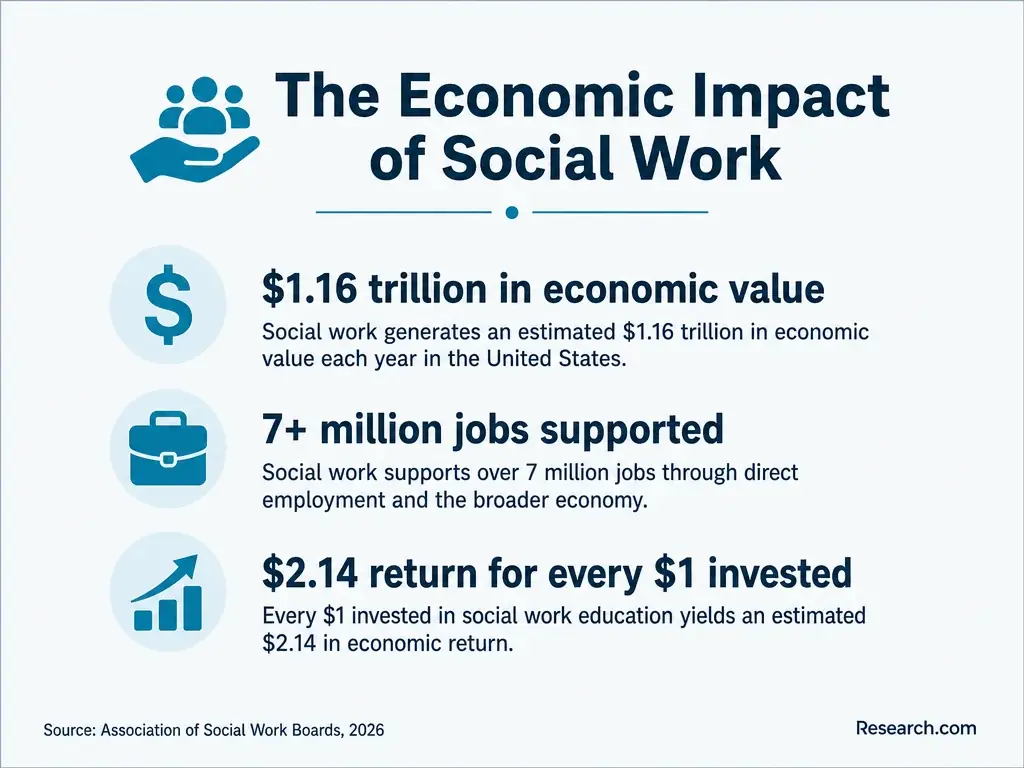
The BLS projects 8% employment growth for the broader healthcare social worker occupation from 2025 to 2035; that is not an ICU-specific hiring forecast. For a BSW-prepared applicant considering graduate study to qualify for more hospital roles, shorter graduate pathways in social work may be worth examining if eligibility and field schedules fit. Before committing, compare the degree's full cost and time demands with actual ICU postings in your target market.
Before you say yes: Request the final job description, schedule and call policy, pay and benefits terms, orientation plan, supervision details, and coverage expectations. If the hospital cannot explain how urgent cases are prioritized or who backs you up, resolve those gaps before accepting—not after your first shift.
Other Things You Should Know About Social Work
Often, yes, if the patient can make that decision. Follow hospital policy, document appropriately, and consult the team if decision-making capacity or a safety obligation is in question.
Use the hospital's qualified interpreter services according to policy. Do not assume a relative should interpret sensitive medical information or that a social worker's conversational fluency makes them an approved medical interpreter.
No. Check the patient's preferences, applicable privacy rules, and hospital procedures before disclosing information. A relative's relationship to the patient does not automatically establish authorization.
Yes. A conversation with prospective colleagues can clarify daily workflow, collaboration, and coverage. Treat their perspective as additional evidence alongside the written offer and the manager's answers.
- Discharge planning from hospital - PMC - NIH https://pmc.ncbi.nlm.nih.gov/articles/PMC8867723/
- Workplace Violence - Overview | Occupational Safety and Health Administration http://www.osha.gov/workplace-violence
- How to Become an LCSW | Texas Behavioral Health Executive Council https://bhec.texas.gov/texas-state-board-of-social-worker-examiners/applying-for-a-social-work-license/how-to-become-an-lcsw/
- Licensed Clinical Social Worker | floridasmentalhealthprofessions.gov https://floridasmentalhealthprofessions.gov/licensed-clinical-social-worker/
- Federal Employee Compensation Package | U.S. Office of Personnel Management https://www.opm.gov/policy-data-oversight/pay-leave/pay-administration/fact-sheets/federal-employee-compensation-package/
- Medical Social Worker - Explore Healthcare Careers | Mayo Clinic College of Medicine and Science https://college.mayo.edu/academics/explore-health-care-careers/careers-a-z/medical-social-worker/
- Workload and Caseload Management | psu.edu https://militaryfamilies.psu.edu/resources/view/workload-and-caseload-management/
- Duties of a Medical Social Worker | Keuka College https://onlinedegrees.keuka.edu/blog/medical-social-worker
- Palliative Care Social Work Role in the ICU and Mentoring Learners | CU Anschutz https://www.cuanschutz.edu/graduate-programs/palliative-care/palliative-care-blog/blog/palliative-care-blog/palliative-care-social-work-role-in-the-icu-and-mentoring-learners
- NASW Standards for Social Work Practice in Health Care Settings | socialworkers.org https://www.socialworkers.org/Practice/NASW-Practice-Standards-Guidelines/NASW-Standards-for-Social-Work-Practice-in-Health-Care-Settings