2027 Long-Term Care vs Community Aging Social Work: Choosing a Practice Setting
Audited and Verified:
Our Editorial and Data Verification Process
Research.com uses government datasets, official education statistics and primary institutional information to support its career and degree guides. Our review process checks factual accuracy, occupational definitions, source dates and the requirements associated with the credentials discussed.
How This Article Was Fact-Checked
Our editorial team verifies salary estimates, employment projections, education requirements and program information against original data providers and official organizations. Salary figures are checked against the relevant occupational definitions and reporting periods. Information about licensure, accreditation and required in-person training is reviewed separately.
Fact-checked and verified on:

Co-Founder and Chief Data Scientist
A nursing home and a community aging agency may serve the same older adult at different points in their life, but the social worker's job can feel very different in each setting.
If you are choosing a field placement, applying for your first role, or considering a move into aging services, the distinction affects your schedule, supervision, clients, and career options. This guide compares the work, qualifications, pay evidence, and training routes, and gives you a practical way to decide which setting fits your goals.
Key Things You Should Know
- Choose nursing home practice if you want ongoing relationships with residents and regular collaboration with an on-site care team; choose community aging practice if you prefer outreach, service navigation, and helping people remain connected to supports where they live.
- Pay data do not identify a winner; the U.S. Bureau of Labor Statistics reports a May 2025 median of $67,880 for healthcare social workers, but that occupation does not isolate nursing home or community aging jobs.
- Check the job, not just its title; degree and license requirements vary by state, employer, and duties. An MSW, aging concentration, or field placement does not itself authorize independent clinical practice.
How does nursing home social work differ from community-based aging social work?
Nursing home social work takes place within a residential facility that provides long-term or skilled nursing care. The social worker addresses residents' psychosocial needs, works with families and the care team, and participates in care and discharge planning.
Community-based aging social work serves older adults outside a nursing home, often through an Area Agency on Aging, nonprofit, public agency, senior center, or home- and community-based services program.
The distinction is primarily where and how support is organized, not whether one setting cares more about independence. A facility social worker may advocate strongly for a resident's choices; a community worker may help someone decide whether remaining at home is safe and feasible. This comparison puts the two settings in practical terms:
| Decision factor | Nursing home | Community aging |
| Primary setting | One facility and its care team | Homes, offices, partner agencies, or multiple sites |
| Typical focus | Adjustment to residence, care planning, family concerns, and transitions | Access to benefits, transportation, meals, housing, caregiver support, and other services |
| Working relationships | Frequent contact with residents, families, nurses, and facility staff | Coordination across clients, caregivers, providers, and community organizations |
| Common constraint | Facility workflows and urgent resident or discharge needs | Service availability, eligibility rules, travel, and funding limits |
"Long-term care" is broader than nursing homes: assisted living, home-based services, and other programs have different staffing and regulatory arrangements. Compare actual job descriptions rather than treating every long-term care role as a nursing home position.
For a wider view of MSW job families and professional development, consider how these aging roles relate to healthcare, case management, and community practice.
What degrees prepare social workers for careers with older adults?
A BSW prepares graduates for generalist social work roles, including some aging-services and facility positions. An MSW adds specialized practice preparation and may be preferred or required for more complex healthcare, supervisory, or clinical-track roles. Neither degree substitutes for an employer's experience requirements or a state license where one is required.
Applicants with a bachelor's degree in another field can seek a traditional or foundation MSW; relevant healthcare or nonprofit experience can strengthen their preparation but does not ordinarily qualify them for advanced standing.
Advanced-standing MSW admission generally requires a qualifying BSW and meeting the program's additional criteria. A DSW or PhD is usually unnecessary for direct aging-services work; those degrees are more relevant to particular leadership, teaching, or research goals.
Before considering affordable advanced social work degree options, determine whether experience, supervision, or targeted training would serve your intended role better.
Some service-navigation jobs accept human services or other related degrees. If your goal is a specific position rather than a protected social work title or licensed practice, review local postings before committing to another degree.
How do salaries compare across nursing home and community aging social work?
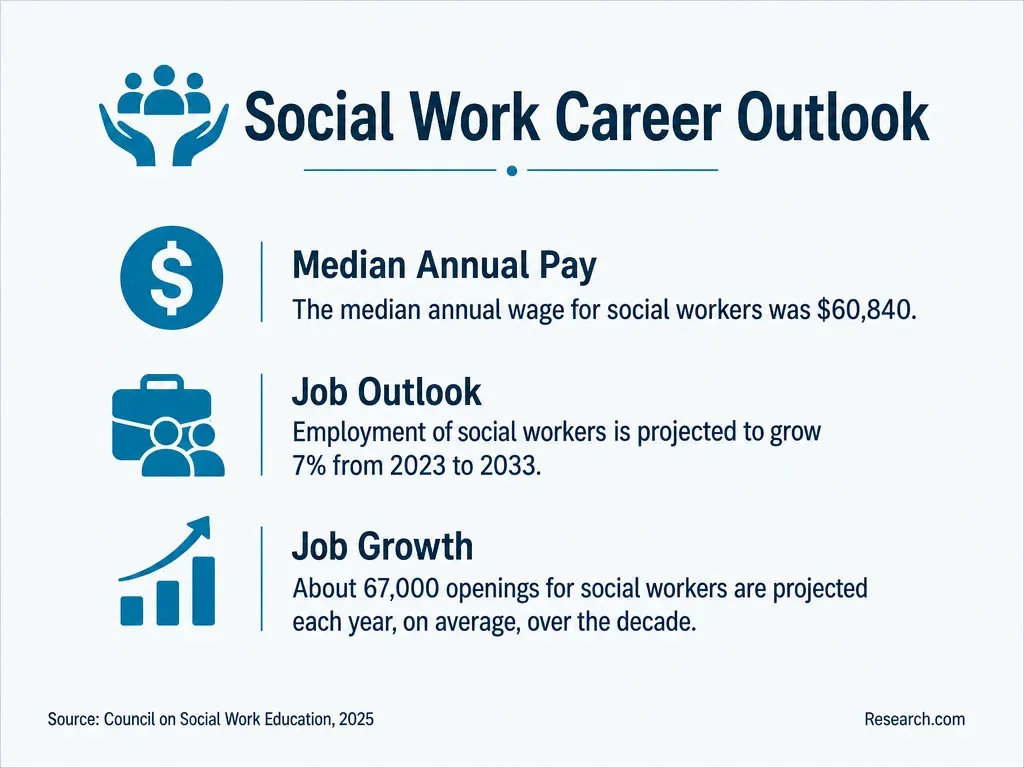
There is no reliable national BLS median that cleanly compares nursing home social workers with community aging social workers. Employers may classify positions differently, and a community role might be reported under a social work occupation or a different human-services occupation. The closest broad benchmarks show why job-specific offers matter more than a single national figure.
The following U.S. Bureau of Labor Statistics medians are for May 2025 and describe occupations, not either aging setting or the earnings of a particular degree holder:
| BLS occupation | Median annual pay | How to use it |
| Healthcare social workers | $67,880 | Potential context for healthcare-oriented roles; not a nursing home pay rate |
| Social workers, all specialties | $61,780 | A broad reference point that mixes settings and specialties |
For an actual comparison, request each position's salary range and assess benefits, paid travel time, mileage, on-call expectations, caseload, and opportunities for advancement. Geography and employer type can change the picture substantially; social work master's salary geography offers context, but a local offer remains the better basis for a decision.
In a nursing home, a day may involve meeting a new resident, contributing to a care-plan meeting, addressing a family concern, documenting psychosocial needs, and coordinating a transition.
Work is concentrated in one building, making interdisciplinary consultation accessible, but admissions, discharges, and resident needs can reorder the day. Facility staffing and the number of residents assigned to a social worker strongly affect whether there is time for meaningful follow-up.
In community aging practice, a worker may conduct assessments, arrange referrals, help navigate benefits or caregiver supports, and follow up with several partner agencies.
Some jobs include home visits and significant driving; others are primarily office-based or organized around outreach and programs. The worker may have more variety in locations and services, but less direct control over waitlists, eligibility decisions, and whether a referral becomes available.
Neither setting is automatically clinical. If a job includes psychotherapy or independently performed clinical assessment, establish the required license, supervision, and permitted scope before accepting it.
Exploring clinical social work master's degrees may be useful if that is your intended direction, but a clinical concentration alone does not grant independent practice authority.
Requirements depend on the state, job title, and work performed. Some aging-services positions are nonclinical and may accept a BSW, MSW, or related qualification under employer and applicable facility rules.
Other positions require a state social work license. Independent psychotherapy requires the appropriate clinical license and satisfaction of the state's post-degree supervision and other requirements; graduation and field education alone do not provide that authority.
Federal nursing home staffing rules also include a qualified social worker requirement for facilities above a specified size, but that rule is not a universal license requirement for every facility social worker.
State rules and individual employers can impose additional qualifications. Voluntary aging-related certifications may demonstrate professional development, but they do not replace a required license or expand legal scope.
Before applying, compare the posting's duties and required credential with the state board's current rules, then ask the employer which qualifications are mandatory at hire. If education is part of your plan, planning social work study for an intended licensing jurisdiction matters more than relying on a program's general licensure claim.
How can you choose between nursing home and community-based practice?
Start with the work you want to do most often, then test whether the employer gives you the time and support to do it well. A strong fit is less about the setting's reputation than about its actual caseload, supervision, resources, and treatment of older adults' preferences.
Use these steps to compare a field placement or two job offers on the same terms:
- Name your preferred work: Ongoing resident and care-team relationships point toward nursing homes; outreach and coordination across services point toward community agencies.
- Check the operating conditions: Ask about caseloads, documentation time, travel, urgent coverage, supervision, and how staff respond when a needed service is unavailable.
- Verify the pathway: Compare the duties with your degree, license status, training needs, and the employer's stated requirements.
- Test the choice: Arrange an informational interview or an approved field experience in the less familiar setting before making a costly education or career move.
If you need an MSW for your target role, weigh its total cost against the qualifications local employers actually request; a guide to affordable online MSW study can help you develop a shortlist. If you already qualify for the work you want, changing agencies or seeking focused aging-services training may be more direct than earning another degree.
Other Things You Should Know About Social Work
No. Hospice focuses on care for people with a terminal illness and support for their families; services may be delivered in a home, facility, or other setting. Some nursing home residents receive hospice care, creating opportunities for collaboration between separate teams.
No. Some roles require regular visits and driving, while others emphasize office-based coordination, outreach events, or program administration. Check the posting and ask how often travel occurs.
The worker should clarify the older adult's wishes and role in decisions, communicate within confidentiality and consent rules, and seek supervision when capacity, safety, or legal authority is in question. Family preference alone does not settle those issues.
Yes. Skills in assessment, family communication, referrals, and documentation transfer, but you will still need orientation to the new setting's services, workflows, and requirements. Ask prospective employers how they train staff making that transition.
- Levels and Eligibility Requirements | North Carolina Social Work Certification and Licensure Board https://www.ncswboard.gov/levels-and-eligibility-requirements/
- eCFR:: 42 CFR Part 483 -- Requirements for States and Long Term Care Facilities https://www.ecfr.gov/current/title-42/chapter-IV/subchapter-G/part-483
- Understanding the Characteristics of Older Adults in Different Residential Settings: Data Sources and Trends | ASPE https://aspe.hhs.gov/reports/understanding-characteristics-older-adults-different-residential-settings-data-sources-trends-0
- Social Determinants of Health and Older Adults https://odphp.health.gov/our-work/national-health-initiatives/healthy-aging/social-determinants-health-and-older-adults
- Addressing Social Needs in Health Care Settings - PMC - NIH https://pmc.ncbi.nlm.nih.gov/articles/PMC8240195/
- What Is Long-Term Care? - National Institute on Aging - NIH https://www.nia.nih.gov/health/long-term-care/what-long-term-care
- From isolation to inclusion: community-based mental health care | who.int https://www.who.int/news-room/commentaries/detail/from-isolation-to-inclusion---community-based-mental-health-care
- The role of social workers in long-term care for older adults | sagepub.com https://journals.sagepub.com/doi/10.1177/00208728241269670
- What do social workers do? Responsibilities and skills | Capella University https://www.capella.edu/blog/social-work-and-human-services/what-do-social-workers-do/
- Core Principles & Values of Effective Team-Based Health Care - NAM https://nam.edu/perspectives/core-principles-values-of-effective-team-based-health-care/