2027 Food Insecurity Screening in Social Work Settings: Role, Training, and Referral Questions
Audited and Verified:
Our Editorial and Data Verification Process
Research.com uses government datasets, official education statistics and primary institutional information to support its career and degree guides. Our review process checks factual accuracy, occupational definitions, source dates and the requirements associated with the credentials discussed.
How This Article Was Fact-Checked
Our editorial team verifies salary estimates, employment projections, education requirements and program information against original data providers and official organizations. Salary figures are checked against the relevant occupational definitions and reporting periods. Information about licensure, accreditation and required in-person training is reviewed separately.
Fact-checked and verified on:

Co-Founder and Chief Data Scientist
A client may have a place to live and still regularly run out of food. Social workers in healthcare, schools, housing services, and community agencies need a way to recognize that need without making assumptions or promising assistance they cannot deliver. This guide explains what food insecurity screening can - and cannot - establish, which questions to ask, how to make useful referrals, and what training supports the work. It is intended for students, early-career social workers, and human services professionals deciding how to build a responsible screening and referral process.
Key Things You Should Know
- The commonly used two-question Hunger Vital Sign asks about food-related worries and shortages over the past 12 months; a positive screen identifies a need for conversation, not eligibility for benefits.
- An effective response checks for food needed now, offers a referral the client can realistically use, and follows up - with permission - to learn whether assistance was accessible.
- Screening and referrals may be part of BSW-level, MSW-level, or other human services work; a clinical license or doctoral degree is not inherently required for this function.
What is food insecurity screening in social work settings?
Food insecurity means a household lacks consistent access to enough food for an active, healthy life because money or other resources are limited. Screening is a brief, standardized way to identify a possible problem and invite further assessment. It is not a diagnosis, a determination of government-benefit eligibility, or proof that a household needs food today.
Social workers may encounter food needs during intake, discharge planning, school-family outreach, case management, or a broader person-in-environment assessment. A household can screen positive even if it receives food assistance; the result reflects reported experience, not whether someone is already enrolled in a program. Conversely, a negative result does not rule out a sudden loss of income or an immediate need that developed after the screening period.
For students considering where this work fits professionally, online social work qualifications and career directions provide context for the different service settings in which social workers may encounter food insecurity. The screening itself is only one part of a larger service response.
What role do social workers play in food insecurity screening?
A social worker's role is to connect a screening result to the client's circumstances and choices. That can mean asking whether food is needed immediately, exploring barriers such as transportation or cooking facilities, explaining available assistance, helping with an application when appropriate, and coordinating with other providers.
Social workers can also notice recurring gaps - such as referrals that require travel clients cannot manage - and bring that information to agency or community partners without disclosing unnecessary client details.
Responsibilities depend on the setting. A hospital social worker may incorporate food access into discharge planning; a school social worker may coordinate with a family and school meal staff; a housing case manager may focus on food storage, transportation, and nearby distribution sites.
None should assume that a positive screen authorizes sharing information across agencies. Readers comparing broader MSW roles can use this guide to professional pathways after an MSW to distinguish service coordination from clinical and other specialized work.
What food insecurity screening questions and tools do social workers use?
The Hunger Vital Sign is a commonly used two-item screen adapted from the U.S. Household Food Security Survey Module. It asks whether, within the past 12 months, either of these statements was true for the household:
- "We worried whether our food would run out before we got money to buy more."
- "The food we bought just didn't last and we didn't have money to get more."
The usual response choices are often true, sometimes true, and never true. Answering often or sometimes true to either item generally makes the screen positive. The tool was validated in research involving low-income families with young children; agencies should consider how well their chosen tool fits the population, language, and setting they serve. When recording a result, distinguish an unanswered item from a negative answer.
The screen's 12-month window makes a separate, plain-language question about immediate needs useful: "Do you have enough food for the next day or two?" Follow-up questions can clarify household size, dietary or accessibility needs, transportation, safe storage, and whether the client wants help.
Use an approved agency version and workflow rather than changing a validated question and treating the altered wording as equivalent. BSW students seeking supervised practice with assessment and documentation can evaluate accredited online BSW programs for relevant field-learning opportunities, not just classroom coverage.
Explain why the questions are being asked, ask in a private setting when possible, and make clear that clients can decline. A neutral introduction - "We ask everyone about access to food because it can affect the support we offer" - avoids singling someone out by appearance or income.
Use a qualified interpreter when needed, follow accessibility procedures, and avoid asking children to interpret sensitive household information. Tell clients what will be recorded, who can see it, and whether sharing with an outside organization requires permission. Collect and share only what is necessary for the agreed referral.
HIPAA may govern records in covered healthcare settings; FERPA may apply to certain school records. Other confidentiality, consent, and reporting rules also depend on the jurisdiction and agency. Follow the applicable law and workplace policy rather than assuming one rule governs every setting.
For experienced practitioners interested in designing or evaluating an agency-wide screening process, doctoral education is one possible route, but it is usually unnecessary for frontline screening. Even when considering faster doctoral study routes for social workers, compare that investment with targeted training and supervised program-improvement experience first.
What are the salary and job outlook for social workers in these roles?
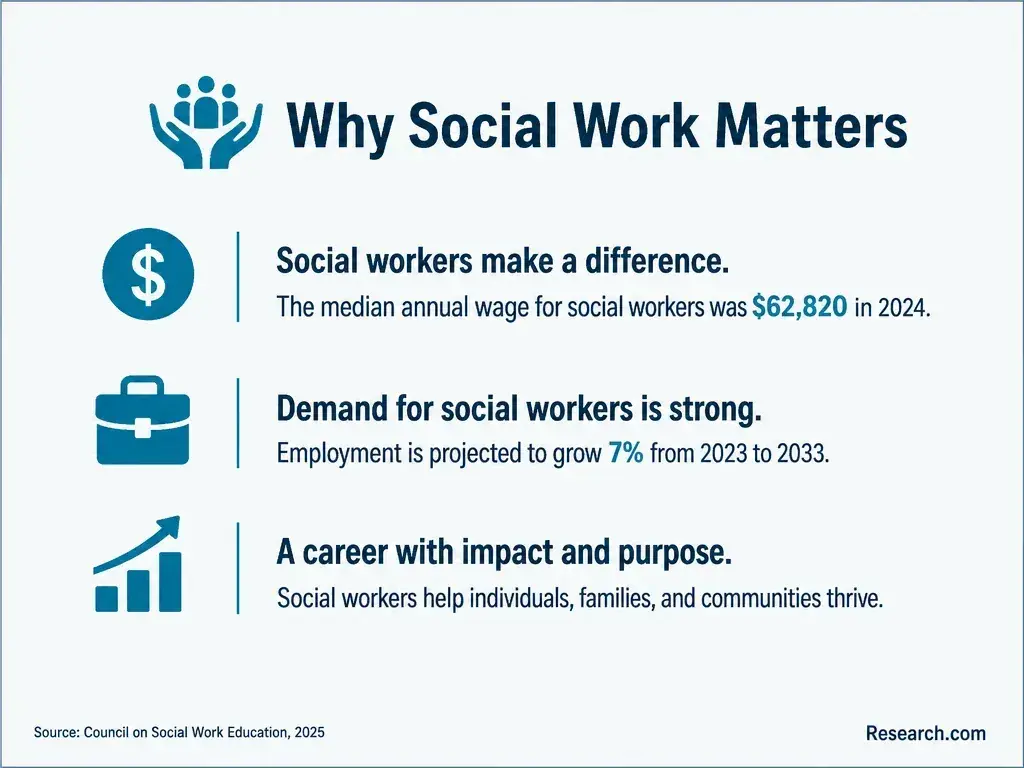
Food screening does not have a separate Bureau of Labor Statistics occupation. The closest social work categories depend on the setting. BLS figures below report U.S. median annual pay for May 2025 and projected employment growth from 2025 to 2035:
| BLS occupation | Median annual pay, May 2025 | Projected growth, 2025-2035 |
| Child, family, and school social workers | $59,550 | 4% |
| Healthcare social workers | $67,880 | 8% |
| Mental health and substance abuse social workers | $60,280 | 10% |
These are occupation-wide figures, not salaries for food insecurity screening or promises to graduates. A resource navigator classified outside social work may have a different pay range. Use the category matching the job's primary duties, then examine local postings, employer pay scales, and license requirements. A state-level social work pay comparison guide can add geographic context, but it cannot replace a specific employer's offer.
Other Things You Should Know About Social Work
No. The screen identifies a possible need; the administering benefits agency decides SNAP eligibility under its rules. A social worker can help someone find application information without promising approval.
Yes. Benefits or charitable food may not cover a household's needs consistently. Screening asks about the household's experience, not whether it participates in assistance programs.
Often, yes, subject to the agency's procedures. Staff can explain available options and any information required by a particular provider without treating refusal to answer a screening question as refusal of help.
Ask whether the placement includes supervised client engagement, assessment, referral follow-up, privacy training, and current community partnerships. Confirm that the social work program approves the site and learning tasks.
- Tips for making trauma-informed warm referrals | mass.gov https://www.mass.gov/info-details/tips-for-making-trauma-informed-warm-referrals
- Screening programmes: a short guide - IRIS https://iris.who.int/bitstreams/b3922afd-3ff9-4bf3-9254-fa6b3f2b6023/download
- Clinical Care and Referral Pathways for Food Security... - PMC https://pmc.ncbi.nlm.nih.gov/articles/PMC13315125/
- Summary of the HIPAA Privacy Rule | hhs.gov https://www.hhs.gov/hipaa/for-professionals/privacy/laws-regulations/index.html
- Food Security in the U.S. - Survey Tools http://www.ers.usda.gov/topics/food-nutrition-assistance/food-security-in-the-us/survey-tools
- Food Assistance and Food System Resources | Nutrition https://www.cdc.gov/nutrition/php/resources/food-and-food-system-resources.html
- Food Insecurity - Healthy People 2030 | odphp.health.gov https://odphp.health.gov/healthypeople/priority-areas/social-determinants-health/literature-summaries/food-insecurity
- Social Needs Screening Tool Comparison Table | ucsf.edu https://sirenetwork.ucsf.edu/tools-resources/resources/screening-tools-comparison