
2027 DSW Applied Research Skills: What Practice Leaders Need to Learn
Audited and Verified:
Our Editorial and Data Verification Process
Research.com uses government datasets, official education statistics and primary institutional information to support its career and degree guides. Our review process checks factual accuracy, occupational definitions, source dates and the requirements associated with the credentials discussed.
How This Article Was Fact-Checked
Our editorial team verifies salary estimates, employment projections, education requirements and program information against original data providers and official organizations. Salary figures are checked against the relevant occupational definitions and reporting periods. Information about licensure, accreditation and required in-person training is reviewed separately.
Fact-checked and verified on:

Co-Founder and Chief Data Scientist
A DSW can help an experienced social worker turn a recurring service problem into a credible, usable improvement project. But a doctorate is a substantial investment, and programs differ in how much support they provide for research design, agency data access, and implementation.
This guide explains the applied research skills practice leaders need, what to look for in DSW coursework and capstones, and when a PhD or targeted professional development may be a better fit.
Key Things You Should Know
- DSW applied research should prepare leaders to define a practice problem, choose feasible measures, evaluate results, and explain the limits of their findings.
- Compare programs on methods mentoring, access to an agency or community partner, project approvals, and the time available to complete a capstone - not the doctorate title alone.
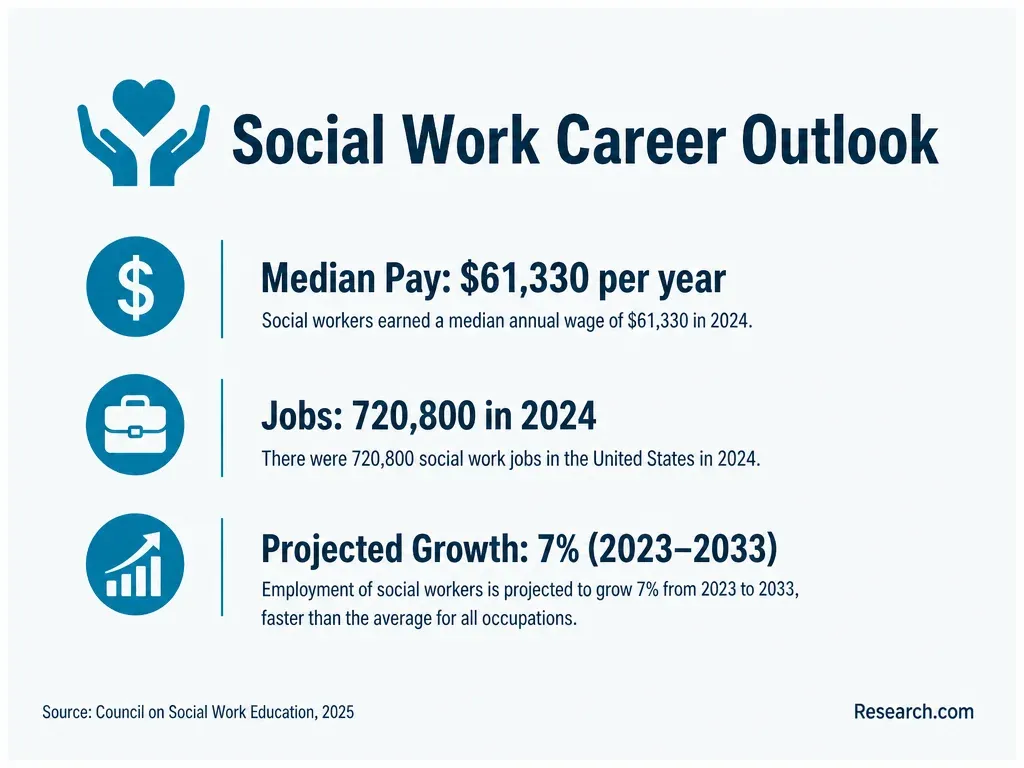
- The Bureau of Labor Statistics reports a $61,780 median annual wage for social workers in May 2025 and projects 6% employment growth from 2025 to 2035; neither figure predicts a DSW graduate's salary or leadership prospects.
What is applied research in a DSW program?
Applied research uses systematic inquiry to answer a practical question. In a DSW, that might mean examining whether a revised referral process reaches eligible families, evaluating how staff implement an intervention, or testing whether an agency's outcome measures capture what clients consider important. The aim is not simply to produce a paper; it is to make a defensible decision that an organization or community partner can use.
A hypothetical housing-services project illustrates the distinction: counting completed referrals describes activity, while examining who was referred, who obtained services, and where access broke down can inform improvement. Even then, an increase after a process change does not prove the change caused it. Practice leaders need to recognize competing explanations, missing data, and the limits of a small or unrepresentative sample.
Experienced social workers who need to strengthen foundational evidence-informed practice before doctoral study can also examine online social work study and professional preparation. The deciding issue for a DSW applicant is whether doctoral coursework advances beyond research literacy to supported, independent practice inquiry.
Which research skills do DSW practice leaders need?
The most valuable skill is matching a question to a decision. A leader deciding whether to expand a service needs different evidence from one investigating why an existing service is inconsistently delivered. Strong DSW training should develop the following connected abilities:
- Problem formulation: Define the population, setting, proposed change, decision-maker, and outcome without assuming the intervention works.
- Design and measurement: Select feasible comparisons, interviews, observations, or mixed methods; assess whether measures are meaningful, accessible, and consistent.
- Critical interpretation: Identify selection bias, incomplete records, small samples, and alternative explanations before making claims about effectiveness.
- Ethical data stewardship: Clarify consent, confidentiality, data access, retention, community input, and the approvals required by the agency and institution.
- Implementation and communication: Present findings in language useful to clients, staff, funders, and executives, including uncertainty and unintended effects.
Research competence develops through feedback on real decisions, not software proficiency alone. MSW-level field learning may introduce observation and evaluation; MSW programs with organized practicum resources can help prospective students assess that earlier foundation. A DSW should then provide substantially deeper methods mentoring and opportunities to revise an applied project.
How does DSW research training differ from a social work PhD?
Both degrees can involve rigorous research, and their requirements vary by institution. The most useful distinction is the work you want the training to support. This comparison describes common emphases, not rules that apply to every program.
| Decision factor | Practice-oriented DSW | Research-oriented PhD |
| Primary aim | Apply evidence to practice, programs, policy implementation, or organizational leadership | Develop and test scholarly questions that extend knowledge in the field |
| Typical scholarly product | Applied capstone, practice dissertation, or other program-defined project | Original dissertation meeting the program's research expectations |
| Best fit | Experienced practitioner seeking to lead and evaluate change | Applicant seeking a research-intensive academic or investigator career |
| Key question to verify | Will advising and agency access support a feasible project? | Are faculty fit, research training, and funding suitable for the intended career? |
An MSW may already provide enough preparation for a leader whose immediate need is to evaluate one program with help from an experienced evaluator. For someone still choosing an MSW entry route, advanced standing eligibility and traditional MSW options are a separate decision: neither track is a substitute for doctoral research training.
Check the university's institutional accreditation, then verify the exact doctoral program's current recognition or accreditation status with the responsible accreditor and the school. Do not infer a DSW's status from the university's accreditation or from its BSW or MSW program's CSWE accreditation. Ask whether the status applies to your intended entering cohort and whether it matters to your employer or target academic role.
A DSW does not issue or upgrade a social work license. Clinical authority depends on the applicable state board's education, examination, supervised-experience, and licensing rules. If independent clinical practice is the goal, confirm the required MSW and post-degree pathway before considering doctoral study; online social work master's programs and state board requirements address that earlier regulatory decision.
Ask admissions and your employer which credential they actually require for advancement. A doctorate may strengthen leadership preparation without satisfying a job's separate clinical-license, school-service, or civil-service qualification.
Requirements differ, but relevant coursework may cover research design, qualitative interviewing, quantitative reasoning, program evaluation, implementation, leadership, and scholarly communication. Review course descriptions and actual project guidelines rather than relying on a curriculum's course titles. Ask how students receive methods feedback and what happens if their original project site becomes unavailable.
A workable capstone starts with a decision an agency can make and data it is permitted to use. For example, a student might propose evaluating whether a new intake workflow improves timely contact. Before collecting anything, the student must establish the project's scope, partner responsibilities, privacy safeguards, and required agency or university review. Calling work "quality improvement" or "program evaluation" does not, by itself, settle whether additional research-ethics review is necessary.
Clinical skill development is a different objective. Applicants primarily seeking advanced treatment preparation should compare clinical Master of Social Work pathways and post-degree training with the methods and leadership work a DSW requires.
Many DSW programs are designed for experienced social workers and require an MSW, relevant professional experience, and evidence that the applicant can undertake graduate-level writing and inquiry. Exact degree, GPA, licensure, employment, and research prerequisites vary. A license may be important to a clinical leadership goal without being a universal DSW admissions requirement.
Present a specific practice problem in your application, along with your role in addressing it and the evidence you would need - not a claim that you already know the answer. Ask whether the program requires an agency partner at admission, how it evaluates prior methods preparation, and whether faculty can mentor your proposed topic.
If you do not yet hold a social work degree, establish the earlier educational route first. Accredited bachelor's pathways into social work may be relevant to some entrants, while applicants with another bachelor's degree may be eligible for a traditional MSW. Neither route establishes automatic admission to a DSW.
Online programs may use live methods seminars, recorded instruction, virtual advising, collaborative workshops, and projects based at a student's workplace or partner agency. Campus programs may offer more in-person research meetings and local partnerships. Either format can teach applied research well if students receive timely feedback, appropriate data support, and access to a viable project setting.
Compare the actual calendar: required live sessions, residencies, group-work meetings, proposal and approval deadlines, and the time needed for data collection. Online delivery does not make a community partnership or agency approval automatic. If you are also comparing earlier degree options, online social work master's programs by duration can help distinguish a shorter MSW schedule from the separate workload of doctoral inquiry.
There is no reliable universal completion time or price: programs differ in credits, pacing, residency requirements, and how long the applied project takes. A delay in data access, approvals, recruitment, or advising can extend enrollment beyond the advertised course sequence. Request the school's current tuition schedule and a degree plan for your intended pace.
For a useful cost comparison, calculate tuition and required fees through the likely completion term, then add travel, technology, project expenses, and any reduced earnings. Subtract only funding you are eligible to receive under its stated conditions. Ask whether project-continuation terms carry charges and whether employer assistance requires continued employment. Social work doctorate affordability comparisons are a starting point, but your expected total cost matters more than an advertised per-credit rate.
A DSW's applied research skills can support program director, clinical or practice leader, quality-improvement, policy implementation, training, and executive roles. The work may involve setting outcome measures, negotiating with community partners, assessing uneven service access, supervising implementation, and explaining results to staff or funders. Hiring still depends on experience, organizational fit, and any role-specific license or credential.
Before enrolling, review several target job descriptions and identify the missing qualification. If they emphasize budget management or supervision more than research, an employer development program or focused training may be more direct. If an MSW is the actual requirement and you do not hold one, MSW program affordability comparisons are more relevant than a DSW search.
What are the salary prospects and job outlook for DSW graduates?
The Bureau of Labor Statistics reports a May 2025 median annual wage of $61,780 for social workers across specialties and projects 6% employment growth from 2025 to 2035. These figures describe an occupation, not DSW graduates or doctoral-level managers. A leadership position may belong to a different occupational category, and compensation varies by employer, geography, duties, and experience.
Evaluate a DSW's potential return against a specific role and your current earnings, not an assumed doctoral pay premium. Check local job postings, public-sector salary schedules where applicable, and whether the employer rewards applied evaluation expertise. For geographic context on social work compensation, consult social work master's salary geography without treating MSW figures as DSW outcomes.
Other Things You Should Know About Social Work
Only if university and agency policies permit the specific tool and data use. Do not enter identifiable or confidential records into an unapproved system; verify outputs and disclose tool use as required.
Possibly. Publication depends on the project's quality, permissions, authorship agreements, privacy protections, and any applicable review requirements. Completing a capstone does not guarantee publication.
Ownership and permitted use depend on agency agreements, university policies, and applicable law. Clarify access, retention, sharing, and publication rights in writing before starting.
Contact your advisor promptly. A narrower question, approved alternative site, or different data source may be possible, but a change can affect approvals and graduation timing.
- Qualitative Methods in Implementation Research - PMC - NIH https://pmc.ncbi.nlm.nih.gov/articles/PMC7023962/
- NIOSH Implementation Science Program | cdc.gov https://www.cdc.gov/niosh/implementation-science/about/index.html
- Ethical considerations in quality improvement: key questions and a practical guide | BMJ Open Quality https://bmjopenquality.bmj.com/content/10/3/e001497
- Doctor of Social Work (DSW) - Degrees at KU https://degrees.ku.edu/graduate/doctoral/social-work-dsw/
- Methods/Analysis Courses - UW School of Social Work https://socialwork.uw.edu/academics/phd/degree-requirements/methodsdata-analysis-courses/
- What Is Implementation Science? A Guide to Turning Research Into Practice | Implementation Science https://impsci.med.ufl.edu/about/articles/core-concepts/what-is-implementation-science/
- Social Work Research Methods | Virginia Commonwealth University https://onlinesocialwork.vcu.edu/blog/social-work-research/
- Evidence-Based Practice, Quality Improvement, and Research | mssm.edu https://researchroadmap.mssm.edu/other-research/cnri/ebp-qi-research/
- Differentiating QI from Research - QPSi Knowledgebase https://knowledge.qpsi.med.ufl.edu/qi-foundations/differentiating-qi-from-research/


