2027 Disability Advocate vs Rehabilitation Social Worker: Comparing Career Paths
Audited and Verified:
Our Editorial and Data Verification Process
Research.com uses government datasets, official education statistics and primary institutional information to support its career and degree guides. Our review process checks factual accuracy, occupational definitions, source dates and the requirements associated with the credentials discussed.
How This Article Was Fact-Checked
Our editorial team verifies salary estimates, employment projections, education requirements and program information against original data providers and official organizations. Salary figures are checked against the relevant occupational definitions and reporting periods. Information about licensure, accreditation and required in-person training is reviewed separately.
Fact-checked and verified on:

Co-Founder and Chief Data Scientist
If you want to improve life for people with disabilities, the choice between advocacy and rehabilitation social work depends less on the population you serve than on the work you want to do. Advocates may focus on access, rights, and systems change; rehabilitation social workers typically coordinate services and address a person's needs within a professional social work role. For career changers and social work students, this comparison explains the qualifications, pay evidence, workplace realities, and education costs worth checking before applying for jobs or enrolling in a degree.
Key Things You Should Know
- "Disability advocate" is a varied job title, not a single licensed occupation; rehabilitation social worker roles have more defined social work education and, in some states or positions, licensing requirements.
- The U.S. Bureau of Labor Statistics reports a May 2025 median annual wage of $67,880 for healthcare social workers, a possible comparison group for some rehabilitation social workers. It does not publish an equivalent wage specifically for disability advocates.
- Choose advocacy for rights, accessibility, and policy work when a target employer accepts your qualifications; choose social work education when you want roles requiring a BSW, MSW, or social work license.
What is the difference between a disability advocate and a rehabilitation social worker?
A disability advocate helps people pursue access, accommodations, services, or policy change. Depending on the employer, the work might involve explaining options, helping someone prepare for a meeting, documenting barriers, organizing a community campaign, or supporting self-advocacy. Advocacy does not automatically include providing legal representation or making clinical decisions.
A rehabilitation social worker uses social work methods to help people adjust to illness, injury, or disability and navigate its effects on daily life. Duties may include assessment, care planning, service coordination, counseling within the worker's authorized scope, family support, and discharge planning. Some employers use different titles for similar work, so compare duties rather than titles alone.
The distinction is often systems change versus accountable service delivery, although the roles overlap. An advocate might press an organization to remove an accessibility barrier; a social worker might help an individual obtain accessible services while coordinating with a rehabilitation team.
If you already have community organizing or disability-service experience, advocacy may offer a more direct entry point. If you want a regulated social work position, compare jobs that use a social work master's degree against actual employer requirements before committing to graduate school.
How do salaries compare for disability advocates and rehabilitation social workers?
There is no reliable national wage figure for the job title "disability advocate." Pay varies substantially across nonprofit advocacy, public agencies, employee support functions, and specialized representative roles. A social work occupation offers a useful benchmark only when its duties match the rehabilitation job under consideration.
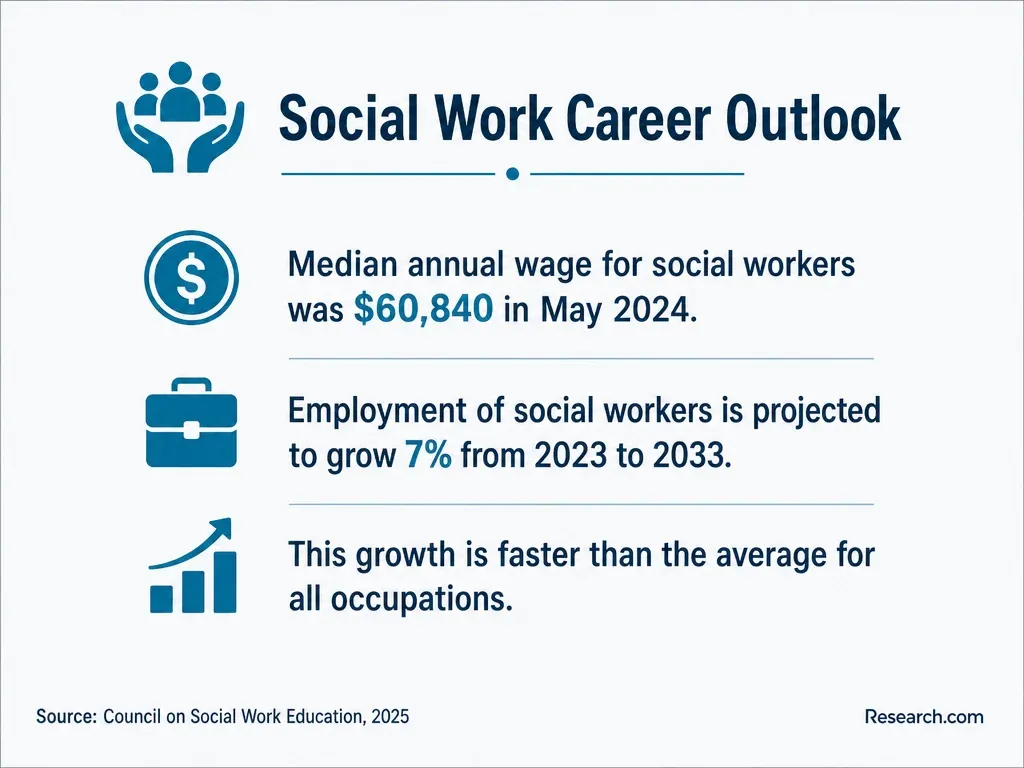
The following U.S. Bureau of Labor Statistics medians are for occupations, not these exact job titles. May 2025 annual figures provide context for evaluating a rehabilitation social worker offer, not a promised starting salary.
| BLS occupation | May 2025 median annual wage | Relevance |
| Healthcare social workers | $67,880 | Potential comparison for hospital or medical rehabilitation social work |
| Social workers, all specialties | $61,780 | Broad context that combines different specialties |
Compare actual postings by location, required license, experience, hours, benefits, and whether the role is grant-funded. For geographically mobile applicants, exploring regional pay patterns for MSW careers can help frame questions, but local offers and living costs matter more than a national median.
What education is needed for each career?
Disability advocacy has no universal degree requirement. Employers may value lived experience, organizing, accessibility knowledge, benefits-navigation skills, or a degree in social work, public policy, law, education, or another field. A specific position may impose its own degree or training requirements.
Rehabilitation social work positions commonly seek a BSW or MSW, depending on the duties and employer. A BSW prepares students for generalist social work; an MSW adds graduate-level practice preparation and may be required for more specialized positions or a clinical licensing pathway. A psychology or human services bachelor's degree may qualify an applicant for a traditional MSW, but it does not normally qualify them for advanced standing, which depends on a qualifying social work degree and the program's rules.
For a career changer, the economical question is whether target postings actually require the social work credential. If they do not, relevant advocacy work and targeted training may be more direct than another degree. If they do, use a guide to accredited undergraduate social work study as a starting point, then confirm each program's current accreditation and suitability for your intended state and role.
There is no general U.S. "disability advocate license." Particular work can have separate rules: representing someone in a legal proceeding, handling certain benefits claims, or providing a regulated professional service may require specific authorization or qualifications. Do not assume an advocacy title permits legal advice or clinical treatment.
Social work licensing depends on the state, license category, and duties. Some rehabilitation social work jobs require an active license; others accept an eligible BSW or MSW graduate or have different hiring rules. An MSW, a clinical concentration, and a passed exam do not independently authorize unsupervised psychotherapy. Where independent clinical practice is the goal, review the board's education, examination, and post-degree supervision requirements. This guide to social work clinical experience requirements explains questions to ask, but the applicable state board determines what counts.
Specialty certifications can demonstrate training but do not replace a required state license. Read the job posting's exact credential language and confirm it with the employer or licensing authority before paying for a certificate.
Disability advocates work in independent-living and disability-rights organizations, community nonprofits, public agencies, schools, and other organizations addressing access or services. The setting affects whether the work emphasizes individual support, community organizing, policy, or institutional change.
Rehabilitation social workers may work in hospitals, inpatient rehabilitation facilities, outpatient programs, community health organizations, or agencies supporting people after injury or illness. Teamwork with clinicians and service providers, documentation, discharge deadlines, and family meetings can shape a typical day. Some positions involve travel or home and community visits.
Evaluate the workplace, not just the mission: ask about caseload, accessibility, supervision, safety practices, travel, documentation, and how much authority staff have to resolve service barriers. If a field placement is your route into a preferred setting, comparing online social work education pathways is useful only alongside confirmation that a program can approve a suitable placement where you live.
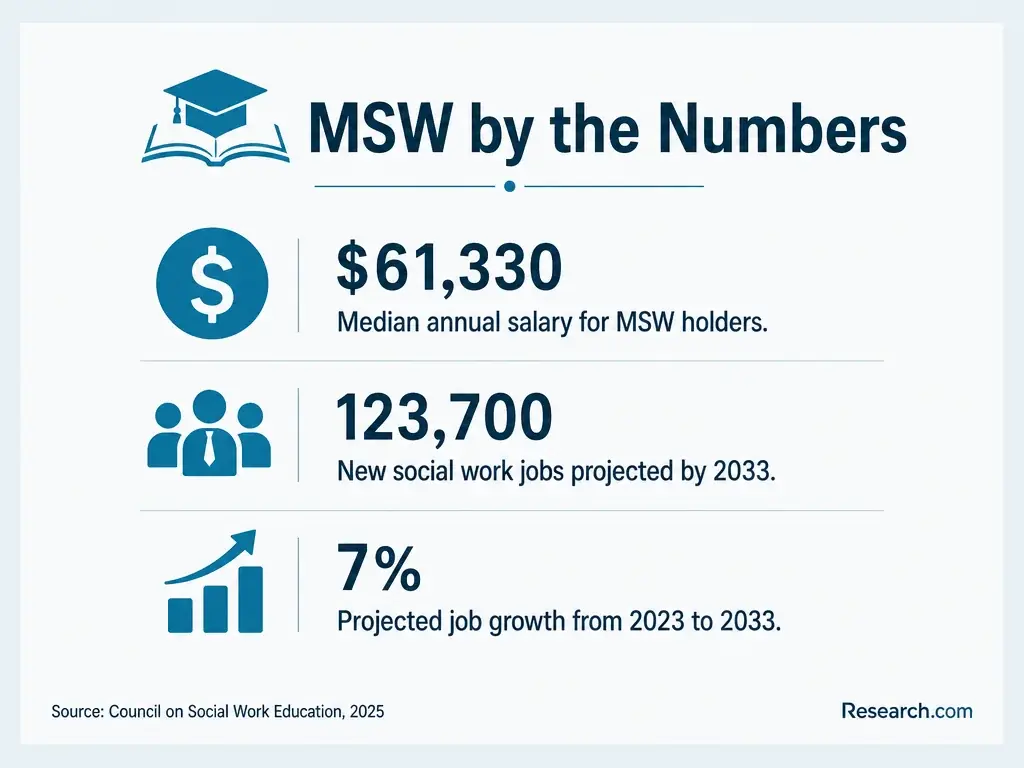
The U.S. Bureau of Labor Statistics projects 6% employment growth for social workers overall from 2025 to 2035 and 8% for healthcare social workers. The healthcare category may be relevant to medical rehabilitation positions, but neither projection counts rehabilitation social workers as a separate job title. It also does not predict openings at a particular hospital or guarantee work for a new graduate.
Disability advocates likewise have no single BLS occupation or defensible occupation-specific growth rate. Opportunities depend on the employer and local funding, policy priorities, and service demand. Search recent postings in your preferred region and sort them by duties and required credentials; that gives a better view of accessible openings than applying a broad social work projection to advocacy.
Even where healthcare hiring is strong, faster completion is worthwhile only if the qualification fits the job. Consider faster graduate social work study routes after checking admission eligibility, field scheduling, total cost, and licensing relevance.
Useful social work coursework includes disability policy, human behavior in social environments, assessment, ethics, service systems, research literacy, and culturally responsive practice. Advocacy-oriented students may particularly value policy analysis, organizing, accessibility, and communication; rehabilitation-focused students may prioritize healthcare coordination, interdisciplinary work, and documentation.
Field education should let students practice relevant skills under an approved learning agreement and qualified instruction. A disability-services nonprofit might support advocacy learning; a hospital or community rehabilitation agency might support care-coordination learning. The school must approve the placement and assess its competencies. Paid work, volunteering, and post-degree clinical supervision are different from curricular field education and do not automatically substitute for it.
Before choosing a program, ask which agencies accept its students, who arranges placements, and how it handles accessibility or scheduling needs. Online MSW field coordination models are particularly relevant if you cannot relocate or leave your job to complete field learning.
How long do relevant degree programs take, and what do they cost?
A full-time BSW commonly takes about four years from the start of undergraduate study, though accepted credits can change an individual timeline. A traditional MSW commonly takes about two years full-time; qualifying BSW graduates may be eligible for a shorter advanced standing sequence. Part-time enrollment, course sequencing, and placement availability can extend any route. Neither a DSW nor a PhD is ordinarily needed to enter these two careers.
There is no honest single price for either pathway. Compare each school's quoted tuition and fees for your entry route, then add books, technology, placement travel, required visits, and earnings you may forgo during field education. For an advocate position that does not require social work education, include the cost of not taking a more direct work-and-training route in your comparison.
Request a written, program-specific estimate before committing. Lower-cost online social work master's programs may offer options to investigate, but the lowest advertised tuition is not necessarily the lowest total cost once field scheduling and lost work hours are included.
Other Things You Should Know About Social Work
Possibly, but representation rules depend on the benefit program and proceeding. Check the relevant agency's rules and the employer's authorization; an advocacy job title alone does not establish permission to represent someone or provide legal advice.
It can strengthen insight and communication, especially when paired with listening and respect for each person's choices. It does not replace a required social work degree, license, or employer training.
Some advocacy, coordination, and documentation tasks can be remote. Client meetings, team responsibilities, travel, accessibility needs, privacy rules, and employer policies determine the actual arrangement.
Ask what a typical week includes, how caseloads are assigned, who provides supervision, and whether staff can raise accessibility or service barriers. The answers reveal more about the role than its title.
- General Schedule Qualification Policies | U.S. Office of Personnel Management https://www.opm.gov/policy-data-oversight/classification-qualifications/general-schedule-qualification-policies/
- The Effects of the ADA | usccr.gov https://www.usccr.gov/files/pubs/ada/ch2.htm
- Guide to Disability Rights Laws | ADA.gov https://www.ada.gov/resources/disability-rights-guide/
- Disability | who.int https://www.who.int/news-room/fact-sheets/detail/disability-and-health
- Case Management - StatPearls - NCBI Bookshelf https://www.ncbi.nlm.nih.gov/books/NBK562214/
- Direct Support Professionals (DSPs) | dol.gov https://www.dol.gov/agencies/odep/program-areas/individuals/DSP
- Where Do Social Workers Work? | Regis College Online https://online.regiscollege.edu/blog/where-do-social-workers-work
- What Does a Social Worker for Disability Services Do? | Virginia Commonwealth University https://onlinesocialwork.vcu.edu/blog/disability-social-worker/
- Social Workers in Healthcare: How They Make a Difference | Adelphi University Online https://online.adelphi.edu/articles/social-workers-in-healthcare-how-they-make-a-difference/
- What Do Social Workers Do? Roles, Duties & Job Description | CU Online https://online.campbellsville.edu/social-work/roles-responsibilities-career-guide/