2027 Closed-Loop Referrals in Social Work: Following Connections Between Social Service Providers
Audited and Verified:
Our Editorial and Data Verification Process
Research.com uses government datasets, official education statistics and primary institutional information to support its career and degree guides. Our review process checks factual accuracy, occupational definitions, source dates and the requirements associated with the credentials discussed.
How This Article Was Fact-Checked
Our editorial team verifies salary estimates, employment projections, education requirements and program information against original data providers and official organizations. Salary figures are checked against the relevant occupational definitions and reporting periods. Information about licensure, accreditation and required in-person training is reviewed separately.
Fact-checked and verified on:

Co-Founder and Chief Data Scientist
A referral is not complete just because a phone number was shared or a form was sent. For clients seeking housing, food, benefits, or treatment, the critical question is whether they connected with a provider—and what should happen if they did not. Closed-loop referrals give social workers and partner agencies a way to check that connection while respecting clients' choices and privacy.
This guide explains the workflow, documentation and consent safeguards, and the training and roles involved, so practitioners and prospective social workers can decide what a sound referral process requires.
Key Things You Should Know
- A closed-loop referral records more than a handoff: it establishes whether contact occurred, whether services began or another outcome was reported, and who will follow up.
- Track distinct statuses such as sent, received, contacted, declined, waitlisted, and service started; a referral sent is not a service delivered.
- Referral coordination does not always require a social work license, but information sharing must follow applicable law, client consent requirements, and agency policy.
What are closed-loop referrals in social work?
A closed-loop referral is a service connection that includes an agreed way to learn what happened after the referral. The referring worker identifies a suitable provider, helps the client make contact, and follows up with the client or receiving organization as permitted. The loop closes when the outcome is known well enough to decide whether further action is needed—not necessarily when the client receives the originally requested service.
That distinction matters when an agency has a waitlist, finds the client ineligible, or cannot reach them. Recording "service unavailable; alternative needed" is more useful than leaving the referral marked "sent." A warm handoff, such as introducing the client to a receiving worker, can be part of the process, but it is not closed-loop unless someone checks the outcome.
Closed-loop referral is a practice method, not a separate license or degree. Readers exploring online degree routes into social work careers should evaluate programs for case coordination and field-learning opportunities rather than assuming a particular degree format teaches this workflow.
How does a closed-loop referral work between social service providers?
The process should specify who owns the next step before information is sent. A practical workflow is:
- Discuss the client's goal, preferences, access needs, and barriers; check the receiving provider's eligibility rules and current capacity where possible.
- Explain the proposed contact and information sharing, obtain any required permission, and agree on a workable method of communication.
- Send the minimum information needed through an approved channel, or support the client in contacting the provider directly.
- Assign a follow-up date and owner; ask the receiving provider or client whether contact occurred and what the next step is.
- Record the outcome and, if the connection failed, discuss an alternative or additional support with the client.
For example, a housing agency might confirm receipt of a referral but later report that its program is full. The referring worker should not mark the client "housed"; the next task is to discuss other options. Timelines should reflect urgency, provider hours, and agency policy rather than a universal deadline.
Students who hope to practice this workflow during field education should consider whether placements offer supervised follow-up during partner agencies' operating hours. Online MSW scheduling for working adults is relevant here: flexible coursework does not necessarily make daytime coordination or field activities flexible.
Why are closed-loop referrals important for clients and social workers?
Follow-up can reveal barriers that a referral alone cannot: an unanswered call, transportation costs, language access needs, an eligibility mismatch, or a provider with no openings. It gives the client and worker a chance to choose a different path instead of assuming the handoff worked. For agencies, recorded outcomes can expose recurring gaps in the local service network.
Closed-loop practice should not become a demand that clients prove they used a service. Clients may decline help, change priorities, or prefer not to disclose an outcome. A useful process respects that choice while documenting what the worker knows and what remains unknown. It also avoids treating a higher count of "completed" referrals as proof that clients' underlying needs were met.
For someone drawn to this work, BSW entry pathways for adult learners may be worth examining if target jobs require social work education. If a local coordinator position accepts human services experience and employer training, an additional degree may not be the most direct route.
A referral does not automatically authorize two organizations to exchange a client's records. Explain what information would be shared, with whom, for what purpose, and whether the client can choose another approach. Use the least information needed for the task and the agency's approved communication method. In some settings, a client may prefer to contact the receiving provider personally.
Applicable rules depend on the organizations and information involved. HIPAA may govern a covered healthcare provider's disclosures; substance use disorder treatment records may be subject to additional federal protections under 42 CFR Part 2. State confidentiality laws, school or child-welfare rules, contracts, and agency policy may also apply. Do not assume that a shared software platform, professional relationship, or general release permits every disclosure. Consult the organization's privacy lead or legal guidance when the basis for sharing is unclear.
A social work license does not override those safeguards. If a role also involves regulated clinical practice, checking online MSW alignment with licensing goals is a separate decision from determining what client information may be exchanged during a referral.
What are the salaries and job outlook for social work referral roles?
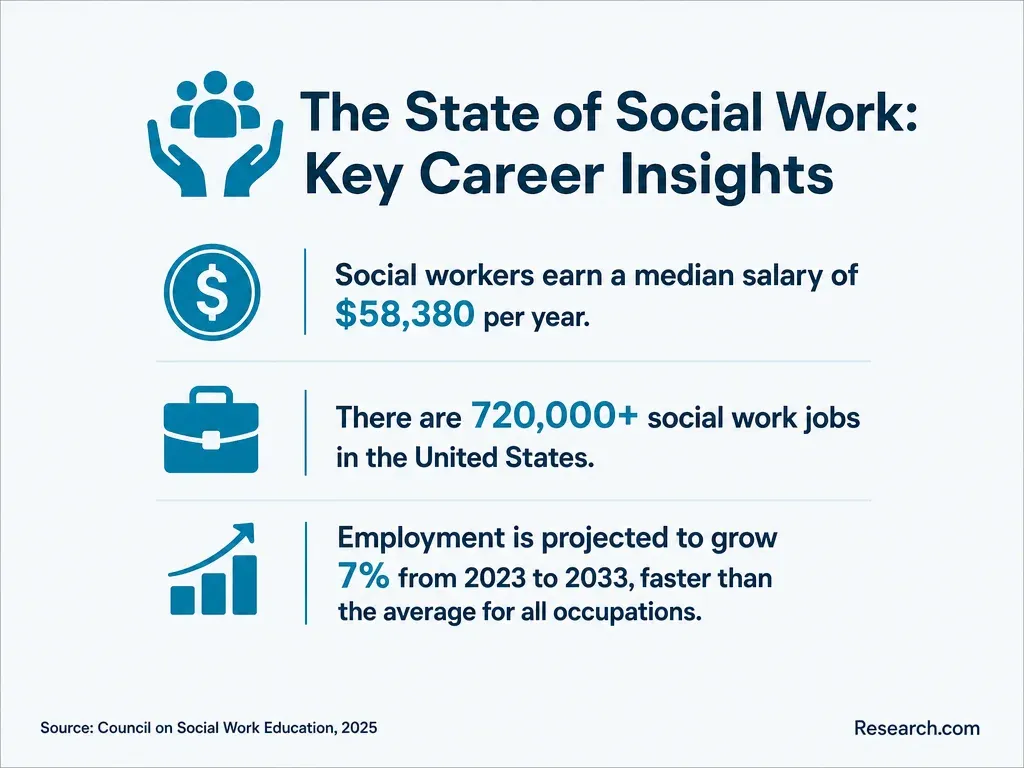
Referral coordinator is not one uniform labor-market category. The U.S. Bureau of Labor Statistics figures below describe broader social work occupations that can include referral duties. They are not wages for referral work specifically or promised pay for a BSW or MSW graduate:
| U.S. occupation | Median annual pay, May 2025 | Projected employment growth, 2025-2035 |
| Child, family, and school social workers | $59,550 | 4% |
| Healthcare social workers | $67,880 | 8% |
| Mental health and substance abuse social workers | $60,280 | 10% |
These figures suggest that setting matters when weighing opportunities, but they do not account for an individual agency's pay scale, location, experience requirements, or license expectations. Non-social-work navigator jobs may fall under a different occupational category. Compare actual local postings and benefits against education costs; MSW salary comparisons by state can provide geographic context without substituting for a specific offer.
Other Things You Should Know About Social Work
Generally, clients can decline an offered service. Explain available options and document the decision without describing it as a failed handoff. Specific safety, reporting, or court-related obligations require guidance under applicable rules.
Tell the client what is known about availability, discuss feasible alternatives and immediate needs, and avoid promising a placement. With the client's agreement, the worker may help with waitlist steps while continuing to check other options.
In many U.S. communities, 211 can help locate social services. Confirm a program's eligibility and capacity before relying on it as a referral destination; a directory listing does not establish that services are available.
Clients can ask the agency how to access or correct information about them. The applicable process depends on the type of record, organization, and governing law, so staff should follow the agency's records procedure rather than promise immediate access to every item.
- High-value referrals - IRIS https://iris.who.int/server/api/core/bitstreams/3ea58f50-7068-4cb5-8f54-a17dbcdeaace/content
- Closed Loop Referral (CLR) FAQ - DHCS - CA.gov https://www.dhcs.ca.gov/calaim-transforming-medi-cal/closed-loop-referral-clr-frequently-asked-questions/
- eCFR:: 42 CFR Part 2 -- Confidentiality of Substance Use Disorder Patient Records https://www.ecfr.gov/current/title-42/chapter-I/subchapter-A/part-2
- Fact Sheet 42 CFR Part 2 Final Rule | hhs.gov https://www.hhs.gov/hipaa/for-professionals/regulatory-initiatives/fact-sheet-42-cfr-part-2-final-rule/index.html
- Social care best practices: Learnings from a technology-enabled closed-loop referral network | SIREN https://sirenetwork.ucsf.edu/tools-resources/resources/social-care-best-practices-learnings-technology-enabled-closed-loop
- Department of Human Services | state.or.us https://secure.sos.state.or.us/oard/viewSingleRule.action
- Referral Tracking in Healthcare: States and Worklists | Linear Health https://linear.health/blog/referral-tracking-healthcare
- Closing the Loop: How Referral Systems Are Transforming Health Care | Missouri PQC https://mopqc.org/news/closing-the-loop-how-referral-systems-are-transforming-health-care/
- Fundamentals of 42 CFR Part 2 and SUD Treatment Privacy | lac.org https://www.lac.org/resource/the-fundamentals-of-42-cfr-part-2
- Who is Required to Comply with 42 CFR Part 2? | hipaajournal.com https://www.training.hipaajournal.com/blog/who-is-required-to-comply-with-42-cfr-part-2/