
# 1 position
Best Welding Training Programs & Trade Schools in Lancaster for 2027
Audited and Verified:
Our Editorial and Data Verification Process
Research.com uses government datasets, official education statistics and primary institutional information to support its career and degree guides. Our review process checks factual accuracy, occupational definitions, source dates and the requirements associated with the credentials discussed.
How This Article Was Fact-Checked
Our editorial team verifies salary estimates, employment projections, education requirements and program information against original data providers and official organizations. Salary figures are checked against the relevant occupational definitions and reporting periods. Information about licensure, accreditation and required in-person training is reviewed separately.
Fact-checked and verified on:

Co-Founder and Chief Data Scientist

Reviewed by Karolina Broda
Fact-Checker and Data Verification
Choosing welding training in Lancaster, California, means deciding whether a school shop, paid apprenticeship, or employer training will get you job-ready at a cost you can manage. The U.S. Bureau of Labor Statistics reports a May 2025 national median wage of $53,750 for welders, cutters, solderers, and brazers - not a starting-pay promise. This guide explains credentials, hands-on training, costs, and career prospects. It also accompanies the Best Welder Trade Schools in Lancaster for 2027 ranking, created by the Research.com team of data scientists to help students identify programs worth considering.
Key findings about welder degrees in Lancaster
- For a Lancaster applicant, the decisive comparison is supervised welding time and access to the processes employers require - not whether two programs award similarly named certificates.
- The California Community Colleges resident enrollment fee was $46 per unit in 2025-26, according to the California Community Colleges Chancellor's Office; supplies, protective equipment, fees, and commuting can make the job-ready cost substantially higher. Check the rate for your enrollment year.
- The U.S. Bureau of Labor Statistics projects 2.4% U.S. employment growth for welders, cutters, solderers, and brazers from 2025 to 2035. That national forecast does not establish how many openings will be available in Lancaster.
Table of Contents
- Best Welding Training Programs & Trade Schools in Lancaster for 2027
- What can I expect from a welder trade school program in Lancaster?
- Where can I work with a welder trade school training in Lancaster?
What can I expect from a welder trade school program in Lancaster?
Expect a progression from shop safety and basic joints to reading fabrication drawings, preparing metal, setting up equipment, and making welds that an instructor can inspect or test. A credible program gives students repeated practice - not just demonstrations - using processes such as shielded metal arc welding, gas metal arc welding, and gas tungsten arc welding where its curriculum calls for them. Ask to see the current course sequence and the share delivered in the shop.
Lancaster's Antelope Valley Community College District is a local public-college option to investigate. Compare its current welding offerings with paid employer training and registered apprenticeships before committing: a school program may provide structured practice before a job search, while an apprenticeship combines supervised work and instruction and generally pays wages during training. Available placements, schedules, and qualifications can differ by sponsor.
Where can I work with a welder trade school training in Lancaster?
Welding skills can lead to fabrication and repair shops, construction contractors, industrial maintenance, and employers producing metal components. In the Antelope Valley, a prospective student should distinguish shop fabrication from field work: the latter may involve travel, outdoor conditions, and employer- or project-specific weld tests. A training provider's list of employer contacts is useful only if those employers hire for the processes and materials the program teaches.
Ask local employers which entry-level jobs they fill, whether they test applicants, and where worksites are located. That check matters in Lancaster because a job advertised for the broader region may require a commute that changes the value of a lower-cost training option.
Published national pay is a benchmark, not a Lancaster offer. The U.S. Bureau of Labor Statistics reports a May 2025 median annual wage of $53,750 for welders, cutters, solderers, and brazers. The median covers workers with different experience levels, specialties, and employers; someone entering the trade should not budget on earning it immediately.
For a local estimate, compare current Lancaster-area postings that specify process, shift, experience, and location. Ask whether advertised pay assumes overtime, travel, or a successful weld test. Use the resulting realistic starting-pay range - not the national median alone - when judging what you can afford to spend on training.
There is no single required number of school hours for a general welding job in California. A short skills course can prepare someone for a particular process; a broader certificate takes more coursework, and an associate-degree pathway adds general education. A registered apprenticeship typically extends over years because instruction accompanies progressively skilled paid work. Confirm each provider's published clock or contact hours, calendar length, and shop hours rather than comparing credentials by title alone.
Acceleration has a limit: fewer weeks are helpful only if they still allow enough supervised practice to pass the weld tests relevant to your target job. A list of best 6 month associate programs online cannot establish that a welding qualification - or the practice needed to earn one - can be completed online in that time.
Online instruction can cover safety concepts, symbols, blueprint reading, and some inspection theory. Making a weld safely, adjusting equipment, handling materials, and demonstrating an acceptable finished joint require in-person shop or worksite practice. A hybrid option is worthwhile if its practical sessions are accessible and provide enough individual booth time; an entirely online course should not be treated as proof of welding competence.
Institutional status is a separate question from hands-on suitability. Even a listing of top accredited non-profit online universities would not tell a Lancaster applicant whether a welding course provides supervised shop training or prepares them for an employer's test.
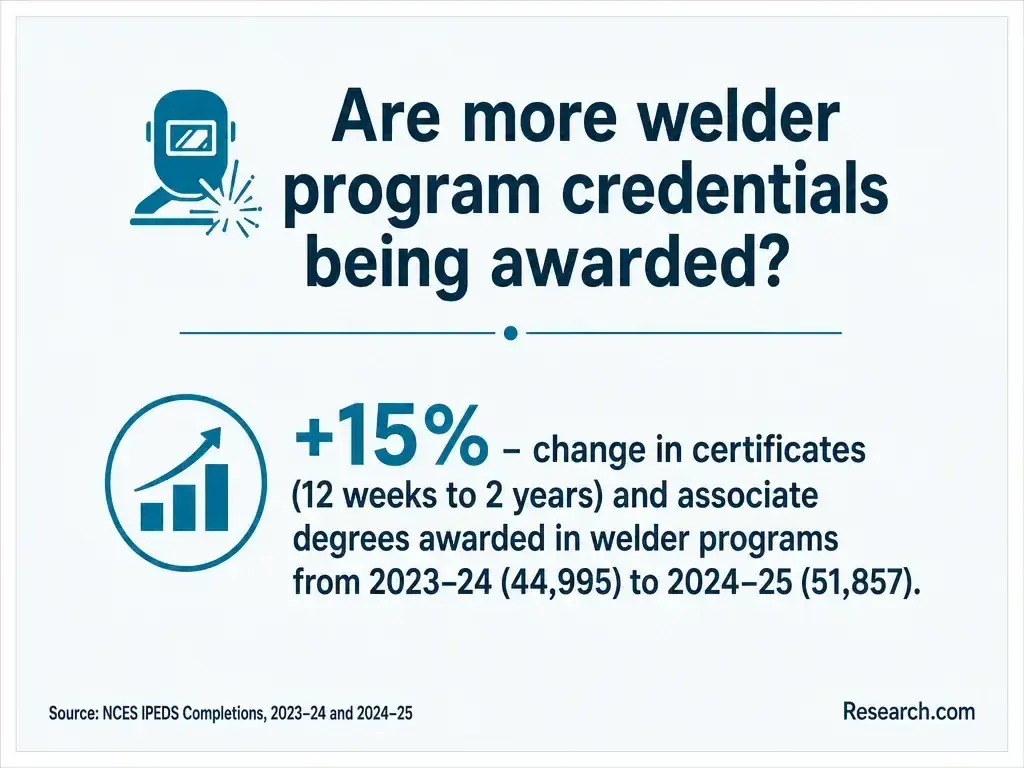
There is no defensible single Lancaster average across college courses, career-school programs, apprenticeships, and employer training: they charge and pay for training differently. As a public-college reference point, the California Community Colleges Chancellor's Office listed a $46-per-unit resident enrollment fee for 2025-26. Confirm the fee and residency rules for your enrollment year; the per-unit figure is not a complete program price.
Request an itemized estimate covering mandatory fees, books, metal and other consumables, tools, welding helmet, protective clothing, transportation, and any qualification-test charges. Then subtract grants or employer support and account for earnings forgone while attending. An apprenticeship may reduce out-of-pocket cost through wages, but availability, entry requirements, and the time until independent work differ from a school program. Compare total cost against a realistic starting-pay estimate and your likelihood of finishing, not tuition alone.
The award depends on the pathway: a school may offer a course completion record, certificate, or associate degree; a registered apprenticeship has its own completion credential; employer training may document job-specific skills. These are not interchangeable with a demonstrated welding qualification. Before enrolling, obtain the exact credential name and ask whether the program includes - or merely prepares you for - a test in the process, position, and code your intended employer uses.
The American Welding Society's Certified Welder program, for example, is based on a performance test administered through an accredited test facility, according to AWS. A school's institutional accreditation does not itself award that certification. Nor does a certificate necessarily mean the holder is qualified for every welding process.
Check the provider's current rules for application, placement, minimum age, prior coursework, and safety equipment; they vary by program. Registered apprenticeships and employers set their own entry and selection requirements, which may include an interview, aptitude assessment, or ability to work at assigned sites. Do not assume admission to a class also secures an apprenticeship or job.
For adults changing careers, the practical entry question is often whether lab times fit work and caregiving obligations. Readers exploring best college courses for older adults online should still plan for welding's in-person shop attendance and ask about evening sections, physical tasks, and safety accommodations where needed.
A useful entry-level curriculum connects safety, measurement, drawing interpretation, metal preparation, equipment setup, weld execution, and inspection. Students should learn to recognize defects, correct technique, and work within shop safety procedures - not simply complete a set of projects. The U.S. Bureau of Labor Statistics identifies blueprint reading, equipment operation, and inspection among welders' occupational tasks.
Process coverage matters. A student targeting precision fabrication should ask about access to the relevant materials and gas tungsten arc welding practice; someone seeking structural work should ask about the positions, joints, and test standards practiced. Get a skills checklist and ask how many opportunities students have to repeat a failed weld under supervision.
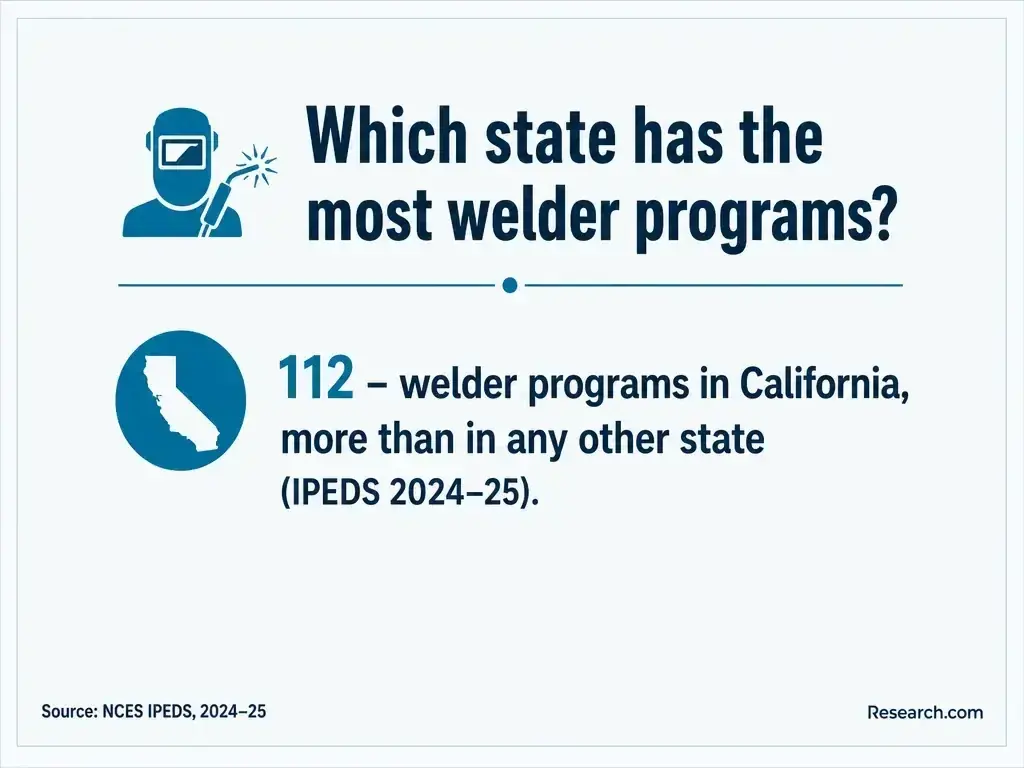
California does not impose a general occupational welder license simply to work as an employee. Employers or contracts may nevertheless require a weld test or documented qualification for particular work. AWS certification is a separate, voluntary credential unless an employer or project specifies it; the American Welding Society sets its own testing requirements. Graduating from a school does not automatically satisfy either an employer test or AWS certification.
If your goal is to operate a contracting business rather than work as an employee, check the California Contractors State License Board's rules for the work you intend to bid. Contractor licensing is a different question from an individual employee's welding skills. Ask prospective employers which code, process, and test position they require before paying for an unrelated exam.
Start with the work you want, then compare programs against that job's test and schedule. A low-cost course with limited practice in the needed process may be a worse investment than a longer program with suitable equipment; a paid apprenticeship may be better if you can secure a place and want work-based learning. A ranking is a shortlist, not a substitute for examining the shop.
Use these checks when speaking with the provider and local employers:
- Ask which processes, materials, positions, and inspection methods students actually practice, and how shop time is allocated.
- Obtain the exact credential, total required hours, full itemized cost, completion schedule, and any fees for repeat practice or tests.
- Verify institutional accreditation or applicable school authorization separately from industry recognition and any individual certification test.
- Ask for recent, clearly defined completion and job-placement results, then check whether local employers recognize the training.
- Compare the net cost and lost work time with paid apprenticeship or employer-training opportunities before enrolling.
Be wary of promises that a certificate guarantees certification, a job, or the occupation's median wage. If welding proves a poor fit after a shop visit, compare other careers in trade school before taking on training debt.
Entry routes include production welding, fabrication assistance, and repair work, depending on the processes practiced and the employer's test. Experience can open more specialized work, inspection-related responsibilities, lead positions, or supervision; each step may require additional demonstrated skills rather than another school credential. Self-employment adds business and, where applicable, contractor-licensing obligations.
Keep wage comparisons within the occupation you intend to enter. An unrelated guide such as which masters degree makes the most money cannot estimate returns on welding training; compare local job requirements, probable entry pay, and your full training cost instead.
The U.S. Bureau of Labor Statistics projects 2.4% national employment growth from 2025 to 2035 for welders, cutters, solderers, and brazers. That describes a broad occupation across the United States, not a forecast of vacancies or hiring by Lancaster employers. Openings also arise when workers leave an occupation, so growth alone is an incomplete measure of opportunity.
For a decision tied to Lancaster, check current postings over several weeks and note the processes, experience, shifts, and travel each requires. A course is a stronger investment when its shop work matches recurring requirements you can realistically commute to - not merely when national demand is positive.
Best Welding Training Programs & Trade Schools in Lancaster for 2027
Education is a consequential investment, so Research.com created this ranking to help readers compare welding programs with other programs serving the same occupation and location. Its team checks program and institutional information against multiple sources. Only programs with completions reported to IPEDS are eligible for the ranking; an unlisted apprenticeship or employer program is not necessarily an inferior option.
Best-program rankings assess student outcomes; earnings and return on investment; costs and debt; and quality and recognition. Programmatic accreditation or occupation-relevant industry recognition accounts for 20% of the score, institutional accreditation for 10%, and student support for 10%. The remaining 60% covers completion, full- and part-time retention, earnings one year after completion, earnings relative to annual attendance cost, tuition, attendance cost, debt - including debt held by students who withdrew - and federal loan default rates. An entropy-based method assigns more weight to indicators that vary more across programs. Most-affordable rankings instead score only tuition, attendance cost, median debt, and loan default rates, using entropy-based weights; accreditation and other quality measures do not enter that score. Neither ranking replaces a check of current shop access or employer requirements.
The team uses the following data sources to verify the measures relevant to each program and occupation. Some sources cover other trades rather than welding specifically:
- IPEDS database
- National Center for Education Statistics
- College Scorecard database
- Peterson's database
- Commission on Accreditation of Allied Health Education Programs (CAAHEP)
- Accrediting Bureau of Health Education Schools (ABHES)
- Commission on Dental Accreditation (CODA)
- Dental Assisting National Board (DANB)
- National Center for Construction Education and Research (NCCER)
- Apprenticeship.gov Partner Finder
Readers can use the ranking to narrow their options, then confirm the current curriculum, full price, and welding qualifications with each provider. Research.com explains its broader approach on its methodology page.
# 2 position
Antelope Valley Community College District - Welding Technology/Welder.
certificate or diplomaFrequently asked questions about welder programs in Lancaster
Is trade school required to become a welder in Lancaster?
No. School, apprenticeship, and employer-sponsored training can all lead toward entry, depending on the job. Employers may require a practical weld test regardless of the route.
Can I learn welding entirely online?
No online-only course can replace supervised practice with welding equipment. Theory may be remote, but assessable practical skills require in-person work.
Does a welding certificate include AWS certification?
Not necessarily. Ask whether the program includes an AWS test through an accredited test facility or only prepares students to take one.
Is an apprenticeship cheaper than school?
Paid training can lower the cost of entering the trade, but compare application prospects, wages, travel, duration, and the skills taught before choosing.
What should I ask before paying a deposit?
Request the full cost, required shop hours, exact credential, test preparation details, refund policy, and evidence that the training matches jobs you want.
- U.S. Bureau of Labor Statistics - Welders, Cutters, Solderers, and Brazers
Used to verify salary, employment outlook, and typical education requirements.
https://www.bls.gov/ooh/production/welders-cutters-solderers-and-brazers.htm - NCCER - Accredited Training
Used to verify programmatic accreditation or industry recognition of programs.
https://www.nccer.org/ - AWS - Certified Welder
Professional certification reference for graduates of this occupation.
https://www.aws.org/certification-and-education/professional-certification/certified-welder/ - Antelope Valley Community College District - official website
Official school website (programs, tuition, admissions).
https://www.avc.edu/