# 1 position


Audited and Verified:
Our Editorial and Data Verification Process
Research.com uses government datasets, official education statistics and primary institutional information to support its career and degree guides. Our review process checks factual accuracy, occupational definitions, source dates and the requirements associated with the credentials discussed.
How This Article Was Fact-Checked
Our editorial team verifies salary estimates, employment projections, education requirements and program information against original data providers and official organizations. Salary figures are checked against the relevant occupational definitions and reporting periods. Information about licensure, accreditation and required in-person training is reviewed separately.
Fact-checked and verified on:

Co-Founder and Chief Data Scientist

Reviewed by Karolina Broda
Fact-Checker and Data Verification
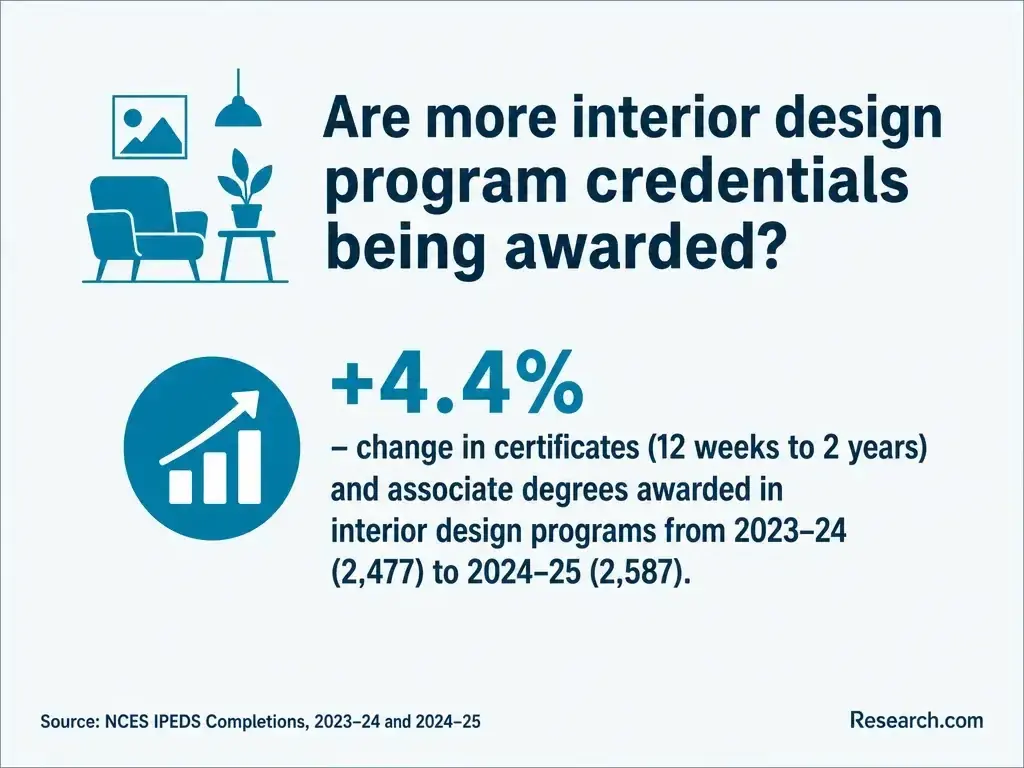
Choosing interior design training in El Paso means deciding whether a short, portfolio-focused credential or a longer program will prepare you for the work you want. The Best Interior Design Trade Schools in El Paso for 2027 ranking, created by the Research.com team of data scientists, is designed to help you identify programs worth considering. The U.S. Bureau of Labor Statistics projects 2.7% national employment growth for interior designers from 2025 to 2035. This guide explains costs, hands-on training, Texas registration rules, and career prospects so you can judge the investment.
Expect instruction in turning a client's needs into a workable space: measured drawings, layouts, materials, lighting, presentations, and revisions. Interior design goes beyond decoration when projects involve building systems, accessibility, or coordination with construction professionals. A useful program makes students demonstrate these skills through critiqued studio projects, not just watch software tutorials.
El Paso Community College is a local provider to investigate, but verify the current catalog before assuming a particular interior design credential, course sequence, or delivery format is available. Ask to see recent student projects and find out whether local firms, showrooms, or contractors offer internships or project briefs. A placement opportunity can help build a portfolio, but it is not the same as guaranteed employment.
Potential workplaces include residential design studios, furniture and kitchen-and-bath showrooms, remodeling businesses, commercial interiors teams, and architecture or construction firms. The work differs: a showroom may prioritize product knowledge and client sales, while a commercial team may expect detailed drawings and coordination with technical specialists. Ask programs which roles their graduates actually pursue, rather than assuming every credential leads directly to an independent designer position.
El Paso's proximity to New Mexico matters if you intend to work across the state line: professional title and registration rules can differ by state. Check the requirements where you plan to offer services, especially before advertising a protected title.
A verified El Paso-specific interior designer wage is not established here, so the national figure is a benchmark - not a local pay estimate. The U.S. Bureau of Labor Statistics reports a $67,190 median annual wage in May 2025 for U.S. interior designers. It includes experienced workers and should not be used as an expected first-job salary.
Compare actual local job postings by role, experience, and required software. Showroom compensation may also depend on sales; an independent designer must cover business expenses. Lists of most lucrative college majors are a poor substitute for occupation- and location-specific pay evidence when evaluating this training investment.
Duration depends on the credential and course schedule. A focused certificate can take less time than an associate degree, which typically requires about two academic years of full-time study; part-time attendance extends either path. Published program requirements - not a general estimate - determine the actual timeline. Texas does not impose a single clock-hour requirement on everyone entering interior design work, but eligibility for professional examination and registration has separate education and experience rules (Texas Board of Architectural Examiners; Council for Interior Design Qualification).
Acceleration is worthwhile only if it leaves enough time for drawing, software practice, critique, and a credible portfolio. Lists of fast track degree programs do not establish how quickly a specific interior design program can prepare someone for paid project work.
Online study can suit design history, presentations, some drafting instruction, and software practice. On-campus or hybrid study can make it easier to receive live critiques, examine materials, measure spaces, and collaborate on projects. Even remotely taught programs should specify how students complete and receive feedback on practical work; an online label alone says nothing about portfolio quality or professional-registration eligibility.
For an El Paso student, compare the commute saved with the cost of suitable software and equipment at home. An institution's appearance in a best non profit accredited online university guide would not, by itself, verify an interior design program's practical training or credential alignment.
There is no defensible single El Paso average without current, comparable prices for the specific credentials under consideration. Request a written, itemized estimate from each provider. Tuition alone omits fees, drawing and model-making supplies, a computer capable of running required design software, software subscriptions, transportation, and earnings forgone while studying.
Check eligibility for federal aid with the school and Federal Student Aid, and ask about scholarships or workforce funding; eligibility depends on the student and program. A lower-priced certificate may be the better investment for an entry-level showroom goal, while a longer program may be worth its added time and cost if its coursework aligns with your intended professional pathway. Evaluate likely completion, debt, and the pay of jobs you could realistically obtain - not just the sticker price.
Possible awards include a school certificate or an associate degree, depending on the provider and program. A course-completion certificate, an academic award, professional certification, and Texas registration are different things. Before enrolling, ask for the exact credential name, transcripted coursework, and whether credits can transfer or stack toward another program. Get any transfer or prior-learning decision from the receiving institution in writing.
Neither an award nor institutional accreditation automatically qualifies someone for the NCIDQ examination or Texas registration. Check the relevant requirements with the Council for Interior Design Qualification and the Texas Board of Architectural Examiners. Searches for easy online phd programs concern a different educational path and cannot help establish whether an interior design trade credential meets your career goal.
Requirements vary by program. Ask whether entry requires a high school credential, placement testing, prerequisite coursework, an initial portfolio, or access to specified computer hardware and software. Also ask whether individual studio courses have prerequisites that could delay completion. Do not assume a program's admission requirements are the same as the later requirements for professional examination or registration.
A strong curriculum connects space planning, hand and digital drawing, materials, lighting, color, and client communication to completed projects. For work involving commercial interiors, ask how the program teaches accessibility, building-code research, documentation, and collaboration with qualified construction professionals. The U.S. Bureau of Labor Statistics describes interior designers as preparing plans and coordinating with contractors; that makes a portfolio showing design decisions and revisions more useful than software badges alone.
Request the course sequence and examples of assessed work. If the intended job calls for construction drawings, a program centered only on styling and product selection may not be enough - even if both programs use "interior design" in their names.
Not for every role. Texas regulates use of the title registered interior designer, but registration is not a blanket prerequisite for all interior design employment (Texas Board of Architectural Examiners). For that protected title, review the board's current application rules and the Council for Interior Design Qualification's education, experience, and examination requirements before choosing a program. Finishing coursework alone does not establish eligibility.
Keep the checks separate: institutional accreditation concerns the school; programmatic accreditation concerns a particular program; a professional examination tests eligibility and competence; and state registration controls a regulated title. Ask the provider which, if any, of these its curriculum supports, and verify the answer with the responsible organization.
Start with the job you want, then compare programs against its actual work. A residential styling or showroom role may reward product knowledge and a persuasive portfolio; a technical commercial role may call for more drafting, code-related instruction, and supervised project experience. The best-ranked option is not automatically the best fit.
Use these checks before paying an enrollment deposit; each addresses a gap a ranking alone cannot resolve:
A short program can make sense when it builds the skills and portfolio needed for a defined entry role. Avoid paying for speed if the promised outcome depends on experience or eligibility the program does not provide.
Training may support entry into showroom sales and design support, drafting or design-assistant work, kitchen-and-bath projects, or residential and commercial interiors teams. Independent client work generally requires more than a credential: a portfolio, reliable estimating and communication skills, and an understanding of which tasks require coordination with other qualified professionals.
Direct entry through a showroom or employer's training can be a sensible alternative to school for someone testing a sales-and-design role. A structured program may be more useful when the goal requires sustained studio practice and technical documentation. Compare these routes with a broader trade school careers list and salaries, but judge each opportunity by its actual duties, local openings, and cost of entry - not by a broad career label.
The U.S. Bureau of Labor Statistics projects 2.7% growth nationally for interior designers from 2025 to 2035. That projection is not an El Paso hiring forecast. Because local openings may be narrower than the range of design-related roles, compare current postings for assistants, showroom staff, and drafting support as well as those titled interior designer. Note which demand portfolios, software proficiency, or prior experience; use those requirements to test whether a program closes a real entry-level skills gap.
Education is a consequential investment. Research.com compares programs with others in the same occupation and location so readers can assess realistic alternatives, rather than relying on a national list that may not reflect their options. Only programs with completions reported to IPEDS qualify for this ranking; an unlisted provider is not necessarily unapproved or ineffective.
Best-program scores consider student outcomes, earnings and return on investment, costs and debt, and quality and recognition. Occupation-relevant programmatic accreditation or industry recognition accounts for 20%, institutional accreditation for 10%, and student support for 10%. The remaining 60% covers completion and retention, earnings one year after completion, earnings relative to annual attendance cost, tuition, attendance cost, debt - including debt among students who withdrew - and federal loan default rates. An entropy-based method gives more weight to indicators that vary more across programs. Most-affordable rankings use only cost and debt indicators, weighted by that method; accreditation and other quality measures do not enter those scores.
The team uses the following sources to check institutional, program, outcome, and recognition information. Some occupation-specific sources in the broader ranking system concern other trades and should not be mistaken for interior design accreditation or licensing authorities:
The ranking provides a starting point, not a substitute for confirming a current program's curriculum, price, and fit with your intended job. Read more about how Research.com creates its rankings.
# 1 position
# 2 position
It can support entry into some assistant or showroom roles if you can show relevant work. It does not automatically meet requirements for professional examination or Texas registration.
Check its current catalog and ask an adviser for the exact award and course sequence. Confirm that its projects and coursework match your target job before relying on a program name.
Some coursework can be remote, but you still need demonstrable practical skills and portfolio feedback. Ask how a specific program assesses projects and whether it requires in-person participation.
It may be if the credential and portfolio improve access to the role you want at a manageable total cost. Compare it with direct-entry work, and account for completion likelihood, debt, and time away from paid work.
Not for every interior design job. Registration matters if you intend to use the regulated title; verify current eligibility with the Texas Board of Architectural Examiners.