
# 1 position
Most Affordable Automotive Technician Schools & Training in Norfolk for 2027
Audited and Verified:
Our Editorial and Data Verification Process
Research.com uses government datasets, official education statistics and primary institutional information to support its career and degree guides. Our review process checks factual accuracy, occupational definitions, source dates and the requirements associated with the credentials discussed.
How This Article Was Fact-Checked
Our editorial team verifies salary estimates, employment projections, education requirements and program information against original data providers and official organizations. Salary figures are checked against the relevant occupational definitions and reporting periods. Information about licensure, accreditation and required in-person training is reviewed separately.
Fact-checked and verified on:

Co-Founder and Chief Data Scientist

Reviewed by Karolina Broda
Fact-Checker and Data Verification
Choosing automotive technician training in Norfolk means weighing more than tuition: shop time, tools, commuting, and the credential employers recognize all affect the investment. The U.S. Bureau of Labor Statistics reports a $50,620 national median annual wage for automotive service technicians and mechanics in May 2025 - not a starting salary. This guide helps prospective students and career changers compare costs, training routes, and job prospects. It also accompanies the Most Affordable Automotive Technician Trade Schools in Norfolk for 2027 ranking, created by the Research.com team of data scientists to help students make an informed choice about programs worth considering.
Key findings about automotive technician degrees in Norfolk
- Compare the total price of becoming job-ready, not tuition alone: tools, safety gear, fees, transportation, and time away from paid work can change which Norfolk option is cheapest.
- A certificate or diploma can lead toward entry-level shop work; an associate degree adds broader coursework, while employer training or a registered apprenticeship may let you earn wages during training. The credential matters less than its hands-on fit with your target job.
- The national median wage for automotive service technicians and mechanics was $50,620 in May 2025, and national employment is projected to grow 5.0% from 2025 to 2035 (U.S. Bureau of Labor Statistics). Neither figure predicts a Norfolk graduate's first paycheck.
Table of Contents
- Most Affordable Automotive Technician Schools & Training in Norfolk for 2027
- What can I expect from an automotive technician trade school program in Norfolk?
- Where can I work with an automotive technician trade school training in Norfolk?
What can I expect from an automotive technician trade school program in Norfolk?
Expect instruction in vehicle systems alongside supervised work on diagnostic equipment and vehicles. When comparing Tidewater Community College and Tidewater Tech-Trades, request each automotive program's current curriculum, award, schedule, and shop-hour breakdown. Similarly named credentials can provide very different amounts of practice.
The main choice is between a shorter, occupation-focused certificate or diploma, a broader associate-degree program, and paid employer-based learning. A shorter program may get you into an entry-level bay sooner but leave more advanced diagnostics to workplace training. An associate degree may suit someone who wants additional general and technical coursework, provided its extra time and cost serve a specific goal. If your search began with easy majors, use a different test here: can you perform the vehicle checks and repairs an employer will ask you to demonstrate?
Work-based learning is another route, not a lesser version of school. An employer-sponsored position or registered apprenticeship can combine paid shop work with structured instruction, but openings, wages, and training quality depend on the sponsor. Confirm whether the opportunity is registered through the U.S. Department of Labor or is simply an employer's own training arrangement.
Where can I work with an automotive technician trade school training in Norfolk?
Likely workplaces include independent repair shops, dealership service departments, tire and quick-service businesses, and organizations that maintain vehicle fleets. In Norfolk, the wider Hampton Roads commute can expand the set of employers you can reach, but a placement across the region is useful only if its hours and travel costs work for you.
Ask programs whether their employer connections lead to passenger-vehicle repair, fleet maintenance, or another specialty. Transit buses and heavy-duty diesel equipment are not interchangeable with passenger cars; choose training in the systems used by the employer you want. The U.S. Bureau of Labor Statistics classifies automotive service technicians separately from bus and truck mechanics, which also matters when comparing job and wage figures.
There is no defensible single starting wage for every newly trained Norfolk technician. For a benchmark, the U.S. Bureau of Labor Statistics reports a $50,620 national median annual wage in May 2025 for automotive service technicians and mechanics. A median describes employed workers across experience levels and employers; it is not a graduate earnings estimate.
For a local comparison, use the latest BLS Occupational Employment and Wage Statistics release for the Virginia Beach-Norfolk-Newport News metropolitan area and check its reference year and occupation definition. That labor market extends beyond Norfolk and crosses into North Carolina, so a metro figure is not a Norfolk-only wage. Ask prospective employers about the pay system - hourly wages, flat-rate work, or another arrangement - and whether tool purchases affect take-home pay.
Duration depends on the award, course sequence, and whether you attend full-time or part-time. A focused certificate or diploma generally takes less time than an associate degree; paid employer training can start sooner but may take longer to build independent diagnostic skills. Do not compare advertised completion dates until you know the required shop and classroom hours, start dates, and whether a work placement is included.
Ask each provider for its catalog's exact credit or clock hours and a sample schedule. Also ask how many hours involve working on vehicles rather than watching demonstrations, whether evening students can access the same labs, and whether prior training can earn credit or advanced standing. If you arrived through a search for 1 year masters programs online, reset the timeline around the automotive credential and in-person competencies you actually need; a fast finish alone does not establish job readiness.
Online coursework can cover service information, electrical theory, safety, and diagnostic concepts. It cannot replace demonstrating safe lifting, using meters and scan tools, or diagnosing and repairing a vehicle under supervision. A hybrid option is credible only when its in-person shop component is specific and accessible from Norfolk.
Before choosing a course advertised as a cheapest online school option, ask where and when practical assessments occur, who supplies vehicles and equipment, and whether the resulting credential meets your intended employer's expectations. For someone working shifts, hybrid theory may ease scheduling; for someone without access to a shop, a campus-based program with substantial lab time may be the more practical purchase.
A reliable Norfolk-wide average is not available from the information presented here. Published tuition may cover different awards and numbers of terms, while employer training may involve wages rather than a conventional tuition bill. Request a written, program-specific estimate before treating any provider - or an affordability rank - as the lowest-cost route.
The comparison below separates charges that are easy to overlook from the offsets that may reduce what you personally pay. Use the same expected completion date and attendance schedule for each option.
| Cost or offset | What to verify |
| School charges | Tuition, mandatory fees, books, software, and consumable supplies through completion |
| Job-entry expenses | Required tools, safety gear, uniforms, certification exams, and travel to shops or placements |
| Time and financing | Lost earnings, borrowing costs, and the risk of paying for training you do not complete |
| Offsets | Grants, eligible aid, scholarships, workforce funding, employer assistance, and wages during training |
Federal aid eligibility depends on both the student and program; verify it through Federal Student Aid and the school, rather than assuming every short course qualifies. Ask about Virginia workforce-training assistance and employer reimbursement as well. If you have been comparing four year degrees that pay well, keep this decision's return-on-investment calculation tied to automotive training: account for completion probability, current earnings, expected post-training earnings, debt, the time horizon, and the value of money received later. A lower sticker price is not necessarily a better return.
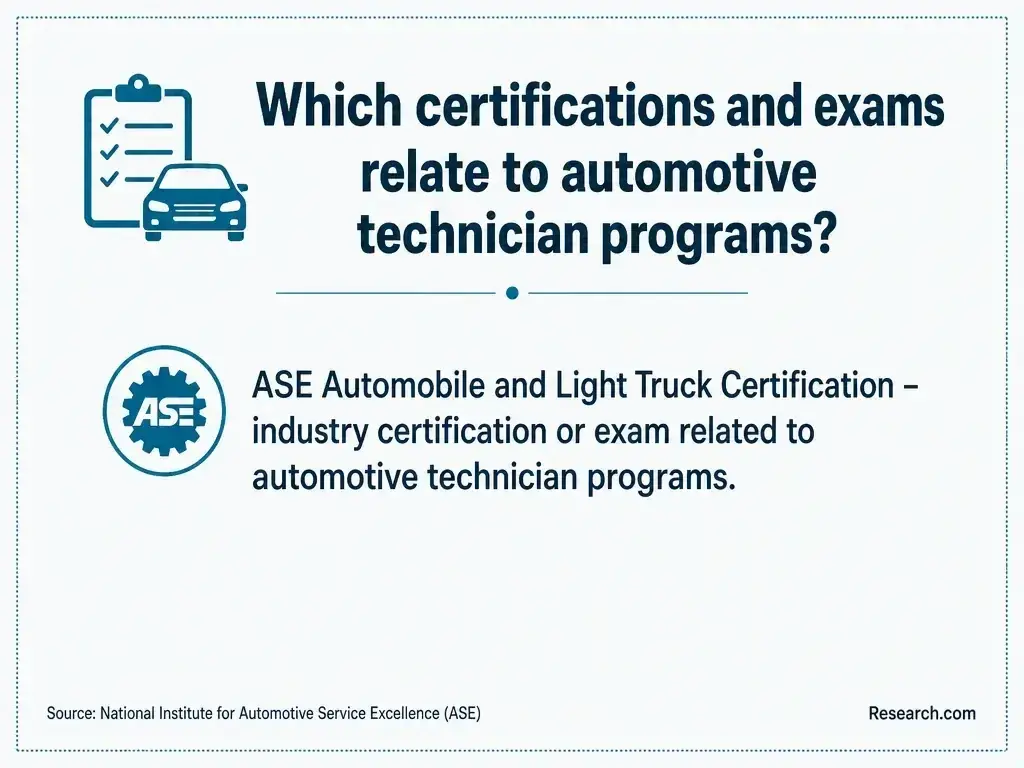
The award depends on the specific program: it may be a certificate, diploma, or associate degree. A school credential records completed education; it is not the same as an Automotive Service Excellence (ASE) certification, an employer qualification, or a registered-apprenticeship completion credential. Ask admissions to name the exact award on the transcript and explain which jobs its graduates typically pursue.
Institutional accreditation concerns the school; automotive program recognition or industry alignment concerns the training. Neither automatically grants ASE certification or a state inspection authorization. If you may continue training later, ask whether credits transfer, prior shop experience earns credit, or classroom instruction can count toward an apprenticeship. Get the receiving institution's or sponsor's answer in writing.
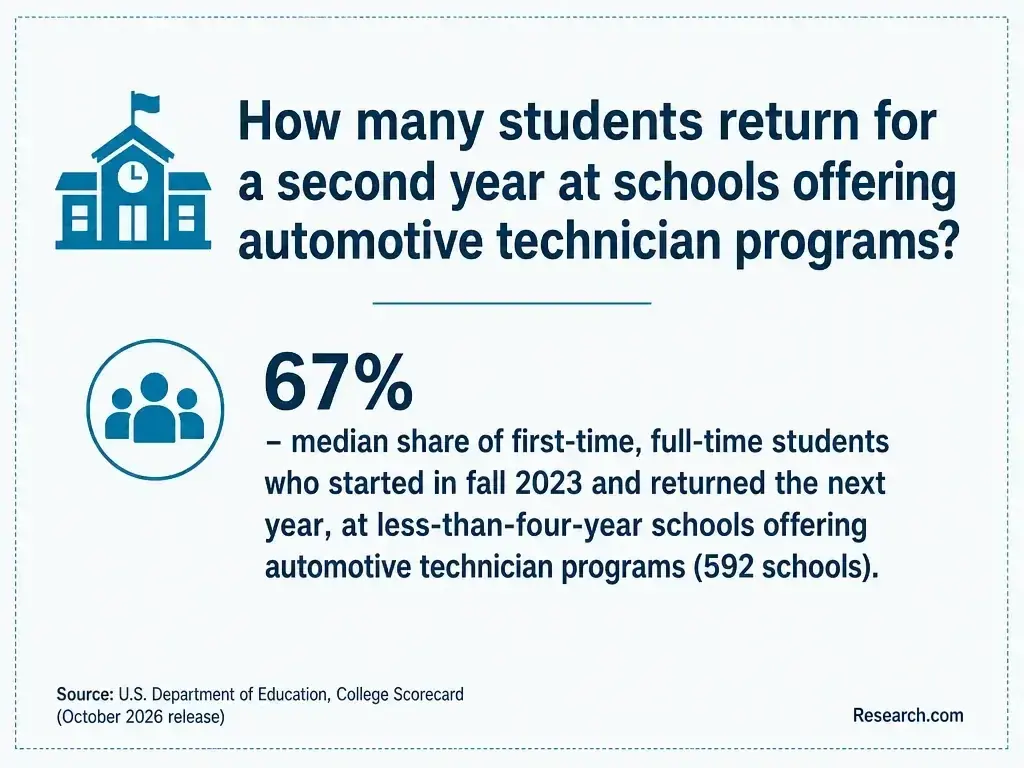
Requirements vary by provider and pathway. Ask each school about its education prerequisite, placement process, start dates, required tools, and any conditions for shop participation. An employer-sponsored position instead requires applying to the employer; a registered apprenticeship has sponsor-specific selection rules and structured on-the-job learning (U.S. Department of Labor).
Separate entry into training from entry into a job. An employer may screen driving history or require a valid driver's license for moving and testing vehicles even when the school does not. Confirm placement requirements before paying a deposit, especially if transportation, shift availability, or access to a worksite could prevent you from completing practical training.
A useful entry-level curriculum connects maintenance and repair with diagnosis: brakes, steering and suspension, engine performance, electrical systems, and safe shop procedures. Technicians also need to interpret service information, record findings, explain recommended work, and check whether a repair solved the original complaint (U.S. Bureau of Labor Statistics, Occupational Outlook Handbook).
Vehicle electronics make the quality of practical instruction especially important. Compare how often students use scan tools, electrical test equipment, service databases, and actual vehicles - not just whether those topics appear in a catalog. If your target employer services a particular fleet or vehicle type, ask whether the program teaches those systems and offers relevant worksite experience.
Virginia does not impose a general occupational license on every automotive repair technician. Specific duties can carry separate requirements: a technician who wants to conduct Virginia safety inspections must meet the Virginia Department of Motor Vehicles' inspector requirements and obtain its authorization. Do not assume that completing an automotive program provides that authorization.
ASE certifications are voluntary professional credentials that employers may value; ASE sets examination and work-experience requirements, so passing a course alone is not certification (National Institute for Automotive Service Excellence). Servicing motor-vehicle air-conditioning systems for compensation involves separate technician-certification rules under EPA Section 609 (U.S. Environmental Protection Agency). Ask the school which exams it prepares students for, which fees it includes, and which work experience or authorization must still be obtained afterward.
Start with the job you want, then compare programs against that job - not against their ranking positions alone. For a passenger-car repair role, a low-cost program with inadequate vehicle practice may be poorer value than a more expensive one with strong shop access; a paid employer route may be better if you can secure structured mentoring.
Use these checks before making a commitment:
- Request the exact award, total credit or clock hours, supervised shop hours, sample schedule, and written all-in cost.
- Verify institutional accreditation with the accreditor and any claimed automotive industry recognition with the issuing organization; confirm state authorization separately where applicable.
- Ask to see the shop, equipment, student access to vehicles, and how practical skills are assessed.
- Request program-specific completion and placement definitions, then ask local employers what experience they expect of a new hire.
- Compare financial aid and paid-training options, travel time, debt, and earnings you may give up while enrolled.
Watch for vague "job guarantee" claims, an advertised online credential without identifiable shop training, or a quote that omits required tools. Ask for written answers before enrolling.
A common path starts with maintenance or entry-level repair, then moves toward diagnostic and specialty work as experience grows. ASE credentials can document developed skills; a technician may later pursue service advising, shop supervision, or self-employment. None is an automatic outcome of an initial certificate, and business ownership brings expenses beyond technician training.
People seeking a good job for introvert should still consider the communication involved: technicians document faults, coordinate with service advisers, and explain technical findings. Ask to observe a shop before enrolling if its pace, physical demands, or customer contact could affect your fit.
The U.S. Bureau of Labor Statistics projects 5.0% national employment growth from 2025 to 2035 for automotive service technicians and mechanics. That supports considering the occupation, but it does not measure Norfolk openings or guarantee a placement. Replacement hiring and the mix of dealerships, independent shops, and fleet employers can matter more to an individual job search than a national growth rate.
Before committing, review current local postings for the exact entry role you want. Note which request experience, a driver's license, tools, or ASE credentials, and ask providers how students acquire those qualifications. Training that leads to demonstrable diagnostic and repair skills is more useful than a credential whose name merely matches the job posting.
Most Affordable Automotive Technician Schools & Training in Norfolk for 2027
Investing in training is an important decision, so Research.com evaluates programs against others in the same occupation and location rather than treating every trade-school option as interchangeable. Only programs with completions reported to IPEDS are eligible for the ranking; that limit does not mean an employer program or apprenticeship absent from IPEDS is unsuitable.
For the most affordable ranking, the score uses tuition, cost of attendance, median student debt, and federal loan default rate. An entropy-based method assigns more weight to measures that distinguish programs more clearly. Accreditation, student outcomes, and other quality indicators are not part of this affordability score. Readers should check them separately before enrolling. Research.com also maintains a distinct best-programs framework that considers outcomes, earnings, costs, accreditation or industry recognition, and student support; its weights should not be mistaken for the affordability-ranking formula.
The Research.com team draws on the following data sources for its trade-program ranking work and verification. Some organizations below cover other trades or healthcare occupations; their inclusion as sources does not make them automotive accreditors or add their criteria to this affordability score.
- IPEDS database - program completions and institution-reported education data.
- National Center for Education Statistics - definitions and context for federal education data.
- College Scorecard database - available institutional cost, debt, and outcomes measures.
- Peterson's database - supplemental institution and program information.
- Commission on Accreditation of Allied Health Education Programs (CAAHEP) - occupation-specific accreditation reference for applicable fields.
- Accrediting Bureau of Health Education Schools (ABHES) - health-education accreditation reference where applicable.
- Commission on Dental Accreditation (CODA) - dental-program accreditation reference where applicable.
- Dental Assisting National Board (DANB) - dental-assisting credential reference where applicable.
- National Center for Construction Education and Research (NCCER) - construction-trade training and credential reference where applicable.
- Apprenticeship.gov Partner Finder - apprenticeship-pathway reference.
This approach helps readers identify lower-cost reported programs, not declare any program the best fit or calculate its full out-of-pocket price. See the Research.com methodology for more about how rankings are created, then confirm current charges and training details with each provider.
# 2 position
Tidewater Community College - Automobile/Automotive Mechanics Technology/Technician.
certificate or diploma# 3 position
Tidewater Tech-Trades - Automobile/Automotive Mechanics Technology/Technician.
certificate or diploma
Frequently asked questions about automotive technician programs in Norfolk
Which Norfolk automotive training route is cheapest?
There is no universal cheapest route. Compare each school's written total cost with paid employer training or apprenticeship options, including tools, travel, aid, wages, and the time needed to finish.
Is an associate degree necessary to become an automotive technician?
No. Entry routes can include a certificate, diploma, associate degree, or structured employer training. Choose based on the practical skills and credential your target employer expects.
Can I train entirely online?
You can study some theory online, but vehicle inspection, diagnosis, and repair require in-person practice and assessment. Confirm where a hybrid program provides that experience.
Does graduation give me ASE certification?
No. ASE certification has its own examination and work-experience requirements. Ask whether the program prepares you for relevant tests and how its training may relate to experience eligibility.
Is an affordability ranking enough to choose a program?
No. Use it to identify options to investigate, then verify current total cost, hands-on hours, completion information, accreditation or recognition claims, and fit with your intended job.
- U.S. Bureau of Labor Statistics - Automotive Service Technicians and Mechanics
Used to verify salary, employment outlook, and typical education requirements.
https://www.bls.gov/ooh/installation-maintenance-and-repair/automotive-service-technicians-and-mechanics.htm - NCES College Navigator (IPEDS)
Used to verify programs offered and institutional accreditation.
https://nces.ed.gov/collegenavigator/ - ASE - Certification
Professional certification reference for graduates of this occupation.
https://www.ase.com/ - Tidewater Community College - official website
Official school website (programs, tuition, admissions).
https://www.tcc.edu/ - Tidewater Tech-Trades - official website
Official school website (programs, tuition, admissions).
https://tidewatertechtrades.edu/