# 1 position


Audited and Verified:
Our Editorial and Data Verification Process
Research.com uses government datasets, official education statistics and primary institutional information to support its career and degree guides. Our review process checks factual accuracy, occupational definitions, source dates and the requirements associated with the credentials discussed.
How This Article Was Fact-Checked
Our editorial team verifies salary estimates, employment projections, education requirements and program information against original data providers and official organizations. Salary figures are checked against the relevant occupational definitions and reporting periods. Information about licensure, accreditation and required in-person training is reviewed separately.
Fact-checked and verified on:

Co-Founder and Chief Data Scientist

Reviewed by Karolina Broda
Fact-Checker and Data Verification
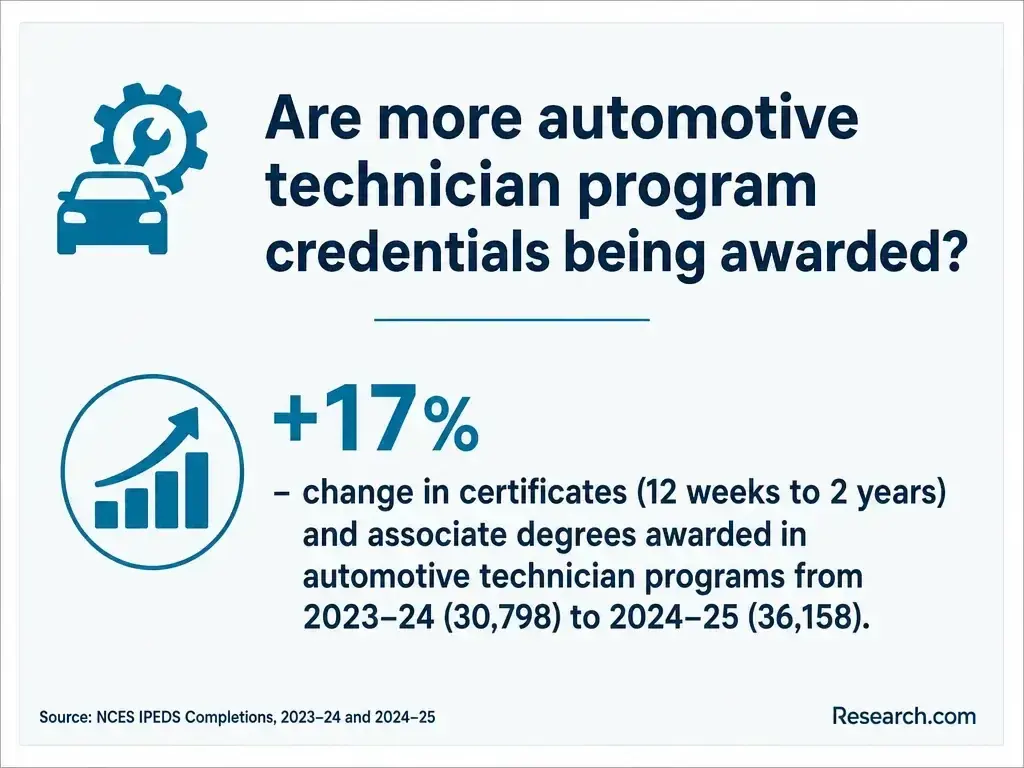
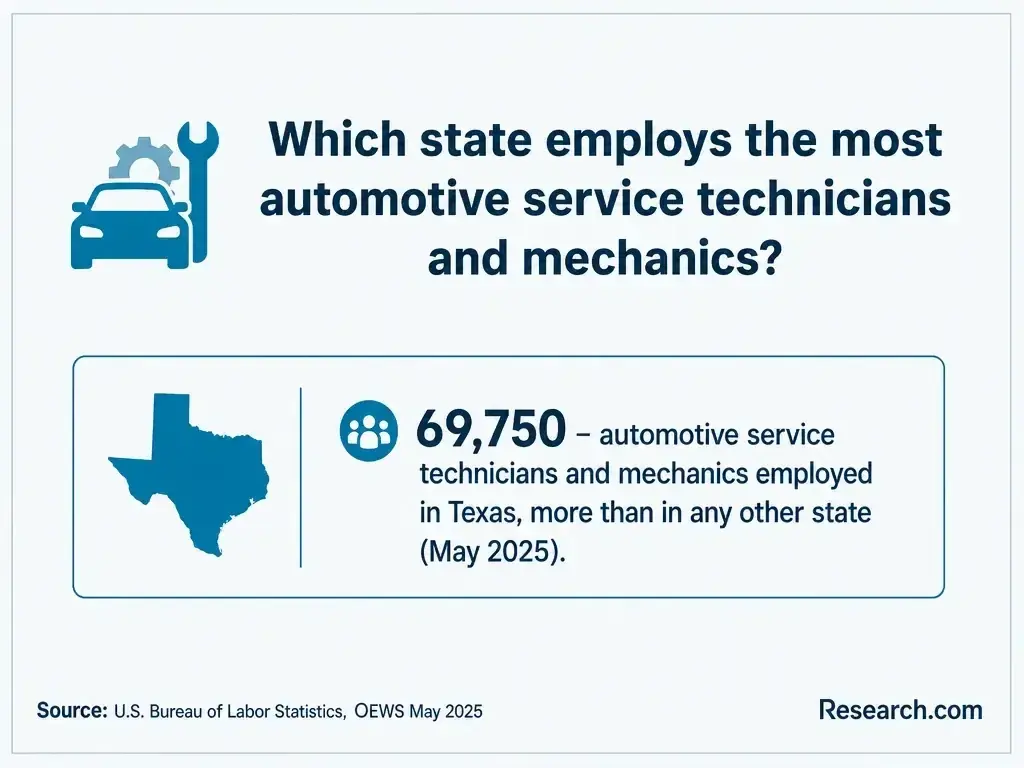
Choosing automotive training means weighing shop time, total cost, and whether employers will value the credential - not just comparing school names. The U.S. Bureau of Labor Statistics projects 5% national growth for automotive service technicians and mechanics from 2025 to 2035, making preparation for changing vehicle technology a timely decision. This guide explains Ohio training routes, costs, credentials, and career prospects. It also features the Best Automotive Technician Trade Schools in Ohio for 2027 ranking, created by the Research.com team of data scientists to help students identify programs worth considering.
Expect a mix of classroom instruction, vehicle-system labs, diagnostic exercises, and supervised shop work. Automotive technology programs commonly cover brakes, steering and suspension, electrical systems, engines, and drivability. Their value depends on how often students diagnose and repair vehicles themselves - not merely on the number of topics in a catalog.
Ohio offers distinct routes. A public college certificate can suit someone seeking focused training at resident tuition rates; an associate degree adds academic coursework and may make more sense for someone who wants a broader credential. A career-center or private career-school diploma may emphasize a structured, shop-intensive schedule. Sinclair Community College, Great Oaks Career Campuses, Ohio Technical College, Polaris Career Center, and Lorain County Joint Vocational School District illustrate the types of providers to investigate, but offerings, eligibility, and schedules must be confirmed for the intended enrollment year.
School is not the only entry route. A paid entry-level service job with employer training may suit someone who cannot stop earning, while a registered apprenticeship combines paid work with structured training when a suitable opening exists. Neither should be assumed to provide the same curriculum or completion credential as a school program. If speed matters, compare actual shop hours and placement support - not just advertised duration - when reviewing 12 month certificate programs that pay well.
Potential workplaces include independent repair shops, dealership service departments, tire and quick-service businesses, municipal fleets, and companies maintaining delivery vehicles. The best training match differs: a general repair shop may value broad diagnostic ability, while a dealership may add manufacturer-specific instruction after hiring.
Location affects access as well as job choice. Larger Ohio metro areas can offer a wider mix of dealerships and fleet employers; a student outside those areas should check where internships or employer placements actually occur and whether the commute is sustainable. Ask prospective employers which entry-level tasks they assign, what tools new hires must supply, and whether paid training continues after hire.
The latest national benchmark supplied by the U.S. Bureau of Labor Statistics is a $50,620 median annual wage in May 2025 for automotive service technicians and mechanics. A median describes workers across experience levels and workplaces; it is not an Ohio starting-wage estimate. Before using any pay claim to justify tuition, ask programs for recent local employer offers and compare them with current Ohio occupational wage data from the state labor-market agency, using the same occupation and reference period.
Pay can also depend on hourly versus flat-rate arrangements, available work, certifications, and tool costs. An employer's advertised earning potential is less useful than its written starting-pay terms and training policy. Lists of most lucrative majors are not a substitute for comparing automotive training costs against your own likely starting pay and current earnings.
Length depends on the credential and schedule. A focused certificate may take less time than a broader diploma or associate degree; part-time attendance extends calendar time without necessarily changing required coursework. Employer training and apprenticeships follow work-based schedules rather than a single school term. There is no universal Ohio clock-hour requirement for entry to the general automotive technician occupation.
Request each provider's published contact hours, the portion spent in a staffed shop, the number of terms, and any required work placement. An accelerated schedule is worthwhile only if you can attend consistently and still get enough practice diagnosing real faults. For working adults, a longer evening program may have a lower opportunity cost than leaving a job for full-time study.
Online study can cover theory, service information, safety, and some diagnostic concepts. On-campus or worksite training is needed to demonstrate tasks such as inspecting brakes, using scan tools and electrical test equipment, and repairing vehicles under supervision. A hybrid program can work well if its in-person shop schedule is accessible; a fully online course should not be treated as equivalent to supervised vehicle practice.
Compare formats by the practical time you can actually attend, not by the convenience of the lecture component. For a rural student, repeated travel to a distant shop may outweigh a modest tuition saving. Likewise, a listing among the cheapest college online options does not establish the cost or quality of its in-person automotive training. Ask where labs take place, who supplies vehicles and equipment, and how skills are assessed.
There is no single reliable statewide average that covers Ohio public colleges, career centers, private career schools, apprenticeships, and employer training on a comparable basis. A published tuition figure may exclude a substantial part of becoming job-ready. Request a written, program-specific estimate for your residency and attendance status.
To compare offers fairly, include tuition and mandatory fees; books and software; tools, safety gear, uniforms, and consumables; optional or required certification exams; and transportation to shops or work placements. Add lost earnings if attendance reduces your work hours, then subtract grants, scholarships, eligible federal aid, workforce funding, or paid-training income you can actually obtain. Federal Student Aid explains that aid eligibility depends on the institution, program, and student - not simply on a school calling itself a trade school.
A shorter, more expensive program is not automatically a worse investment, nor is a lower tuition price automatically better. Compare total net cost, time out of work, completion prospects, expected pay improvement, debt payments, and the time needed to recover your investment. OhioMeansJobs can help eligible residents investigate workforce-training assistance; confirm eligibility and approved-provider status before enrolling.
The award may be a certificate, diploma, or associate degree, depending on the program. A registered apprenticeship produces a work-based completion credential under its sponsor's terms; employer training may produce only company-specific documentation. Ask for the exact award printed on completion records and what requirements must be met to receive it.
These credentials are distinct from Automotive Service Excellence (ASE) certification. ASE certifications generally require both passing the relevant test and meeting its work-experience rules; training may count toward experience under ASE's policies, but finishing a course alone does not confer certification (ASE). ASE Education Foundation program accreditation, where held, evaluates automotive training against its standards. It is separate from institutional accreditation, Ohio school authorization, and an individual technician's ASE certification (ASE Education Foundation).
Requirements vary by provider and pathway. Schools may request an application, evidence of prior schooling or an equivalent credential, placement information, and proof that the applicant can meet shop-safety expectations. Work-based routes may add an employer interview, driving-record review, or hiring requirements. Ask whether prior automotive coursework or documented work experience can shorten training, and obtain any credit decision in writing.
Open admission to an institution does not necessarily mean immediate access to a particular shop course, desired schedule, or employer placement. That distinction matters when comparing online college open enrollment with automotive training that has equipment, lab-capacity, and in-person attendance requirements. Confirm the next start date and required courses before making work or transportation plans.
A useful program teaches technicians to move from a customer complaint to a safe, documented diagnosis rather than simply replacing a suspected part. Students should practice reading service information and wiring diagrams, testing circuits, using scan data, inspecting mechanical systems, and verifying a repair. Communication, accurate estimates, and workplace safety matter because technicians must explain findings and work around moving equipment, chemicals, and high-voltage systems.
Ask to see how the curriculum handles hybrid and electric vehicles, advanced driver-assistance systems, and current diagnostic software. Coverage of these technologies does not automatically make a graduate qualified for every specialized repair: employers may require additional manufacturer instruction and supervised experience. Compare the vehicles, tools, instructor access, and assessed shop tasks available to students - not just course titles.
No general statewide automotive technician license is required for ordinary entry-level repair work in Ohio. This makes school completion and ASE certification different from permission to enter the occupation. Employers can still set hiring and training standards, and particular work can trigger separate requirements. For example, the U.S. Environmental Protection Agency requires Section 609 technician certification for servicing motor-vehicle air-conditioning systems in ways covered by its refrigerant rules.
Check the tasks attached to your intended job before paying for an exam. Verify ASE experience and test requirements with ASE, and ask a program which certifications its instruction prepares students to pursue. Institutional accreditation or Ohio authorization does not substitute for an individual certification or any task-specific federal requirement.
Start with the job you want - general repair, dealership service, or fleet maintenance - and compare programs against that goal. A ranking can identify options to investigate, but it cannot tell you whether a lab schedule fits your work hours or whether local employers recruit from a particular program.
Use the same questions for every provider so a polished tour or a low advertised tuition does not obscure a weak fit:
Be cautious if a provider cannot document shop access, presents ASE certification as an automatic graduation benefit, or quotes earnings without identifying the occupation and reference period. For an applicant who already has access to a supportive paid shop job, employer training may be a better first step than borrowing; for someone who needs structured foundations and equipment access, a school program may justify its cost.
Training can lead first to general service or entry-level repair, followed by more independent diagnosis as skills grow. With experience, technicians may specialize in electrical faults, drivability, brakes, climate control, or manufacturer-specific systems; some move into shop supervision or service operations. Self-employment adds business and equipment costs rather than following automatically from a training credential.
Use trade schools careers comparisons as a starting point, then ask Ohio employers which tasks and experience they require for the role you want. A program heavily focused on one service area may be an efficient entry route but a less complete foundation for broad diagnostic work. Optional advanced certifications can help document skills after experience; they are not a general Ohio entry license.
The U.S. Bureau of Labor Statistics projects 5% national employment growth from 2025 to 2035 for automotive service technicians and mechanics. This is a national occupational projection, not an Ohio placement rate or a guarantee of an opening near a particular school. Use current Ohio labor-market projections and local employer postings to test demand in the area where you intend to work.
Vehicle electronics and changing powertrains make diagnostic practice important, but they do not remove the need for foundational mechanical skills. When comparing programs, look for both: a student who can safely inspect and repair common systems while learning updated diagnostic methods has more options than one trained only on a narrow set of tasks.
Investing in education is an important decision. The Research.com team created the ranking to help readers compare automotive technician programs against other programs in the same occupation and location, rather than against unrelated schools. Only programs with completions reported to the Integrated Postsecondary Education Data System (IPEDS) are eligible; that limit means the ranking does not cover every apprenticeship, employer training program, or other available route.
Best-program rankings assess student outcomes; earnings and return on investment; costs and debt; and quality and recognition. Measures include completion and full-time and part-time retention, median earnings one year after completion, earnings relative to annual attendance cost, tuition, attendance cost, median debt including debt held by students who withdrew, federal loan default rates, accreditation or relevant industry recognition, and student support. Programmatic accreditation or industry recognition relevant to the occupation receives 20% of the score, institutional accreditation 10%, and student support 10%. The remaining 60% covers outcomes, earnings, and costs, with weights distributed using an entropy-based method that gives more weight to indicators that vary more across programs.
Most-affordable-program rankings are different: they score tuition, attendance cost, median debt, and federal loan default rates using entropy-based weights. Accreditation and other quality indicators are not part of that affordability score. This distinction helps readers use each ranking for its intended purpose without mistaking a low-cost result for a full evaluation of training quality.
The team uses the following sources to check program, institutional, outcome, and recognition information across its trade-school rankings. Some are relevant to other occupations rather than automotive technology; their inclusion does not make them automotive accreditors.
Using multiple sources and separating best-program from affordability criteria makes the ranking a more useful starting point. Readers should still confirm current program costs, shop access, and employer connections directly. More detail appears in Research.com's ranking methodology.
# 1 position
# 2 position
# 3 position
# 4 position
# 5 position
Automobile/Automotive Mechanics Technology/Technician
Delivery mode: On Campus (May Include Online Courses)
56.54
/ 100
Final score
Accreditation
Institutional accreditation from Accrediting Commission of Career Schools and Colleges.
Ohio Technical College earned a Research.com Trade Program Score of 56.54/100, supported by 87% school graduation rate and 97% full-time student retention rate.
# 6 position

# 7 position
# 8 position

# 9 position
# 10 position

# 11 position
# 12 position
# 13 position

# 14 position

# 15 position

# 16 position
# 17 position
# 18 position
# 19 position
# 20 position

It can be if supervised shop access and employer connections help you reach a job you could not obtain as readily through paid entry-level training. Compare the program's total net cost, time away from work, and credential against local hiring requirements before committing.
Yes. Some employers train entry-level hires, and a suitable apprenticeship may combine paid work with instruction. Ask what training, supervision, and completion documentation each route provides.
No general Ohio rule requires ASE certification for entry-level automotive technician work. Employers may value it, and ASE sets separate testing and experience requirements.
Online coursework can teach theory, but vehicle inspection, diagnosis, and repair require practical experience. Confirm where and when supervised shop training occurs before enrolling in an online or hybrid program.
Ohio does not require a general statewide license for ordinary automotive technician work. Specific tasks can have separate rules, including federal EPA Section 609 certification requirements for covered motor-vehicle air-conditioning service.