# 1 position


Audited and Verified:
Our Editorial and Data Verification Process
Research.com uses government datasets, official education statistics and primary institutional information to support its career and degree guides. Our review process checks factual accuracy, occupational definitions, source dates and the requirements associated with the credentials discussed.
How This Article Was Fact-Checked
Our editorial team verifies salary estimates, employment projections, education requirements and program information against original data providers and official organizations. Salary figures are checked against the relevant occupational definitions and reporting periods. Information about licensure, accreditation and required in-person training is reviewed separately.
Fact-checked and verified on:

Co-Founder and Chief Data Scientist

Reviewed by Karolina Broda
Fact-Checker and Data Verification
Choosing automotive technician training in Washington means weighing shop experience, cost, and time away from paid work - not just a school's name. The U.S. Bureau of Labor Statistics projects 5% national employment growth for automotive service technicians and mechanics from 2025 to 2035. The Best Automotive Technician Trade Schools in Washington for 2027 ranking, created by the Research.com team of data scientists, is designed to help students identify programs worth considering. This guide explains how to compare those options with apprenticeships and employer training, then judge which path fits your budget and career goal.
Expect a combination of classroom instruction and supervised shop work: inspecting vehicles, using scan tools and service information, testing electrical circuits, servicing brakes and steering systems, and documenting repairs. A program should explain which tasks students perform themselves, not merely which systems its catalog mentions. Automotive Service Excellence (ASE) describes its credentials as tests of knowledge and, for most professional certifications, applicable work experience; completing a course is not the same as earning ASE certification (ASE).
The main routes differ in when you earn, how much work-based practice is built in, and what credential you leave with. This comparison helps identify the route that matches your need for income and structured instruction.
| Route | Typical credential or outcome | Best fit and principal trade-off |
| Community or technical college | Certificate or, where offered, an associate degree | Fits students seeking structured instruction and a documented credential; check fees, scheduling, and shop access. |
| Private career school | Usually a certificate or diploma, depending on the program | May suit a student seeking a focused schedule; compare total charges and independently verify outcomes. |
| Registered apprenticeship | Paid, structured on-the-job training with related instruction and a completion credential | Fits someone ready to learn while employed; openings and entry conditions depend on the sponsor. |
| Employer-sponsored or direct-entry training | Employer training record, with optional later certifications | Can reduce upfront school costs; training breadth depends on the workplace. |
A college-based route can make sense if you need broad practice before applying to shops. If an employer will pay you to learn and provide qualified supervision, compare that offer before paying for an accelerated course. A fast track program may save calendar time, but speed alone does not establish that you will get enough hands-on diagnostic practice.
Potential workplaces include independent repair shops, dealership service departments, tire and quick-service businesses, and vehicle-fleet maintenance operations. The employer matters as much as the job title: a quick-service position may build inspection and routine-maintenance skills, while a general repair shop may offer a wider path into electrical and drivability diagnosis. Automotive technicians work across these kinds of settings nationally (U.S. Bureau of Labor Statistics, Occupational Outlook Handbook).
Ask local employers what vehicles and systems their entry-level technicians actually service. A student planning to work near a particular Washington community should favor accessible shops and training sites over a distant program whose schedule makes commuting or work placement impractical. If your goal is dealership work, ask whether the program offers manufacturer-specific equipment or employer connections; if it does not, a general automotive program may still be useful, but expect additional employer training.
Use Washington-specific occupational wage information when budgeting for a local job search. The Washington Employment Security Department publishes occupational wage information; compare its automotive service technician and mechanic figures for the area where you intend to work with actual entry-level postings. Statewide figures can mask differences among labor markets and do not describe what a new technician will be offered.
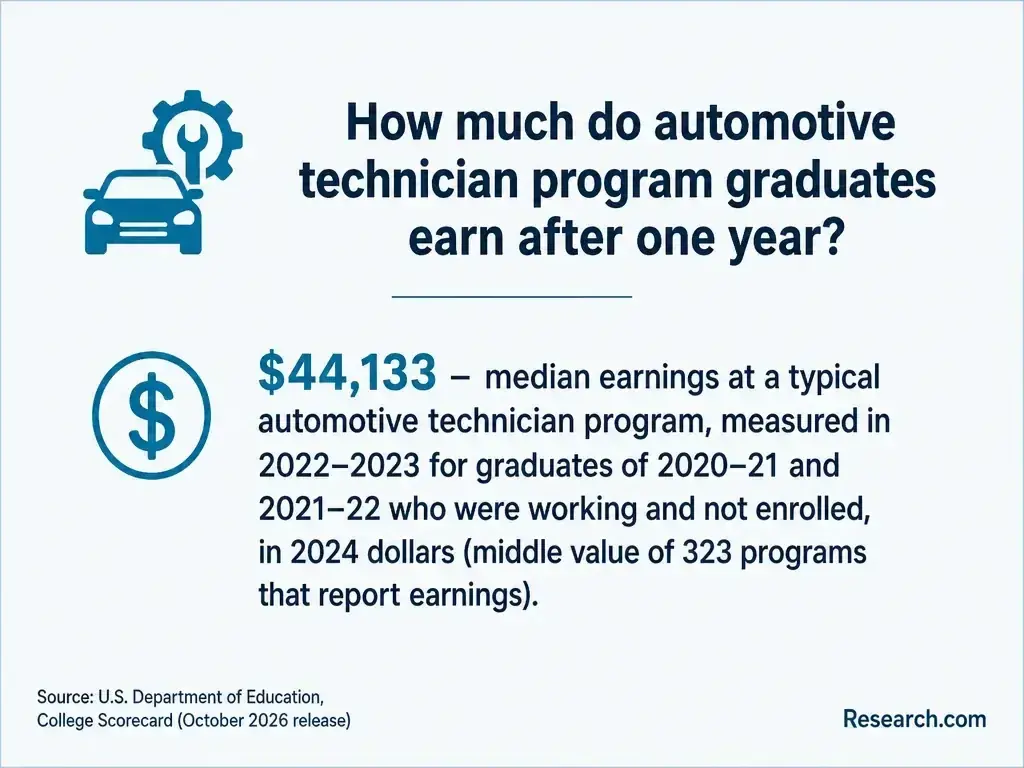
For a national reference point, the median annual wage for automotive service technicians and mechanics was $50,620 in May 2025 (U.S. Bureau of Labor Statistics, Occupational Outlook Handbook). Half of workers in the occupation earned more and half earned less; the figure includes experienced technicians. Ask prospective employers how pay works - hourly wages, flat-rate compensation, or another arrangement - and whether tool purchases or employer-provided training affect your first-year take-home pay.
There is no single Washington-required number of classroom or shop hours for entry into general automotive service. A focused certificate, a broader associate degree, an apprenticeship, and employer training follow different calendars; full-time and part-time schedules differ as well. Request each program's current catalog for its total credits or clock hours, scheduled shop hours, and expected completion time. Do not infer hands-on time from the credential's name.
A shorter program may get you into paid work sooner, while a longer one may cover more systems and provide more supervised troubleshooting. For working adults, evening access to a shop and the number of days per week on campus can matter more than advertised speed. Guides to top degrees for older adults online address a different education format; automotive trainees of any age still need a practical plan for in-person skill development.
Online instruction can cover service procedures, safety, system theory, and some diagnostic reasoning. It cannot replace physically testing a circuit, operating shop equipment, inspecting a vehicle, or completing a repair under supervision. A hybrid program is credible only if it specifies where those practical tasks occur, who evaluates them, and whether students can attend at workable times.
Ask for the share of instruction delivered in a shop, whether vehicles and current diagnostic tools are available, and how missed lab sessions are made up. An entirely online course may be useful preparation for an entry-level job, but it should not be treated as equivalent to supervised automotive shop training. Lists of accredited online universities offering free applications answer a different question: neither an online application nor institutional accreditation confirms hands-on automotive competence.
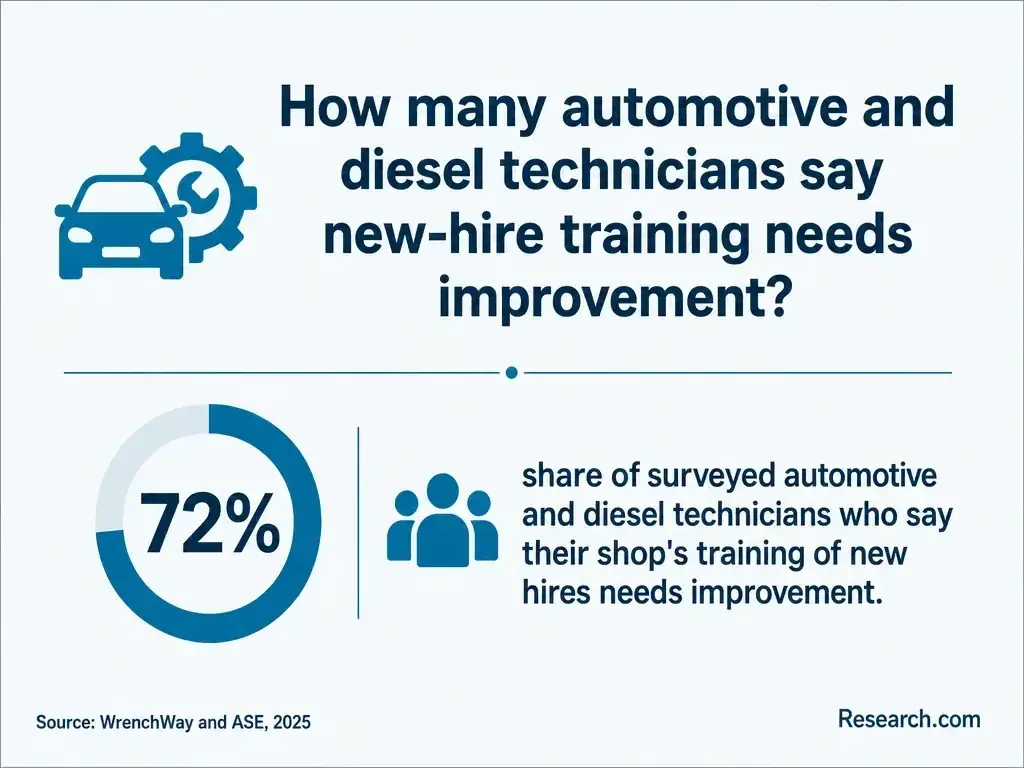
There is no defensible single price for every Washington automotive pathway: schools set different tuition and fees, programs vary in length, and paid employer training has a different cost structure from full-time study. Compare a written, current cost estimate for the exact credential and your residency status. At public colleges, confirm whether residency affects your rate; at any school, check which expenses are included in its advertised price.
The amount you need to become job-ready may include mandatory fees, textbooks or software, tools, safety gear, consumables, transportation to shops, and optional certification exam fees. Time out of the workforce is also a real cost. Grants, scholarships, eligible federal or Washington state aid, workforce assistance, and paid training can change the amount you ultimately pay; eligibility depends on the student and program (Federal Student Aid; Washington Student Achievement Council).
For a useful return-on-investment comparison, estimate the full training cost and earnings you would forgo, then compare realistic post-training pay with what you could earn without enrolling. Account for aid, likely borrowing, your chance of completing, and how long you expect to work in the field. A low tuition quote is not necessarily the cheaper route if it omits required tools or prevents you from working.
The credential depends on the route: a school may award a certificate, diploma, or associate degree; a registered apprenticeship has its own completion credential; an employer may document completed training without awarding a school credential. Confirm the exact award in the current catalog and ask what work a student can demonstrate on completion. Similar credential names do not mean programs provide the same shop experience.
Keep the categories separate. Institutional accreditation evaluates a school; state authorization concerns its permission to operate; occupation-relevant program recognition concerns particular training standards; and ASE certification is an individual professional credential with its own requirements. None automatically substitutes for another (U.S. Department of Education; ASE). An online dual degree program is not a substitute for the practical automotive credential or work experience an employer expects.
Requirements vary by provider. A school may ask for an application, evidence of prior education, placement information, and participation in an orientation; a registered apprenticeship or employer training position may instead require hiring eligibility and selection by a sponsor or shop. Verify requirements directly with the provider rather than assuming admission rules are uniform (institution or apprenticeship sponsor admissions policies).
Before paying an application fee, ask whether you need tools, work clothing, or transportation from the first day; whether you can safely participate in shop tasks; and whether the schedule permits your existing job. Also ask if previous automotive coursework or documented work experience can count toward a certificate, provide advanced standing, or connect with an apprenticeship. Get any credit decision in writing: prior learning is not automatically accepted.
Useful entry-level training joins mechanical work with evidence-based diagnosis. Students should learn to interpret customer concerns, use repair information, inspect and test systems, explain findings, complete work safely, and verify the repair. Core areas commonly include brakes, steering and suspension, electrical systems, engine performance, and routine maintenance (U.S. Bureau of Labor Statistics, Occupational Outlook Handbook; ASE).
Vehicle electronics make equipment access especially important. Ask to see the scan tools, electrical-testing equipment, vehicles, and service-information systems students use - not just a course-title list. If you hope to work on hybrids or electric vehicles, ask what high-voltage safety instruction and supervised practice the program provides. Do not assume every general automotive course covers those systems in depth.
Washington does not impose a general individual occupational license simply to work as an automotive service technician. Employers can still set hiring and training requirements, and particular tasks or businesses may be subject to separate rules. Verify requirements for a specialized role with the relevant Washington regulator or employer rather than assuming the general rule covers every activity (Washington State Department of Licensing).
ASE certification is a separate, voluntary professional credential, not a Washington entry license. ASE's professional certifications generally require passing the applicable test and documenting qualifying work experience; students should check the current requirements for the specific certification they want (ASE). A school's accreditation or industry recognition may help you assess training quality, but it does not award ASE certification or replace experience.
Start with the job you want and the area where you intend to work. Then compare the ranking's school-based options with local apprenticeships and employers willing to train new hires. Research.com's ranking is a screening tool, not a substitute for inspecting a shop, checking current prices, and speaking with people who hire technicians.
Use these checks to find gaps that a brochure or ranking score may not reveal:
A warning sign is a promise of certification or a particular salary merely for enrolling. Another is an "online" automotive program that cannot explain how students practice and have repairs assessed. Choose the route that gives you credible skills at a sustainable total cost, not simply the shortest advertised timeline.
An initial role may center on maintenance and inspections, with broader diagnostic and repair responsibility developing through supervised work. Experienced technicians may specialize in electrical or drivability problems, pursue relevant ASE certifications, train newer staff, or move into shop leadership. Advancement depends on demonstrated skill and opportunity; a starting certificate does not confer a senior role (U.S. Bureau of Labor Statistics, Occupational Outlook Handbook; ASE).
If you want to own or manage a repair business, learn how estimates, customer communication, parts decisions, and workflow affect the job - not only how to repair vehicles. For someone whose goal is hands-on automotive service, a doctorate without dissertation is unrelated to occupational entry; supervised shop experience and relevant technical training are the investments to evaluate.
The U.S. Bureau of Labor Statistics projects 5% national employment growth for automotive service technicians and mechanics from 2025 to 2035. This is a national projection, not a forecast of openings in your Washington community. For a local decision, consult Washington Employment Security Department occupational projections and compare them with current postings in the places you could realistically commute to.
Job growth alone cannot establish that training will pay off. Look for employers offering supervised development, note the vehicle systems named in postings, and ask whether a program's shop equipment prepares you for those tasks. If nearby entry-level opportunities are limited, the availability of paid placements or your willingness to commute may change which program is worth its cost.
Education is a consequential investment. Research.com created this ranking to help readers compare automotive technician programs with other programs serving the same occupation and location, rather than with unrelated schools. The team uses reported outcomes, costs, recognition, and student-support information to assess program quality and check the credibility of its comparisons.
Only programs with completions reported to the Integrated Postsecondary Education Data System (IPEDS) are eligible. That boundary matters: an employer training program or apprenticeship may be a strong option even if it does not appear in this ranking. Best-program scores consider student completion and full-time and part-time retention; earnings one year after completion and earnings relative to annual attendance cost; tuition, attendance cost, debt - including debt held by students who withdrew - and federal loan default rates; and relevant recognition and student support.
Programmatic accreditation or occupation-relevant industry recognition accounts for 20% of the score, institutional accreditation for 10%, and student support for 10%. Outcomes, earnings, and costs account for the remaining 60%, with an entropy-based method assigning more weight to indicators that vary more across programs. Separate most-affordable-program rankings score only tuition, attendance cost, median debt, and federal loan default rates; accreditation and other quality indicators do not enter that score.
The ranking draws on the following sources. Some accreditation and certification sources cover other trades and health occupations; their inclusion in the broader source set does not imply that those credentials apply to automotive training.
Use the ranking to narrow your search, then verify current program details directly. A score cannot tell you whether a particular shop schedule, tool bill, or employer connection fits your circumstances. More information about the approach appears on the Research.com methodology page.
# 1 position
# 2 position
# 3 position
# 4 position
# 5 position
# 6 position

# 7 position
# 8 position

# 9 position
# 10 position
# 11 position
# 12 position

# 13 position
# 14 position

# 15 position

# 16 position
# 17 position
# 18 position
# 19 position

# 20 position
It can be if the program provides substantial supervised practice and its full cost is reasonable relative to your other options. Compare it with paid employer training or an apprenticeship, especially if you need income while learning.
Yes. Some employers train entry-level workers, and registered apprenticeships combine paid work with instruction. Ask how each route develops diagnostic skills and documents your experience.
You can study theory online, but vehicle inspection, testing, and repair require in-person practice. Check where a hybrid program conducts and evaluates its shop work.
No. ASE certification has separate testing and applicable experience requirements. Ask whether a program prepares you for specific tests without assuming completion awards certification (ASE).
Request the total cost, exact credential, shop-hour breakdown, schedule, available aid, and evidence behind completion or employment claims. Visit the training shop if possible and compare the offer with a paid-training route.