2027 Should You Choose a BS in Business Administration or A Safety Management Certificate for Your Next Career Step?
Audited and Verified:
Our Editorial and Data Verification Process
Research.com uses government datasets, official education statistics and primary institutional information to support its career and degree guides. Our review process checks factual accuracy, occupational definitions, source dates and the requirements associated with the credentials discussed.
How This Article Was Fact-Checked
Our editorial team verifies salary estimates, employment projections, education requirements and program information against original data providers and official organizations. Salary figures are checked against the relevant occupational definitions and reporting periods. Information about licensure, accreditation and required in-person training is reviewed separately.
Fact-checked and verified on:

Co-Founder and Chief Data Scientist
A business administration degree and a safety management certificate can both support career growth, but they solve different problems. The degree develops broad organizational skills and may satisfy a bachelor's requirement; the certificate concentrates on preventing workplace injuries and managing safety programs. For employees considering a promotion or career change, choosing the wrong credential can mean paying for education that does not address the hiring requirement. This comparison shows what each pathway teaches, where it can lead, and what to verify before enrolling.
Key Things You Should Know
- Choose a BS in Business Administration when your target roles call for a bachelor's degree and broad skills in finance, operations, and management; choose a safety management certificate when you need focused safety training and already meet - or can separately meet - the role's education requirements.
- A safety certificate is an academic or training award, not a professional certification or license. It does not automatically qualify you for a safety specialist position or a Board of Certified Safety Professionals credential.
- Salary comparisons must use specific occupations, not credential names: U.S. management analysts had a May 2025 median annual wage of $101,860, but that occupation commonly requires related experience and the figure is not a new business graduate's expected pay.
What Is the Difference Between a Business Administration Degree and a Safety Management Certificate?
The deciding difference is breadth versus specialization. A BS in Business Administration is an undergraduate degree covering multiple business functions. A safety management certificate is a shorter, focused educational award covering workplace hazards, controls, and safety-program practices. Neither credential automatically replaces the other in a job posting.
The comparison below separates what the credentials establish from what employers may still require.
| Decision factor | BS in Business Administration | Safety management certificate |
| Primary purpose | Broad preparation for business functions and organizational decisions | Focused preparation for workplace safety responsibilities |
| Credential awarded | Bachelor's degree | School- or provider-issued certificate; not necessarily professional certification |
| Best fit | Roles requiring a bachelor's degree or cross-functional business knowledge | Adding safety duties to an existing role or developing a specific safety skill gap |
| Main limitation | May contain little occupational safety content | Usually does not satisfy a bachelor's-degree requirement |
If your goal is general supervision rather than safety practice, a leadership-focused degree may also merit comparison. Review accelerated online organizational leadership school choices against the actual requirements of your target job, rather than treating leadership and safety credentials as interchangeable.
Which Career Path Offers Better Job Opportunities and Salary Potential?
Neither credential has a universally better labor market. A business degree can apply across operations, HR, purchasing, sales, and other functions, but applicants still need evidence of relevant skills. A safety certificate is narrower and can be valuable in construction, manufacturing, logistics, or other settings with substantial workplace hazards - especially when paired with industry experience.
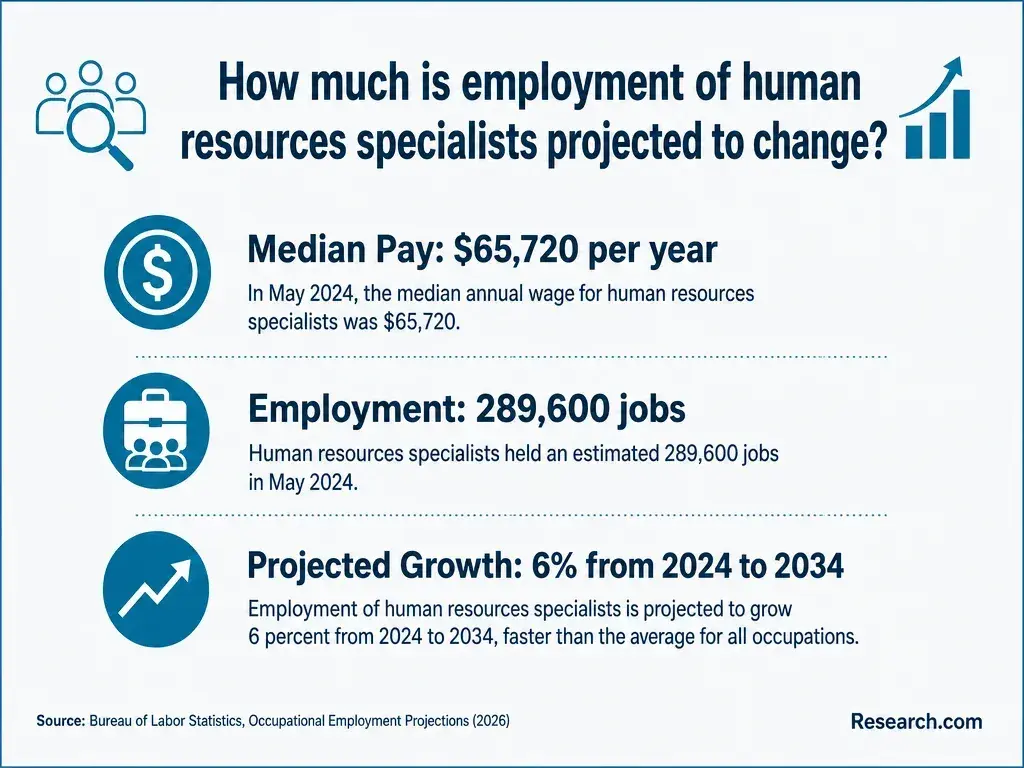
For a concrete business-side benchmark, the U.S. Bureau of Labor Statistics reports a May 2025 median annual wage of $75,940 for human resources specialists and projects 6% employment growth from 2025 to 2035.
That occupation-wide median includes experienced workers; it is not a salary forecast for business graduates. An HR-focused applicant should also compare HR curricula and career directions before assuming a general business program provides sufficient HR depth.
For safety jobs, compare postings for the specific title you want - such as safety coordinator, occupational health and safety specialist, or safety manager. These positions can differ substantially in their expectations for a bachelor's degree, technical knowledge, site experience, and professional certification. A certificate can strengthen an application, but it does not turn an entry-level applicant into a manager.
What Education and Training Does Each Career Path Require?
Start with your current experience and the requirements of several jobs you would realistically seek next. An experienced warehouse supervisor taking on incident reporting may need targeted safety coursework; someone seeking a specialist role may face a bachelor's requirement and expectations for field-specific knowledge.
Business operations roles likewise vary: a degree may meet an education requirement without proving proficiency in a particular function.
Read each posting for required versus preferred qualifications. For safety work, look for hazard-assessment experience, knowledge of applicable regulations, incident investigation, training delivery, and any stated degree or certification requirement. For business roles, look for the function - such as HR, budgeting, or operations - and the work samples or experience that demonstrate readiness.
If your actual goal is project coordination rather than safety oversight, compare that route separately. Comparing HR bachelor's transfer policies is useful for an HR target role, but it will not resolve a safety specialist's technical requirements. The same principle applies to any adjacent degree: select it for the work you intend to do.
A BS in Business Administration commonly brings together accounting, finance, economics, marketing, management, operations, and quantitative decision-making. Courses may ask students to interpret financial statements, build a budget, evaluate a process, or explain a recommendation to stakeholders. The exact curriculum, available concentrations, and applied assignments depend on the school.
For a future safety leader, the business content can be useful when proposing training budgets, coordinating vendors, measuring program costs, or communicating risk to executives. Its limitation is equally important: general operations or business-law courses should not be mistaken for training in exposure assessment, industrial hygiene, or site-specific hazard controls.
If your work centers on schedules and deliverables rather than occupational hazards, online project management bachelor's programs accepting transfer credits offer another degree pathway to evaluate. Check how prior credits apply to required courses; acceptance as electives alone may not shorten the degree as much as expected.
Content varies by provider, but a substantial safety management certificate may address hazard recognition, risk controls, incident investigation, safety training, emergency planning, and evaluation of a safety program. Some programs emphasize a particular industry or regulatory environment. Review actual course descriptions and assessments rather than relying on the certificate's title.
For working professionals, the strongest applied assignment is one you can complete without assuming access to confidential incident records or permission to change workplace procedures. A classroom hazard assessment can demonstrate learning; implementing its recommendations at work requires employer authority, appropriate data access, and site-specific review.
Safety training and project-management education sometimes overlap in planning and communication, but they serve different responsibilities. If you are comparing both options on cost, compare aid and tuition at online project management schools only as part of a separate degree decision - not as a proxy for the price or value of a safety certificate.
Online study can reduce commuting, but it may still require scheduled discussions, proctored exams, group projects, or fixed deadlines. Campus study may make it easier to practice demonstrations or connect with local employers, although travel and class times can be harder to accommodate alongside work. Neither format is inherently more rigorous or more flexible.
For a safety certificate, ask how students practice inspections, hazard assessments, and communication of findings. For a business degree, check whether team assignments, presentations, internships, or a capstone require live attendance. Before selecting an online degree, use a US online business college selection guide as a starting point, then confirm scheduling and assessment rules with the school offering your intended program.
A bachelor's program typically requires undergraduate admission and completion of general education, business courses, and any institutional residency requirements. A certificate may have fewer entry requirements, but some are designed for people with prior college study or relevant work experience. Schools determine whether transfer credits apply to specific degree requirements, so a preliminary credit estimate is not a completion plan.
Compare remaining requirements and total cost, not advertised program length alone. For the degree, request a written degree audit and an estimate covering tuition, mandatory fees, books or software, and the likely enrollment schedule.
For the certificate, request the complete course sequence, all charges, and any travel or required equipment. A short certificate can be the less costly next step, but not if you later need a bachelor's degree and its credits do not apply.
If the degree is necessary, explore ways to reduce tuition costs for a business degree. Confirm transfer applicability and employer reimbursement rules before counting either as savings.
For a BS, verify the institution's accreditation through the accreditor and confirm that it covers the institution awarding the degree. If a school advertises AACSB, ACBSP, or IACBE accreditation, check the accreditor's stated scope; institutional accreditation and business-program accreditation are different. Neither establishes that a business curriculum provides specialized occupational safety preparation.
For a certificate, identify the issuing school or training provider, the courses and assessed learning outcomes, and whether any advertised external recognition actually applies to that certificate. A provider's general reputation does not prove that an award meets an employer's or certifying body's requirement.
Accreditation also does not settle admission or credit transfer. Use a business administration applicant eligibility checklist to prepare questions about prerequisites, then obtain the prospective school's decision on your own records.
There is no single license or certification required for every U.S. safety management job. Requirements depend on the occupation, work performed, jurisdiction, and employer.
Some employers seek voluntary professional credentials, while particular tasks or industries can involve separate regulatory training or authorization. Check the job posting and the applicable regulator rather than assuming a general certificate grants legal authority to perform specialized work.
Keep three credentials distinct: an educational certificate documents completion of a program; a professional certification is awarded by a certifying organization under its eligibility and assessment rules; and a license, where applicable, is issued under government authority.
For example, the Board of Certified Safety Professionals sets its own requirements for its credentials. Confirm its current education, experience, and examination rules directly before choosing coursework.
If a bachelor's degree is part of your longer-term credential plan, US fast-track undergraduate business degree options may be worth screening. Verify that the degree satisfies the certifier's specific rules; a faster calendar schedule cannot substitute for an ineligible degree or missing safety experience.
How Can You Choose a Reputable Program for Your Career Goals?
Make the decision backward from the next role, not forward from an appealing program description. The most useful evidence is a set of relevant job postings, your current qualifications, and written answers from programs about what you will study and receive.
Use this sequence to narrow the choice without paying for overlapping credentials unnecessarily:
- Identify the exact role and separate its required degree, safety knowledge, experience, and preferred credentials.
- Map your existing work and education against those requirements; note which gaps a certificate can close and which require a bachelor's degree or supervised experience.
- Request curricula, assessed assignments, delivery obligations, total charges, and written transfer or degree-audit results where applicable.
- Verify institutional accreditation, any claimed programmatic recognition, and eligibility rules with the organization that sets each requirement.
- Choose the option that closes the binding gap first; plan how you will demonstrate the new skills in appropriate work samples or responsibilities.
Choose the BS when a bachelor's requirement or broad business progression is the main obstacle. Choose the safety management certificate when focused safety competence is the immediate gap and your existing education and experience otherwise fit the role.
If you need both, their order should depend on hiring requirements, credit applicability, and available time. When speed matters, compare bachelor's programs for faster completion against a realistic course schedule rather than assuming acceleration reduces the total work.
Other Things You Should Know About Business Administration
Yes, once it has been awarded. Name the issuing provider and the exact credential. If you are still enrolled, label it "in progress" and do not present it as a professional certification.
Possibly. Ask HR whether each program qualifies, whether approval is needed before enrollment, when reimbursement occurs, and whether grades or continued employment affect payment.
Only if the receiving school approves them for credit and applies them to your degree requirements. Request a written evaluation; even accepted credits may count only as electives.
A second bachelor's may be unnecessary. Compare the target job's degree wording with your existing qualification, then assess whether safety coursework, relevant experience, or another specific credential addresses the remaining gap.
- Environment, Health, and Safety Professional | Energy.gov https://www.energy.gov/cmei/water/environment-health-and-safety-professional
- Occupational Safety and Health Professionals - NCBI https://www.ncbi.nlm.nih.gov/books/NBK225528/
- Occupational Health and Safety Technicians | wa.gov https://careerbridge.wa.gov/work/career-groups/government-and-public-administration/occupational-health-and-safety-technicians
- How to Become a Safety Officer: What Employers Want | Columbia Southern University https://www.columbiasouthern.edu/blog/blog-articles/2021/september/how-to-become-a-safety-officer
- 8 Best Business Jobs for Work-Life Balance | Western Governors University https://www.wgu.edu/blog/8-best-business-jobs-work-life-balance2308.html
- What Jobs Can I Get With a Business Management Degree? | UMass Global https://www.umassglobal.edu/blog-news/jobs-can-i-get-a-business-management-degree
- Occupational Safety and Risk Management, Business | Bakersfield College https://programmap.bakersfieldcollege.edu/program/occupational-safety-and-risk-management-business/
- Entry-Level Jobs With a Business Administration Degree | Warner Pacific University http://www.warnerpacific.edu/blog/top-entry-level-jobs-ba-business-administration/
- Which Safety Certifications Are Right for You | Georgia Tech Professional Education https://pe.gatech.edu/blog/industry-trends/safety-certifications-which-are-right-for-you
- Bachelor of Science in Safety Management | erau.edu https://erau.edu/degrees/bachelor/safety-management