2027 Online MLIS Programs With Multiple Start Dates and Fixed Course Sequences

Co-Founder and Chief Data Scientist
Choosing when to start an online MLIS is easier than knowing whether its course sequence will fit your life after enrollment. Multiple entry dates can shorten the wait to begin, but a fixed sequence may limit when you can take a missed course or an elective. The decision matters for a career investment: the U.S. median annual salary for librarians and media collections specialists was $68,270 in May 2025, not a guaranteed graduate salary. This guide helps prospective students check accreditation, map the actual schedule, and compare costs before committing.
Key Things You Should Know
- Multiple start dates do not necessarily mean flexible pacing: ask for the course-by-course calendar for your intended cohort.
- Verify ALA accreditation for the specific master's program and confirm online delivery and cohort rules separately.
- Compare the complete cost and time to graduation, including the risk of waiting for a required course; librarian and media collections specialist employment is projected to grow 2.6% from 2025 to 2035.
What are online MLIS programs with multiple start dates and fixed course sequences?
These are master's programs in library and information science that admit students at more than one point during the year but prescribe the order in which a cohort takes some or all courses. A program might offer several entry terms while requiring new students to begin with foundations, take later courses alongside their cohort, and complete a culminating project at a specified point.
Entry flexibility and pacing flexibility are different. Some programs enforce a lockstep sequence; others publish a recommended plan but allow substitutions or part-time enrollment. An MLIS, MLS, or institution-specific LIS master's degree may follow either model. The degree name alone does not establish its scheduling rules.
Which online MLIS programs are accredited by the American Library Association?
The American Library Association (ALA) accredits specific master's programs in library and information studies, including programs with degree names other than MLIS. It does not separately accredit an online delivery format, a start date, or a cohort sequence. Institutional accreditation is important, but it is not a substitute for ALA program accreditation.
To identify a suitable option, check the current ALA directory for the exact degree, then confirm on the university's current program page that it is available online. Ask the program for its next entry dates and a written sequence for the cohort you would join. A catalog listing alone does not establish that a particular online elective or start term will be available to you.
If location affects tuition or employer preferences, a regional search such as best value library programs in the South can help you build a shortlist. Verify each shortlisted program's current ALA status, delivery format, and published charges directly before comparing offers.
How do fixed course sequences and multiple start dates work?
A start date determines when you enter; a sequence determines what you can take afterward. The distinction matters most if you expect to study part time, need a particular elective, or might pause enrollment. These common scheduling models show what to clarify with an adviser.
| Feature | What it may mean | Decision consequence |
| Multiple cohort starts | New groups enter in different terms | A later start may not let you join courses offered to an earlier group |
| Lockstep sequence | Required courses follow a prescribed order | Missing one course may delay later requirements |
| Recommended sequence | An adviser suggests an order, with some choice | Flexibility depends on prerequisites and course availability |
| Synchronous meetings | Students attend live online sessions | Work hours and time zones may limit access even without campus visits |
Request the schedule for your intended start, not just a sample curriculum. Confirm whether courses are asynchronous or require live attendance, whether a missed requirement can be taken with another cohort, and whether a practicum or campus activity has fixed dates. An online label does not answer those questions.
What courses are included in an online MLIS curriculum?
Curricula vary, but foundational study commonly covers information organization, reference and information services, research methods, and the social and ethical responsibilities of information work. Programs may then offer electives in areas such as archives, digital collections, metadata, youth services, or information technology. A relevant elective is not the same as a formally named concentration.
For a fixed sequence, when a course runs can matter as much as its title. A student interested in digital collections, for example, should look for opportunities to practice describing and managing digital materials, not merely a catalog entry mentioning metadata. Ask which courses are required, which electives ran for recent online cohorts, whether prerequisites restrict choices, and whether an applied project can become a portfolio sample. Catalog inclusion does not guarantee an elective every term.
What are the admission requirements for online MLIS programs?
Applicants generally need a bachelor's degree and must meet the university's published graduate admission rules. Depending on the institution, an application may call for transcripts, a statement of purpose, recommendations, a résumé, or additional documentation. Requirements, deadlines, and whether a specific start term accepts new students must be checked for the exact program.
If you have prior graduate coursework, ask whether it can satisfy an MLIS requirement and whether accepting it would change your assigned cohort. Graduate transfer-credit policies differ from undergraduate transfer rules; an online information science transfer pathway is a starting point for questions, not assurance that credits will be accepted. Applicants seeking school librarian preparation should also ask how the program's admission pathway relates to their state's certification requirements.
How long do online MLIS programs take to complete?
Completion time depends on required credits, the number of courses allowed each term, prerequisites, and the frequency of required offerings. Multiple starts may reduce the wait to enroll without reducing the time between your first course and graduation. A fixed sequence can make the timeline predictable if you remain on plan, but less forgiving if you need a break.
Compare programs using a personalized term-by-term graduation map. Include your intended course load, summers, any practicum, and a contingency for missing one required course. If speed is your priority, a one year library science program comparison can help frame the trade-off; confirm that an accelerated schedule is actually available for your start term and manageable alongside work.
How much do online MLIS programs cost?
There is no reliable single price for this format: tuition rates, required credits, residency rules, and fees vary by institution and enrollment term. Calculate each school's published tuition for the credits you would need, then add mandatory fees and likely expenses for books, technology, travel, or fieldwork. Do not assume online students receive in-state rates.
Sequence-related costs deserve particular attention. If a missed required course pushes graduation into another term, ask whether you would owe additional term-based fees and how the delay would affect your work plans. Compare the gross program cost with any confirmed employer support or aid offer; borrowing changes when you pay, not what the education costs. An affordable short librarian degree comparison can help narrow options, but use current school charges and your own enrollment plan for a final budget.
What careers can you pursue with an online MLIS degree?
An MLIS can prepare students for professional roles in public, academic, school, government, and special libraries. Work may involve reference services, information literacy instruction, collection development, community programming, or stewardship of digital resources. Archives, metadata, records management, and research support are additional pathways, although employers may accept other degrees or expect specialized experience.
Choose courses and applied work around the jobs you intend to seek. An aspiring academic librarian might build an instruction or research-support portfolio; a digital collections applicant might document a metadata or preservation project. If your target job does not typically require an MLIS, relevant experience, a focused certificate, or another graduate degree may be a better investment. For a broader view of advancement possibilities, compare advanced librarian roles and salary against actual job requirements rather than assuming the degree alone qualifies you.
What salaries and job outlook can MLIS graduates expect?
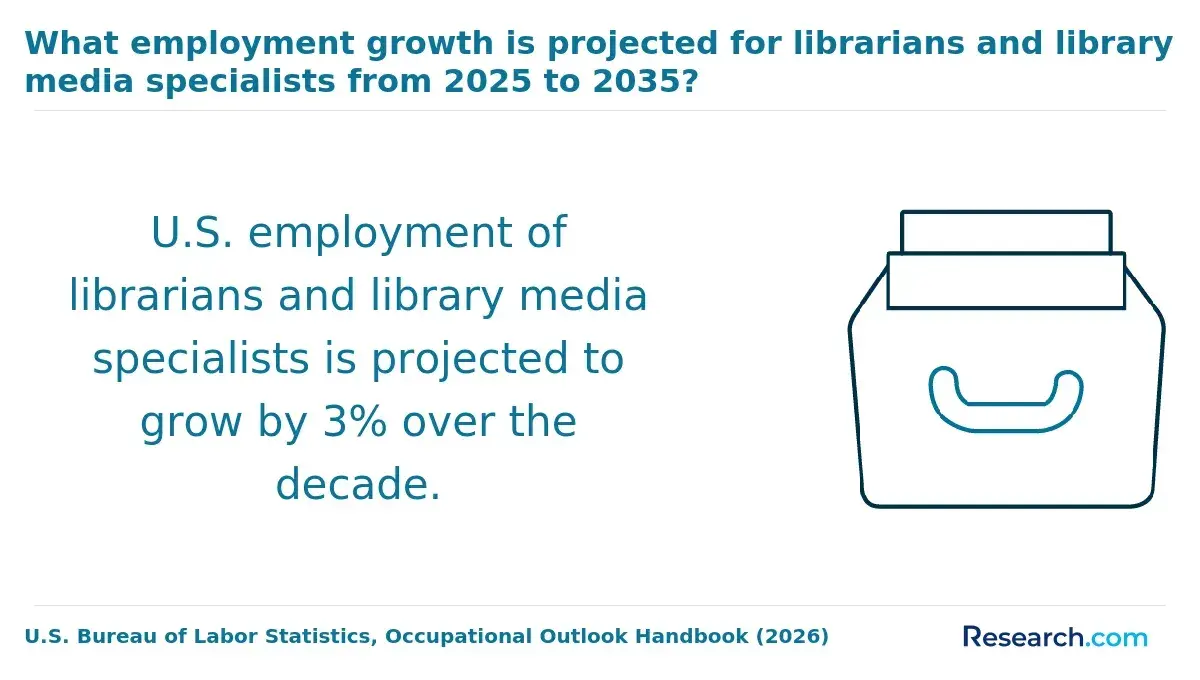
The U.S. Bureau of Labor Statistics reports a May 2025 median annual salary of $68,270 for librarians and media collections specialists and projects 2.6% employment growth from 2025 to 2035. Those figures describe an occupation, not the earnings or placement rate of a particular MLIS cohort. Location, employer, experience, duties, and whether a position is full time all affect an individual offer.
For a realistic return-on-investment decision, compare local postings for your target role with your current earnings, expected borrowing, and the time you would spend in school. A fixed sequence may suit an employed student who can plan well ahead; it is less attractive if its timetable would force an extended reduction in paid work.
Do MLIS graduates need professional licenses or certifications?
Licensing depends on the role and jurisdiction; an ALA-accredited degree is not itself a professional license. School librarian positions commonly involve state educator certification, licensure, or endorsement requirements. Check the appropriate state education authority and ask whether the online program's coursework and field placement meet that state's rules before enrolling.
Public and academic library employers may specify degree or experience requirements, while specialized positions may favor subject expertise or other credentials. Do not assume an optional professional certification is universally required. If licensure is your goal, obtain a written explanation of the program's preparation pathway and verify it against current state requirements.
Other Things You Should Know About Library Science
Yes. Library assistant and technician positions can offer experience, though their duties and qualifications differ from professional librarian roles. Check local postings to see which entry points fit your background.
Often, yes. A class project, volunteer assignment, or independently documented information-organization project may demonstrate your skills. Get permission before sharing employer or patron materials.
It can be useful in records, digital collections, information governance, and related work. Employers may also value other degrees, so compare the qualifications in postings for the jobs you want.
Ask whether the published schedule matched their experience, how easy it was to access desired electives, and what support they received when plans changed. Their experience is valuable context, not a guarantee that the next cohort will work the same way.
References
- Cost of Attendance (Budget) | 2025-2026 Federal Student Aid Handbook https://fsapartners.ed.gov/knowledge-center/fsa-handbook/2025-2026/vol3/ch2-cost-attendance-budget
- Semester Course Load and Student Performance - PMC - NIH https://pmc.ncbi.nlm.nih.gov/articles/PMC7568764/
- GAC - Chapter 135-9 CONTINUING EDUCATION https://rules.sos.ga.gov/gac/135-9
- Exchange Visitor Visa | state.gov https://travel.state.gov/content/travel/en/us-visas/study/exchange.html
- Cohort Programs Admission | lincolnuca.edu https://admissions.lincolnuca.edu/cohort-programs-admission/
- Library Science Master's Online - UW Information School https://ischool.uw.edu/programs/mlis/degree-options/online
- Tuition Payment Deadlines - Bursar's Office | Financial Aid and Scholarship Office https://www.sjsu.edu/bursar/fees-due-dates/tuition-other-fees/index.php
- Office of the Registrar | Course Requisites | Pace University New York https://www.pace.edu/registrar/registration/course-requisites
- Tuition & Fees for Academic Year 2026-2027 - myUSF https://myusf.usfca.edu/billing-tuition/tuition-fees
- A cohort is a group of people gathered together for a purpose. | UNT Health Fort Worth https://www.unthealth.edu/tcom/public-health/future-students/cohort-model.html