2027 Online Data Science Master's for Test Automation Engineers: A Career Transition Guide

Co-Founder and Chief Data Scientist
Test automation engineers already work with code, data, and questions about whether a system behaves as expected. Moving into data science, however, requires stronger statistical reasoning and experience drawing conclusions from imperfect data. An online master's can help bridge that gap, but it is not the only route.
This guide helps working engineers decide whether graduate study fits their target role, what to look for in a program, and what to verify before committing.
Key Things You Should Know
- Automation experience transfers most directly to analytics engineering, data quality, and machine-learning testing; a data scientist role usually demands additional statistics, modeling, and experimental-design skills.
- A master's is useful when it provides rigorous coursework and credible projects that fill those gaps, not simply because it awards a data science credential.
- The U.S. Bureau of Labor Statistics projects 35% growth in data scientist employment from 2025 to 2035, but that occupation-wide forecast does not predict an individual graduate's hiring prospects.
What is an online data science master's degree for test automation engineers?
It is a graduate degree completed primarily online that combines computing, statistics, and applied analysis. It is not a separate qualification reserved for test automation engineers.
Its value for someone in QA is the opportunity to move beyond checking whether a result is correct and learn to frame a question, assess the data, build a model, and explain how reliable the conclusion is.
That distinction should drive program choice. An engineer who wants to analyze product experiments needs substantial statistics and causal reasoning; one who wants to work on production data systems may benefit more from databases, pipelines, and software engineering.
If building AI systems rather than analyzing data is the primary goal, compare the curriculum and total cost with lower-tuition artificial intelligence degree options instead of assuming a data science title is the best fit.
How can test automation engineers transition into data science careers?
Start with a target role, then identify which parts of your current work already provide evidence for it. Writing Python tests, querying databases, investigating failures, and designing reproducible checks are valuable. They do not, by themselves, demonstrate that you can select an appropriate statistical method or evaluate whether a model will work on new data.
The table separates transferable experience from the evidence a hiring manager may still need. It can also help you judge whether a prospective degree addresses your particular gaps.
| Existing automation experience | Related data role | Evidence still needed |
| SQL checks and validation of incoming data | Analytics engineer or data quality engineer | Data modeling, reliable pipelines, and documented business definitions |
| Failure investigation and test-result reporting | Product or operations analyst | Statistical analysis, clear visualizations, and decision-focused explanations |
| Testing APIs and automated deployments | Machine-learning test or MLOps engineer | Model monitoring, data drift, and evaluation beyond pass-or-fail tests |
| Programming and systematic experimentation | Data scientist | Probability, inference, modeling, and sound validation on unfamiliar data |
Build one portfolio project around a problem you understand, such as predicting test failures or detecting unusual changes in build times. Use data you have permission to share, document the baseline, and explain false alarms and limitations.
A master's is most compelling if you need structured quantitative training, supervised projects, or access to roles that favor graduate study. If your target is closer to data quality or analytics engineering, focused coursework and demonstrable work may be a less costly first step.
What do online data science master's programs typically require for admission?
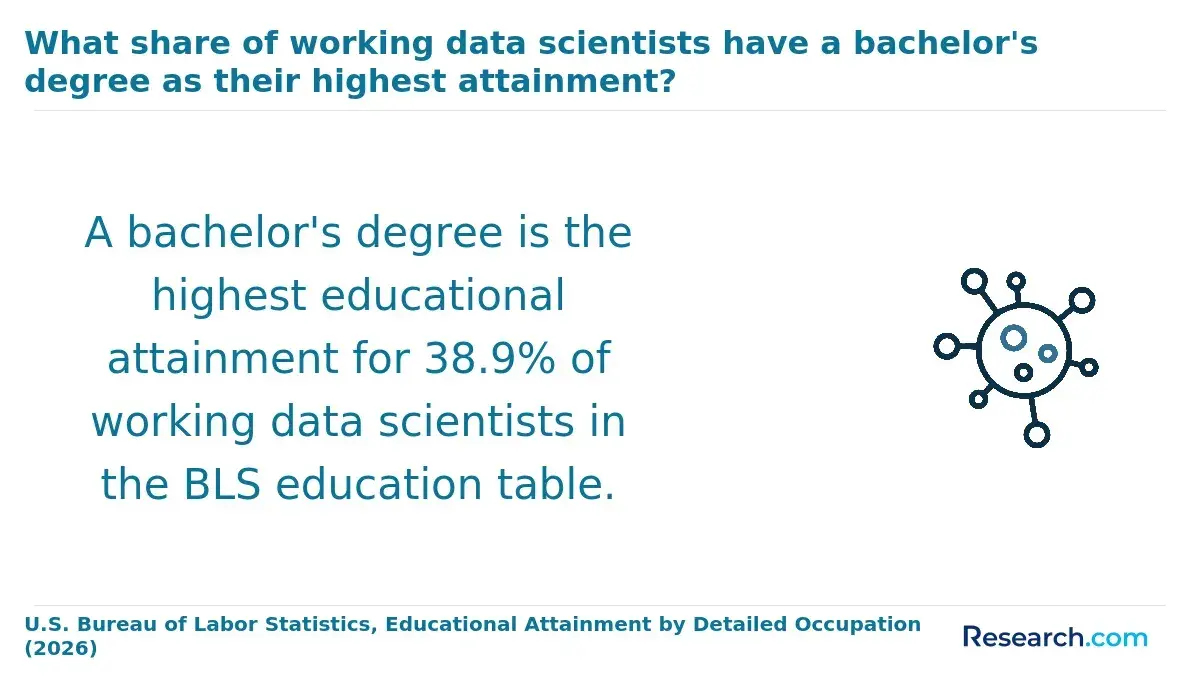
Requirements vary by institution, so an automation engineering job title neither guarantees admission nor rules it out. Programs may ask for an accredited bachelor's degree, transcripts, programming experience, quantitative preparation, recommendations, and a statement of purpose.
Some specify prior courses; others assess readiness through a broader application. Check each program's current admissions page for its actual requirements and whether prerequisite work must be complete before enrollment.
Pay particular attention to calculus, linear algebra, probability, and statistics. An applicant who writes production-quality test code may still need formal preparation in these subjects. Conversely, a degree outside computer science does not necessarily mean starting over.
If you are also considering AI programs, guidance on choosing an AI master's with a non-CS degree can help frame questions about your academic background.
Before applying, send an admissions adviser your transcript and a short account of your coding and quantitative work. Ask which prerequisites are mandatory, which can be completed conditionally, and whether professional experience can demonstrate readiness.
Self-study can prepare you to succeed, but it should not be treated as formal prerequisite credit unless the program confirms that it counts.
Which courses should test automation engineers expect in a data science master's program?
Course titles differ, but a suitable curriculum should develop the abilities missing from your intended next role.
For a data scientist path, look for probability and statistical inference, regression, machine learning, experimental design, data management, and communication of results. For an analytics engineering or MLOps path, examine the depth of database systems, pipelines, deployment, and monitoring alongside the statistics core.
A catalog entry called "machine learning" is not enough to establish depth. Review course descriptions and project expectations: Do students compare models against a baseline, guard against data leakage, explain uncertainty, and work with messy data?
An engineer focused on production systems can also compare data infrastructure skills in artificial intelligence graduate programs with those offered by data science degrees.
Favor a capstone or substantial project if it lets you demonstrate a transition beyond QA. A useful project might analyze CI failures, but it should answer a measurable question and evaluate whether its findings hold up, not merely automate another test suite.
How do online and campus-based data science master's programs compare?
For an employed engineer, online study can preserve a full-time job and make it easier to apply new methods at work. Campus study may offer more convenient in-person contact with faculty, classmates, and local employers. Neither format is inherently more rigorous or better for hiring; curriculum, project quality, and the support available to you matter more than the delivery label.
Check the operating details before choosing. "Online" can still involve live meetings, group work across time zones, scheduled exams, or a campus visit. Ask whether lectures are recorded, when required sessions meet, how projects are supervised, and what career services remote students can actually use. Choose the format whose demands you can sustain while continuing to work, rather than the one that merely sounds more flexible.
How long do online data science master's programs take and cost?
There is no reliable single timeline or price for this degree category. Completion depends on required credits, course availability, transfer policies, and whether you study part time.
Published tuition may be charged per credit, term, or program, and it may exclude mandatory fees. Compare programs using their current official schedules and the pace you can realistically maintain.
For an apples-to-apples comparison, request a written estimate that covers tuition, required fees, materials or computing costs, any travel, and the effect of taking fewer courses in a term. Ask whether tuition can change before you finish and whether a required course is offered often enough to support your planned graduation date.
Engineers trying to limit time away from other goals can examine shorter-duration master's degrees in data science, while checking that faster pacing leaves enough room for the quantitative work they need.
A common mistake is comparing one school's tuition-only figure with another school's all-in estimate. Also account for opportunity cost: remaining employed may reduce lost wages, but an accelerated schedule can restrict the time available for work or portfolio development.
How can students verify data science program accreditation and quality?
Verify the university's institutional accreditation through its current institutional disclosures and the recognized accreditor's directory. Then confirm that the specific online master's is awarded by that university and available to students in your state. Institutional accreditation and state authorization answer different questions; neither, on its own, establishes that a curriculum fits your career goal.
Evaluate quality through evidence you can inspect: current required courses, faculty and project supervision, examples or descriptions of capstone work, access to remote support, and the program's policies for course availability and completion.
If a school advertises employment or salary outcomes, ask which students were counted, when they graduated, and whether the figures separate career changers from experienced data professionals. Treat rankings and promotional claims as starting points for questions, not substitutes for those answers.
What data science jobs can test automation engineers pursue after graduation?
Potential targets include data scientist, product analyst, analytics engineer, data quality engineer, and machine-learning test or MLOps engineer. These jobs are not interchangeable.
A data scientist may be expected to formulate and evaluate models; an analytics engineer typically concentrates on dependable datasets and definitions; an MLOps-focused role connects software practices with model deployment and monitoring. Employers set their own titles and requirements.
Graduation will not automatically make an experienced QA engineer a senior data scientist. Your strongest applications will connect prior engineering responsibility with new analytical evidence. For example, a project that quantifies unreliable test signals and explains its validation can show both domain knowledge and statistical judgment.
Target adjacent roles if they make fuller use of your existing experience; target data scientist roles when your coursework and projects demonstrate the required modeling depth.
What salaries can data science graduates and test automation engineers expect?
The U.S. Bureau of Labor Statistics reports a $120,230 median annual wage for data scientists in May 2025. That is an occupation-wide figure, not a starting salary or an expected wage for a new master's graduate. It does not isolate former test automation engineers, and it should not be compared with a personal offer without accounting for role level, location, and employer.
There is no single equally reliable salary figure for "test automation engineer" here because employers use that title for differing responsibilities. To assess the financial decision, compare actual postings for your current skill level with postings for your target role, then weigh a plausible pay difference against the program's full cost and the time needed to qualify.
Employer tuition assistance, scholarships, and borrowing terms can change that calculation; understanding aid for data science graduate programs is useful before treating the advertised tuition as your final expense. A higher occupational median alone does not show that the degree will pay for itself.
What certifications and skills strengthen a data science career transition?
Prioritize demonstrable skills over collecting credentials. For a data scientist target, strengthen SQL, Python, statistics, experimental design, model validation, and communication.
For data infrastructure or MLOps work, add pipeline design, version control for data and models, deployment, and monitoring. Your automation background is especially useful when you can explain how you made analytical work reproducible and caught defects before results reached users.
A relevant cloud or platform certification may help when job postings repeatedly name that technology, but it does not replace evidence that you can reason about data. Before paying for an exam, review the roles you intend to pursue and check whether the certification appears as a requirement, a preference, or not at all.
If it is not central, invest that time in a documented project that shows a sound question, a defensible method, and an honest assessment of limitations.
Other Things You Should Know About Data Science Programs
Only if you have permission to share them. Workplace logs can contain customer information, credentials, or proprietary details. Public or synthetic data is a safer choice when permission is uncertain; document how the substitute data limits your conclusions.
Yes, if you clearly label it "in progress" and give an expected completion date only when you have a realistic plan. Highlight completed, relevant coursework or projects rather than implying that you already hold the degree.
Not necessarily. Computing requirements depend on the courses and the resources the university supplies. Ask the program what hardware or cloud access students need before purchasing equipment.
Possibly, but access varies by program and faculty availability. If research matters to you, ask whether remote students can join faculty projects, how supervisors are assigned, and whether past online students have completed research-based projects.
References
- Employer-offered educational assistance programs can help pay for college | Internal Revenue Service https://www.irs.gov/newsroom/employer-offered-educational-assistance-programs-can-help-pay-for-college
- Cost of Attendance (Budget) | 2025-2026 Federal Student Aid Handbook https://fsapartners.ed.gov/knowledge-center/fsa-handbook/2025-2026/vol3/ch2-cost-attendance-budget
- Semester Course Load and Student Performance - PMC - NIH https://pmc.ncbi.nlm.nih.gov/articles/PMC7568764/
- Types of Financial Aid: Grants, Work-Study, and Loans | studentaid.gov https://studentaid.gov/understand-aid/types
- What You Can Do with a Master's in Data Science and Artificial Intelligence | Harvard Extension School https://extension.harvard.edu/blog/what-you-can-do-with-a-masters-in-data-science-and-artificial-intelligence/
- Importance of Software Skills in Data Science | virginia.edu https://datascience.virginia.edu/news/importance-software-skills-data-science
- What Can I Do With a Degree in Data Science? Career Paths & Skills | Harvard SEAS https://seas.harvard.edu/news/what-can-i-do-degree-data-science-career-paths-skills
- Master's in Data Science | utexas.edu https://cdso.utexas.edu/msds