
2027 Online Data Science Master's for Risk Managers: A Career Transition Guide

Co-Founder and Chief Data Scientist
Risk managers already work with uncertainty, controls, and decisions under pressure. Moving into data science usually means adding stronger programming, statistical modeling, and model-evaluation skills - not starting a career from scratch. An online master's may provide that training while you keep working, but its value depends on your target role and the evidence you can build along the way.
This guide helps you identify realistic transitions, compare programs, and decide whether a degree is worth the commitment.
Key Things You Should Know
- Choose a program for the role you want: model-risk and quantitative-risk work call for different technical depth than risk reporting or analytics leadership.
- Prioritize Python or R, statistics, machine learning, and projects that demonstrate both model performance and sound risk judgment; a degree title alone does not show that depth.
- The U.S. Bureau of Labor Statistics reports a $120,230 median annual wage for data scientists in May 2025, but that occupation-wide figure is not a predicted salary for a risk manager who earns a master's.
What is an online data science master's degree for risk managers?
It is a graduate degree that teaches students to work with data, build and assess models, and communicate findings, delivered primarily online. It is not usually a separate credential designed exclusively for risk managers. Its usefulness depends on whether you can apply the coursework to problems such as credit losses, fraud, operational incidents, insurance claims, or model oversight.
The distinction between using models and governing models should guide your search. A risk manager aiming to build predictive systems needs substantial coding and statistical training. Someone aiming to challenge models or lead risk analytics also needs to examine assumptions, data quality, monitoring, and the consequences of errors. If your main goal is improved reporting rather than model development, master's degree programs in data analytics may be worth comparing before committing to a data science curriculum.
How can risk managers transition into data science through an online master's program?
Start with your existing advantage: you know which losses matter, how decisions are reviewed, and where an apparently accurate model could fail in practice. The transition is to make that judgment technically demonstrable. A useful path is to choose a target role, assess your coding and quantitative gaps, select coursework that closes them, and build a project you can explain to both technical and risk stakeholders.
The strongest project resembles work a hiring team could evaluate: define a risk decision, establish a simple baseline, document data limitations, compare methods, test performance across relevant groups or time periods, and explain how the model would be monitored. Use public, synthetic, or expressly approved data rather than assuming workplace records can be used in class.
A master's is not always necessary. If you already build models and can document that work, an internal move, targeted coursework, or supervised projects may be a faster route. A degree is more compelling when you need sustained instruction across programming, statistics, and machine learning - or when the roles you want explicitly prefer graduate preparation.
What are the admission requirements for an online data science master's?
Requirements vary by institution. Programs may ask for a bachelor's degree, transcripts, a statement of purpose, recommendations, and evidence of quantitative or programming preparation. Professional risk experience can strengthen an application, but it should not be assumed to replace a stated prerequisite.
Risk managers often have strengths in probability, financial analysis, controls, or regulatory communication, while their preparation in calculus, linear algebra, Python, or software development may vary. Before applying, compare each program's stated prerequisites with coursework you can document. Ask admissions staff whether a preparatory course formally satisfies a requirement; a self-directed project may show readiness without fulfilling an official prerequisite.
What do online data science master's programs teach future risk managers?
Look beyond course titles. The most useful curriculum joins statistical reasoning, programming, data management, and machine learning with opportunities to explain when a model should - and should not - inform a consequential decision. The table connects common risk-management strengths to the additional training different transitions may require.
| Existing risk-management strength | Training to look for | Likely application |
| Loss analysis and scenario thinking | Statistical inference, forecasting, and validation | Testing whether a risk signal holds outside the development sample |
| Control design and documentation | Reproducible coding, data pipelines, and model monitoring | Making analytical work reviewable and maintainable |
| Stakeholder and regulatory communication | Interpretability, visualization, and responsible model use | Explaining trade-offs to decision-makers |
For model-building roles, check whether students implement methods and evaluate them on realistic data, rather than only discuss concepts. For model-risk roles, look for assignments involving validation, drift, documentation, or limitations. A relevant capstone or substantial project is particularly useful because it can show how your domain judgment changes an analytical decision.
How do online and campus-based data science master's programs compare?
An online program may let you retain your risk-management job and apply lessons immediately. A campus program may offer easier access to in-person collaboration, recruiting events, or research activity. Neither format is inherently more rigorous: compare the actual courses, instructors, project expectations, and access to support.
For a working risk manager, the decisive format questions are operational. Confirm whether classes are live or self-paced, when exams occur, whether group work crosses time zones, and whether any campus visits are required. Choose online study if its schedule lets you complete demanding technical work consistently; choose campus study if in-person access is central to your intended transition and feasible financially.
If your target is specifically AI development rather than broader risk analytics, you can also review affordable online artificial intelligence master's options. Compare required coursework and total charges, not just degree names or advertised tuition.
How long does an online data science master's take, and what does it cost?
Both depend on the program's credit requirements, course schedule, and your pace. A part-time plan may preserve income but extend the time to completion; a heavier load may finish sooner while leaving less room for work and project-building. Ask for a term-by-term plan based on the number of courses you can realistically take, including when required courses are offered.
Compare total expected cost, not tuition alone. Request the current tuition rate and mandatory fees, then account for books or software, any travel, financing costs, and the income you would forgo if you reduce work hours. Check employer reimbursement rules before relying on that benefit.
Published charges can change, and a lower-priced program is not automatically better value if it lacks the technical depth your target role requires. If machine learning is your main goal and you have a firm budget, online machine learning master's cost limits offer another comparison point. Verify each school's current tuition and required fees directly before deciding.
How should risk managers evaluate accreditation and program quality?
First, confirm the university's current institutional accreditation through the institution and the accreditor's official records. Then assess the specific degree on its merits: accreditation of the institution does not, by itself, establish that a data science curriculum fits risk work. Confirm that the program is available to students in your state of residence, since online enrollment rules can vary.
A useful quality check is to request syllabi or detailed course descriptions and inspect the work students actually complete. Look for substantial coding, statistical evaluation, feedback on projects, and access to instructors. Ask how online students receive career support and whether the school publishes outcomes for this specific program. If completion, placement, or salary figures are not publicly reported, do not treat promotional testimonials as substitutes. Rankings and a prestigious name are poor stand-ins for evidence of role fit.
What careers can risk managers pursue with a data science master's?
The closest transitions usually combine new technical ability with existing risk expertise. A credit-risk analyst might move toward predictive modeling; an operational-risk manager might develop anomaly-detection work; an experienced model reviewer might pursue model validation or model-risk analytics. A general data scientist role is also possible, but it may demand more production coding and experimentation than a risk-focused position.
Target employers and projects together. In finance or insurance, demonstrate that you can measure error costs and explain model limitations. In healthcare-related risk work, privacy and the consequences of incorrect decisions become central to project design; readers considering that direction can explore healthcare-focused career paths through an AI master's. An adjacent role at your current employer may offer a more credible first move than applying immediately to senior data scientist positions outside your domain.
What salaries and job outlook can data science-trained risk managers expect?
The U.S. Bureau of Labor Statistics puts the median annual wage for data scientists at $120,230 in May 2025. That is a benchmark for the occupation, not the expected pay for a master's graduate or for a particular risk-analytics role. Prior experience, responsibilities, industry, and location can change an offer substantially; data science salaries by industry provide additional context for comparing possible paths.
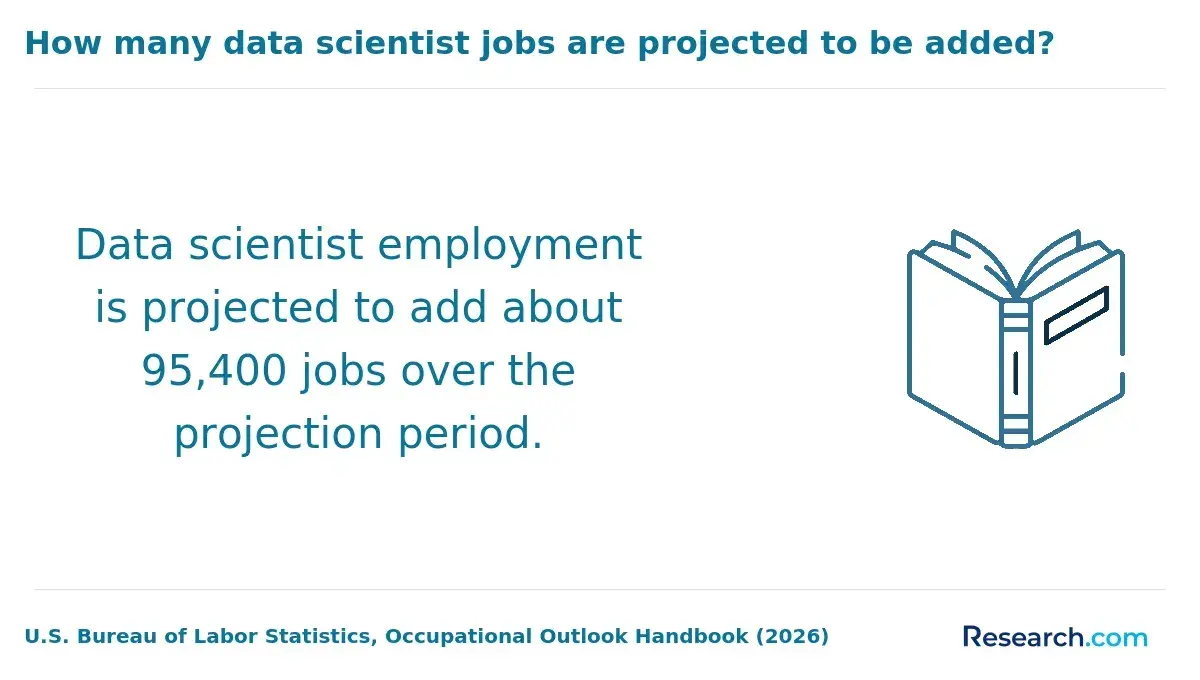
BLS projects 35% employment growth for data scientists from 2025 to 2035. The projection signals demand across the occupation, not guaranteed openings in your preferred risk specialty. When assessing a degree's return, compare plausible roles you could pursue with and without it, and do not attribute an eventual salary increase solely to the credential.
Which certifications support a data science career in risk management?
A risk credential such as the Financial Risk Manager (FRM) or Professional Risk Manager (PRM) can reinforce domain expertise. A technical certificate may help demonstrate a particular tool or method. Neither automatically substitutes for the programming, statistics, and project evidence expected in model-building roles, and a master's does not automatically replace an employer's preferred risk credential.
Choose a certification only after reviewing the qualifications in roles you actually want. If your gap is risk-domain credibility, a risk credential may be useful; if your gap is demonstrable modeling ability, spend time on substantial technical work first. Verify current exam, experience, and continuing-education rules with the credentialing organization before paying for preparation.
Other Things You Should Know About Data Science
Not without explicit authorization from your employer and any required school approval. Public or synthetic data can often demonstrate the same analytical approach without exposing sensitive records.
It may, but rules depend on the credentialing organization and the course. Check its current eligibility and documentation requirements before enrolling for that purpose.
Do not assume so. Ask the school about enrollment eligibility, technology access, assessment requirements, and any location restrictions before applying.
That depends on the degree. Programs may require a thesis, a capstone, another project, or coursework alone. Check the current catalog for graduation requirements rather than relying on the program's marketing summary.
References
- Guideline E-23 - Model Risk Management (2027) https://www.osfi-bsif.gc.ca/en/guidance/guidance-library/guideline-e-23-model-risk-management-2027
- Cost of Attendance (Budget) | 2026-2027 Federal Student Aid Handbook https://fsapartners.ed.gov/knowledge-center/fsa-handbook/2026-2027/vol3/ch2-cost-attendance-budget
- CS MS Applicants - Emory CS https://computerscience.emory.edu/graduate-ms/admissions/index.html
- Online Master of Data Science Degree Program | MDS@Rice https://csweb.rice.edu/academics/graduate-programs/online-mds
- Online Program - UChicago Data Science Institute https://datascience.uchicago.edu/education/masters-programs/online-program/
- Online Master's in Data Science (MSDS) | Northwestern University https://sps.northwestern.edu/masters/data-science/
- M.S. in Data Science, Online | virginia.edu https://datascience.virginia.edu/degrees/msds-online
- FRE Industry-Hosted Capstone Projects - NYU Tandon https://engineering.nyu.edu/academics/departments/finance-and-risk-engineering/capstone/industry-hosted-capstone-projects
- Artificial Intelligence Risk & Governance - Wharton Human-AI Research https://ai.wharton.upenn.edu/white-paper/artificial-intelligence-risk-governance/
- What preparations do I need for graduate education? | Statistics & Data Science Graduate Interdisciplinary Program https://stat.arizona.edu/what-preparations-do-i-need-graduate-education


