
2027 Online Data Science Master's for Clinical Research Coordinators: A Career Transition Guide

Co-Founder and Chief Data Scientist
Clinical research coordinators already work with complex study data, but moving into an analytical role usually requires stronger programming, statistics, and project evidence. An online data science master's can help close those gaps without leaving a job - if its curriculum fits the role you want.
This guide shows how to assess programs, costs, and career paths so you can decide whether a degree is the right next step or whether a smaller investment would serve you better.
Key Things You Should Know
- Start with a target role: clinical data analyst, healthcare data scientist, and trial-focused biostatistician require different levels and types of training.
- Favor programs that teach statistical inference, Python or R, SQL, and substantial projects; clinical research experience is valuable but does not replace those skills.
- The U.S. Bureau of Labor Statistics projects 35% growth in data scientist employment from 2025 to 2035, but that occupation-wide forecast does not predict an individual graduate's prospects.
What is an online data science master's for clinical research coordinators?
It is a graduate degree in statistical and computational analysis completed primarily online. It is generally not a coordinator-specific credential. Its value to a clinical research coordinator depends on whether the coursework helps turn familiarity with protocols, data collection, and study operations into the ability to analyze data independently.
That distinction matters when choosing a degree title. A data science program may prepare you for work across healthcare and other industries; biostatistics may be a closer fit if you want to design analyses for clinical trials. Health informatics may fit better if your goal is improving clinical information systems. If your main interest is building AI systems rather than analyzing study data, compare the curriculum and total expense of economical online AI graduate study before assuming a data science degree is interchangeable.
How can clinical research coordinators transition into data science careers?
Coordinators can bring useful domain knowledge to an analytics team: they understand protocol deviations, missing visits, inconsistent records, and why a variable's definition matters. The likely gap is demonstrating that they can write code, evaluate an analysis, and communicate its limitations - not simply manage the process that produces the data.
A practical transition has several stages. Use your target job postings to determine how much technical depth you need before committing to a degree.
- Choose an adjacent target role and compare its job descriptions for recurring requirements in SQL, Python or R, statistics, and data visualization.
- Test the work with an introductory coding and statistics project using data you are authorized to use; document your cleaning decisions and results.
- Address missing prerequisites, then select a master's only if its courses and projects build skills your current experience and shorter training cannot demonstrate.
- Seek an internal analytics assignment or entry-level data role while studying, rather than waiting for graduation to begin the transition.
A short course may be enough for someone seeking more reporting responsibility in an existing team. A master's is more compelling when the desired role calls for sustained statistical and computational work. Applicants considering an AI-focused route can also compare AI master's bridge course comparisons, while confirming whether a bridge course satisfies a particular school's formal prerequisites.
What are the best online data science master's programs for clinical research professionals?
There is no defensible universal "best" program for coordinators. Start with online degrees worth investigating, then compare their current catalogs against your intended role. The examples below are candidates for a shortlist, not a ranking or a claim that any offers a clinical-trial specialization.
This comparison identifies what to verify at each institution. The deciding evidence is the current course list, project options, admissions policy, and full cost - not the degree name alone.
| Program to investigate | Question that matters for a coordinator |
| University of Texas at Austin, online M.S. in Data Science | Can its statistics and computing courses support the depth required by your target role? |
| University of Michigan, online Master of Applied Data Science | Can you produce a substantial project relevant to healthcare or clinical research? |
| Johns Hopkins University, Engineering for Professionals M.S. in Data Science | Do its technical prerequisites and available electives fit your preparation and interests? |
| Georgia Tech, Online Master of Science in Analytics | Would an analytics degree meet the requirements of your target jobs, even though it is not titled data science? |
Verify each program's current online availability, state authorization where relevant, required courses, scheduling, and tuition directly with the school before applying. Ask whether you can use an approved public dataset for a clinically relevant project; proximity to a medical school does not establish that clinical data or mentors will be available. For a broader comparison organized around prospective jobs, review data science study options for emerging data roles.
How do online and campus-based data science master's programs compare?
An online program can let a coordinator retain employment and apply new skills at work. A campus program may make in-person collaboration and local employer connections easier. Neither format, by itself, establishes stronger instruction or better employment outcomes.
The operational details are more useful than the online-versus-campus label. A coordinator with changing visit schedules should ask about live attendance, group meetings, exam windows, course availability, and any required travel. Someone changing employers or seeking research-lab access may place greater weight on campus opportunities - but should confirm that students in the specific degree can use them. Compare each format's complete cost, including fees, travel, and any income you would forgo.
What courses do online data science master's programs typically include?
Look for a progression from programming and statistical foundations to analysis that can withstand scrutiny. Relevant subjects include Python or R, SQL and databases, probability, statistical inference, machine learning, data visualization, and responsible data use. Course titles alone do not show whether students practice these skills extensively.
For clinical research, inspect assignments and electives for study design, regression, missing-data methods, causal inference, or analysis of longitudinal data. Machine learning is useful, but a program focused heavily on predictive models may be a weaker fit if your goal is interpreting treatment effects or supporting trial analyses. A strong project should require a clear research question, reproducible code, justified methods, and an explanation of limitations - not just an accurate model.
What are the admission requirements for an online data science master's?
Requirements vary by program. Schools may expect a bachelor's degree, prior quantitative coursework, programming preparation, transcripts, and application statements; some specify prerequisite courses, while others assess readiness more broadly. Coordinator experience can strengthen an application but should not be assumed to satisfy a mathematics or coding prerequisite.
Before applying, compare your transcript with each school's stated requirements. If you lack calculus, linear algebra, statistics, or programming, ask admissions which gaps must be completed for eligibility and which can be addressed through preparatory study. That distinction prevents a common mistake: treating a useful self-paced course as formal prerequisite credit when the school has not approved it.
How long do online data science master's programs take and cost?
Time to completion depends on required credits, course sequencing, and whether you study full-time or around site visits and participant appointments. Published timelines may assume a fixed course load that is unrealistic during a busy study period. Ask how often required courses run and whether a lighter term delays completion.
For cost, calculate required credits multiplied by your applicable tuition rate, then add mandatory fees, materials, and any travel. Check whether rates differ by residency or enrollment status, whether tuition can change, and whether employer assistance applies to the specific program. Compare equivalent total-cost estimates rather than one school's tuition-only figure with another's full estimate. Economical online data science master's options can help build a shortlist, but confirm current charges with each institution.
Before borrowing, consider the role and pay you could realistically pursue without the degree. A future salary is not a return on investment caused by the program; prior experience, location, employer, and the jobs you obtain all affect that calculation.
What careers can clinical research coordinators pursue with a data science master's?
The most direct moves are often roles that reward both study knowledge and new analytical skills: clinical data analyst, research data analyst, real-world evidence analyst, or healthcare analytics specialist. A data scientist role may be attainable when you can demonstrate stronger programming, statistical modeling, and independent project work. Trial-focused biostatistician positions may instead call for a more specialized statistics background; check individual postings before selecting a degree.
Build a portfolio around the work you want: for example, analyze missing observations in a public health dataset and explain how different assumptions change the conclusion. Never publish participant-level records, employer data, or confidential study materials without explicit authorization. If you pursue AI-focused positions, evaluate whether a program provides useful employer and peer connections rather than treating an alumni network as proof of placement; comparisons of AI graduate study and access to alumni networks can inform that separate choice.
What salaries and job outlook can data science graduates expect?
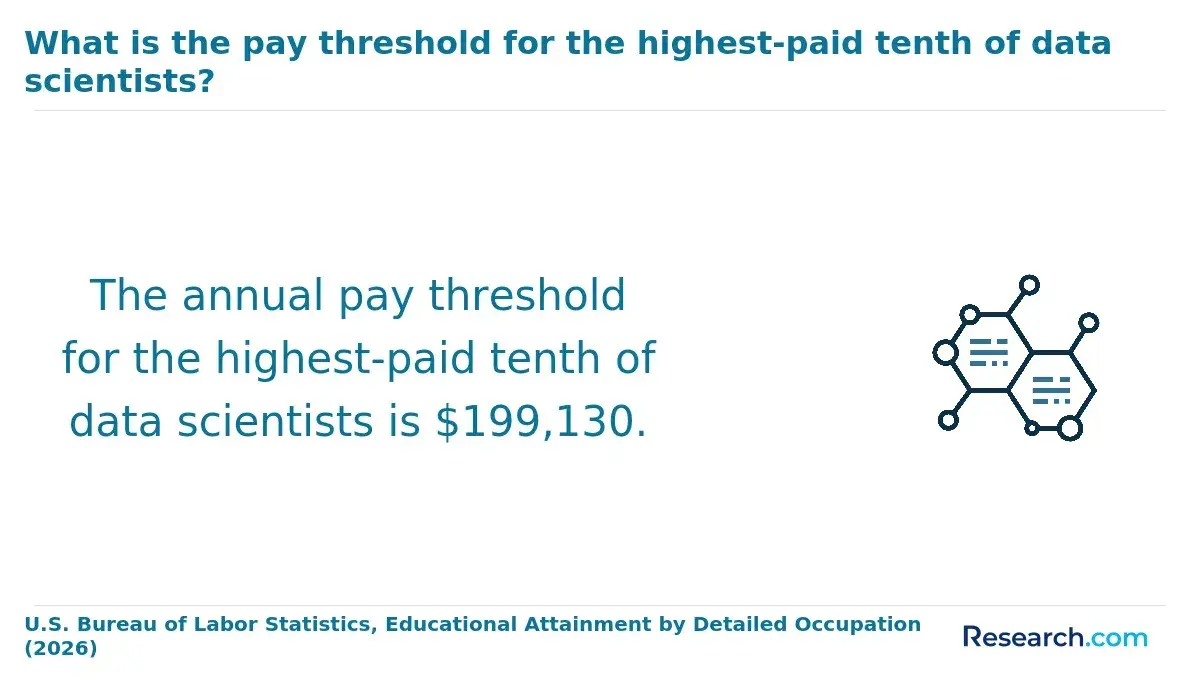
The U.S. Bureau of Labor Statistics reports a $120,230 median annual wage for data scientists in May 2025. That figure describes workers across the occupation, not newly graduated coordinators or salaries attributable to a master's degree. An initial move into a clinical data analyst role may have a different pay profile.
BLS projects 35% employment growth for data scientists from 2025 to 2035. This signals occupation-wide demand, not guaranteed openings in clinical research or for applicants without substantial coding experience. Evaluate local and remote job postings for required tools, experience, and salary ranges before using the national figure in a personal financial plan.
Do clinical research coordinators need certifications or licenses after earning a data science master's?
Data scientist roles generally do not require a professional license simply because the work involves data. Employers may nevertheless require documented training for particular duties, such as handling protected health information or working on regulated studies. Existing clinical research certifications can signal domain experience, but they do not substitute for evidence of analytical ability.
Check requirements for the job and duties, not just the job title. If a position involves independent clinical practice or another regulated profession, a data science master's does not confer that profession's license. Before paying for an additional certification, look for it in your target employers' postings and determine whether a technical project would address a more important hiring gap.
Other Things You Should Know About Data Science
Consider it if your goal is trial design, statistical analysis plans, or inference about treatment effects. Compare required statistics courses and target job postings rather than deciding by degree title.
Only with the permissions required by your employer, study agreements, and applicable privacy rules. Enrollment in a degree does not authorize you to transfer study data into a class or personal portfolio.
Use an appropriately licensed public dataset or a clearly labeled synthetic dataset. Explain its limitations so a reviewer can distinguish a sound analysis from claims about real trial participants.
It can be a practical route if your organization has an analytics team willing to consider staff with study-operations experience. Ask what technical work you could contribute, and document the skills required before relying on an internal opening.
References
- Understanding College Costs | studentaid.gov https://studentaid.gov/resources/prepare-for-college/students/choosing-schools/consider-costs
- Healthcare data scientist qualifications, skills, and job focus | nih.gov https://pmc.ncbi.nlm.nih.gov/articles/PMC7787353/
- Cost of Attendance (Budget) | 2026-2027 Federal Student Aid Handbook https://fsapartners.ed.gov/knowledge-center/fsa-handbook/2026-2027/vol3/ch2-cost-attendance-budget
- HIPAA and Research | hhs.gov https://www.hhs.gov/hipaa/for-professionals/special-topics/research/index.html
- Clinical Research Coordinator Career Ladder | umich.edu https://medresearch.umich.edu/office-research/about-office-research/our-units/clinical-trials-support-office/study-coordinator-support/clinical-research-coordinator-career-ladder
- Prerequisite Key Topics - UVA School of Data Science https://datascience.virginia.edu/pages/prerequisite-key-topics
- MS in Biostatistics and Data Science | cornell.edu https://phs.weill.cornell.edu/graduate-education-clinical-training/masters-track/biostatistics-data-science
- In-Demand Entry-Level Roles (and What They Do) | Duke Clinical and Translational Science Institute https://ctsi.duke.edu/career-development/education-and-workforce-development/entry-level-clinical-research-careers/demand
- Online Master's in Healthcare Data Science | Northwestern SPS https://sps.northwestern.edu/masters/healthcare-data-science/


