
2027 Online Data Science Master's for Analytics Engineers: A Career Transition Guide

Co-Founder and Chief Data Scientist
An online data science master's can help an analytics engineer move from building reliable data models to designing statistical analyses and predictive systems. But a degree is a substantial commitment, and not every target role requires one. This guide helps working analytics engineers identify the skills they already bring, compare programs against their career goals, and decide whether graduate study offers more value than a shorter, project-focused route.
Key Things You Should Know
- Choose a master's for substantial gaps in statistics, experimentation, or machine learning—not simply to strengthen skills in SQL and data pipelines you already use.
- Look for assessed modeling projects and a schedule you can sustain while working; a course title alone does not establish technical depth.
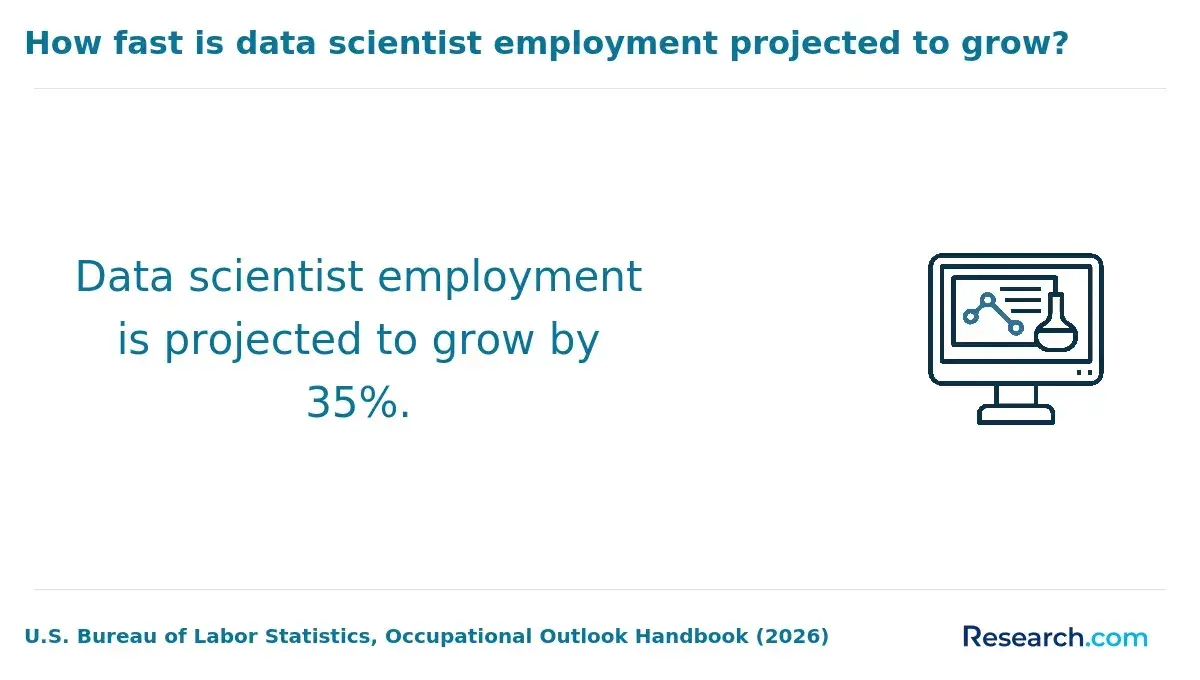
- The U.S. Bureau of Labor Statistics projects 35% growth in data scientist employment from 2025 to 2035, but that occupation-wide forecast does not predict an individual graduate's prospects.
What Is an Online Data Science Master's for Analytics Engineers?
For an analytics engineer, an online data science master's is a way to build on existing work in SQL, data transformation, testing, documentation, and stakeholder-facing metrics. Its distinctive value is deeper preparation in inference, experimental design, predictive modeling, and evaluation—not another introduction to building dashboards or maintaining warehouse tables.
Program names are imperfect guides. A data science degree may emphasize research-oriented modeling, applied analytics, or computing infrastructure. If your goal is analytics leadership or more advanced reporting rather than predictive work, compare master's pathways in data analytics before assuming data science is the better fit.
How Can Analytics Engineers Transition Into Data Science Roles?
Analytics engineers already understand a problem that modeling teams often face: whether data definitions are trustworthy. That experience remains valuable when constructing features, detecting leakage, reproducing results, and explaining why a model's inputs changed. The likely gap is less about obtaining data than about deciding which analytical method answers a question and whether its results hold up.
Use the following sequence to test the transition before committing to a degree:
- Pick an adjacent target role, such as product data scientist, experimentation analyst, or applied data scientist, and inspect its requirements rather than relying on the title.
- Audit your experience against probability, statistical inference, Python-based analysis, experimental design, and model evaluation.
- Build a reproducible project that starts with documented source data, states a business question, compares a baseline with a more complex method, and explains limitations.
- Seek an internal analysis or experimentation assignment; use the results to identify gaps that graduate coursework would address.
A master's is more compelling if target jobs call for sustained statistical and modeling work and you want structured instruction and feedback. If your main gap is a tool or a single method, focused study and a credible work project may be a more economical first step. Neither route substitutes for evidence that you can make sound decisions with imperfect data.
What Should You Look for in an Accredited Online Data Science Master's?
Start by verifying the institution's recognized accreditation and whether it can enroll students in your state. Institutional accreditation is not, by itself, evidence that a particular curriculum fits your goal. Ask the university directly about authorization, residency requirements, and any restrictions that affect your location.
Then examine course descriptions, assignments, and recent capstone examples. A strong fit should let you move beyond data preparation into statistical reasoning, model validation, and communication of uncertainty. Check whether working students can access instructors, project feedback, computing resources, and career support remotely. A warning sign is a program that advertises machine learning prominently but cannot show where students apply and evaluate models in assessed work.
How Do Online and Campus Data Science Master's Programs Compare?
The important difference is not whether a degree is earned online or on campus; it is whether the delivery format lets you complete demanding work and receive useful feedback. Compare equivalent programs on the same curriculum and support criteria, then assess the practical trade-offs below.
| Factor | Online program | Campus program |
| Scheduling | May offer more flexibility, though live sessions and deadlines can still be fixed | Usually requires attendance at scheduled campus activities |
| Employment | May make it easier to retain a current analytics engineering role | May require commuting, reduced hours, or relocation |
| Collaboration | Depends heavily on remote project design and instructor access | May offer more opportunities for in-person collaboration |
Choose online study if keeping your job and applying new methods at work are priorities. Campus study may suit someone seeking an immersive change of environment. In either format, confirm synchronous attendance, group-work expectations, and the maximum completion period; these details matter more than a broad claim of flexibility. Comparisons of online AI master's duration and workload trade-offs can also help if you are weighing a faster AI-focused route, though AI and data science curricula should be assessed separately.
What Courses Are Included in an Online Data Science Master's?
For a career transition, prioritize the progression from probability and statistics to inference, experimentation, machine learning, and model evaluation. Programming and data management matter too, but an analytics engineer should check whether introductory courses repeat work they already do. Electives might cover causal inference, time series, natural language processing, or deployment; availability and depth vary by program.
Read beyond course titles. A machine learning course should require students to establish baselines, select validation methods, investigate errors, and discuss consequences of deployment. A capstone is most useful when it includes a clearly defined question, appropriate data access, reproducible methods, and defensible conclusions.
If AI is the primary goal but your mathematics or programming background is uneven, compare AI graduate programs with foundation study; confirm whether any foundation courses count toward the degree or add time and cost.
What Are the Admission Requirements for Online Data Science Master's Programs?
Requirements vary by institution. Programs may ask for a bachelor's degree, transcripts, quantitative and programming preparation, recommendations, a statement of purpose, or evidence of professional experience. An analytics engineering job can demonstrate practical SQL, data quality, and collaboration skills, but it does not automatically fulfill a formal calculus, linear algebra, or statistics prerequisite.
Before applying, match each published prerequisite against your transcript and ask admissions staff how they evaluate relevant coursework or work experience. If a gap remains, confirm which course would satisfy the requirement before paying for it. In your application, explain the analytical decisions you have made—not just the tools you have used—and identify the modeling or inference skills you want to develop.
How Long Does an Online Data Science Master's Take and Cost?
There is no reliable universal price or completion time: credit requirements, per-credit tuition, mandatory fees, course availability, and enrollment pace differ. Calculate a program-specific estimate using the current university tuition schedule and required credits, then add applicable technology charges, materials, computing costs, and any travel for in-person components. Ask whether tuition changes during enrollment and whether part-time study affects aid eligibility.
The opportunity cost also matters. Staying employed may preserve income, but fewer courses per term can extend the commitment. Compare the full estimated cost with a realistic alternative, such as targeted courses plus a substantial workplace project. If financing affects the decision, review data science master's financial aid options and ask your employer about tuition assistance before borrowing. Do not treat a possible future salary increase as a guaranteed return.
What Jobs Can Analytics Engineers Get With a Data Science Master's?
Adjacent possibilities include product data scientist, experimentation analyst, applied data scientist, and roles combining machine learning with data infrastructure. Fit depends on the actual work: an experimentation role may reward strong metric definitions and causal reasoning, while a modeling role may demand more advanced statistics and production evaluation. A degree does not replace the project evidence or domain knowledge an employer seeks.
The Bureau of Labor Statistics projects about 24,800 U.S. data scientist openings annually, on average, over 2025-2035. That figure includes replacement openings and covers a broad occupation; it is not a count of positions reserved for new master's graduates or analytics engineers. If healthcare is your intended destination, assess privacy, clinical context, and model-use constraints alongside methods; artificial intelligence master's preparation for healthcare work offers a more specialized comparison.
How Much Can Data Science Graduates Earn in Analytics Engineering Roles?
The Bureau of Labor Statistics reports a May 2025 median annual wage of $120,230 for U.S. data scientists. It is an occupation-wide median, not a salary for master's graduates and not a measure of analytics engineering pay. BLS does not provide a directly equivalent national wage figure for the analytics engineer job title, so using the data scientist median to predict a raise in a current role would be misleading.
For a personal comparison, examine compensation ranges for the exact roles you would pursue, in your location and with your experience. Compare those ranges with your current pay and the full cost of study. A move that offers more interesting modeling work may be worthwhile, but neither the credential nor the occupational median establishes what an individual employer will offer.
What Certifications and Skills Improve Analytics Engineering Career Prospects?
Prioritize demonstrable capability over collecting credentials. For a data science transition, useful evidence includes sound experimental design, statistical programming, model validation, version-controlled analysis, and explanations that a stakeholder can act on. Your existing strengths in tested transformations and documented metrics can make that evidence more credible.
A platform certification may help when a target employer explicitly uses that platform, but it is a narrower signal than a project showing how you framed a question, checked data quality, evaluated a method, and communicated uncertainty. Review job descriptions before investing in an exam. Avoid choosing a certification—or a master's—solely because it names a popular AI tool; match the learning to the work you want to perform.
Other Things You Should Know About Data Science
Only with your employer's permission and appropriate privacy review. When access is restricted, use approved aggregate results, synthetic data, or a public dataset to demonstrate the same methods.
Diploma wording is set by the institution. Ask the registrar for the exact wording rather than assuming the online and campus credentials are presented identically.
Possibly. Confirm the program's project rules and your employer's data-use terms early; supervision, publication, and confidentiality requirements may limit what you can submit.
It can be a useful way to test your fit for analytical work. Ask about a scoped project with clear responsibilities and feedback, without assuming that an internal move or future offer is assured.
References
- Cost of Attendance (Budget) | 2025-2026 Federal Student Aid Handbook https://fsapartners.ed.gov/knowledge-center/fsa-handbook/2025-2026/vol3/ch2-cost-attendance-budget
- Types of Financial Aid: Grants, Work-Study, and Loans | studentaid.gov https://studentaid.gov/understand-aid/types
- Healthcare data scientist qualifications, skills, and job focus | nih.gov https://pmc.ncbi.nlm.nih.gov/articles/PMC7787353/
- Accreditation in the U.S. | ed.gov http://www.ed.gov/laws-and-policy/higher-education-laws-and-policy/college-accreditation/accreditation-in-the-us
- M.S. in Data Science, Online | virginia.edu https://datascience.virginia.edu/degrees/msds-online
- Data Science Curriculum | UC Berkeley School of Information's Online Master's Programs https://ischoolonline.berkeley.edu/data-science/curriculum/
- Online Data Analytics Engineering Master's Program | jhu.edu https://ep.jhu.edu/programs/data-analytics-engineering/
- A Guide to Choosing Between Data Science vs. Data Analytics | UCLA MSOL Data Science https://www.msol.ucla.edu/data-science-engineering/articles/demystifying-data-guide-choosing-between-data-science-vs-data-analytics/
- Data Science vs. Applied Data Science: Main Differences | Syracuse University https://ischool.syracuse.edu/applied-data-science-vs-data-science/
- Artificial Intelligence for Engineering Data Analytics Capstone | Professional Degrees & Certificates https://pdc.wisc.edu/degrees/ai-engineering-data-analytics-capstone/


