2027 Online Data Science Master's After a Bachelor's in Mathematics: Prerequisites and Program Fit

Co-Founder and Chief Data Scientist
A mathematics bachelor's degree can provide a strong foundation for an online data science master's, but it does not establish readiness for every program. The deciding questions are usually how much programming and applied data work you have done, what the program expects before enrollment, and whether its curriculum builds toward your intended role. This guide helps mathematics graduates identify gaps, compare programs, and decide whether to apply now or prepare first.
Key Things You Should Know
- Mathematics graduates often bring valuable quantitative preparation; programming, databases, and applied projects are the gaps most worth checking against each program's published prerequisites.
- Choose a program for the skills it will add - not for introductory math courses that largely repeat your bachelor's degree. Confirm whether prerequisites must be completed before admission or can be taken after enrollment.
- The U.S. Bureau of Labor Statistics projects 35% growth in data scientist employment from 2025 to 2035, but that outlook does not make every degree or curriculum a good fit.
What is an online data science master's after a mathematics bachelor's degree?
It is a graduate degree that applies quantitative reasoning to collecting, managing, analyzing, and communicating data. For a mathematics graduate, its value usually lies in adding computational practice and experience with less tidy, real-world problems - not simply studying more mathematics.
Your degree may have included statistics, numerical methods, optimization, or mathematical modeling, but mathematics curricula differ. Compare your transcript and projects with the program's required preparation. A theory-heavy graduate may benefit from a program with substantial programming and data engineering support; someone who already builds software may be ready for more advanced statistical learning or research-oriented electives.
What prerequisites do mathematics graduates need for online data science master's programs?
Requirements vary by program. Linear algebra, calculus, probability, statistics, and programming commonly matter, but a mathematics degree alone does not prove that every topic was covered at the level a particular school expects. The comparison below separates likely strengths from gaps worth investigating; it is not a universal admissions checklist.
| Preparation area | What a mathematics background may provide | What may still be missing |
| Quantitative foundations | Calculus, linear algebra, proofs, or optimization | Applied probability or statistical inference, depending on coursework |
| Programming | Possible experience in numerical computing | Writing, testing, and maintaining code for data analysis |
| Working with data | Experience interpreting mathematical models | SQL, data cleaning, and work with incomplete or unstructured data |
| Applied communication | Explaining rigorous quantitative results | Presenting model limitations and recommendations to nontechnical audiences |
Start with the program's prerequisite page, then match each requirement to a transcript course, substantial project, or work example. If a gap remains, ask admissions whether a graded course is required and whether a community college course, nondegree university course, or placement assessment qualifies. Self-study and online courses can build competence, but they do not automatically fulfill a formal prerequisite.
How do you choose an accredited online data science master's program?
First, verify the institution's current accreditation through its stated accreditor and the U.S. Department of Education's accreditation records. Then confirm that the online program accepts students in your state of residence; institutional accreditation and permission to enroll residents of a particular state are separate questions. Do not assume a data science degree needs a specialized programmatic accreditation unless a specific employer or further credential requires it.
A warning sign is a program that advertises advanced machine learning but provides little detail about programming preparation, projects, or how students reach those courses. Request a sample course sequence before committing.
What admission requirements apply to online data science master's programs?
Expect each institution to set its own rules for transcripts, prerequisite courses, recommendations, a résumé, statements, tests, and English-language proficiency where applicable. Some programs evaluate applicants holistically; others specify courses that must appear on a transcript. Neither approach means a mathematics bachelor's guarantees admission.
Make your application evidence specific: identify relevant math and statistics courses, describe what you personally coded, and explain a project's data, methods, and limitations. If you lack a required course, contact the program before applying rather than assuming experience will substitute for academic credit. If application writing is a concern, information on no-essay admissions for online machine learning master's programs can illustrate how requirements differ across related degrees; verify the current policy of any data science program you actually select.
What courses are included in an online data science master's curriculum?
Curricula commonly combine statistical modeling, machine learning, programming, databases or data management, visualization, and applied projects. Some emphasize research methods; others emphasize deploying analyses in organizations. Course titles alone cannot tell you how deeply a subject is taught.
For a mathematics graduate, the most useful sequence generally turns quantitative knowledge into practice: write reliable code, obtain and clean data, select and evaluate models, and explain uncertainty. Inspect syllabi or sample assignments for work with real datasets and for clear treatment of validation and model limitations. If you want to work with AI systems, check whether relevant coursework includes hands-on evaluation and responsible use rather than merely mentioning AI in a description.
A capstone can be particularly valuable when it requires you to define a problem, document reproducible work, and communicate a result. If the curriculum has no capstone, look for comparable substantial projects across courses.
How long do online data science master's programs take and cost?
Completion time depends on required credits, course availability, and whether you study part time or full time. An advertised fast route may not fit someone who must first complete programming or statistics prerequisites. Ask for a term-by-term plan that includes those courses, required project work, and any limit on time to completion.
There is no responsible single price for this category: schools charge differently, and a tuition quote may exclude mandatory fees, software, books, or prerequisite courses. Compare the cost of the same realistic enrollment plan at each school, including whether tuition changes with residency or course load. For a fuller worksheet, see budget planning for a data science master's. Confirm current charges and eligibility for employer assistance or financial aid with the institution; neither should be assumed.
How do online and campus-based data science master's programs compare?
Online study may let a mathematics graduate keep working and apply new skills on the job. Campus study may offer easier access to in-person research, recruiting, or collaboration. Neither format establishes academic quality by itself; compare the actual courses, faculty access, project opportunities, and career support.
Online programs also differ from one another. Live sessions, group projects, exams, and occasional campus requirements can make a nominally flexible degree hard to combine with work. Ask when required activities occur, whether recordings are available, and how teams coordinate across time zones. These operational details matter especially if you plan to fill a programming gap while employed. For more scheduling considerations, see online master's in data science for busy professionals.
What careers can follow an online data science master's degree?
Possible directions include data scientist, machine learning practitioner, statistical analyst, and analytics-focused roles. The best fit depends on your existing experience as well as the degree: strong modeling skills may suit analytical work, while software-intensive roles generally demand convincing coding and engineering evidence.
Use target job descriptions to test a program's fit. Compare their required tools and responsibilities with the courses and projects you would complete, then identify what evidence you could show an employer. A mathematics graduate with little coding experience may find an applied analyst role a more realistic first step than a role responsible for deploying production systems. A master's can strengthen preparation, but it is not the only route into data work and does not replace demonstrated skills.
What salaries and job outlook can data science graduates expect?
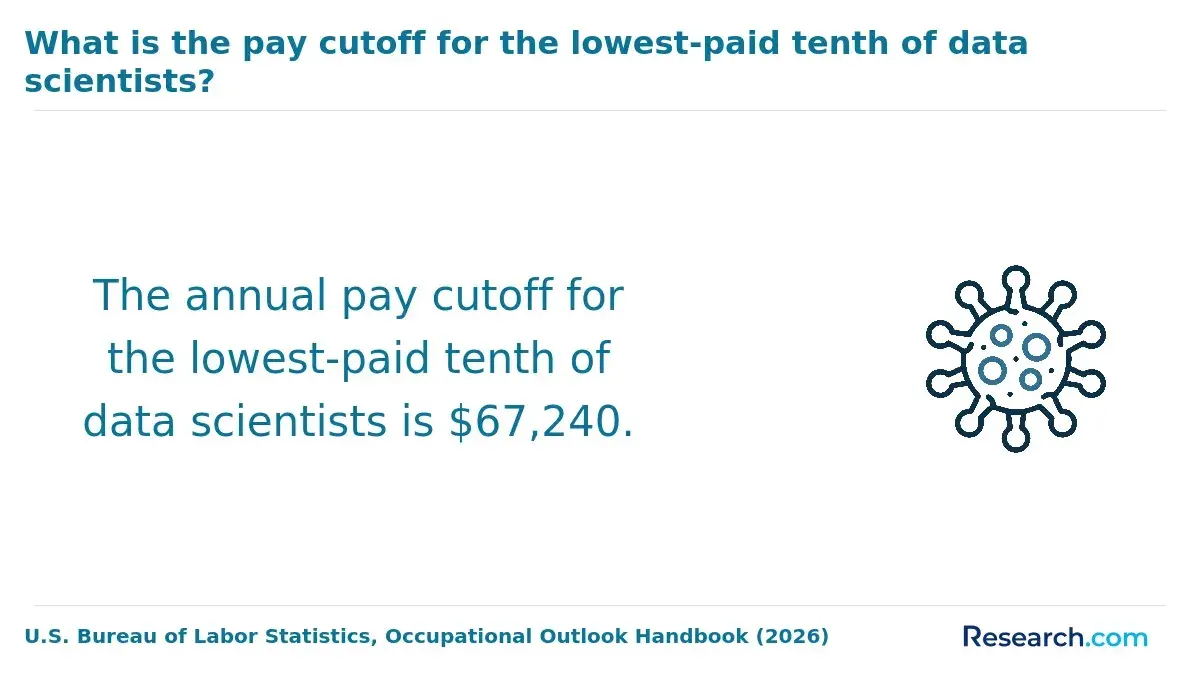
The U.S. Bureau of Labor Statistics reports a median annual wage of $120,230 for data scientists in May 2025. That is the median for workers in the occupation, not a starting salary or an outcome attributable to a master's degree. Prior experience, role, employer, and location all affect an individual offer.
For a career decision, compare the opportunities available to you now with roles for which a particular program would make you more competitive. If you want to compare data science graduate pay across industries, keep differences in job duties and experience in view rather than treating an industry figure as a personal forecast. Employment growth signals opportunity, not a guarantee of placement.
Do data science graduates need certifications or professional licenses?
Data scientist roles generally do not have a single professional license required for entry across the United States. A particular employer may value a platform certification, but it is usually better to prioritize the skills and projects demanded by your target roles before paying for an additional credential. Requirements can differ for regulated work or for a separate licensed profession that uses data science.
If a program promotes a certification alongside the degree, ask whether the exam and its fees are included and whether target employers actually request it. A certification can document familiarity with a tool; it is not a substitute for evidence that you can frame and solve a data problem.
Other Things You Should Know About Data Science
Diploma wording is set by the institution. Ask the registrar for the exact wording and, if it matters to you, how the program appears on the transcript.
Yes, if you can share it and explain your contribution clearly. For data science roles, supplement a theoretical thesis with evidence of coding, data handling, or applied evaluation where possible.
It can support an application, but doctoral programs set their own research and preparation requirements. If that is your goal, look closely at thesis options, faculty research, and opportunities to produce scholarly work.
Check your target programs and roles first. If both are relevant and you are new to programming, Python can help you begin analytical projects, while SQL helps you retrieve and organize data; neither automatically satisfies an admissions prerequisite.
References
- Cost of Attendance (Budget) | 2025-2026 Federal Student Aid Handbook https://fsapartners.ed.gov/knowledge-center/fsa-handbook/2025-2026/vol3/ch2-cost-attendance-budget
- Tuition & Fees | Bursar | Chicago State University https://www.csu.edu/financialoperations/bursar/tuition/
- MS in Data Science | Online | $9900 | Eastern University https://www.eastern.edu/academics/graduate-programs/ms-data-science
- Admissions and Application Requirements - UNC Online https://online.unc.edu/online-masters-programs/masters-data-science/admissions/
- What Can I Do With a Degree in Data Science? Career Paths & Skills | Harvard SEAS https://seas.harvard.edu/news/what-can-i-do-degree-data-science-career-paths-skills
- MS Admissions FAQ | Department of Statistics https://statistics.stanford.edu/msadmissions/ms-admissions-faq
- Top 12 Data Science Programming Languages | MDS@Rice https://csweb.rice.edu/academics/graduate-programs/online-mds/blog/programming-languages-for-data-science
- Prerequisite Key Topics - UVA School of Data Science https://datascience.virginia.edu/pages/prerequisite-key-topics
- How to Apply - Master in Data Science & Analytics - Georgetown https://analytics.georgetown.edu/admissions-tuition/how-to-apply/
- How to Apply - UChicago Data Science Institute https://datascience.uchicago.edu/education/masters-programs/ms-in-applied-data-science/how-to-apply/