2027 MLIS Programs for Legal Assistants Moving Into Law Libraries

Co-Founder and Chief Data Scientist
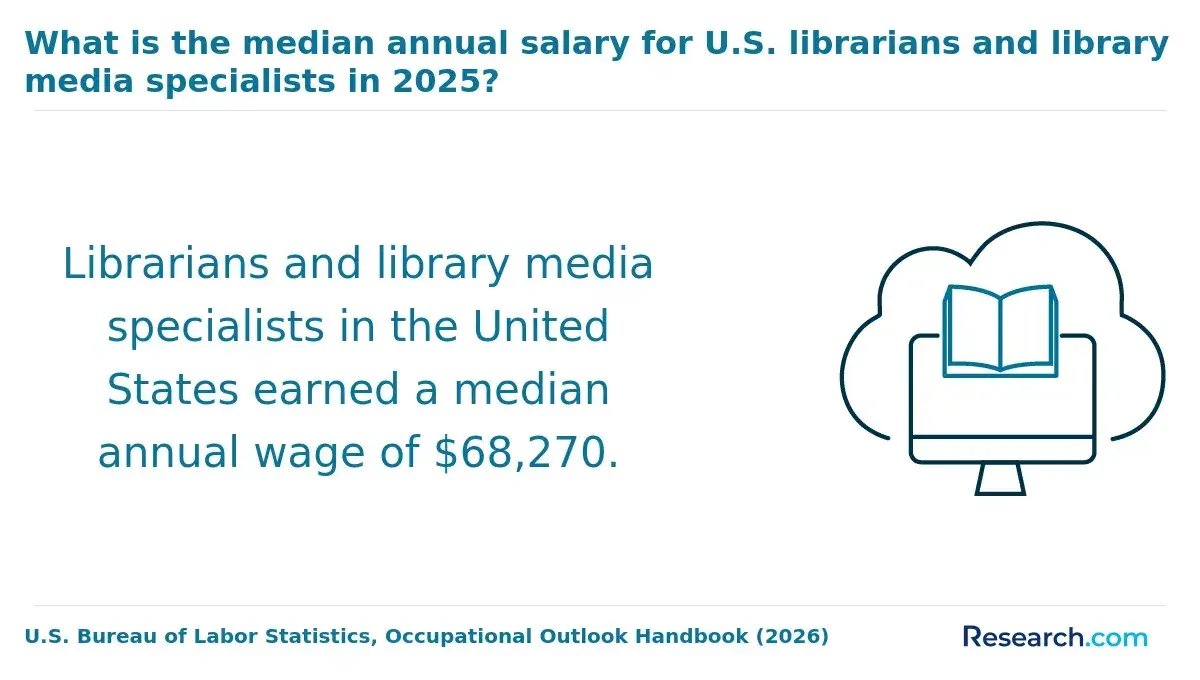
Legal assistants often know how to find a case or statute, but moving into a law librarian role can require a different credential and broader information-management skills. The U.S. Bureau of Labor Statistics reports a May 2025 median annual wage of $68,270 for librarians and media collections specialists; that figure covers many settings, not law libraries alone.
This guide helps legal assistants assess whether an MLIS is worth pursuing, which programs can support legal information work, and how to compare credentials, practical experience, time, and cost before enrolling.
Key Things You Should Know
- Start with an ALA-accredited master's program if you want the broadest access to professional librarian roles, verify the specific program's status, not just the university's accreditation.
- Prioritize legal research instruction, information organization, and supervised law library experience. A law librarianship elective alone does not establish a formal specialization.
- BLS projects 2.6% employment growth for librarians and media collections specialists from 2025 to 2035. That broad outlook does not predict openings in a particular law library.
What is an MLIS degree, and why is it valuable for legal assistants entering law libraries?
A Master of Library and Information Science (MLIS) prepares students to organize information, support research, teach users, manage collections, and evaluate information services. Institutions may instead award an MLS, a Master of Science in Library Science, or another LIS degree. For hiring purposes, check the particular program's accreditation and the employer's stated requirements rather than relying on the degree abbreviation.
A legal assistant's experience with citations, court documents, and research requests is useful, but law librarians often work beyond a single case or matter. They may train attorneys or students to use research tools, manage print and digital resources, assess database subscriptions, and help users find reliable legal authority. The MLIS can supply the service design, teaching, collection-management, and information-organization skills that legal work alone may not provide.
The degree is most compelling when the jobs you want identify an ALA-accredited master's as required or preferred. If your goal is to remain in a legal assistant position while becoming a stronger researcher, employer training or targeted legal research coursework may be a less costly first step.
Which accreditation should legal assistants look for in an MLIS program?
For U.S. professional librarian positions, look for a master's program currently accredited by the American Library Association (ALA). Check the specific program in ALA's directory and confirm that the degree and delivery option you intend to pursue fall under that program. A university's institutional accreditation matters, but it is not the same as ALA accreditation of its LIS master's program.
Accreditation does not verify that a school offers a law librarianship concentration, a particular elective, or a law library internship. Treat those as separate questions for the program. Read current job postings from the types of law libraries that interest you: an employer may specify an ALA-accredited degree, accept equivalent preparation, or set additional qualifications for a particular role.
What education and experience are required to become a law librarian?
Requirements depend on the position. Many professional law librarian jobs seek an ALA-accredited LIS master's and relevant research or library experience. Some academic law library roles, particularly positions centered on teaching legal research, may seek or require a JD. A JD is not a universal requirement for law librarians, and an MLIS is not necessarily required for library assistant or technician positions.
Legal assistants can build on their existing knowledge of legal sources while gaining experience with reference interviews, instruction, catalog or discovery systems, and collection work. Before enrolling, compare several recent postings for your target setting - law firms, law schools, courts, or government libraries - and note which qualifications are required rather than merely preferred. Ask prospective programs whether students can complete supervised work in that setting.
A shorter schedule can help someone change roles sooner, but pace should not displace practical preparation. If speed is a priority, compare one year MLIS tuition and outcomes alongside course sequencing and opportunities to gain law library experience. A fast degree does not make an applicant competitive for every law librarian role.
Should legal assistants choose an online or campus-based MLIS program?
Either format can support a law library transition if the program meets your credential needs and provides access to relevant coursework and experience. The important distinction is not whether classes are online, but whether you can actually attend them, complete any required fieldwork, and connect with a law library where you hope to work.
The comparison below highlights scheduling and experience trade-offs. Individual programs vary, so confirm each feature with the school rather than assuming it follows from the format.
| Factor | Online study | Campus-based study |
| Class schedule | May include asynchronous work or live sessions; neither is guaranteed | Usually requires attendance at scheduled campus classes |
| Law library experience | May depend on arranging an approved local placement | May offer access to nearby institutions, subject to placement availability |
| Additional expenses | Check technology, travel, and any campus-visit costs | Account for commuting or relocation as well as tuition and fees |
Ask whether required courses run at workable times, whether legal information electives are offered often enough for your graduation plan, and who arranges practicum placements. Online students should also check residency-based tuition rules. For readers comparing regional options, a guide to an online MLIS for Southern students can provide a starting point, but each school's current charges and placement rules still need confirmation.
What courses should an MLIS program include for law librarianship?
Start with a foundation in reference services, research instruction, information organization, collection development, and information technology. These subjects map to common law library work: answering research questions, teaching source evaluation, making materials discoverable, and managing access to costly digital resources.
Legal research or legal information courses are especially valuable when they cover statutes, regulations, case law, citators, and the differences between free and subscription sources. Courses in government information, licensing, digital collections, or management can support particular roles. For example, someone interested in firm libraries may benefit from evaluating resource contracts and maintaining internal knowledge collections; an aspiring academic law librarian may prioritize instruction and assessment.
Distinguish a formal specialization named by the university from a relevant elective or an independent project. Then inspect the current catalog and ask when desired electives are expected to run. A course listed in a catalog may not be available during your enrollment. A supervised project, such as a legal research guide or a usability review of a discovery tool, can show how you apply coursework without assuming that a program offers a dedicated law librarianship track.
What are the admission requirements for MLIS programs?
Applicants generally need a bachelor's degree and must submit the materials specified by the program, which may include transcripts, a statement of purpose, recommendations, and a résumé. Minimum grades, tests, deadlines, and prerequisites vary. Legal assistant experience can strengthen an application narrative, but it does not automatically replace an academic requirement.
In your statement, connect specific work - such as explaining a research result or maintaining legal information - to the librarian role you want. Ask admissions staff how they evaluate professional experience and whether any previously completed graduate courses are eligible for credit. Transfer decisions are program-specific; undergraduate coursework and workplace training should not be assumed to count toward graduate degree requirements. Readers with prior graduate study can use this guide to MLIS admissions with transfer coursework as a starting point for questions to put to each school.
How long do MLIS programs take, and how much do they cost?
Completion time depends on required credits, course availability, fieldwork, and whether you study full time while leaving your job or part time while continuing legal work. An advertised accelerated route is useful only if its required courses and any placement fit your schedule. Ask the program for a term-by-term plan based on the pace you can realistically maintain.
For a comparable cost estimate, multiply each school's published per-credit tuition by its required credits, then add mandatory fees and expected books, equipment, travel, and practicum expenses. Confirm the tuition category that applies to you; online enrollment does not necessarily mean in-state pricing. Compare gross program cost with your likely out-of-pocket cost after any confirmed employer support or grants, and separately consider how much you would borrow. Do not count an unawarded scholarship as savings.
If budget and speed are central constraints, a guide to a low cost fast MLIS degree may help identify options to investigate. Verify current tuition, fees, credit requirements, and elective availability directly with each institution before deciding. Federal aid eligibility and borrowing terms also depend on the student and enrollment period, so obtain current guidance from the school's financial aid office rather than assuming the full cost can be financed.
What careers can legal assistants pursue with an MLIS degree?
An MLIS can support several legal information careers, but employers do not use titles consistently. The table distinguishes roles that commonly draw on librarian preparation from adjacent work for which experience or another credential may also be appropriate.
| Role and setting | Typical work | Credential consideration |
| Law librarian in a firm, court, or government library | Legal reference, research training, resource access, and collection support | Check whether the posting requires or prefers an ALA-accredited master's |
| Academic law librarian | Research instruction, faculty or student support, and collection services | Some positions seek a JD in addition to an LIS master's |
| Legal knowledge or information specialist | Organizing internal expertise, research resources, and searchable content | An MLIS may help, but employers may also value legal operations or technology experience |
| Library assistant or technician | Supporting access, circulation, and resource maintenance | Can be an entry point without an MLIS; duties and advancement vary |
Match the degree to the job you actually want. If supervising services or budgets is a longer-term goal, compare coursework in a library management specialization with opportunities to manage projects at work. If your preferred postings focus on legal operations rather than professional librarianship, relevant experience or targeted training may offer a more direct path than an MLIS.
How much do law librarians and related professionals earn?
BLS reports a May 2025 median annual wage of $68,270 for librarians and media collections specialists. This is a national, multi-setting occupational median - not a law librarian salary, an entry-level offer, or an MLIS graduate outcome. Use it as context, then examine posted pay for the employer type and location you are targeting.
For comparison, the BLS median for library technicians was $44,580 in May 2025. The distinction matters if you are weighing a professional librarian position against an assistant or technician entry point, but the two medians do not measure the salary increase an individual legal assistant would receive after earning an MLIS. Compare actual job offers with your present earnings and the amount you would spend or borrow.
What is the job outlook for law librarians and legal information specialists?
BLS projects 2.6% employment growth for librarians and media collections specialists from 2025 to 2035. Because that category covers multiple kinds of libraries, the projection cannot establish how many law librarian openings will appear in your area. Legal information specialist jobs may also be classified under different occupations, making a single growth figure an imperfect guide.
Expect job requirements to reflect the tools used to find, organize, and assess digital information. For example, AI-assisted research can make source checking, citation verification, privacy judgment, and clear instruction especially relevant skills; it does not remove the need to assess legal authority. To gauge your prospects, review current postings by setting, identify recurring requirements, and seek work samples or supervised experience that address them. If local opportunities are scarce, factor geographic flexibility into your education decision rather than treating a national projection as a promise of employment.
Other Things You Should Know About Library Science
Only with appropriate permission and protection of confidential information. A safer option is to create a new research guide or instructional example using public legal sources and explain the methods you used.
Membership is generally a professional-development choice, not a universal employment credential. It can help you learn about the field and meet practitioners; check the terms and cost before joining.
Request a brief informational conversation through a law library or professional event. Ask about daily duties, hiring requirements, and which skills are hardest to learn without supervised practice.
Locate and read the underlying authorities, verify citations and current validity, and follow workplace rules for confidential material. A plausible summary is not a substitute for checking the source itself.
References
- Supreme Court Internship Program https://www.supremecourt.gov/jobs/internship/internshipprogram.aspx
- Types of Financial Aid: Grants, Work-Study, and Loans | studentaid.gov https://studentaid.gov/understand-aid/types
- Law Librarianship FAQ - UW Information School https://ischool.uw.edu/programs/mlis/degree-options/law-librarianship/faq
- Careers in the Legal Field Without a Law Degree | UTSA PaCE https://www.utsa.edu/pace/news/careers-in-the-legal-field-without-law-degree.html
- Where Will Your Legal Education Take You?: Law Librarian | uw.edu https://lib.law.uw.edu/c.php
- Graduate Scholarships and Financial Aid Guide | FIU College of Business https://business.fiu.edu/academics/graduate/insights/posts/graduate-scholarships-and-financial-aid-guide.html
- Guidelines for Choosing a Master's Program in Library and Information Studies | ALA https://www.ala.org/educationcareers/accreditedprograms/guidelines-choosing-masters-program-library-and-information-studies
- Education | Legal Information Services to the Public SIS https://www.aallnet.org/careers/about-the-profession/education/