
2027 MLIS Programs for Health Sciences Librarians

Co-Founder and Chief Data Scientist
Choosing an MLIS for health sciences librarianship means looking beyond a program's name. You need coursework and practical experience that prepare you to support clinicians, researchers, and patients with reliable information.
The U.S. Bureau of Labor Statistics reports a May 2025 median annual wage of $68,270 for librarians and media collections specialists, but that figure is not specific to medical libraries. This guide shows prospective students and career changers how to evaluate accreditation, training, format, cost, and career fit before committing to a degree.
Key Things You Should Know
- Start with an ALA-accredited master's program, then verify health-focused courses and applied opportunities separately; accreditation does not establish that a medical librarianship track exists.
- Prioritize evidence searching, critical appraisal, research support, and clinical communication. A project demonstrating a reproducible search strategy can be more useful than a concentration label alone.
- The BLS projects 2.6% employment growth for the broad librarians and media collections specialists occupation from 2025 to 2035; use that as context, not a forecast for health sciences librarian openings.
What is an MLIS program for health sciences librarians?
It is a graduate library and information science program that a student uses to prepare for information work in healthcare and biomedical research. Depending on the institution, the degree may be called an MLIS, MLS, Master of Science in Library Science, or Master of Information. The degree title alone does not tell you whether its courses suit medical librarianship.
Health sciences librarians help people find, assess, organize, and use biomedical evidence. In a hospital, that may mean answering a clinician's time-sensitive literature question or teaching staff to search effectively. At a university, it may involve systematic reviews, research data support, or instruction for health professions students. Some programs document a formal health-related specialization; others offer relevant electives or an individually designed project. Compare what students can actually study and produce, not just the label.
Which accreditation should health sciences librarianship programs have?
For most U.S. professional librarian roles, an American Library Association (ALA)-accredited master's program is the clearest starting point. Check the specific degree program in the current ALA directory before applying. A university's institutional accreditation is important, but it is not the same as ALA accreditation of its LIS master's program.
ALA accreditation evaluates the program; it does not certify a health sciences concentration, guarantee an internship, or confirm that a desired elective will run during your enrollment. You can use a comparison of the best accredited MLIS for working adults to begin a shortlist, then confirm each program's current status and health-related offerings with the school. If a job posting accepts an equivalent information degree, assess that option against the actual role rather than assuming every employer requires an MLIS.
What degree and training do medical librarians need?
An ALA-accredited LIS master's is a common qualification for professional medical librarian positions, but requirements vary by employer and job. A science or health undergraduate major can help, yet it is not a universal prerequisite. Employers may also value experience in healthcare, research, teaching, database searching, or scholarly publishing.
The most useful training connects search methods to real decisions. Learn to translate a clinical question into searchable concepts, select appropriate databases, document search strategies, and explain the strengths and limits of retrieved evidence. Familiarity with PubMed and Medical Subject Headings (MeSH), the vocabulary used to index biomedical literature, is particularly relevant. For systematic review work, look for supervised practice developing transparent, reproducible searches and collaborating with research teams.
Before enrolling, compare a few job descriptions from the settings that interest you with each program's curriculum. If you already have a suitable LIS degree and need only stronger biomedical searching skills, continuing education and supervised experience may be more proportionate than another master's.
Are online or campus-based MLIS programs better for health sciences librarians?
Neither format is inherently better. An online program may let you keep a healthcare or library job while studying; a campus program may make local research partnerships easier to access. For either format, the decisive question is whether you can complete relevant coursework and obtain meaningful practice where you live.
Ask whether classes are asynchronous or require live attendance, when health-focused electives are scheduled, and whether an applied project can involve a hospital, medical school, or research team. Do not assume an online degree includes a remote practicum or that a catalog listing means a course runs every term. If completion speed matters, compare quick online information science masters against elective sequencing and the time needed to build a credible portfolio; a shorter route is less useful if it excludes the training your target job requires.
What courses do health sciences librarianship programs include?
Expect general LIS foundations such as reference, information organization, instruction, and research methods, with health-focused preparation built through available electives and projects. Course titles and requirements differ by school. The following comparison helps you identify what each subject should enable you to do.
| Learning area | Relevant capability | Possible work sample |
| Biomedical information retrieval | Search PubMed and other appropriate resources using subject terms and keywords | Documented search strategy with a rationale for database choices |
| Evidence synthesis | Support a review team with transparent, reproducible searching | Search log and documented revisions |
| Instruction and reference | Teach clinicians or students to find and evaluate evidence | Accessible teaching plan or resource guide |
| Research data and scholarly communication | Advise researchers on data organization, publishing, or access within the librarian's expertise | Data-support guide or publishing consultation example |
Before treating a course as a reason to choose a school, ask whether it is required or elective, when it is next expected to run, and whether its assignments address biomedical work. A general research methods course can be valuable without being a formal medical librarianship specialization.
What are the admission requirements for health sciences MLIS programs?
Applicants generally need a bachelor's degree and must meet the individual graduate program's published requirements. Schools may request transcripts, a statement of purpose, recommendations, a résumé, or evidence of relevant experience; policies on tests, prerequisites, and international credentials vary. Do not assume that hospital employment replaces an academic admission requirement.
Use your statement to connect a specific goal - such as clinical reference or evidence synthesis - to verified courses and projects. If you have an unusual academic history or need to know whether prior graduate coursework can transfer, request an individual review before relying on a general policy. Admission and funding are separate decisions: investigate financial aid for online library programs alongside your applications, and confirm eligibility and deadlines directly with each school.
How long do health sciences MLIS programs take and cost?
Completion time depends on required credits, enrollment pace, course sequencing, and any applied-work requirement. Full-time study may shorten the calendar, while part-time study may preserve income and allow time to gain relevant experience. Ask for a term-by-term plan that includes the health-focused electives you want, rather than estimating duration from the shortest advertised pathway.
Calculate tuition by multiplying required credits by the rate that applies to you, then add mandatory fees, materials, and any travel or practicum expenses. Published tuition alone is not the total cost. Compare an affordable part time MLIS degree on that complete basis, especially if taking fewer courses changes fees or extends enrollment. Ask financial aid staff about current eligibility for your enrollment period, and distinguish the program's gross cost from what you would pay after confirmed assistance and what you would borrow.
For return on investment, weigh that personal cost against your present earnings and the qualifications in jobs you could realistically pursue. Neither an occupational median wage nor a program's advertised completion time establishes your likely financial outcome.
What careers can you pursue with a health sciences MLIS degree?
The degree can support several roles, but titles overlap and qualifications vary. This comparison connects likely work with the preparation to look for when evaluating programs.
| Role | Typical setting and work | Preparation to prioritize |
| Clinical or hospital librarian | Healthcare organization; evidence searches, reference, and staff instruction | Clinical-question searching, communication, and healthcare exposure |
| Health sciences academic librarian | University; student instruction, faculty research support, and collections | Teaching practice and biomedical research services |
| Evidence synthesis librarian | University, health system, or research organization; systematic review search collaboration | Reproducible strategies, documentation, and team projects |
| Research data or scholarly communication specialist | Academic or research institution; data and publishing support | Relevant project experience; some positions favor other technical degrees |
An MLIS is often relevant to librarian-titled roles, but adjacent data, publishing, and information-management jobs may accept or prefer different qualifications. Entry-level competitiveness can improve through a supervised search project, instruction experience, or work in a health library. Preserve confidentiality in portfolio samples, and make your own contribution to team projects clear.
How much do health sciences librarians earn?
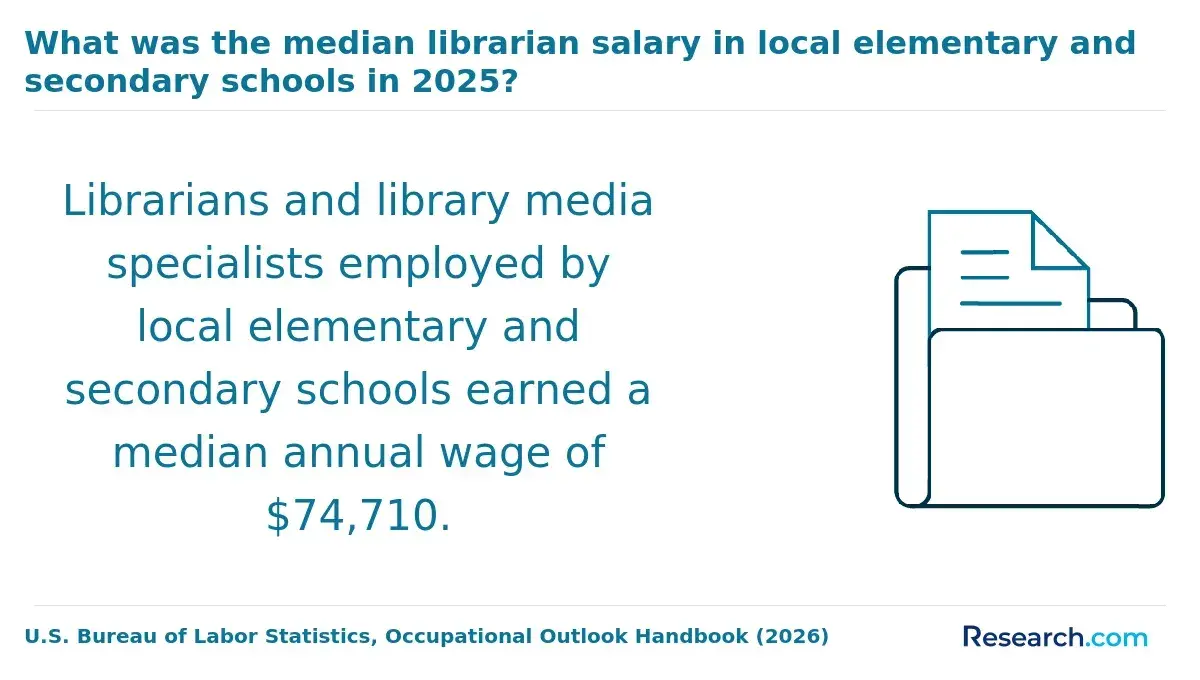
The BLS reports a May 2025 median annual wage of $68,270 for librarians and media collections specialists. This is a broad U.S. occupation, not a medical-librarian salary figure or a prediction for new MLIS graduates. Pay for a particular opening will depend on its employer, location, duties, and experience requirements.
Compare posted compensation for hospital, university, and research roles in your intended area before borrowing for a degree. If earnings are a central goal, a guide to well paid information science careers can broaden your search, but check each role's qualifications: higher-paying adjacent work does not necessarily require or reward an MLIS.
What certifications and professional standards apply to health sciences librarians?
The Medical Library Association's Academy of Health Information Professionals (AHIP) is a professional recognition pathway, not a universal license to work as a medical librarian. An employer may value it, but applicants should follow the current AHIP criteria rather than assume that earning an MLIS automatically confers the credential.
Professional practice also calls for responsible handling of information: document searches so collaborators can understand what was done, respect database-use terms, and follow employer privacy rules when work could involve patient information. In evidence synthesis, use the review team's reporting and search-review expectations to guide documentation. When comparing programs, ask whether students receive feedback on these practices through authentic assignments or supervised work; a course title alone cannot demonstrate proficiency.
Other Things You Should Know About Library Science
No. MEDLINE is a biomedical bibliographic database; PubMed is a free search platform that includes MEDLINE records and additional citations. Knowing the distinction helps you describe exactly what a literature search covered.
Gray literature is material distributed outside conventional journal publishing, such as some reports and guidelines. A review team may search it to address a question more completely, but should document the sources and methods used.
Usually, you can show your search design if you have permission to share the work. Remove confidential details, follow organizational policies, and identify any collaborators' contributions.
No. Authorship depends on the project's applicable criteria and the librarian's contribution, not solely on a job title or a completed search. Discuss roles, credit, and documentation with the team early.
References
- Mapping the pathways to health sciences librarianship - PMC https://pmc.ncbi.nlm.nih.gov/articles/PMC10621722/
- NCDS Data Internship | NNLM https://www.nnlm.gov/offices/ncds/internship
- Online Master's in Library & Information Science (MLIS) | Drexel University Online https://www.online.drexel.edu/online-degrees/information-sciences-degrees/ms-di/index.aspx
- Databases and Sources - Systematic Reviews and Meta Analysis - Research Guides at Harvard Library https://guides.library.harvard.edu/meta-analysis/databases
- MLIS Career Outcomes | College of Information Science https://infosci.arizona.edu/ma-library-information-science/career-outcomes
- iSchool Fees - SJSU | School of Information https://ischool.sjsu.edu/fees
- EBM Overview - Evidence-Based Medicine Subject Guide https://guides.lib.uci.edu/ebm/overview
- LibGuides: Systematic Reviews: 5. Conduct the Search | osu.edu https://hslguides.osu.edu/systematic_reviews/search
- Systematic Reviews: Where to Search | Research Guides at George Washington University https://guides.himmelfarb.gwu.edu/systematic_review/medical-literature-databases-to-search
- Learning from Experience: Librarians as Research Partners | osu.edu https://kb.osu.edu/bitstreams/dd65f0d8-270b-4399-831e-bcf8d79f988f/download


