
2027 Choosing an Online Data Science Master's for a Career in Online Marketplaces

Co-Founder and Chief Data Scientist
Choosing an online data science master's for a marketplace career means looking beyond a degree title. A program may teach strong modeling skills yet offer little practice with the experiments, search systems, pricing decisions, and two-sided dynamics common to marketplaces.
This guide is for prospective students weighing programs against roles in e-commerce, resale, delivery, travel, or service platforms. It explains which skills and projects matter most, what to verify before enrolling, and when a broader data science program may still be the right choice.
Key Things You Should Know
- Prioritize programs that let you apply statistics, experimentation, and machine learning to marketplace problems - not merely study those subjects in isolation.
- Ask whether you can complete a project involving buyers and sellers, search or recommendations, pricing, or marketplace trust; a relevant portfolio can make general coursework more useful.
- U.S. data scientist employment is projected to grow 35% from 2025 to 2035, but that occupation-wide forecast does not establish demand for marketplace specialists or guarantee a job.
What Is an Online Data Science Master's for Marketplace Careers?
It is usually a general data science master's completed primarily online, with courses and projects selected to prepare for analytical work at a platform that connects different groups of users. The degree need not have "marketplace" in its name. What matters is whether it builds the skills to analyze interactions among buyers, sellers, listings, transactions, and the systems that match them.
Marketplace data differs from a simple customer dataset. A change that benefits buyers may affect seller participation; an increase in transactions may reflect better matching, a promotion, or a shift in which users are active. A suitable program gives students practice defining outcomes, testing explanations, and communicating trade-offs - not just fitting predictive models.
Why Choose Data Science for an Online Marketplace Career?
Marketplace teams use data to investigate questions such as whether search results help buyers find relevant listings, whether incentives attract sustainable seller supply, and whether fraud controls reduce harm without blocking legitimate users. These questions call for statistical reasoning alongside knowledge of how the platform operates.
A data science master's is a good fit if you want to design analyses or models and explain their implications to product, operations, or engineering teams. If your goal is primarily to build production AI infrastructure, compare the curriculum with an artificial intelligence online degree guide instead. Neither degree title substitutes for checking actual courses, project opportunities, and the preparation required for your target role.
What Careers Can an Online Data Science Master's Prepare You For?
Potential roles include product data scientist, experimentation scientist, search or recommendation data scientist, pricing analyst, fraud or trust analyst, and marketplace operations analyst. Job titles vary by employer. A product-focused role may emphasize metrics and experiments, while a recommendation-focused role may require deeper modeling and software collaboration.
Choose a target role before comparing programs. For experimentation roles, favor causal inference, statistical design, and product analytics. For search or recommendation roles, look for machine learning, information retrieval, evaluation, and substantial programming. For trust and fraud work, consider courses or projects addressing imbalanced data, changing behavior, and the costs of false positives. These paths are part of the broader landscape of data science study options for emerging data roles, but their skill priorities are not identical.
A master's may help you develop evidence of these skills, but it is not the only route into an analyst role. Relevant work experience, strong projects, and technical preparation may also matter; check current job descriptions for the positions you intend to pursue.
What Do You Learn in an Online Data Science Master's Program?
Program content varies, so inspect required courses and recent syllabi rather than relying on a list of electives. For marketplace work, a useful foundation combines SQL and data management, probability and statistics, experimental design, machine learning, and clear communication of uncertainty. Advanced options in causal inference, optimization, information retrieval, or recommendation systems can strengthen a particular career path.
Look especially for opportunities to study problems that arise when platform decisions affect multiple groups. A credible project might evaluate search ranking against both buyer engagement and seller exposure, estimate the effect of a promotion without confusing correlation with causation, or assess a fraud model's errors for legitimate users. Ask what data students may use, how results are evaluated, and whether projects require reproducible code and a defensible account of limitations. A course title alone does not establish that level of depth.
How Do Online and Campus Data Science Master's Programs Compare?
The delivery format does not, by itself, determine academic rigor or career relevance. This comparison highlights practical differences to verify for each program, rather than assuming every online or campus degree works the same way.
| Consideration | Online program | Campus program |
| Schedule | May offer asynchronous study, live sessions, or both | Typically centers on scheduled in-person classes |
| Team projects | May require remote coordination across time zones | May make in-person coordination easier |
| Industry access | May let working students retain a relevant job | May offer easier access to local campus events and employers |
| Required travel | Varies; some programs may have in-person requirements | Regular campus attendance is generally expected |
Choose online study if its schedule lets you keep valuable work experience and the program still supports rigorous projects and career interaction. Campus study may be more suitable if in-person collaboration or access to a particular local employer network is central to your plan. Confirm live-session times, group-work expectations, exams, and any campus visits before committing.
What Are the Admission Requirements for Online Data Science Master's Programs?
Requirements differ by institution. Programs may ask for a bachelor's degree, transcripts, a statement of purpose, recommendations, and evidence of quantitative or programming preparation; whether tests or specific prerequisite courses are required must be checked in the current admissions policy. Professional marketplace experience can strengthen an application, but it should not be assumed to replace a formal prerequisite.
Compare your background with the courses you would actually take. Someone experienced in product analytics may already know SQL and metrics but need more probability or linear algebra; a software engineer may need more experimental design and statistical inference. If you have gaps, distinguish coursework that formally satisfies an admissions condition from preparation that simply helps you succeed. Programs with foundation coursework before an AI master's illustrate the questions worth asking about preparatory study, but confirm the policy of each data science program directly.
How Long Does an Online Data Science Master's Take and Cost?
Time to completion depends on required credits, course availability, transfer-credit policies, and whether you study part time or full time. Published tuition may be charged per credit, term, or program; those figures are not interchangeable. No single duration or price reliably describes all online data science master's programs.
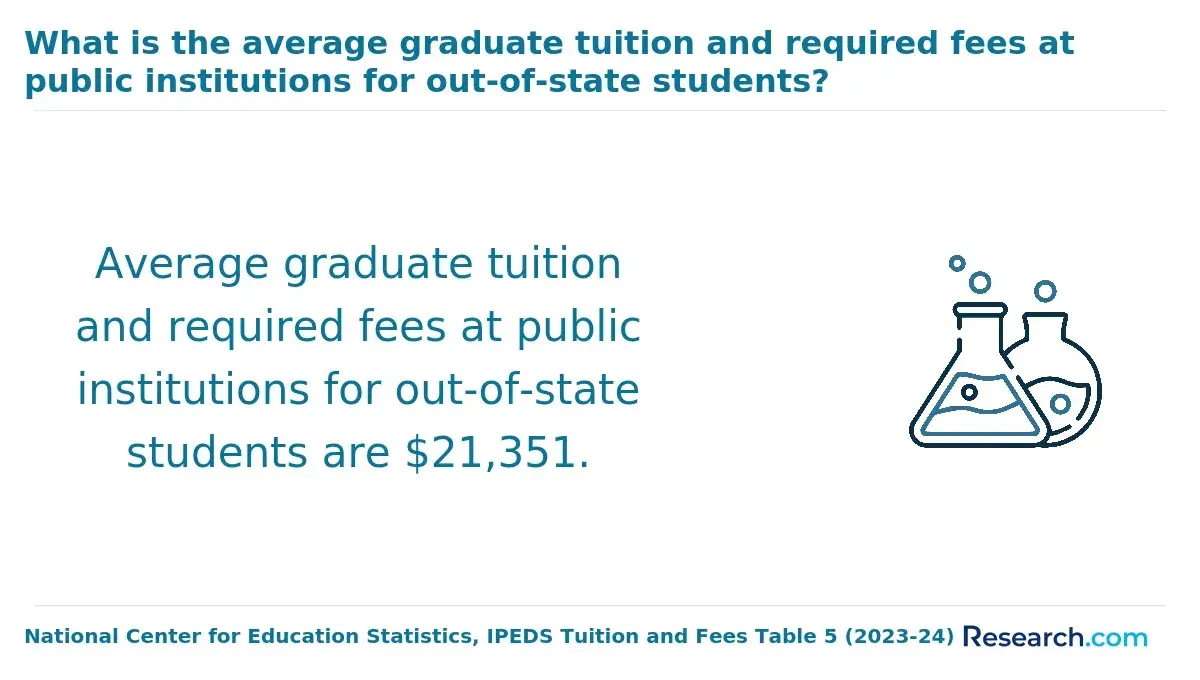
Before comparing offers, request a written estimate for your intended pace. Include mandatory fees, materials or software, any travel, and the financing cost of borrowing - not tuition alone. If you plan to keep working, consider whether the schedule protects your income; if you plan to leave work, include forgone earnings in your decision. An advertised fast path is useful only if its course sequence, workload, and eligibility rules work for you. Review online data science master's completion options as a starting point, then confirm current costs and timelines with the schools.
A sensible value comparison asks what you would pay for the curriculum and project opportunities you need, not whether a degree's price can be justified by an occupation-wide salary figure. Employer tuition support, if available to you, can change that calculation.
How Can You Verify an Online Data Science Program's Accreditation?
Check the institution's accreditation before applying. Accreditation of the university and any separate accreditation claimed for a program are different matters; do not assume one establishes the other. Accreditation also does not indicate whether the curriculum fits marketplace work.
Use this short verification sequence rather than relying on a promotional badge:
- Find the institution's official accreditation statement and identify the accrediting agency.
- Confirm the institution and its current status through the U.S. Department of Education's accreditation database or the accreditor's official directory.
- Ask the university whether the online program is available to students in your state and whether any required activities have location restrictions.
If a school makes a specialized accreditation claim, verify its scope directly with the named accreditor. State authorization concerns permission to offer education where you live; it is not a substitute for accreditation.
What Salaries and Job Outlook Can Data Science Graduates Expect?
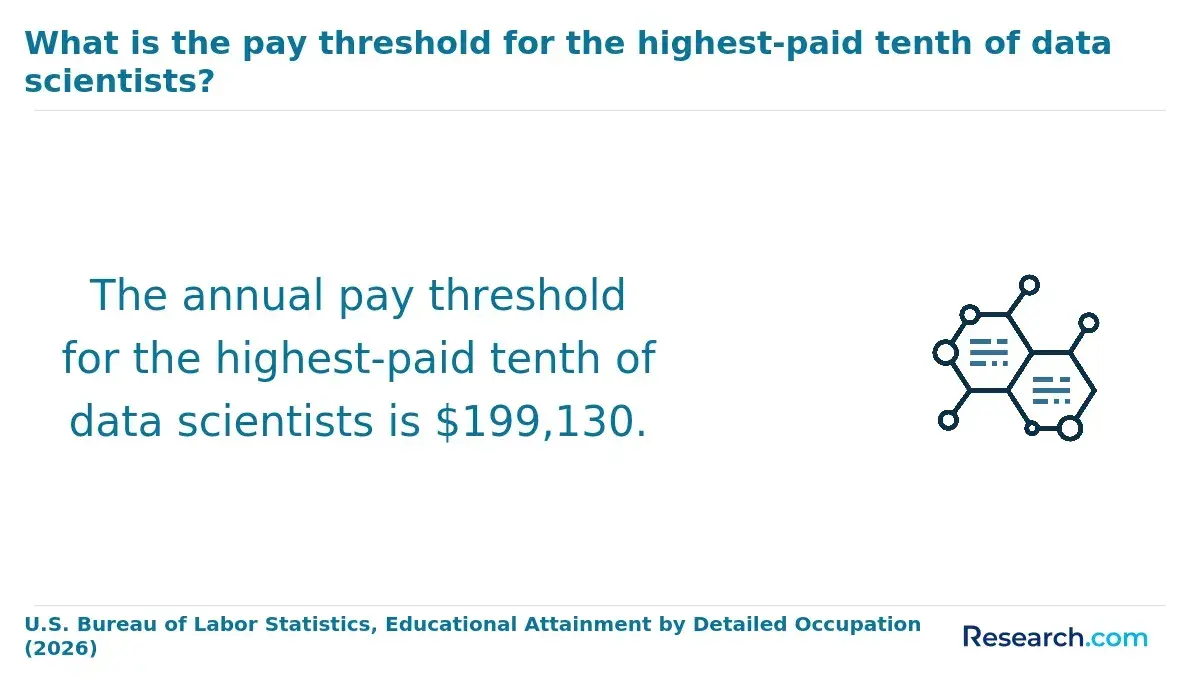
The U.S. Bureau of Labor Statistics reports a median annual wage of $120,230 for data scientists in May 2025. That is an occupation-wide figure, not a starting salary, a marketplace-specific salary, or evidence that a master's degree caused a particular person's earnings. The same agency projects strong growth for the occupation, but marketplace hiring will depend on employers and roles.
Compare opportunities using the job's responsibilities, required experience, location, and compensation structure. Industry salary differences for data science graduates can provide context, but broad averages cannot replace actual offers or verified outcomes from a program. If a school publishes graduate salaries, ask who responded, whether they were employed before enrolling, and whether the figure represents salary level or salary increase.
Do Marketplace Data Scientists Need Certifications or Licenses?
Marketplace data science roles generally do not have a universal professional license. Employers may value evidence of SQL, statistics, experimentation, modeling, and communication more than a particular optional certificate. Verify the requirements in job postings for your target employers rather than buying a credential on the assumption that it is mandatory.
Certifications can be useful when they close a specific tool gap or give you a structured way to learn. They are less compelling if they duplicate graduate coursework without producing work you can explain and defend. A portfolio project that documents its data, assumptions, evaluation, and marketplace trade-offs may give an interviewer more to assess than a certificate alone.
Other Things You Should Know About Data Science
Yes. Public or appropriately licensed datasets, or clearly labeled synthetic data, can support useful analyses. State what the data cannot represent, particularly if you lack the full buyer-seller interaction history.
Not without evidence from a real deployment or a valid experiment. Describe what your analysis estimated or what an offline model achieved, and separate those results from untested business impact.
Not necessarily. Experience in product analytics, experimentation, operations, software, or another platform business may transfer. Show that you understand how decisions affect both sides of a marketplace.
Ask who may access the data, whether it can be used for coursework, what must be removed or protected, and whether you may discuss the results publicly. Obtain the necessary approvals before transferring data into school tools.
References
- Types of Financial Aid: Grants, Work-Study, and Loans | studentaid.gov https://studentaid.gov/understand-aid/types
- Cost of Attendance (Budget) | 2025-2026 Federal Student Aid Handbook https://fsapartners.ed.gov/knowledge-center/fsa-handbook/2025-2026/vol3/ch2-cost-attendance-budget
- Online Experimentation: Benefits, Operational and Methodological Challenges, and Scaling Guide · Issue 4.3, Summer 2022 https://hdsr.mitpress.mit.edu/pub/aj31wj81
- What Does a Data Scientist Do? Tasks, Skills & Career Paths | Syracuse University https://ischool.syracuse.edu/what-does-a-data-scientist-do/
- A/B testing: A systematic literature review | sciencedirect.com https://www.sciencedirect.com/science/article/pii/S0164121224000542
- Frequently Asked Questions | Department of Mathematics and Statistics | Georgetown University https://mathstat.georgetown.edu/ms-mathematics-statistics/faq/
- Online M.S. in Data Science | njit.edu https://www.njit.edu/academics/degree/online-ms-data-science
- What Can I Do With a Degree in Data Science? Career Paths & Skills | Harvard SEAS https://seas.harvard.edu/news/what-can-i-do-degree-data-science-career-paths-skills
- Syracuse Online Master's in Applied Data Science https://onlinegrad.syracuse.edu/information-science/applied-data-science/
- Choosing a learning format that works for you | Gary W. Rollins College of Business https://blog.utc.edu/business/2025/06/09/choosing-a-learning-format-that-works-for-you/


