2027 Can You Get Into an Online Speech Pathology Doctorate Program with a Low GPA? Admission Chances and Alternatives

Co-Founder and Chief Data Scientist

Reviewed by Rhea Paul, PhD
SLP Education & Research Expert
A low GPA can make doctoral admissions feel uncertain, especially in speech-language pathology, where many applicants already hold graduate credentials and clinical experience. The decision matters because the U. S. Bureau of Labor Statistics reported a May 2024 median wage of $95,410 for speech-language pathologists, with demand remaining strong in schools, healthcare, and aging-related services. This guide is for prospective online SLPD, PhD, and related doctoral applicants who want to know whether to apply now, strengthen their profile first, or choose another route. You will learn how schools evaluate GPA, what can offset it, and which next step fits your goals.
Key Things You Should Know
- A low GPA does not automatically prevent admission, but many online speech pathology doctorate programs use a 3.0 graduate GPA as a common screening benchmark; applicants below that level usually need a waiver, conditional review, or unusually strong professional evidence.
- For most post-professional online SLP doctorates, recent graduate coursework, CCC-SLP status, clinical leadership, writing ability, and fit with faculty or program goals can matter more than an older undergraduate GPA.
- The financial and career decision should be realistic: BLS reported a May 2024 median SLP wage of $95,410, while federal graduate Direct Unsubsidized Loans are capped at $20,500 per academic year before other loan options are considered.
Can You Get Into an Online Speech Pathology Doctorate Program With a Low GPA?
Yes, it is possible to get into an online speech pathology doctorate program with a low GPA, but your chances depend on the type of doctorate, how low the GPA is, whether the low GPA is from undergraduate or graduate study, and whether the program uses strict minimums or holistic review. In this context, a "low GPA" usually means below 3.0 on a 4.0 scale, because many graduate schools use 3.0 as a standard minimum for regular admission.
The most important distinction is program type. A post-professional Doctor of Speech-Language Pathology, often called an SLPD, is usually designed for licensed or certified speech-language pathologists who already have a master's degree. A PhD is usually research-focused and may place more weight on research fit, academic writing, statistics preparation, and faculty mentorship. An EdD or leadership doctorate may be broader and may consider professional experience heavily. None of these should be confused with the entry-level master's degree that prepares students for SLP licensure.
The table below shows how GPA is commonly interpreted across online or hybrid doctoral pathways. These are general patterns, not universal admission rules, so applicants should verify each school's published policy before applying.
| Program type | Typical applicant profile | How a low GPA is usually viewed | Best compensating evidence |
| Post-professional SLPD | Practicing SLP with a master's degree and clinical credentials | An older undergraduate GPA may matter less than graduate performance and professional readiness | Strong master's GPA, CCC-SLP status, leadership, clinical specialization, and clear career goals |
| Research PhD in communication sciences and disorders | Applicant seeking research, faculty, or grant-funded roles | Low GPA can be a bigger concern if it appears in research methods, statistics, or graduate coursework | Research experience, writing sample, faculty match, publications, and strong quantitative preparation |
| EdD or leadership-focused doctorate | Practitioner pursuing administration, teaching, supervision, or systems-level work | Professional record may carry significant weight, but minimum GPA rules may still apply | Leadership record, employer support, graduate-level success, and strong recommendations |
| Direct-entry or master's-to-doctorate pathway | Applicant still preparing for professional SLP eligibility | Low GPA is more likely to be a barrier because programs must assess readiness for foundational graduate work | Prerequisite completion, recent A grades, strong clinical exposure, and academic explanation |
If your GPA is below the posted minimum, admission is still possible only if the school allows exceptions. Some universities state that applicants below the minimum may be considered with departmental approval, while others automatically screen them out. This is why contacting admissions before paying application fees is not optional; it can save time and money.
A practical rule is to separate "admissible" from "competitive." You may be admissible if the program permits GPA exceptions. You become competitive when the rest of your application gives the committee confidence that the GPA does not predict your current doctoral performance.
What Admissions Factors Matter Most Beyond GPA for Online Speech Pathology Doctorate Programs?
Beyond GPA, online speech pathology doctorate programs look for evidence that you can complete advanced coursework, contribute to the profession, and manage doctoral-level writing or research while often working full time. For low-GPA applicants, the goal is not to hide the GPA; it is to replace uncertainty with stronger evidence of readiness.
The table below summarizes the non-GPA factors that commonly matter in holistic review. Use it to identify where your application is already strong and where you may need to add evidence before applying.
| Admission factor | Why it matters | What stronger evidence looks like |
| Graduate academic record | Recent graduate performance often predicts doctoral readiness better than an older undergraduate record | A strong master's GPA, recent A grades, or successful completion of advanced courses |
| Clinical credentials | Post-professional SLPD programs often expect applicants to understand real clinical problems | CCC-SLP status, state licensure where applicable, specialty experience, or supervisory roles |
| Professional experience | Doctoral programs value applicants who can connect coursework to practice, policy, education, or leadership | Documented outcomes, program development, mentorship, school or healthcare leadership, and interdisciplinary work |
| Writing sample or statement | Doctoral work requires synthesis, argumentation, and evidence-based writing | A focused statement that explains your goals, addresses academic concerns briefly, and shows program fit |
| Recommendations | Letters can validate that your current performance exceeds what the GPA suggests | Specific letters from supervisors, graduate faculty, clinical directors, or research mentors |
| Research or evidence-based practice experience | Especially important for PhD applicants and useful for SLPD applicants completing capstones | Conference posters, quality-improvement projects, literature reviews, data collection, or publications |
GRE policies also matter. Many programs are test-optional or do not require standardized tests, reflecting a broader graduate admissions trend away from test-heavy screening. If a program allows optional scores, submit them only when they clearly strengthen the file, such as when quantitative or verbal scores show skills not reflected in your GPA. A mediocre optional score rarely helps a low-GPA application.
Technology is becoming another differentiator. Online doctoral students increasingly use telepractice platforms, data dashboards, AI-assisted documentation tools, and digital collaboration systems. Admissions committees may not require expertise in these tools, but applicants who can discuss responsible technology use in SLP settings can show current professional awareness.
Which Online Speech Pathology Doctorate Programs Offer Flexible Admission Pathways?
Flexible admission pathways are usually found in programs that use holistic review, accept professional portfolios, allow conditional admission, or evaluate applicants through department-level review rather than GPA alone. However, "flexible" does not mean "easy." Doctoral programs still need evidence that you can succeed in advanced coursework and complete a capstone, dissertation, or applied project.
Applicants with low GPAs should look closely at the wording on admissions pages. Phrases such as "preferred GPA," "holistic review," "exceptions may be considered," or "departmental approval" suggest more flexibility than language stating that applications below a threshold will not be reviewed.
The following program features often signal a better fit for applicants whose GPA is not their strongest credential:
- Post-professional design for practicing SLPs who already hold a master's degree and can show clinical maturity.
- Application review that weighs professional experience, leadership, writing, and career goals in addition to transcripts.
- Optional or waived GRE requirements, especially when the program asks for a portfolio, interview, or goal statement instead.
- Conditional admission policies that allow students to prove readiness through initial doctoral coursework.
- Capstone or applied-project models that align with clinical, school-based, or administrative practice rather than only full-time research training.
If your academic background is outside communication sciences and disorders, a doctorate is usually not the first step. You may need prerequisite or leveling work first, and an SLP bridge program can help you understand how non-SLP majors typically build the foundation needed for graduate-level speech pathology study.
One caution: verify accreditation and licensure relevance before applying. The Council on Academic Accreditation in Audiology and Speech-Language Pathology accredits entry-level graduate programs in speech-language pathology and audiology, but many post-professional SLPD programs are not designed as licensure-entry programs. If your goal is to become an SLP, you generally need the appropriate accredited master's pathway, not simply a doctorate with "speech pathology" in the title.
How Can Applicants Strengthen an Online Speech Pathology Doctorate Application With a Low GPA?
A low-GPA applicant should build an application that answers one question: why should the committee believe you are academically stronger now than your transcript suggests? The strongest applications are specific, evidence-based, and consistent across the statement, resume, recommendations, and transcript history.
Use the steps below to improve your application before submission. They are ordered from highest impact to lower impact for most low-GPA doctoral applicants.
- Identify the exact GPA problem by separating undergraduate GPA, graduate GPA, major GPA, prerequisite GPA, and most recent coursework performance.
- Contact admissions and ask whether applicants below the stated GPA are reviewed, whether waivers are possible, and what evidence the committee prefers.
- Complete one or two relevant graduate-level courses with strong grades if your recent academic record is weak or outdated.
- Write a concise GPA addendum only if there is a real explanation, such as illness, caregiving, military service, work disruption, or a clear upward academic trend.
- Ask recommenders to address doctoral readiness directly, including writing skill, independent learning, clinical judgment, leadership, and follow-through.
- Revise your statement so it connects your professional goals to the program's curriculum, faculty interests, capstone model, or research strengths.
- Prepare for an interview by explaining what changed academically and how you now manage time, feedback, writing, and evidence-based work.
Common mistakes can weaken even a promising application. Avoid apologizing excessively for the GPA, blaming previous instructors, submitting a generic personal statement, applying only to highly selective programs, or assuming years of experience automatically override academic concerns. Experience helps most when it is tied to measurable responsibility, leadership, or professional growth.
If you are also comparing master's-level options or need a broader admissions strategy, reviewing the easiest SLP programs to get into can help you understand how GPA flexibility, prerequisites, and holistic review differ across speech-language pathology pathways.
Should Students Complete Additional Coursework Before Applying to an Online Speech Pathology Doctorate?
Additional coursework can help, but it is not always necessary. It makes the most sense when your low GPA is recent, your transcript lacks strong grades in research or statistics, your master's degree is older, or the program specifically recommends academic strengthening before reapplying.
The table below compares common academic repair options. It is meant to help you decide which option fits your situation, not to replace school-specific admissions advice.
| Option | Best fit | Main advantage | Main limitation |
| Nondegree graduate course | Applicant with one weak area, such as statistics, research methods, or academic writing | Fast way to show recent doctoral readiness | May not change cumulative GPA much |
| Graduate certificate | Applicant who needs a structured record of new academic success | Creates a clearer trend across multiple courses | Adds cost and time before doctoral admission |
| Second master's or related master's | Applicant changing fields or lacking an SLP graduate foundation | Can build eligibility for roles or further study | Often too much if the applicant already has the required SLP master's credential |
| Prerequisite or leveling coursework | Applicant missing communication sciences and disorders prerequisites | Builds the academic base needed for SLP graduate study | Usually supports entry-level graduate admission more than post-professional doctoral admission |
Before enrolling in extra coursework, ask the doctorate program whether it will consider new grades and whether specific subjects would be most persuasive. For many applicants, a recent A in graduate statistics, research design, neuroscience, dysphagia, language disorders, or evidence-based practice is more useful than retaking unrelated undergraduate courses.
If your real goal is SLP licensure rather than a post-professional doctorate, comparing accredited and affordable online SLP programs may be a better first step than applying directly to doctoral programs.
Cost should also factor into the decision. Additional coursework can improve admission odds, but it may not be worth taking multiple courses unless schools confirm that doing so will make your application more viable. If you need only a narrow academic signal, one targeted course may be more efficient than a full certificate.
How Do Conditional Admission and Probationary Admission Work in Online Speech Pathology Doctorate Programs?
Conditional admission and probationary admission are pathways that allow a program to admit a student who does not meet every standard requirement but appears capable of succeeding. The terms vary by school, so applicants should read policies carefully and ask whether the status appears on internal records, affects registration, or limits financial aid eligibility.
In many graduate programs, conditional admission means the student must meet specific requirements during the first term or first set of courses. Probationary admission may mean the student is admitted under closer academic monitoring and must earn a minimum GPA to continue. These options can help low-GPA applicants, but they also increase early pressure.
Applicants should clarify these details before accepting an offer:
- How many credits or courses must be completed before the condition is removed.
- What minimum grade or GPA is required during the conditional period.
- Whether a single grade below the threshold leads to dismissal or only triggers review.
- Whether the student can take a full course load while on conditional or probationary status.
- Whether financial aid, assistantships, employer tuition benefits, or scholarships are affected.
- Whether the condition is academic only or tied to missing documents, licensure proof, or prerequisite completion.
Conditional admission is most helpful when the applicant has a plausible explanation for the GPA and a strong current record. It is less helpful when the applicant is already overextended, working excessive hours, or unsure about doctoral-level writing expectations. In that case, academic strengthening before admission may be safer than starting under probationary pressure.
Does a Low GPA Affect Financial Aid or Scholarship Opportunities in Online Speech Pathology Doctorate Programs?
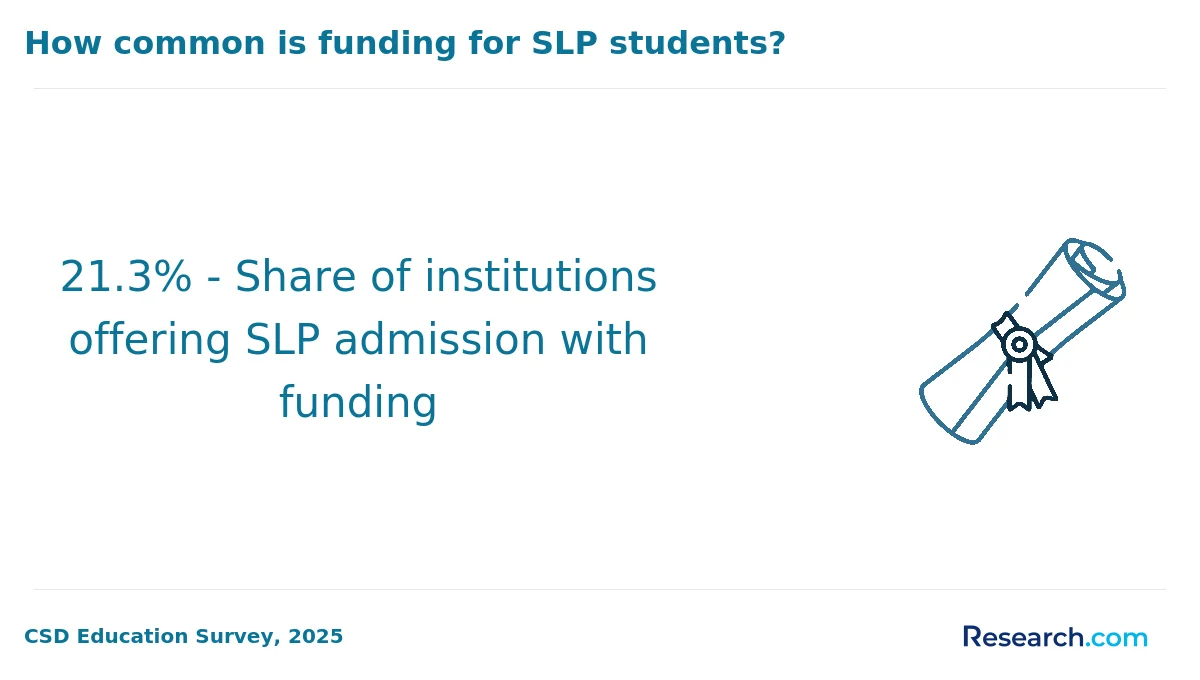
A low GPA usually does not prevent a student from filing the FAFSA or being considered for federal graduate loans, but it can affect institutional scholarships, assistantships, and continued eligibility through satisfactory academic progress rules. Financial aid rules are separate from admission rules, which means being admitted with a low GPA does not automatically mean every funding option is available.
For the 2024-25 award year, the federal Direct Unsubsidized Loan annual limit for most graduate and professional students is $20,500. That figure matters because many online doctoral students finance tuition through a mix of employer support, savings, unsubsidized loans, and sometimes Grad PLUS Loans; a GPA issue may not block borrowing, but it can reduce access to merit aid that would lower total debt.
The table below explains how GPA can interact with common funding sources. Use it to ask better questions before committing to a program.
| Funding source | How GPA may matter | What to ask the school |
| Federal Direct Unsubsidized Loans | Admission and enrollment status matter more than admission GPA, but ongoing satisfactory academic progress is required | What GPA and credit-completion rate must doctoral students maintain? |
| Grad PLUS Loans | Generally tied to federal eligibility and credit review rather than admission GPA | What is the estimated total cost of attendance after fees and residency expenses? |
| Institutional scholarships | May require a minimum GPA or prioritize high academic records | Are conditionally admitted students eligible for merit scholarships? |
| Graduate assistantships | Often competitive and may favor stronger academic profiles or research fit | Are online doctoral students eligible, and how are selections made? |
| Employer tuition assistance | Employer policies may require minimum grades for reimbursement | Will the employer reimburse doctoral courses if admission is conditional? |
Low-GPA applicants should be especially cautious about borrowing for a doctorate that is not required for licensure or promotion. A post-professional SLPD may be valuable for leadership, teaching, specialization, or personal career development, but the return depends on your employer, location, role, and whether the credential changes your advancement options.
Does a Low GPA Affect Career Outcomes After Completing an Online Speech Pathology Doctorate?
After graduation, employers usually care more about licensure, certification, clinical competence, experience, leadership, and the relevance of the doctorate than about an old admissions GPA. A low GPA may matter during school if it affects progression, scholarships, or assistantship eligibility, but it rarely remains a central hiring issue once the student has completed the doctoral program and can show current expertise.
The career value of an online speech pathology doctorate depends on the role you want. For a practicing clinician, the doctorate may support specialization, advanced clinical leadership, teaching, program development, or supervisory roles. For a future tenure-track professor or independent researcher, a PhD is usually more aligned than an SLPD because it emphasizes research design, theory, publication, and grant preparation.
BLS projects employment for speech-language pathologists to grow 17% from 2025 to 2035, much faster than the average for all occupations. That growth supports continued demand for SLP expertise, but it does not mean every doctoral pathway produces the same financial return. Many SLP roles require a master's degree and state licensure rather than a doctorate, so the doctorate should be evaluated based on advancement, specialization, teaching goals, and employer recognition.
Online learning is also changing employer expectations. Graduates who can demonstrate telepractice competence, interprofessional collaboration, outcomes measurement, ethical use of AI-supported documentation, and data-informed decision-making may be better positioned for leadership roles than graduates who treat the doctorate only as a credential.
Which Students Are Most Likely to Succeed in an Online Speech Pathology Doctorate Despite a Low GPA?
Students most likely to succeed despite a low GPA tend to have a clear reason for pursuing the doctorate, strong recent performance, mature study habits, and professional responsibilities that connect directly to doctoral work. The GPA may be a weakness, but it is not the whole academic story.
The table below compares application scenarios. It can help you estimate whether applying now is reasonable or whether strengthening your profile first would be wiser.
| Applicant scenario | Admission outlook | Why |
| Low undergraduate GPA, strong SLP master's GPA, CCC-SLP, several years of leadership | Often the strongest low-GPA scenario | Recent graduate success and professional maturity help reduce concern about older grades |
| Low graduate GPA in the SLP master's program | More challenging | The GPA weakness is directly tied to the level of work expected in doctoral study |
| Low GPA but recent A grades in graduate statistics or research methods | Potentially competitive at holistic programs | Recent targeted coursework shows improved academic readiness |
| Low GPA and no SLP licensure or clinical background | Usually poor fit for post-professional SLPD admission | The applicant may need an entry-level SLP pathway first |
| Low GPA, strong research match, publications, and faculty support | Possible for research doctorates | Faculty fit and research readiness can matter heavily in PhD admissions |
| Low GPA with unclear goals and generic application materials | Weak | The committee has little evidence that doctoral study is realistic or purposeful |
Successful low-GPA doctoral students are also realistic about workload. Online does not mean easier; it usually means more self-direction. Students who plan weekly writing time, use faculty feedback early, maintain a manageable work schedule, and seek academic support before problems escalate are better positioned to persist.
Students who should pause before applying include those who are currently struggling with time management, cannot explain why they need the doctorate, have unresolved prerequisite gaps, or are applying mainly because they believe a doctorate will automatically increase salary. In those cases, strengthening the foundation first is usually the more strategic move.
How Should Students Decide Whether to Apply to an Online Speech Pathology Doctorate With a Low GPA?
The best decision depends on your GPA level, program minimums, recent academic evidence, career goal, and tolerance for cost and risk. A low-GPA applicant should not apply randomly. The better approach is to sort programs by admission flexibility, contact schools directly, and compare the doctorate against alternatives.
Use this decision sequence before submitting applications. It will help you avoid spending money on programs that are unlikely to review your file.
- Confirm your goal: licensure, clinical leadership, college teaching, research, administration, specialization, or salary advancement.
- Identify the correct degree type: master's for entry-level SLP preparation, SLPD for post-professional clinical leadership, PhD for research, or EdD for education and systems leadership.
- List each target program's minimum GPA, preferred GPA, GRE policy, prerequisite requirements, accreditation relevance, and whether exceptions are allowed.
- Email admissions with your GPA context and ask whether applicants with your profile have a realistic path to review.
- Choose a balanced application list that includes holistic programs rather than only the most selective options.
- Decide whether one term of additional coursework would materially improve your case before applying.
- Compare total cost, employer support, loan needs, expected workload, and whether the credential is recognized for your intended role.
Applying now makes sense if you meet or nearly meet the minimum GPA, have strong recent graduate performance, can show meaningful SLP experience, and have confirmed that the program reviews applicants holistically. Waiting makes sense if you are below a hard cutoff, lack recent academic evidence, need prerequisites, or cannot yet explain your doctoral purpose clearly.
An alternative pathway may be better if your goal is speed, licensure, or career entry rather than post-professional doctoral advancement. For example, students comparing time-to-completion options may want to review accelerated speech pathology programs before committing to a longer doctoral route.
The most practical final test is this: if the doctorate does not clearly connect to a role you want and cannot realistically finance, wait or choose another pathway. If it aligns with your career plan and you can show readiness beyond the GPA, a low GPA should be treated as an application challenge, not an automatic stop sign.
Other Things You Should Know About Speech Pathology
No. In most cases, becoming a speech-language pathologist requires a qualifying master's degree, supervised clinical experience, passing the required exam, and meeting state licensure rules. A doctorate is usually optional and is more often used for advanced clinical leadership, research, teaching, or administration.
An SLPD is typically a practice-focused doctorate for working clinicians who want advanced applied expertise. A PhD is a research-focused doctorate designed for people who want to conduct original research, publish, teach at the university level, or pursue research-intensive academic roles.
Many online and hybrid speech pathology doctorate programs are designed for working professionals, but full-time work can still be demanding alongside doctoral reading, writing, projects, and possible residencies. Applicants should ask about weekly time expectations before enrolling.
Some online programs are fully online, while others include short residencies, intensive weekends, clinical meetings, or dissertation and capstone presentations. Requirements vary by school, so students should confirm travel expectations, added costs, and scheduling before applying.
References
- U.S. Bureau of Labor Statistics - Speech-Language Pathologists https://www.bls.gov/ooh/healthcare/speech-language-pathologists.htm
- ASHA EdFind - Accredited Speech-Language Pathology Programs https://find.asha.org/ed/
- Audiology and Speech-Language Pathology Interstate Compact https://aslpcompact.com/compact-map/
- Idaho State University - Master of Science in Speech-Language Pathology (Online/Distance Education) https://www.isu.edu/slp/programs-offered/slp-graduate-program/
- West Virginia University - Speech-Language Pathology, M.S. - Online https://medicine.hsc.wvu.edu/communications-sciences-and-disorders/speech-language-pathology-ms/future-students/curriculum/online-slp-program/
- Nova Southeastern University - SLP Program - Master of Science in Speech-Language Pathology https://osteopathic.nova.edu/degrees/masters/speech-language-pathology/index.html
- New England Institute of Technology - Master of Science in Speech Language Pathology https://www.neit.edu/academics/graduate-degrees/speech-language-pathology-ms
- Baylor University - Master of Science in Speech-Language Pathology (Online) https://csd.robbins.baylor.edu/graduate/online-csd-graduate-program