2027 BS in Business Administration Decision Guide: A General Track or a Concentration for Someone Staying with One Employer
Audited and Verified:
Our Editorial and Data Verification Process
Research.com uses government datasets, official education statistics and primary institutional information to support its career and degree guides. Our review process checks factual accuracy, occupational definitions, source dates and the requirements associated with the credentials discussed.
How This Article Was Fact-Checked
Our editorial team verifies salary estimates, employment projections, education requirements and program information against original data providers and official organizations. Salary figures are checked against the relevant occupational definitions and reporting periods. Information about licensure, accreditation and required in-person training is reviewed separately.
Fact-checked and verified on:

Co-Founder and Chief Data Scientist
Staying with one employer changes how you should choose a BS in Business Administration. A concentration may prepare you for a defined opening in finance, HR, or operations; a general track may leave more room to move between departments as the organization changes. Neither choice guarantees promotion.
This guide is for employees finishing or starting a bachelor's degree who want to compare the two paths against their employer's actual roles, tuition policies, and scheduling demands - and leave with a way to choose.
Key Things You Should Know
- Choose the general track if your likely next roles span departments; choose a concentration when a specific function has a clear skill gap and credible openings at your employer.
- Compare the official degree audit, not concentration names alone: required courses, transfer-credit application, course scheduling, and employer reimbursement can change the better choice.
- Labor-market growth is context, not a promotion forecast: the Bureau of Labor Statistics projects 18% employment growth for logisticians from 2025 to 2035, but your employer's openings and requirements matter more to an internal move.
What is the difference between a general business administration degree and a concentration?
A general BS in Business Administration typically combines a business core with electives across functions. A concentration retains much of that core but reserves some coursework for a named field, such as accounting, marketing, HR, analytics, or supply chain management. The school determines whether that focus is an official concentration, an informal elective cluster, or a separate major. Check the catalog and ask whether the concentration appears on the transcript.
For an employee who wants to remain at one organization, the distinction is breadth versus targeted depth, not "flexible degree versus better degree." Broad electives can support moves among operations, customer service, and administration. Concentrated courses may help you build evidence for one team's work, provided the courses teach skills that team uses. If your target is organizational leadership rather than a business function, compare the actual curriculum and completion requirements of an organizational leadership bachelor's completion planning pathway rather than assuming its title makes it equivalent to a business concentration.
Which BS in business administration option is better for staying with one employer?
Start with the next role, not your current job title. A general track is usually the safer choice when you are valued as a cross-functional employee, your employer reorganizes frequently, or you cannot yet identify a specific internal opening. A concentration is more compelling when you have identified a function, confirmed its hiring criteria with a manager or internal recruiter, and can obtain relevant assignments while studying.
The comparison below focuses on what each option can contribute to internal advancement. Neither substitutes for a record of taking on responsibility.
| Decision factor | General track | Concentration |
| Likely internal moves | Several departments or an undefined next role | A defined function with recurring openings |
| Best workplace evidence | Cross-functional coordination and process improvement | Function-specific work samples and supervised assignments |
| Main risk | Too little depth for a specialist opening | Too little elective space if your goal changes |
| Academic check | Whether electives develop a coherent skill set | Whether prerequisites or infrequent courses delay completion |
Ask your manager and HR which roles are realistically open to internal applicants, what successful candidates have done, and whether the degree is required or merely preferred. If your goal is specifically project management, compare a business concentration with budget-conscious project management degrees only after checking whether your employer seeks project coordination experience, a particular degree, or both. A focused credential is not automatically the shortest route.
What careers can a general or concentrated business administration degree support?
At one employer, the most useful career map is a sequence of responsibilities. A general track can support applications for administrative specialist, operations coordinator, sales operations, or project coordinator roles where employees work across teams. A marketing concentration may support a move into campaign coordination or market research support; HR coursework may help with recruiting or HR operations; accounting and finance courses may help with budgeting support. Each move still depends on the job description, experience, and available openings.
For example, an employee who already schedules vendors and tracks spending could seek a procurement or project-support assignment before applying for a specialist role. That assignment provides stronger evidence than a concentration label alone. If the target is a dedicated project management career rather than mobility within the current organization, investigate whether applying previous coursework to a project management degree offers a more direct completion path; only the receiving school can determine how those credits satisfy its requirements.
Management roles generally require demonstrated judgment, accountability, and often supervisory experience. Graduation does not itself make an employee eligible to manage staff or a major budget.
Look beyond industry labels to the function your employer needs staffed. A hospital may need revenue-cycle analysts, HR staff, purchasers, and operations coordinators; a manufacturer may need finance and marketing as well as supply chain staff. Match the concentration's required courses to the work you can observe and, with permission, practice.
A useful test is whether you can name a target internal role, identify two or three recurring tasks from its posting, and connect those tasks to both courses and attainable workplace assignments. Supply chain coursework, for instance, may be relevant if your organization handles inventory, sourcing, or distribution. If you want a more specialized undergraduate route, compare its requirements and course availability with accelerated degree planning for supply chain undergraduates. An advertised fast timeline is meaningful only if your accepted credits and the remaining course sequence support it.
If the employer has no realistic opening in your chosen function, consider a general track with carefully selected electives. You can retain internal flexibility while developing a skill that would also be useful elsewhere.
Many programs share foundational study in accounting, economics, finance, marketing, management, statistics, information systems, and business communication. A general track may use upper-level electives across these areas. A concentration typically directs those electives into a sequence: an analytics focus might build from statistics to data analysis, while an HR focus might add staffing and employment-related coursework. Actual course depth and prerequisites vary by school.
For a working employee, sequencing can matter more than the concentration's title. Ask for a degree audit showing which previous courses satisfy the business core, which satisfy the concentration, and which count only as free electives. Then check when each remaining course is offered. A concentration that adds no credits on paper can still delay graduation if a prerequisite or final course is unavailable when you need it. Use a guide to check prerequisites before applying to business administration programs, then obtain the specific school's determination.
Online study may reduce commuting, but it does not necessarily remove fixed deadlines, live presentations, proctored exams, or group meetings. Campus courses may offer easier in-person access to faculty and classmates but require travel at set times. The better format is the one in which you can complete the specific remaining courses without repeatedly conflicting with work.
Before enrolling, request sample schedules for upper-level concentration courses as well as the general track. Confirm whether required courses are available online every term, whether an internship or capstone can use approved work at your employer, and what happens if your shift changes. You can compare business administration degrees for working learners, but verify attendance and assessment policies directly with each program. Current employment alone does not satisfy an academic workplace-project requirement.
Requirements vary by institution and by whether you enter as a first-year or transfer student. Schools may evaluate prior transcripts, GPA, general education, and prerequisites before admitting you to the business major or a concentration. A bachelor's program is commonly structured around four years of full-time study, but a working student's remaining time depends on accepted credits, how those credits apply to requirements, enrollment pace, and course availability.
Compare cost to finish, not just tuition per credit. Request a written estimate covering remaining required credits, fees, books or software, and any travel or proctoring charges. Ask your employer when reimbursement is paid, which grades and programs qualify, and whether leaving the company triggers repayment. Application fees are a smaller but avoidable comparison cost; you can compare no-fee college applications without treating a waived fee as evidence of program quality.
Verify the institution's current accreditation through its accreditor and check that the accreditor is recognized by the U.S. Department of Education or the Council for Higher Education Accreditation. If a school advertises AACSB, ACBSP, or IACBE accreditation, confirm its scope: the claim may concern a business school or particular programs, not every concentration or location.
For this decision, quality also means that you can finish the intended track and use what you learn. Ask for the current catalog, a transfer-credit evaluation, a term-by-term course schedule, faculty access arrangements, and rules for employer-based projects. When comparing low-cost business administration degrees with federal aid options, verify aid eligibility and the final cost of your own degree plan; neither a low advertised price nor accreditation alone establishes a good fit.
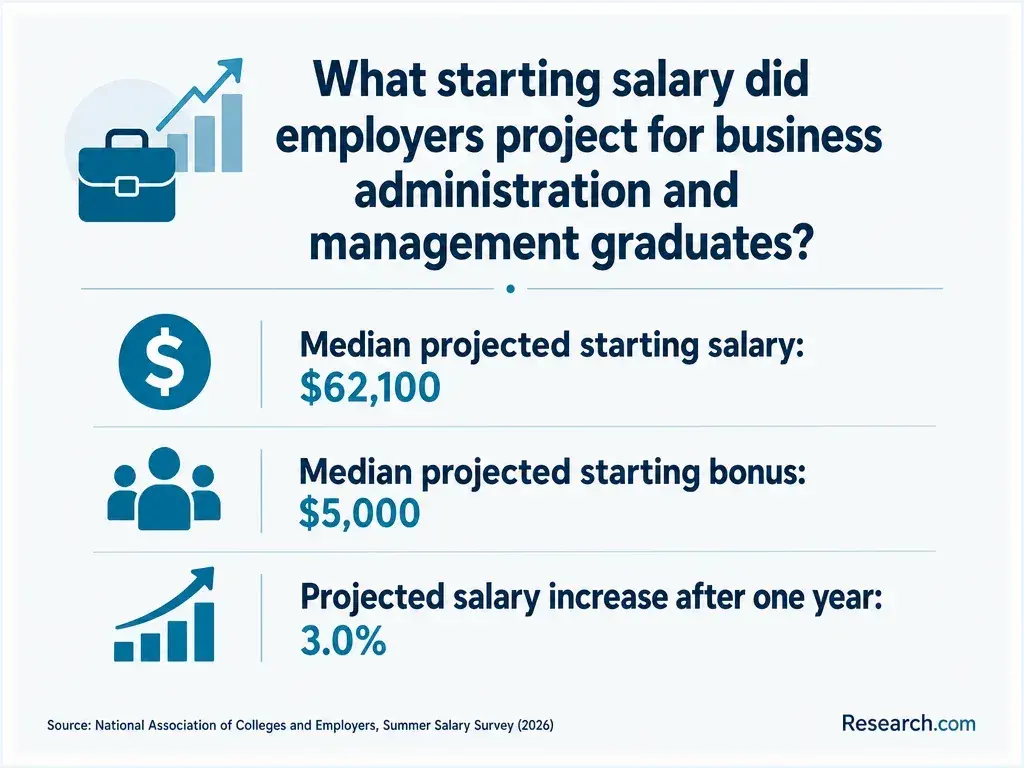
There is no single salary or growth rate for a BS in Business Administration. The Bureau of Labor Statistics reports a May 2025 median annual wage of $75,940 for human resources specialists and projects 6% employment growth for that occupation from 2025 to 2035. Those figures describe workers across the occupation - not new graduates, employees at your company, or people with an HR concentration specifically.
Use occupation data to assess a possible career direction, then use your employer's posted pay ranges, internal hiring criteria, and location to evaluate the actual opportunity. If you are comparing completion time with potential earnings, a business administration education length and salary outlook guide can provide context, but it cannot establish that choosing a concentration will raise your pay. Include remaining education costs and any reimbursement conditions in your decision.
Do business administration careers require licenses or professional certifications?
Many business coordination and administrative roles have no universal professional license. Requirements become more specific in regulated or specialized work: a business degree alone does not authorize CPA practice, grant a financial-services license, or confer an HR or project-management certification. Eligibility for those credentials is set by the relevant state regulator or certifying body and may require particular coursework, exams, or experience.
Before selecting a concentration for an internal specialist role, ask whether your employer requires a credential, prefers one, or primarily values demonstrated work. If HR is your target, a guide to studying human resources can help you compare academic preparation; confirm any separate certification requirements with the credentialing organization. Do not pay for a more specialized track on the assumption that its name fulfills a licensing rule.
Other Things You Should Know About Business Administration
Your degree remains yours. A concentration can still signal relevant study to another employer, but explain the skills and work you gained rather than relying on the concentration name alone.
Not necessarily. Schools differ in whether they record it on the diploma, transcript, both, or neither. Ask the registrar how your completed credential will be documented.
Only if the program approves it under its internship rules. Your duties may need to meet learning objectives, supervision, and assessment requirements; ordinary employment is not automatically academic credit.
Check your employer's confidentiality and intellectual-property policies first. If permitted, use an approved, redacted account of your methods and responsibilities rather than exposing internal data or claiming results the organization has not verified.
- Employer-offered educational assistance programs can help pay for college | Internal Revenue Service https://www.irs.gov/newsroom/employer-offered-educational-assistance-programs-can-help-pay-for-college
- Reader's Guide to the Catalog | University of Oregon Academic Catalog https://catalog.uoregon.edu/readersguide/
- Concentrations (Undergraduate) | Academic Programs and Planning https://academicprograms.calpoly.edu/content/academicpolicies/Policies-Undergrad/Concentrations
- What Can You Do With a Business Administration Degree? | snhu.edu https://www.snhu.edu/about-us/newsroom/business/what-can-you-do-with-a-business-administration-degree
- Understanding Accreditation for Online Degrees | UMass Global https://www.umassglobal.edu/blog-news/online-degrees-accredited-identify-quality-distance-learning-programs
- Bachelor of Science in Business Administration | unomaha.edu https://catalog.unomaha.edu/undergraduate/college-business-administration/bs-business-administration/
- Guide to Tuition Reimbursement and Education Benefits | stanford.edu https://online.stanford.edu/guide-tuition-reimbursement-and-education-benefits
- College Degree Requirements | K-State https://artsci.k-state.edu/academics/degree_requirements/
- Writing an Effective Job Description | Human Resources | Wright State University https://www.wright.edu/human-resources/writing-an-effective-job-description
- Academic Rules - Course Catalog - Syracuse University https://courses.syracuse.edu/undergraduate/academic-rules