2027 BS in Business Administration: Comparing a Business Degree with Staying in a Trade
Audited and Verified:
Our Editorial and Data Verification Process
Research.com uses government datasets, official education statistics and primary institutional information to support its career and degree guides. Our review process checks factual accuracy, occupational definitions, source dates and the requirements associated with the credentials discussed.
How This Article Was Fact-Checked
Our editorial team verifies salary estimates, employment projections, education requirements and program information against original data providers and official organizations. Salary figures are checked against the relevant occupational definitions and reporting periods. Information about licensure, accreditation and required in-person training is reviewed separately.
Fact-checked and verified on:

Co-Founder and Chief Data Scientist
If you already work in a skilled trade, a business degree is not automatically a step up. It may open a path toward estimating, operations, procurement, or running a company - but completing it can cost money and take time away from paid work. This guide compares a BS in Business Administration with continued trade training and advancement. It is for tradespeople considering a career change or broader responsibility, and for students choosing between the two paths. You'll learn what each option can prepare you to do and what to verify before committing.
Key Things You Should Know
- Stay in your trade if your goal is higher-level technical work and the next required credential is a license, apprenticeship milestone, or specialized training - not a bachelor's degree.
- Consider a business degree if you want to move into estimating, purchasing, operations, or business ownership and need broader financial and organizational skills. A degree alone does not qualify you to manage people or practice a licensed trade.
- Compare remaining tuition and lost wages with realistic job options, not occupation-wide medians. For context, the U.S. Bureau of Labor Statistics reports a May 2025 median wage of $82,320 for logisticians; that is not a starting salary for business graduates.
What Is a BS in Business Administration?
A Bachelor of Science in Business Administration is an undergraduate degree covering how organizations manage money, people, customers, and operations. Depending on the school, it combines general education with accounting, finance, marketing, management, economics, and quantitative coursework. Some programs offer formal concentrations; others offer only electives. A BS, BBA, and specialized business bachelor's may overlap, but their requirements are not interchangeable.
For a tradesperson, the degree's value is often in connecting field knowledge to office-side decisions. An HVAC technician who understands service delays, for example, may use operations coursework to assess scheduling and inventory choices. Coursework can develop that analysis; it cannot replace hands-on experience, a trade license, or an employer's assessment of readiness. When comparing programs, check the actual curriculum and degree title rather than assuming all entries in American online business school options provide the same preparation.
Is a Business Degree Better Than Staying in a Trade?
Neither path is universally better. The choice depends on the work you want next, your physical and scheduling needs, and whether your trade experience gives you an advantage in that role. Staying can be the more direct route to advanced technical responsibility. A business degree becomes more compelling when a specific target role calls for bachelor's-level preparation or when you need skills beyond technical practice.
The comparison below separates the next step in each path from a longer-term ambition. It can help you avoid comparing an experienced tradesperson's current earnings with an untested promise of a management job.
| Goal | Path to examine first | Key limitation |
| Perform more advanced licensed work | Trade hours, licensing, and specialized training | A business degree does not replace trade qualifications. |
| Become a field supervisor | Documented job-site leadership and employer training | A degree may help, but supervisory trust depends on results. |
| Move into estimating, purchasing, or operations | Trade experience plus targeted business skills; a degree if employers require or prefer one | Entry routes and degree expectations differ by employer. |
| Build or expand a contracting company | Licensing, financial controls, and practical business training | A full degree may be more than the immediate goal requires. |
Before enrolling, read postings for the role you want and speak with people doing that work. Compare their requirements with your existing experience, then evaluate the price, duration, and outcomes of business administration degrees against a shorter course, mentorship, or promotion within your trade. The recommendation changes if your employer requires a bachelor's for advancement - or if you can reach the same goal without one.
What Careers Can You Pursue With a Business Administration Degree?
Trade experience can be valuable in business roles tied to construction, maintenance, utilities, manufacturing, and service companies. An estimator draws on knowledge of labor and materials; a purchasing or logistics employee coordinates supplies; an operations coordinator tracks schedules, costs, and service problems. These are more plausible transitions than moving directly from graduation into a senior management title.
Other possibilities include sales support for technical products, project coordination, and human resources work. Each has different skill gaps. A technician pursuing HR, for instance, would need to learn hiring processes, employment practices, and confidential record handling; human resources college study options may provide more focused preparation than a general business curriculum.
Use job descriptions to identify the required evidence: spreadsheet work for estimating, vendor coordination for purchasing, or schedules and stakeholder updates for project coordination. Ask whether your current employer can give you supervised exposure to those tasks. A degree can strengthen your application, but relevant work samples and experience often determine whether you can perform the role.
Compare what you would pay from this point forward, not the original price of training you have already completed. A degree budget includes remaining tuition and fees, books or software, travel if required, and interest on any loans. Its largest hidden cost may be reduced work hours. Trade advancement can also carry tuition, exam, tool, and licensing costs, but paid apprenticeship or employer-supported training may change the comparison substantially.
Request an official degree audit before estimating the business degree's total cost: accepted credits do not always satisfy business-core or residency requirements. Then obtain written details of grants, employer reimbursement, payment timing, and any obligation to repay an employer if you leave. Compare that net cost with the training needed for your next trade credential. If project coordination is your goal, low-cost project management degree options offer another price point to examine, though a narrower degree is not necessarily a better fit.
A useful return-on-investment test is whether the new qualification helps you compete for a specific job you would accept. Do not build the calculation around an assumed raise or a manager's median wage. Price both a full degree and a smaller first step, such as accounting coursework or employer-sponsored estimating training.
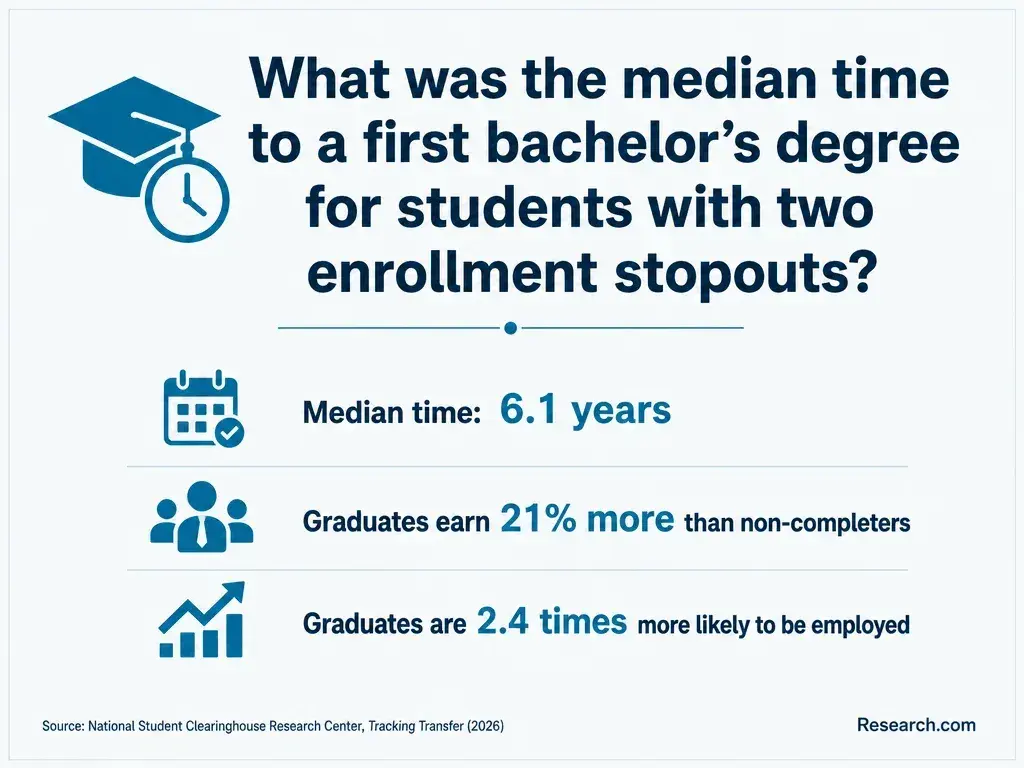
A bachelor's degree commonly represents about four years of full-time undergraduate study, but a tradesperson's remaining timeline depends on transfer credit, enrollment pace, prerequisites, and when required courses run. Accelerated formats may shorten the calendar without reducing the work required. Review the course sequence and weekly workload - not just advertised completion times - when considering bachelor's degrees with compressed schedules.
Trade timelines vary more than a single comparison allows. An apprenticeship may combine paid work and instruction over several years; a short certificate may teach a limited skill without satisfying apprenticeship or licensing requirements. If you are already qualified in a trade, the relevant comparison is the time until your next advancement opportunity versus the time until you can use business coursework or finish the degree. Part-time study while continuing to earn may be preferable to the fastest possible graduation.
The most useful courses depend on the transition you want. Accounting and finance can help you interpret job costs, cash flow, and budgets. Operations and supply chain courses address scheduling, purchasing, inventory, and process problems. Marketing and management introduce customer decisions, organizational behavior, and communication. Statistics and spreadsheets help you test assumptions rather than rely solely on intuition.
Look for assignments that let you apply those subjects to a realistic trade-related problem, such as comparing supplier terms or explaining why a service schedule fails. Use hypothetical or approved data unless your employer permits access to company records. If purchasing and logistics are your clear destination, compare a general business degree with a specialized supply chain curriculum; shorter completion timelines for supply chain bachelor's students are worth checking alongside course depth and transfer-credit rules. An elective in supply chain is not necessarily a formal concentration.
Online study can let you retain trade income, but online does not mean self-paced. Classes may have live meetings, group projects, timed assessments, or fixed deadlines that conflict with shifts and emergency calls. Campus study may offer easier face-to-face collaboration and access to local recruiting, but commuting can increase time away from work.
Ask each program for a sample term schedule, including live attendance, exams, team assignments, and any campus visits. Check whether required courses are available part-time and what happens if work forces a pause. If preserving employment is central to the decision, plan how to balance employment and business administration college study before choosing a delivery format. The best format is the one whose actual obligations you can meet consistently.
Requirements vary by institution and by whether you apply as a first-year or transfer student. Schools commonly request prior transcripts and evidence of secondary-school completion or previous college study. A business major may separately require introductory courses or a particular academic standing. Math, accounting, and statistics requirements differ, so trade experience should not be assumed to waive them.
Gather transcripts from every college attended, plus documentation of apprenticeship or other evaluated learning if the school accepts it. Ask admissions what establishes eligibility; ask the registrar or transfer office which credits transfer; and ask a business adviser which accepted credits actually fulfill degree requirements. The business administration admissions preparation guide can help frame those questions, but only the institution can confirm your applicable requirements and degree audit.
There is no single reliable salary for either "business graduate" or "skilled tradesperson." Occupation, location, experience, overtime, union agreements, and self-employment all affect earnings. For a business-side reference, the U.S. Bureau of Labor Statistics reports that project management specialists had a May 2025 median annual wage of $102,320, with employment projected to grow 7% from 2025 to 2035. That median covers workers across experience levels and industries; it is not the expected pay for a new business graduate or a tradesperson entering project coordination.
Compare your actual compensation - including benefits, paid training, and likely future trade opportunities - with local postings for roles you could plausibly obtain. For a project-focused move, include the cost of preparation; guidance on budgeting for online project management college study can help you identify expenses beyond tuition. Do not assume that a higher occupation-wide median will offset degree costs or income lost while studying.
How Do Accreditation, Certifications, and Licensing Affect Career Choices?
These credentials answer different questions. Institutional accreditation concerns the college; business-school or programmatic accreditation, such as AACSB, ACBSP, or IACBE, has its own scope and must be checked for the program in question. A concentration is part of a degree, not a separate occupational license. Trade licensing is generally governed by state or local rules and may require specified training, supervised experience, and examinations that business coursework does not replace.
If you plan to keep working in your trade, confirm renewal and continuing-education obligations with the relevant licensing authority. If you want an office role, check whether employers request a bachelor's, a professional certification, particular software skills, or experience instead. When reviewing online undergraduate business rankings for shorter study paths, verify accreditation scope and credential requirements directly rather than treating speed as proof of professional eligibility.
Other Things You Should Know About Business Administration
Yes, if the school permits nondegree enrollment. Confirm whether the courses would count toward a later degree, whether financial aid is available in your enrollment status, and whether a short course would meet your immediate goal.
Possibly. Some colleges evaluate documented training or offer prior-learning assessment, but policies and credit applicability vary. Request a written evaluation before counting on those credits to reduce your remaining requirements.
Not necessarily. Estimating assistance, scheduling, purchasing, or customer-facing responsibilities at your current company may help you test the transition while you keep earning and building trade experience.
Only after comparing its duties and likely career value with the income and experience you would give up. Ask whether your program allows an approved project or relevant work at your current employer instead; ordinary employment does not automatically meet internship requirements.
- General Schedule Qualification Policies | U.S. Office of Personnel Management https://www.opm.gov/policy-data-oversight/classification-qualifications/general-schedule-qualification-policies/
- Interest Rates and Fees for Federal Student Loans | studentaid.gov https://studentaid.gov/understand-aid/types/loans/interest-rates
- Your financial path to graduation | consumerfinance.gov https://www.consumerfinance.gov/paying-for-college/your-financial-path-to-graduation/
- Annual Earnings by Educational Attainment - COE https://nces.ed.gov/programs/coe/indicator/cba/annual-earnings
- Research Summary: Education and Lifetime Earnings | ssa.gov https://www.ssa.gov/policy/docs/research-summaries/education-earnings.html
- Business Administration | Delta College https://www.deltacollege.edu/academics/degrees-certificates/business-administration
- Operations Management Career Path | Roles, Skills & Salary | YSU https://online.ysu.edu/degrees/undergraduate/bsba/management/operations-manager-career-path/
- Bachelor's Degree in Business: Administration or Accounting? | Bay Path University https://www.baypath.edu/news/bay-path-university-blogs/post/bachelor-s-degree-in-business-administration-or-accounting/
- What AACSB Accreditation Means for Your Business Career | App State Online https://onlineprograms.appstate.edu/blog/why-aacsb-accreditation-matters-business-program/
- BA vs. BS in Business Administration | New England College https://www.nec.edu/news/ba-vs-bs-business-administration