2027 BS in Business Administration: Choosing a Faster Program That Requires Fewer Paid Work Hours
Audited and Verified:
Our Editorial and Data Verification Process
Research.com uses government datasets, official education statistics and primary institutional information to support its career and degree guides. Our review process checks factual accuracy, occupational definitions, source dates and the requirements associated with the credentials discussed.
How This Article Was Fact-Checked
Our editorial team verifies salary estimates, employment projections, education requirements and program information against original data providers and official organizations. Salary figures are checked against the relevant occupational definitions and reporting periods. Information about licensure, accreditation and required in-person training is reviewed separately.
Fact-checked and verified on:

Co-Founder and Chief Data Scientist
Finishing a BS in Business Administration sooner can free up time, but an accelerated program may also demand higher payments or more time away from work. For adults paying for school through wages, the better choice is the program that fits both a graduation plan and a household budget. This guide shows how to compare credit evaluations, schedules, aid, and payment timing so you can identify a faster path without assuming that "accelerated" means fewer paid work hours.
Key Things You Should Know
- Measure affordability in paid hours: net cash you must earn for school ÷ your take-home hourly wage. Add wages you would lose by reducing work to study.
- Ask for a degree audit showing which transfer credits satisfy specific requirements. Accepted credits that count only as electives may not shorten the path to graduation.
- Compare payment dates as well as total cost. A lower-priced program can require more paid shifts upfront if aid or employer reimbursement arrives later.
What Is a BS in Business Administration?
A Bachelor of Science in Business Administration is an undergraduate degree combining general education with subjects such as accounting, management, marketing, finance, and operations. Schools differ in their quantitative requirements, concentrations, transfer policies, and applied projects. A BS, BBA, and BA in business can overlap substantially, but the degree title alone does not establish which will be fastest or least costly to finish.
For someone financing school through paid work, the relevant unit is the remaining degree, not the advertised full program. When using online business school comparisons across the United States, check each school's current catalog against your transcript and intended enrollment term before estimating completion time.
How Can You Complete a BS in Business Administration Faster?
The strongest shortcut is usually applying prior learning to requirements you would otherwise have to complete. Ask each school for a written, requirement-by-requirement evaluation covering general education, business prerequisites, the major, electives, and credits that must be earned at the institution. An accepted accounting course that fills only an elective slot may save less time than one that satisfies the business core.
Accelerated terms, summer enrollment, credit-by-exam, and approved prior-learning assessments may also shorten the calendar. Each has limits: courses may run in a required sequence, exams may not replace upper-level work, and a heavier term may force you to cut paid shifts. Use accelerated business bachelor's school comparisons to find candidates, then request a term-by-term plan based on your evaluated credits and realistic weekly availability. The fastest advertised schedule is not necessarily the fastest schedule you can sustain.
Which Business Administration Programs Require Fewer Paid Work Hours?
No program type consistently requires the fewest paid work hours. The answer depends on what you must pay, when you must pay it, how many credits apply to graduation, and whether the schedule lets you keep earning. This comparison separates features that can lower the bill from those that can protect wages.
The table describes possible effects, not verified features or prices of particular schools.
| Program feature | Potential effect on school payments | Potential effect on paid work |
| Strong transfer-credit applicability | Fewer remaining courses may reduce tuition and fees. | A shorter path may reduce the time spent balancing work and school. |
| Accelerated, intensive terms | Fewer calendar terms may reduce term-based charges, but not necessarily per-credit tuition. | Heavy weekly workloads may require fewer shifts. |
| Part-time, predictable scheduling | Charges may be spread over more terms; total fees could rise. | May allow more consistent earnings. |
| Employer tuition assistance | May lower eventual personal cost, subject to eligibility and caps. | Reimbursement after grades are posted may still require upfront cash or borrowing. |
Estimate required paid hours by dividing the net cash you must earn to cover school by your take-home hourly wage, then account separately for wages lost to classes, travel, or unpaid placements. Compare the same remaining degree requirements at each school. You can use compare shorter business administration college programs as a starting point, but only a current school-issued evaluation can establish your likely path.
Online study can eliminate commuting without eliminating scheduled obligations. Live classes, timed exams, group meetings, presentations, and fixed deadlines can still conflict with paid shifts. Campus study may offer convenient access to faculty, classmates, and local employers, but travel and class times can reduce earning hours.
Before deciding, obtain sample syllabi for required upper-level courses and ask about live attendance, proctoring, internships, campus visits, and leave policies. Compare those obligations with your actual work schedule - not just the delivery label. Business administration programs for advancement while working can help narrow the search, but confirm scheduling details directly with the school.
Common requirements include financial and managerial accounting, economics, statistics or quantitative reasoning, marketing, management, finance, operations, business law, and a strategy or capstone course. General education and elective requirements vary. Some schools require prerequisites before upper-level business courses, so a missing accounting or statistics class can delay an otherwise short completion plan.
Choose electives for a role you can plausibly pursue, not just for their titles. For example, someone considering HR work can examine employment practices and organizational behavior while also comparing choosing a degree in human resources. An HR elective is not necessarily a formal concentration or professional certification. Confirm whether any concentration adds credits or restricts course availability before treating it as part of your fastest route.
Schools commonly request prior-school transcripts and evidence that applicants meet their undergraduate admission standards. Transfer applicants may face separate requirements for entry into the business major, including minimum grades or prerequisite courses. Admission, acceptance of transfer credit, and application of that credit to the major are separate decisions.
Gather transcripts from every prior college and ask admissions when the business department will complete an official degree audit. If a prerequisite is missing, find out whether you can take it after admission and whether it blocks later courses. A business administration applicant eligibility checklist can help organize questions, but the institution's published policy and written evaluation control your case.
A first-time, full-time student commonly plans around four academic years for a bachelor's degree; a transfer or returning student needs an individual estimate. Remaining requirements, course sequencing, enrollment intensity, and required residency credits matter more than an advertised completion time. A faster calendar may save term-based fees yet increase weekly study demands or require unpaid time away from work.
Request an itemized estimate for remaining tuition and mandatory fees, plus books, software, proctoring, and any travel. Then subtract only aid you are eligible to receive, noting when each payment is due. Federal aid eligibility and school participation should be confirmed through the institution's financial-aid office; FAFSA-accepting colleges for business administration students are a search starting point, not a guarantee of an award.
For employer benefits, ask whether payment is upfront or reimbursed, whether grades or continued employment are required, and whether a cap applies. Compare that cash-flow picture with cost-effective paths to a business degree only after you know how many courses each school says you must complete.
Check the institution's accreditation with the accreditor and confirm that its recognized status covers the school where you would enroll. Then separately check any claimed business accreditation - such as AACSB, ACBSP, or IACBE - with that accreditor, including whether the relevant business unit or program is within scope. Institutional accreditation and business-specific accreditation are not interchangeable.
Accreditation does not establish that a program will accept your credits, fit your schedule, or lead to a particular job. Free application options at accredited online schools may reduce the cost of seeking evaluations from more than one institution; verify the current application policy and accreditation status before applying.
Graduates may seek entry-level roles in marketing coordination, operations, HR support, sales, or project coordination, depending on their experience and coursework. A business degree does not by itself qualify someone to manage staff or enter a licensed profession. Relevant employment, internships, and work samples can help demonstrate skills that a transcript alone cannot.
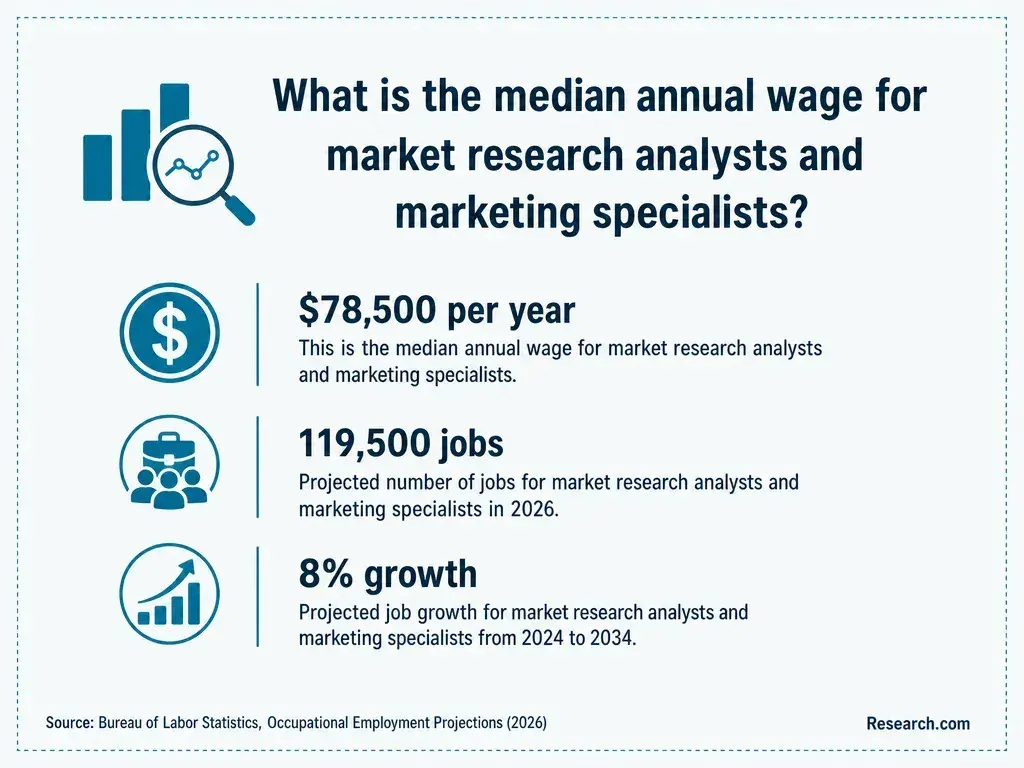
For context, the US Bureau of Labor Statistics reports a May 2025 median annual wage of $78,760 for market research analysts. That occupation-wide median includes experienced workers; it is not a starting salary or an earnings estimate for BS in Business Administration graduates. Compare job postings for your target role with the program's courses and your existing skills. If project coordination is the goal, compare the business degree's relevant coursework and total cost with more focused training, including project management tuition fees and financial aid, before committing to a second pathway.
What Is the Job Outlook for Business Administration Graduates?
There is no single job-growth rate for holders of a business administration degree: employers hire for occupations, not one degree title. The Bureau of Labor Statistics projects 7% employment growth for market research analysts from 2025 to 2035. That projection describes a specific occupation and national labor market, not a graduate's chance of being hired.
Use the outlook for the role you want, alongside its entry requirements and local openings. When reviewing online business school comparisons across the United States, prioritize verifiable course access and career support over broad claims about "business jobs." A program that preserves your income and helps you finish a relevant degree may be a sounder choice than a nominally faster one that disrupts work.
Other Things You Should Know About Business Administration
Possibly. Ask whether the capstone permits a project based on your workplace and what faculty approval is required. Your employer must also permit any use of internal information; otherwise, a public-data or hypothetical project may be more appropriate.
No. Schools set their own prior-learning assessment rules, documentation requirements, fees, and limits. Ask which degree requirement an approved award would satisfy before paying for an assessment.
It may be if you need a specific skill and your target employer does not require a bachelor's degree. Check actual job requirements and compare the certificate's cost and content with the remaining work for a degree.
Ask an adviser about dropping a course, changing pace, or taking leave before a deadline passes. Confirm how the change would affect tuition refunds, financial aid, course sequencing, and your expected graduation date.
- Accreditation in the U.S. | ed.gov http://www.ed.gov/laws-and-policy/higher-education-laws-and-policy/college-accreditation/accreditation-in-the-us
- Academic Years, Academic Calendars, Payment Periods, and Disbursements | 2025-2026 Federal Student Aid Handbook https://fsapartners.ed.gov/knowledge-center/fsa-handbook/2025-2026/vol3/ch1-academic-years-academic-calendars-payment-periods-and-disbursements
- Bachelor's Degree in Business: 3-Year Track | One-Stop Student Services Center https://www.adelphi.edu/program/undergraduate/business-administration/
- Time Managment Calculator | School of Chemical Sciences | Illinois https://scs.illinois.edu/time-managment-calculator
- Regional vs. National Accreditation: Which is Better? | Drexel University Online https://www.online.drexel.edu/news/national-vs-regional-accreditation.aspx
- Competency-Based Education Student Handbook | East Texas A&M University, ETAMU https://www.etamu.edu/cbe-student-handbook/
- What are Asynchronous Classes? | University of Bridgeport https://www.bridgeport.edu/news/what-are-asynchronous-classes/
- Accelerated Degree Program Basics - What You Need to Know https://fremont.edu/accelerated-degree-program-basics/
- Credit for Prior Learning - IU Southeast - Indiana University https://southeast.iu.edu/admissions/undergraduate-admissions/credit-transfer/credit-prior-learning.html
- 4.1.18 Credit Earned through Transfer, Examination, and Prior Learning | Illinois State https://policy.illinoisstate.edu/academic/4-1-18/