
2027 Boston University Online MSDS vs. Pace Online MS in Data Science: Cost, Curriculum, Admissions, and Format

Co-Founder and Chief Data Scientist
Boston University's online MS in Data Science and Pace University's online MS in Data Science may lead toward similar careers, but the better choice depends on what each program will actually cost you, teach you, and require of your schedule. This comparison is for prospective students deciding where to apply or enroll.
It separates what can be assessed now from tuition, course, and scheduling details that should be confirmed with each university before making a financial commitment.
Key Things You Should Know
- Neither program is a defensible cost winner without current, comparable estimates of required tuition and fees for your enrollment plan.
- Compare required courses and project opportunities - not degree titles alone - against the technical skills your target role demands.
- The U.S. median annual wage for data scientists was $120,230 in May 2025, but that occupation-wide figure is not an earnings forecast for either program's graduates.
How do Boston University and Pace compare for online master's degrees in data science?
Both are online master's options at universities, so the useful comparison is not whether one awards a "real" degree. It is whether the required education, delivery, and price fit your goals. The table applies the same test to each school without treating unverified program details as settled facts.
| Decision factor | Boston University online MS in Data Science | Pace online MS in Data Science |
| Cost | Request a current estimate for all required credits and fees. | Request the same estimate using your expected enrollment schedule. |
| Curriculum | Check required technical courses, electives, and project expectations. | Check the same items against the same target role. |
| Admissions | Confirm current preparation and application requirements. | Confirm current preparation and application requirements. |
| Format | Verify live-session, attendance, and group-work expectations. | Verify those expectations and available course schedules. |
There is no evidence here that establishes a universal winner on those criteria. A school's reputation may matter to you, but a stronger decision starts with the courses you will take and the amount you will pay to take them.
Which online data science master's program costs less?
A current, like-for-like total for Boston University and Pace cannot be established from verified tuition and fee information here. Calling either program cheaper - or quoting an old advertised price as your final bill - would risk a misleading comparison. Ask both schools for written estimates based on the same intended start term and enrollment pace.
For each estimate, distinguish required tuition and mandatory fees from books, software, financing charges, and any optional travel. Then ask whether the quoted rate applies throughout the degree, whether a slower schedule changes the total, and which scholarships or employer benefits can actually be used. A lower tuition figure is less valuable if scheduling forces you to pay for extra terms or reduce paid work.
If price is the deciding constraint and you are also considering a more specialized credential, affordable paths to an artificial intelligence degree can provide an alternative set of programs to investigate. Compare their full requirements rather than assuming a lower advertised price means a lower total cost.
How do Boston University and Pace differ in curriculum and coursework?
Both degree names identify data science, but the names alone do not establish which offers more statistics, software engineering, machine learning, or applied project work. A reliable course-by-course distinction requires the current catalogs and a schedule showing which electives online students can actually take.
Compare required coursework first: statistical inference, programming, data management, machine learning, and responsible use of data. Next, check whether a substantial project requires students to frame a problem, evaluate a model, and explain results. An elective listed in a catalog is less useful if it is rarely available during your enrollment window.
If your goal is specifically to build or deploy AI systems, examine the depth of AI coursework rather than assuming either data science degree serves that goal equally. Guidance on choosing between AI degree pathways can help clarify which technical emphasis to seek in the two course plans.
What are the admission requirements for each online data science program?
Do not assume Boston University and Pace use identical prerequisites because their degrees share a name. Current program admissions pages should settle each school's degree, transcript, application-material, and preparation requirements; those requirements are not verified here. In particular, neither prior coding experience nor a particular undergraduate major should be treated as an automatic admission guarantee or disqualifier without the school's stated policy.
Before applying, send each admissions team a concise account of your mathematics, statistics, and programming background. Ask which gaps are formal prerequisites, which are recommendations for success, and whether prior coursework or professional work can demonstrate readiness. If you need structured preparation, examples of AI master's programs with preparatory coursework may help you assess alternatives; a preparatory course elsewhere does not automatically satisfy either university's admissions rules.
How long do the Boston University and Pace programs take to complete?
A dependable completion-time comparison needs each program's current credit requirement and course sequence, plus the number of courses you can realistically take per term. A published fastest-possible timeline may not describe a working student's experience, and no current, comparable completion period is established here.
Ask each school for a term-by-term plan at your intended pace. Pay particular attention to prerequisites, courses offered only in certain terms, and any final project that cannot begin until other work is complete. That plan is more useful than comparing headline completion times.
How do the online formats compare at Boston University and Pace?
"Online" does not by itself tell you whether a course has required live meetings, fixed deadlines, timed exams, or group projects. Those operational details need confirmation for both programs; they can determine whether the degree works alongside a full-time job.
Request a sample course calendar from each school and identify required meeting times, typical assignment cycles, time-zone expectations, and any campus attendance. If your work hours change from week to week, required live sessions may matter more than the difference between two course titles. For a broader scheduling benchmark, see pursuing a data science master's while keeping your job.
Are Boston University and Pace accredited for data science degrees?
For either school, distinguish institutional accreditation from program-specific accreditation. Do not assume an online data science master's has separate specialized accreditation simply because its university is accredited, or that specialized accreditation is normally required for a data science job.
Before enrolling, confirm each institution's current status in an official accreditor or U.S. Department of Education directory and ask the university whether the online program is available to residents of your state. Accreditation addresses institutional standing; it does not establish that the two curricula or graduate outcomes are equivalent.
What careers and salaries can graduates expect after earning the degree?
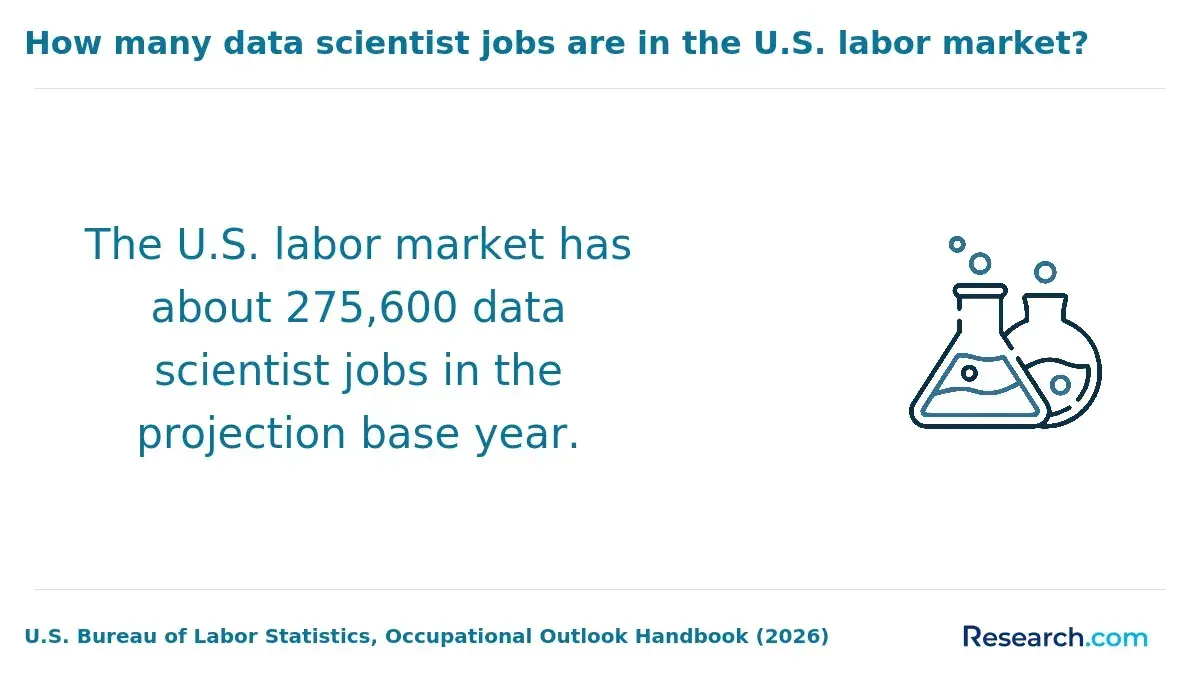
Data scientist is one possible target; analytics, machine learning, and data-focused software roles may also be relevant depending on your prior experience and completed projects. The U.S. Bureau of Labor Statistics reports a $120,230 median annual wage for data scientists in May 2025. That figure covers people working in the occupation across experience levels, not new graduates of Boston University or Pace.
For either program, request any published graduate employment report and examine who responded, what jobs they held before enrolling, and whether reported pay is a salary level or a salary increase. A portfolio aligned with your intended role may be more informative than the degree title alone. Explore online data science degrees for in-demand careers if you need to define the roles against which to assess each curriculum.
What is the job outlook for data science master's graduates?
BLS projects U.S. data scientist employment to grow 35% from 2025 to 2035. That is a favorable occupation-level outlook, not a placement rate for either master's program or a promise that every graduate will qualify for the same openings.
The practical implication is to test your skills against actual roles you want: employers may weigh programming ability, statistical judgment, relevant domain experience, and demonstrable work differently. Growth in the occupation cannot make up for a curriculum that misses a skill central to your chosen role.
How should students choose between Boston University and Pace?
Choose the program whose verified total cost, required coursework, and workable schedule best match your circumstances. Favor Boston University if its current course plan better covers your target skills and its full cost and timetable work for you. Favor Pace under the same test if its plan is the stronger fit. Neither recommendation should rest on an unverified tuition quote or the school name alone.
Before accepting an offer, obtain a written cost estimate, a current online course sequence, and a sample weekly schedule from both schools. Mark which required courses build skills you lack, then check that you can complete the sequence without relying on an elective that may not run. The most common avoidable mistake is comparing an advertised price or ideal completion time at one school with an actual, slower enrollment plan at the other.
Other Things You Should Know About Data Science
Not necessarily. Employers set their own requirements, and relevant technical skills and work experience may qualify candidates for some roles. Check postings for the jobs you want before deciding whether a master's is necessary.
Not automatically. Tools change, and courses vary. Compare current syllabi with job postings, focusing on whether you will apply tools to meaningful problems rather than merely encounter their names.
Ask the program and your employer before planning on it. Course rules and employer confidentiality, privacy, and intellectual-property policies may restrict which data or results you can use.
You do not need one exact title, but you should identify a small set of target roles. Their required skills give you a concrete way to judge whether either degree's courses are worth the time and expense.
References
- Cost of Attendance (Budget) | 2025-2026 Federal Student Aid Handbook https://fsapartners.ed.gov/knowledge-center/fsa-handbook/2025-2026/vol3/ch2-cost-attendance-budget
- A Guide to Teaching Data Science - PMC - NIH https://pmc.ncbi.nlm.nih.gov/articles/PMC6519964/
- Changes in Currently Registered Programs | nysed.gov https://www.nysed.gov/book/export/html/3740
- HEI | Tuition & Fees Inventory https://highered.ohio.gov/wps/portal/gov/odhe/data-reports/hei-system/hei-file-doc/hei-tuition-fees-inventory-sa
- What's the Difference Between Asynchronous and Synchronous Learning? | Ohio State Online https://online.osu.edu/content-hub/blogs/whats-the-difference-between-asynchronous-and-synchronous-learning/
- MSDS Tuition, Scholarship and Financial Aid | Boston University https://www.bu.edu/cds-faculty/programs-admissions/ms-data-science/msds-tuition-scholarship-and-financial-aid/
- Application Requirements - Graduate Admissions https://graduate.admissions.gwu.edu/application-requirements
- Data Science vs. Machine Learning: Key Differences Explained | Syracuse University https://ischool.syracuse.edu/data-science-vs-machine-learning/
- A Guide to Choosing Between Data Science vs. Data Analytics | UCLA MSOL Data Science https://www.msol.ucla.edu/data-science-engineering/articles/demystifying-data-guide-choosing-between-data-science-vs-data-analytics/
- Tuition & Financial Aid | MS in Data Science - Pace Online https://online.pace.edu/graduate-programs/ms-in-data-science/tuition-and-financial-aid/


