
2027 Best Online ESL & TESOL Doctorate Programs for Executive and Leadership Careers

Co-Founder and Chief Data Scientist
Choosing an online ESL or TESOL doctorate is really a leadership investment: it can prepare experienced educators, program directors, consultants, and senior managers to design language-learning systems, lead multilingual initiatives, and influence policy. NCES reported in 2024 that English learners made up 10.6% of U. S. public school enrollment, showing why advanced multilingual-education leadership matters.
This guide helps working professionals compare program types, accreditation, online flexibility, dissertation expectations, cost, and executive career fit before committing time and money.
Key Things You Should Know
- The best online ESL and TESOL doctorate programs for leaders are accredited, flexible for full-time professionals, and built around applied research, language-program leadership, curriculum strategy, assessment, and organizational change rather than classroom methods alone.
- True online doctorates explicitly titled ESL or TESOL are limited, so strong-fit options often include EdD or PhD programs in TESOL, applied linguistics, language education, bilingual education, curriculum and instruction, or educational leadership with a multilingual-learning focus.
- Expect many online doctorates to take about 3 to 6 years; total cost can vary widely by institution, transfer credit, residency travel, fees, and dissertation length, while BLS May 2024 data places related leadership roles such as postsecondary education administrators at a median annual wage of $103,960.
What Are the Best Online ESL & TESOL Doctorate Programs for Executive and Leadership Careers?
The best online ESL and TESOL doctorate is not always the one with the most recognizable university name. For executive and leadership careers, the stronger question is whether the program helps you lead multilingual education systems, evaluate language programs, manage faculty or staff, shape policy, and use research to make high-stakes decisions.
Because fully online doctorates with "ESL" or "TESOL" in the exact title are uncommon, serious candidates should compare both direct TESOL doctorates and adjacent doctoral programs that allow a dissertation, capstone, or concentration in multilingual education. The table below summarizes the strongest program types for different leadership goals:
| Program type | Best fit | Executive value | Trade-off to consider |
| Online EdD in TESOL or language education | Experienced ESL teachers, coordinators, curriculum leaders, and program directors | Strong applied leadership focus for solving real institutional problems | May be less research-intensive than a traditional PhD |
| Online PhD in education with TESOL, applied linguistics, or language-learning research | Future faculty, researchers, policy analysts, and research directors | Best fit for scholarly publication, research leadership, and academic advancement | Often longer, more selective, and less practice-focused |
| Online EdD in curriculum and instruction with multilingual or literacy focus | District leaders, instructional executives, assessment leaders, and nonprofit education managers | Connects language learning to curriculum design, evaluation, and instructional systems | May require you to shape electives and dissertation work around ESL or TESOL |
| Online EdD in educational leadership with an ESL-related research focus | Senior administrators, principals, deans, policy leaders, and organizational executives | Useful for governance, finance, staff leadership, compliance, and strategic planning | TESOL content may be indirect unless faculty expertise is available |
| Hybrid doctorate in applied linguistics or bilingual education | Professionals who want deeper research training and can travel for residencies | May offer stronger faculty mentorship, research networks, and academic credibility | Residency travel can reduce flexibility and raise total cost |
The best programs for executives typically share several features. Look for a curriculum that includes doctoral research, language assessment, second-language acquisition, program evaluation, policy, leadership, and change management. A program that only repeats master's-level ESL teaching methods may not provide enough strategic depth for senior leadership.
Use the following checklist to separate credible leadership-focused programs from weaker fits:
- Verify institutional accreditation from a recognized U.S. accreditor before comparing curriculum or cost.
- Confirm that TESOL, ESL, bilingual education, applied linguistics, or multilingual education is supported by faculty expertise, not just a single elective.
- Ask whether the dissertation or capstone can focus on executive-level problems such as language-program evaluation, teacher-development systems, multilingual policy, or large-scale curriculum implementation.
- Review synchronous class times, residency requirements, and dissertation milestones to see whether the program works with senior-level work travel and management responsibilities.
- Compare total program cost, not just per-credit tuition, because doctoral fees, dissertation continuation credits, technology fees, and residency travel can materially change ROI.
A common mistake is choosing a program based only on a national ranking or an advertised "online" label. For a working executive, the better program is the one with the right mix of accreditation, faculty alignment, research support, schedule design, and career relevance.
ESL program directors and multilingual education leaders seeking to transition into district-level administration may pursue EdD online programs designed for working educators, building systems-level expertise in curriculum, policy, and organizational change. These accessible programs enable experienced teachers and coordinators to develop strategic leadership credentials while maintaining employment, supporting advancement into superintendent, central office, or nonprofit education leadership roles.
Which Type of ESL & TESOL Doctorate Is Best for Executive Leadership Careers?
For most working leaders, the main choice is between a professional doctorate, usually an EdD, and a research doctorate, usually a PhD. Both can be credible, but they serve different career strategies.
The comparison below helps clarify which doctoral path fits your long-term goal. This is especially important if you are deciding between moving into senior administration, consulting, policy work, or higher education.
| Degree option | Primary purpose | Best for | Less ideal for |
| EdD in TESOL, language education, or educational leadership | Applying research to improve organizations, programs, and systems | Executives, directors, school leaders, nonprofit leaders, and consultants | Candidates whose main goal is a tenure-track research career |
| PhD in TESOL, applied linguistics, or language education | Producing original scholarship and advancing theory or research methods | Future professors, researchers, policy analysts, and research-focused leaders | Professionals who want the shortest applied leadership route |
| DBA or organizational leadership doctorate with education focus | Leading organizations, strategy, finance, and change | Executives in education companies, edtech, publishing, or workforce learning | Professionals who need deep TESOL specialization |
| Doctorate in curriculum and instruction | Improving instructional systems, curriculum, assessment, and faculty development | District curriculum leaders, instructional executives, and academic program directors | Candidates seeking linguistics-heavy doctoral research |
An EdD is often the better fit if you want to become a district multilingual-learning director, chief academic officer, language-program executive, dean, nonprofit education leader, or consultant. The degree's applied structure usually lets you study a real leadership problem in your workplace or professional network.
A PhD is usually the better fit if you want to publish research, teach at a university, lead academic research teams, or compete for roles where scholarly expertise in applied linguistics matters. It can also support leadership careers, but the path is usually more research-intensive and may take longer.
Professionals should consider another degree if their goal is not specifically tied to language education. For example, a superintendent-track professional may benefit more from an EdD in educational leadership, while an edtech executive may find a doctorate in learning sciences, instructional design, or organizational leadership more directly aligned with business responsibilities.
What Accreditation Should an Online ESL & TESOL Doctorate Program Have?
Accreditation is the first quality screen for any online doctorate. It affects credit transfer, employer recognition, federal financial aid eligibility, and whether the degree is taken seriously in academic or leadership settings.
At minimum, choose a university accredited by a recognized institutional accreditor. Programmatic accreditation may also matter depending on your career path, but it is not equally available or required for every TESOL-related doctoral program.
| Accreditation or approval type | Why it matters | What to verify |
| Institutional accreditation | Establishes baseline academic legitimacy and is commonly required for federal aid and employer recognition | Confirm the institution is accredited by an agency recognized by the U.S. Department of Education or CHEA |
| Education-school accreditation | Can signal stronger quality assurance for educator preparation and educational leadership programs | Check whether the school or college of education has relevant professional accreditation when applicable |
| State approval or licensure alignment | Important if the doctorate connects to principal, superintendent, or administrative credentials | Verify state-specific requirements directly with the licensing board |
| TESOL-specific professional alignment | Shows that courses reflect current language-teaching and multilingual-learning standards | Look for faculty participation in TESOL, applied linguistics, bilingual education, or language-assessment fields |
Be cautious with schools that emphasize speed, low admissions standards, or vague "international accreditation" without clear U.S. institutional accreditation. For executive roles, the reputational risk of a weakly accredited doctorate can outweigh a lower sticker price.
Accreditation also matters for ROI. If your employer offers tuition assistance, promotion credit, or salary-lane movement, the policy may specify accredited institutions. Before enrolling, ask human resources or your supervisor whether the program qualifies under your organization's rules.
Language educators transitioning into library leadership and multilingual collection development may pursue online library science programs accredited by the American Library Association, building credentials in information services for diverse communities. These accessible programs enable teachers to develop library leadership expertise while maintaining teaching roles, supporting advancement into positions requiring both language expertise and information science competency.
What Do Students Learn in an Online ESL & TESOL Doctorate Program?
An online ESL or TESOL doctorate should move beyond lesson planning and classroom technique. At the doctoral level, students learn how to analyze language-learning systems, evaluate programs, lead adult professionals, conduct research, and make strategic decisions for multilingual populations.
The strongest executive-focused curricula usually combine language expertise with leadership and evidence-based management. These areas are especially important for professionals who want to influence programs at the school, district, university, nonprofit, corporate, or policy level.
- Second-language acquisition theory and how it informs program design for multilingual learners.
- Language assessment, placement, accountability, and evaluation of learner progress.
- Curriculum leadership for ESL, ELL, bilingual, dual-language, and international English programs.
- Program evaluation methods for measuring outcomes, equity, staffing, and instructional quality.
- Qualitative, quantitative, or mixed-methods research used in doctoral dissertations and applied capstones.
- Organizational leadership, strategic planning, budgeting, policy implementation, and change management.
- Faculty development, teacher coaching, professional learning systems, and adult learning theory.
- Technology-enabled language learning, including learning platforms, digital assessment, and responsible use of AI tools.
AI is becoming especially relevant in TESOL leadership. Executives are increasingly asked to evaluate automated writing feedback, translation tools, adaptive learning platforms, and academic-integrity risks. A strong doctorate will not simply praise technology; it should teach leaders to assess whether tools improve learning, protect student privacy, and support equitable access.
Students should also expect substantial research training. Even in applied EdD programs, doctoral-level leaders need to interpret evidence, challenge weak data, and communicate findings to boards, administrators, funders, faculty, or public agencies.
Language educators transitioning into multilingual library leadership may complement ESL expertise through a library science masters, developing specialized competencies in diverse collection development and culturally responsive information services. These accessible programs enable teachers to lead library programs serving English learners while deepening information literacy expertise.
Can You Complete an Online ESL & TESOL Doctorate While Working Full Time?
Yes, many online ESL and TESOL doctorate programs are designed for working professionals, but "online" does not always mean fully asynchronous or easy to fit around executive responsibilities. Senior leaders should examine the weekly schedule, residency rules, research expectations, and dissertation support before assuming the format will work.
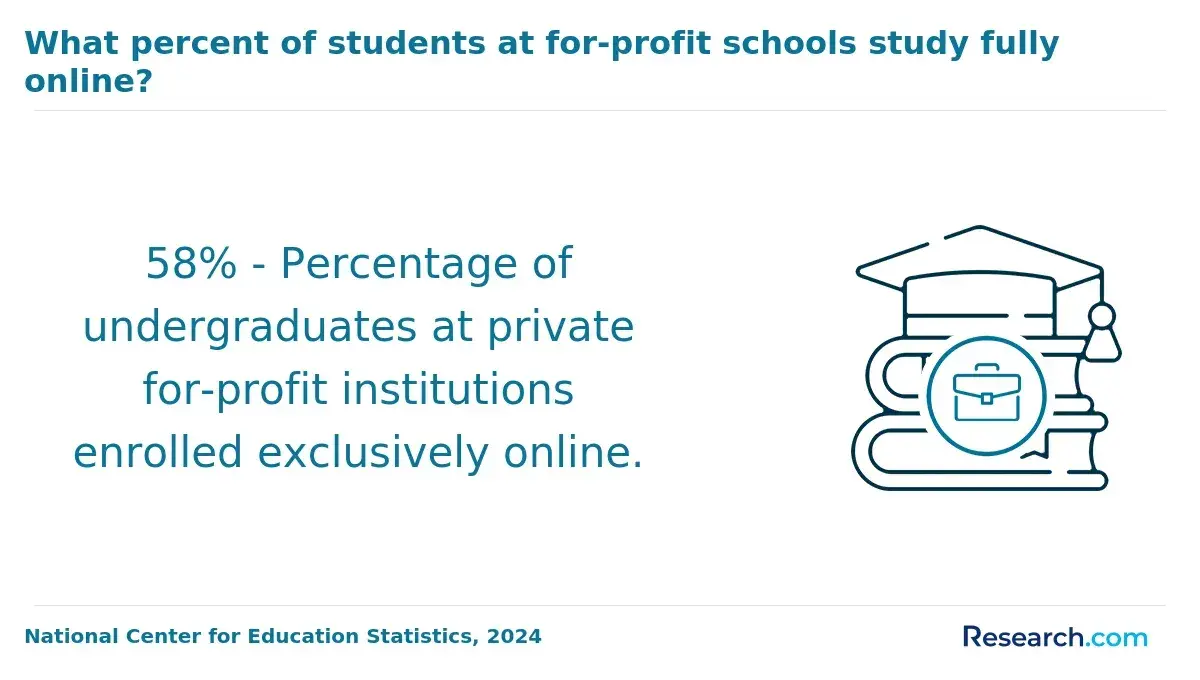
NCES data published in 2024 shows that graduate students are major users of distance education, reflecting the demand for flexible formats among adults who are balancing work, family, and professional advancement. For doctoral students, the practical issue is not whether online learning is accepted; it is whether the program's structure matches the reality of full-time leadership work.
These format details can determine whether a program is manageable while you remain employed:
- Asynchronous courses are usually easiest for executives with travel, meetings, or irregular work hours.
- Synchronous evening or weekend sessions can support networking but may create conflicts across time zones.
- Short residencies can strengthen faculty relationships, but travel costs and time away from work should be included in the decision.
- Cohort-based models provide structure and peer accountability, while self-paced models may offer more flexibility but require stronger discipline.
- Dissertation or capstone milestones can create an uneven workload, with heavier demands during proposal, data collection, and final defense stages.
A realistic full-time work plan usually involves taking fewer credits per term, protecting weekly writing time, and choosing a dissertation topic connected to your professional setting. Candidates with unpredictable executive calendars should ask whether missed synchronous sessions can be made up and whether dissertation advising is available during evenings or nontraditional hours.
The biggest red flag is a program that advertises speed but gives little detail about advising, research support, or completion expectations. Faster is not always better if the structure leaves working professionals isolated during the dissertation stage.
What Are the Admission Requirements for an Online ESL & TESOL Doctorate?
Admission requirements vary by school, but online ESL and TESOL doctorate programs commonly expect applicants to show graduate-level academic preparation, professional experience, and a clear research or leadership purpose. Executive-oriented programs may value leadership experience as much as test scores.
Before applying, review whether the program is built for licensed educators, higher education professionals, language-program managers, or broader organizational leaders. Requirements often differ depending on that target audience:
- Master's degree from an accredited institution, often in TESOL, applied linguistics, education, curriculum and instruction, bilingual education, English, or a related field.
- Graduate GPA meeting the school's minimum, commonly with stronger expectations for competitive doctoral programs.
- Professional experience in teaching, administration, curriculum leadership, language assessment, program management, or education consulting.
- Statement of purpose explaining leadership goals, research interests, and why the program's faculty and format fit those goals.
- Academic or professional writing sample showing readiness for doctoral research and analytical writing.
- Letters of recommendation from supervisors, faculty members, or senior colleagues who can speak to leadership potential and graduate-level ability.
- Resume or CV documenting teaching, management, publications, presentations, curriculum projects, grants, or program leadership.
- Interview, prerequisite coursework, or English proficiency documentation when required by the institution.
GRE requirements have become less common in many education doctorates, but applicants should not assume test-optional admission means the program is less rigorous. Schools may instead place more weight on writing quality, leadership experience, and research fit.
One common mistake is applying with a vague goal such as "I want to advance my career." A stronger application identifies a specific leadership problem, such as improving multilingual learner outcomes across a district, evaluating adult ESL placement practices, scaling teacher professional development, or designing equitable language-assessment policy.
How Long Does It Take to Earn an Online ESL & TESOL Doctorate?
Most online ESL and TESOL-related doctorates take about 3 to 6 years, depending on degree type, credit requirements, transfer policy, enrollment intensity, and dissertation progress. Executive students often choose part-time enrollment because it reduces short-term workload, but it can extend time to completion.
The table below shows common timeline patterns. Use it to compare how different formats affect speed, depth, and feasibility for a working leader.
| Enrollment pattern | Typical completion window | Best fit | Main risk |
| Accelerated full-time online doctorate | About 3 years | Professionals with strong employer support or flexible schedules | High workload may conflict with executive responsibilities |
| Standard part-time online doctorate | About 4 to 5 years | Working managers, directors, and senior educators | Requires sustained motivation and long-term planning |
| Research-intensive PhD route | About 5 to 6 years or more | Future scholars, faculty, and research leaders | Longer opportunity cost and more intensive research expectations |
| ABD or dissertation-extension path | Varies widely | Students who completed coursework but need more research time | Continuation fees and delayed ROI can accumulate |
Coursework is usually the most predictable part of the timeline. The dissertation or capstone stage is harder to estimate because it depends on topic scope, data access, research approvals, adviser feedback, and the student's writing consistency.
To choose wisely, ask each school for completion-time data for online doctoral students, not just the shortest advertised path. Also ask how many students finish within the standard program length and what fees apply if the dissertation takes additional terms.
Language education leaders considering doctoral investment may compare earning potential with the time required for completion, recognizing that SLP salary trajectories and administrative compensation vary by credential, experience, and geographic market. Strategic doctoral planning should factor total cost against realistic career advancement and earnings gains within the profession.
Does an Online ESL & TESOL Doctorate Require a Dissertation?
Many online ESL and TESOL doctorates require a dissertation, but some professional doctorates use an applied dissertation, doctoral capstone, dissertation-in-practice, or improvement project. The difference matters because it affects timeline, workload, research design, and career signaling.
The table below explains the most common culminating-project models and how they fit executive goals:
| Doctoral requirement | What it usually involves | Best for | Leadership advantage |
| Traditional dissertation | Original research with formal proposal, methodology, analysis, and defense | Academic, research, and policy-focused candidates | Demonstrates advanced scholarly expertise |
| Applied dissertation | Research addressing a practical problem in an educational or organizational setting | Program directors, administrators, and consultants | Connects doctoral research to measurable workplace problems |
| Dissertation-in-practice | Improvement-focused inquiry often tied to equity, systems change, or organizational outcomes | EdD students and practitioner-leaders | Useful for executive decision-making and change leadership |
| Doctoral capstone | Major applied project, evaluation, or implementation plan with scholarly grounding | Professionals focused on practice rather than academic research | Can produce a portfolio-ready leadership deliverable |
Executives should choose a dissertation model that supports their next career move. A district leader might study multilingual learner placement systems, while a higher education administrator might evaluate an intensive English program's retention strategy. A consultant might design and assess a professional-development model for ESL instructors.
A major red flag is a program that describes the final project vaguely. Before enrolling, ask how topics are approved, how advisers are assigned, whether research methods support is embedded in coursework, and what happens if your original workplace-based research site becomes unavailable.
How Much Does an Online ESL & TESOL Doctorate Cost, and Is It Worth the Investment?
The cost of an online ESL or TESOL doctorate depends on tuition, credit load, fees, transfer credits, dissertation duration, books, technology, and residency travel. The advertised per-credit price is only one part of the real investment.
Federal student loan costs should also be considered. For federal loans first disbursed during the 2024-2025 aid year, the U.S. Department of Education lists origination fees of 1.057% for Direct Unsubsidized Loans and 4.228% for Direct PLUS Loans, which means borrowed doctoral costs can be higher than the tuition number alone.
When comparing programs, build a total-cost estimate that includes all major categories. Schools may present these costs differently, so asking consistent questions helps avoid misleading comparisons.
- Tuition per credit multiplied by the total required doctoral credits.
- Mandatory university, technology, online learning, registration, and graduation fees.
- Dissertation or continuation credits if research extends beyond the standard timeline.
- Residency travel, lodging, meals, parking, and time away from work if the program is hybrid.
- Books, software, transcription, research tools, assessment instruments, or data-analysis applications.
- Loan interest and origination fees if you finance part of the program.
- Opportunity cost, including reduced consulting hours, overload teaching, or leadership travel, you may decline while studying.
The doctorate may be worth the investment if it directly supports a realistic executive goal: moving from teaching into program leadership, qualifying for senior administrative roles, strengthening consulting credibility, preparing for higher education leadership, or building research authority in multilingual education. It is less likely to be worth it if you expect the credential alone to create a promotion without a leadership record, professional network, or clear organizational need.
Use this ROI lens before committing:
- Define the specific role or market you want after graduation, such as district director, dean, consultant, faculty member, nonprofit executive, or assessment leader.
- Check whether people in that role commonly hold doctorates or whether a master's degree plus leadership experience is sufficient.
- Compare total program cost against likely career benefits, including promotion eligibility, consulting rates, employer tuition support, and long-term mobility.
- Ask your employer whether the degree affects compensation, leadership eligibility, tuition reimbursement, or salary-lane movement.
- Choose the lowest-cost accredited program that still offers the faculty expertise, research support, and leadership curriculum required for your goal.
Avoid assuming that a more expensive program automatically produces a better outcome. For executive careers, fit often matters more than price: the right adviser, dissertation topic, network, and applied leadership portfolio can be more valuable than institutional prestige alone.
What Executive Careers Can You Pursue With an Online ESL & TESOL Doctorate?
An online ESL or TESOL doctorate can support advancement into senior roles across K-12 education, higher education, adult education, nonprofits, government-adjacent organizations, edtech, publishing, assessment, and consulting. It does not guarantee promotion, but it can strengthen your credibility when paired with leadership experience and measurable results.
BLS May 2024 wage data gives useful context for related leadership paths. For example, postsecondary education administrators had a median annual wage of $103,960, while training and development managers had a median annual wage of $125,040. These figures are not TESOL-specific, but they show the compensation environment for adjacent leadership roles where doctoral-level education expertise may be relevant.
The table below connects common executive paths to responsibilities and how a TESOL-related doctorate may help:
| Career path | Typical responsibilities | How the doctorate may help | |
| Director of multilingual learner programs | Oversee ESL, ELL, bilingual, or dual-language services; supervise staff; manage compliance and outcomes | Supports evidence-based program design, evaluation, and policy leadership | |
| Chief academic officer or curriculum executive | Lead instructional strategy, curriculum adoption, assessment systems, and faculty development | Adds expertise in language access, equity, and multilingual curriculum systems | |
| Higher education administrator | Manage English language institutes, international programs, academic support, or teacher preparation units | Builds research credibility and administrative depth for academic leadership | |
| TESOL or multilingual education consultant | Advise districts, universities, publishers, nonprofits, or edtech companies | Strengthens authority, research skills, and ability to evaluate programs | |
| Faculty member or doctoral-level educator | Teach TESOL, applied linguistics, literacy, curriculum, or education leadership courses | May meet doctorate expectations for higher education teaching, depending on institution | |
| Language assessment or policy leader | Develop, evaluate, or implement language-proficiency assessment systems and policy frameworks | Provides advanced training in assessment, research methods, and multilingual learner needs | |
| Edtech or learning-product executive | Lead products serving English learners, adult language learners, or global education markets | Combines language-learning expertise with strategic product and implementation insight |
The strongest career outcomes usually come from combining the doctorate with a leadership portfolio. That portfolio might include districtwide program improvements, published research, conference presentations, grant leadership, assessment redesign, faculty-development systems, or measurable student-success initiatives.
Professionals should also be realistic about competition. A doctorate can help you stand out, but executive hiring still depends on management experience, budget responsibility, communication ability, institutional fit, and evidence that you can lead teams through change.
Other Things You Should Know About ESL & TESOL
Yes, it can be respected if it comes from an accredited institution and the curriculum aligns with your career goal. Employers usually care about accreditation, leadership experience, research quality, and whether the degree is relevant to the role.
An EdD is usually better for applied executive leadership, program administration, and consulting. A PhD is usually better for research-intensive university roles, scholarly publishing, and academic research leadership.
Many students do, especially in part-time or cohort-based online programs. Before enrolling, confirm synchronous meeting times, residency requirements, dissertation expectations, and the level of advising support available to working professionals.
You may not need this degree if your goal can be reached with a master's degree, administrator license, certificate, or targeted leadership experience. It may also be a poor fit if you do not want to complete advanced research or cannot connect the degree to a specific career outcome.
References
- World TESOL Academy - TESOL/TEFL Certificate https://www.worldtesolacademy.com/
- ESL Teaching Careers: Explore Worldwide Opportunities https://teflinstitute.com/blog/esl-teacher-career-pathways-guide/
- Online EdD Programs in TESOL and English Language Learning https://www.onlineeddprograms.com/faqs/edd-programs-tesol
- TESOL Master's Degree Programs – Bank Street Graduate School https://graduate.bankstreet.edu/tesol-programs/
- Best Online EdD in Higher Education Programs of 2025 https://www.eddprograms.org/schools/higher-education/
- How to Advance Your Career with an Ed.D. in Educational Leadership - Graduate Programs for Educators https://www.graduateprogram.org/blog/how-to-advance-your-career-with-an-ed-d-in-educational-leadership/
- 2025 Most Affordable Online Master's Programs https://www.onlineu.com/most-affordable-colleges/masters-degrees
- Make Your Experience Count: Careers in EFL - BridgeUniverse - TEFL Blog, News, Tips & Resources https://bridge.edu/tefl/blog/careers-in-efl/
- Teacher Leadership in TESOL Certificate https://www.hamline.edu/programs/teacher-leadership-tesol
- Doctor of Education in TESOL (EdD) | Online TESOL Doctorate | Anaheim University https://anaheim.edu/schools-and-institutes/graduate-school-of-education/doctor-of-education-in-tesol.html


