
2027 Best Online Associate Degree Programs With Open Enrollment

Co-Founder and Chief Data Scientist
Need an online associate degree without waiting for a competitive admissions cycle? Open-enrollment colleges can offer an accessible starting point, but admission to a college does not always mean admission to its nursing or other selective programs. Cost matters, too: the College Board reported average published in-district tuition and fees of $4,050 at public two-year colleges for 2024-25.
That figure excludes many expenses and may not apply to online or out-of-district students. This guide compares degree paths, explains what "open enrollment" actually covers, and shows you what to verify before applying.
Key Things You Should Know
- Start with the admissions policy for your specific major: open admission to a college does not remove separate clinical-program prerequisites or selection.
- Most associate pathways require about 60 credits; your timeline depends on course load, accepted credits, course availability, and any clinical sequence. A nursing associate degree can lead toward RN licensure, but it does not confer a license.
- The U.S. Bureau of Labor Statistics reports a May 2024 median wage of $93,600 for registered nurses across the occupation, not for new associate graduates.
Top 10 Best Online Associate Degree Programs With Open Enrollment
Business Programs
An online Associate of Arts (AA) or Associate of Science (AS) in business is often the better choice if you intend to transfer into a bachelor's program. An Associate of Applied Science (AAS) may emphasize accounting, office systems, or operations for earlier workforce entry. Open college admission usually makes these programs accessible, but some upper-level courses have prerequisites. Compare transfer agreements and required software before choosing: a low-cost AAS may be a poor bargain if many of its credits do not apply to your intended bachelor's degree.
Healthcare Programs
Online healthcare options include health information and medical administrative programs, but their career targets differ. A health information curriculum may involve coding, records systems, and privacy rules; an administrative program may focus on scheduling and billing. Check whether the credential is designed for employment, transfer, or preparation for a separate certification exam. Do not assume an online listing means every requirement is remote: internships, proctored assessments, or local placements may apply. Clinical allied-health majors can have selective admissions even at open-admission colleges.
Information Technology Programs
IT associate programs commonly cover networking, programming, cybersecurity fundamentals, or technical support. An AS may favor transfer, while an AAS may prioritize hands-on job skills; compare the actual courses rather than relying on the abbreviation. Many classes can be completed online, although labs may require specific hardware, software, or scheduled access. Open admission does not eliminate math placement or course prerequisites. Employers may also value demonstrable projects and industry certifications, which are separate from the degree and may cost extra.
Nursing / Pre-Nursing Programs
Pre-nursing and nursing are not interchangeable. An online pre-nursing associate pathway may provide general education and science prerequisites without admitting you to an RN program. Associate Degree in Nursing (ADN) programs typically require separate, selective entry and in-person clinical training, even when lectures are online. Before applying, confirm the nursing program's approval with the relevant state board, its applicable accreditation, placement requirements, and eligibility for licensure in your state. Graduates must meet state requirements and pass the NCLEX-RN to become licensed.
Criminal Justice Programs
An online criminal justice associate degree introduces courts, corrections, policing, and legal procedures. Choose an AA or AS when a bachelor's degree is your next step; a career-focused AAS may suit someone seeking foundational workplace knowledge. Open admission to the college does not replace an agency's hiring standards, background checks, academy training, or other role-specific requirements. Ask whether online courses have scheduled discussions and whether the school has a transfer agreement covering the criminal justice major.
Psychology / Counseling Programs
Online psychology associate programs usually serve as transfer foundations, with coursework in research methods, development, and behavior. Some human-services programs add fieldwork that may require a local site. Neither an associate degree in psychology nor one labeled counseling qualifies someone to practice independently as a licensed counselor or psychologist; those paths require substantial additional education and state-specific requirements. If you plan to transfer, confirm that statistics, science, and other courses meet your destination program's requirements.
What Are Online Associate Degree Programs With Open Enrollment?
Open enrollment generally means a college admits applicants who meet basic eligibility requirements, rather than selecting them through a highly competitive institution-wide process. It does not necessarily mean immediate admission, year-round course starts, guaranteed seats, or entry into every major. Colleges may use "open enrollment," "open admission," and "rolling admission" differently; check the published policy and registration calendar.
An online associate degree typically combines general education with a major or concentration. AA and AS degrees often support transfer; AAS degrees often emphasize employment, though each school's curriculum determines its purpose. Online delivery can mean self-paced access to weekly work or required live meetings. If speed is important, compare course availability and credit requirements with accelerated degrees; short course terms alone do not shorten the entire degree.
Which Accredited Colleges Offer Online Associate Degrees With Open Enrollment?
Public community colleges are a sensible place to start because many have broad-access admissions and established online offerings. Rio Salado College, Sinclair Community College, and Northern Virginia Community College are examples to investigate for online associate pathways. None should be treated as a blanket promise that every major is open admission or every required course is fully online.
The comparison below identifies useful starting points, not a ranked list or a substitute for checking the current program catalog.
| College | Pathway to investigate | Decision-critical check |
| Rio Salado College | Online transfer-oriented associate options | Confirm the chosen degree's online course availability, residency pricing, and transfer fit. |
| Sinclair Community College | Online associate and transfer pathways | Confirm that every required course is offered online when you need it. |
| Northern Virginia Community College | NOVA Online associate pathways | Check major-specific admission, proctoring, and transfer requirements. |
All three are institutionally accredited colleges, but verify current accreditation through the college and its accreditor before enrolling. Compare the exact degree plan, not just the institution's online catalog. If application charges affect your shortlist, online colleges with no application fee offer another comparison point; a waived fee does not establish open admission or a lower total degree cost.
What Admission Requirements Apply to Open-Enrollment Online Associate Programs?
Open-admission associate applicants commonly need an application and proof of secondary-school completion or another accepted eligibility credential. A college may also request transcripts to evaluate prior credit and determine course placement. Testing or placement measures, where used, can affect which classes you take first without necessarily determining whether the college admits you.
Requirements become more demanding when a major has limited seats, external placements, or licensure implications. Nursing and some allied-health programs may specify prerequisite grades, a minimum GPA, an entrance exam, and clinical-clearance requirements. Never infer "no GPA requirement" or "no testing" simply because a general admissions page does not mention one. Read both the college admissions page and the current program application instructions before spending money on prerequisites.
How Long Do Online Associate Degree Programs Take and What Do They Cost?
Many associate degrees require roughly 60 credits. Two years is a reasonable full-time planning estimate, not a completion guarantee: part-time attendance, prerequisite sequences, limited course offerings, or clinical placements can extend it. Accepted transfer credit can reduce remaining coursework, subject to course equivalencies and the college's minimum-credit residency rule.
These cost categories explain why published tuition alone cannot tell you what you will pay to finish.
| Cost category | What to compare |
| Tuition and mandatory fees | Price for your residency status and all remaining credits, including online course fees. |
| Materials and technology | Books, software, equipment, and dependable internet access. |
| Program requirements | Exams, background checks, transportation, and clinical or internship expenses where applicable. |
| Financial aid | Your estimated grant eligibility and borrowing after completing the FAFSA and reviewing the school's offer. |
Ask each college for a degree audit and an estimate covering all remaining requirements. A lower per-credit rate may cost more overall if fewer previous credits apply or required courses are unavailable when you can take them. Check the school's federal financial aid eligibility, scholarships, payment plans, and employer assistance rather than assuming open enrollment includes automatic aid.
What Coursework Do Online Associate Degree Programs Typically Include?
Most programs combine writing, mathematics, humanities or social science, and major courses. A transfer-focused student should pay particular attention to whether those general education courses satisfy the intended bachelor's program. Career-focused programs may substitute more technical courses, which can be useful for employment but less efficient for transfer.
Coursework also reveals whether "online" fits your schedule. Business students may use accounting software; IT students may need remote labs; healthcare students may need supervised practice. Ask about live attendance, exams, equipment, and in-person requirements before registering. A program that is convenient for lectures can still be difficult to complete if its required lab or placement conflicts with work.
Are Online Associate Degrees as Valuable as Campus-Based Degrees?
An online associate degree from an appropriately accredited institution is a real college credential, not a lesser degree solely because classes were online. Its value depends more on program quality, relevance to your goal, and whether you complete any required hands-on components. For transfer, confirm that a prospective bachelor's institution will apply particular credits toward your intended major; accepting credits as electives is not the same outcome.
Campus study may be preferable if you need regular face-to-face support or easier access to facilities. Online study may work better if commuting would prevent enrollment, provided its deadlines and required meetings fit your life. Neither format removes separate employer, certification, or licensing requirements.
What Careers Can You Pursue With an Online Associate Degree?
Career possibilities depend on the major and on qualifications beyond the degree. This comparison separates plausible entry points from longer-term goals so you can choose a curriculum that matches your intended next step.
| Associate pathway | Possible direction | Important limitation |
| Business or accounting | Administrative, bookkeeping, or operations support | Management positions typically require relevant experience and may require more education. |
| Information technology | Technical support or junior IT roles | Employers may require particular skills, certifications, or experience. |
| Health information | Records or administrative support | Specialized roles may require separate certification. |
| Nursing | RN pathway after an approved ADN | State eligibility requirements and NCLEX-RN passage apply. |
| Psychology or criminal justice | Transfer or relevant support roles | Licensed counseling and many public-safety roles require additional qualifications. |
If your target occupation ordinarily requires a bachelor's degree, start with a transfer plan rather than assuming any associate major will lead directly to it. Comparing most lucrative college majors may help frame a longer-term goal, but earnings associated with an occupation are not a promise about any particular student's outcome.
What Salaries and Job Outlook Can Graduates Expect?
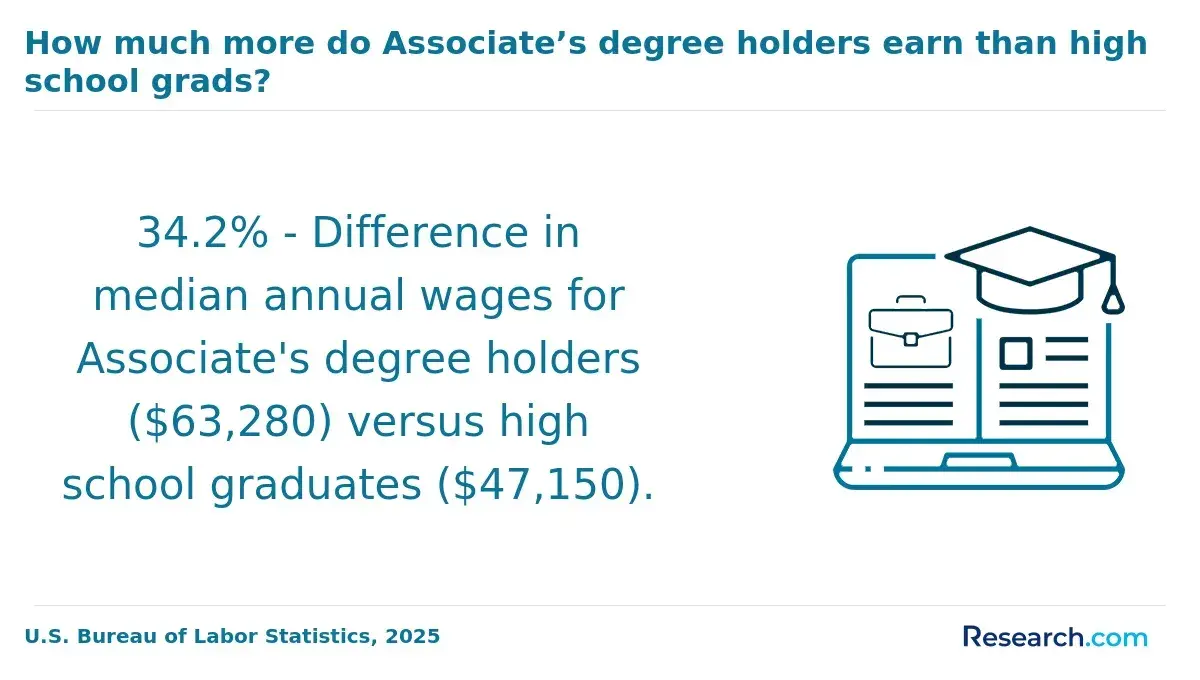
U.S. Bureau of Labor Statistics occupational figures are useful for comparing career paths, but they describe workers across experience levels and educational backgrounds - not the starting pay of associate degree graduates. For example, the BLS reports a May 2024 median annual wage of $93,600 for registered nurses. Reaching that occupation requires licensure; earning an ADN alone is not sufficient.
Use job outlook with the same caution. National growth projections do not show how many entry-level openings exist near you or whether an employer will accept your credential. Check local postings for required skills, licenses, and experience, then compare those requirements with the program's courses and any additional training you would need.
How Do You Choose a Reputable Online Associate Degree Program?
The best open-enrollment option is the one you can enter and complete without losing sight of your career or transfer goal. Before applying, use the following checks to narrow your shortlist:
- Confirm institutional accreditation and the published admissions policy for the exact major, not only the college.
- Request the degree plan and identify every live meeting, campus visit, lab, exam, internship, or clinical requirement.
- Get a written review of previous credits and ask which courses will satisfy degree requirements rather than count only as electives.
- Compare estimated total tuition, mandatory fees, and program expenses for the credits you still need.
- If transfer or licensure is the goal, confirm requirements with the receiving university or relevant state board before enrolling.
Watch for claims of "fully online" that omit placements, admissions pages that do not address selective majors, and unusually short completion estimates that assume substantial prior credit. Plan for the credential your goal actually requires: an associate degree may be the right first step toward a bachelor's degree, while a research career could eventually involve graduate study, including options such as a cheapest online PhD. That distant option should not drive your immediate choice as much as verified transfer requirements do.
Other Things You Should Know About
No. A college may admit you generally while its nursing program requires a separate application, prerequisites, and competitive selection.
Sometimes. Check every required course and whether the program includes live meetings, proctored exams, labs, campus visits, or local clinical work.
Many broad-access colleges do not require them for general admission, but placement and selective-program rules vary. Check the current policy for your college and major.
Not automatically. Ask your intended bachelor's institution which courses will meet general education and major requirements before you enroll.
References
- Student Guide to Transfer - Maryland Higher Education Commission https://mhec.maryland.gov/preparing/pages/stuguide.aspx
- Rule 3357:15-18-01 | Admission policy. https://codes.ohio.gov/ohio-administrative-code/rule-3357:15-18-01
- 2026-27 Survey Materials Instructions | ed.gov https://surveys.nces.ed.gov/ipeds/public/survey-materials/instructions
- Fast Facts: Undergraduate graduation rates (40) | ed.gov https://nces.ed.gov/fastfacts/display.asp
- DAPIP | Homepage - Office of Postsecondary Education (OPE) https://ope.ed.gov/dapip/
- Transfer Credit Policies and Procedures | Prince George's Community College https://www.pgcc.edu/hs/transfer-credit-policies-and-procedures/
- 5.01 - Admission - Policies & Procedures Manual | Ozarks Technical Community College https://ozarkstech.edu/policy/5-01-admission-policy/
- Explanation of Fees | University of North Texas - Student Accounting https://studentaccounting.unt.edu/explanation-fees.html
- Asynchronous vs Synchronous Classes: Finding the Right Fit | Northern Virginia Community College https://www.nvcc.edu/discover/asynchronous-vs-synchronous-classes-find-the-right-fit-for-you.html
- What Does Open Admissions Mean? | Goodwin University https://www.goodwin.edu/glossary/open-admissions


