2027 Berkeley MIDS vs. Grand Canyon Online MS in Data Science: Cost, Curriculum, Admissions, and Format

Co-Founder and Chief Data Scientist
Berkeley's Master of Information and Data Science (MIDS) and Grand Canyon University's online Master of Science in Data Science offer different choices for prospective students: the right fit depends on the coursework you need, the schedule you can sustain, and the full cost you can justify. This comparison focuses on what can be established without treating a degree title, advertised tuition rate, or national salary figure as a promise. Use it to identify your likely fit and the specific program details to confirm before applying.
Key Things You Should Know
- Berkeley awards a Master of Information and Data Science; Grand Canyon University awards an MS in Data Science. Compare current required courses and projects, not the degree titles alone.
- A reliable 2026 total cost comparison requires each school's current tuition, mandatory fees, required credits or units, and any travel obligations. Do not compare a per-unit price with a whole-program estimate.
- The US Bureau of Labor Statistics reports a $120,230 median annual wage for data scientists in May 2025; that occupation-wide figure is not a salary outcome for graduates of either program.
How Does Berkeley MIDS Compare With Grand Canyon's Online MS in Data Science?
The clearest established difference is the credential: Berkeley MIDS is an information and data science degree, while Grand Canyon University (GCU) offers a Master of Science in Data Science. Neither title establishes which program teaches more advanced modeling, offers better employer access, or produces better career outcomes. The comparison below separates what the programs are from what an applicant still needs to verify.
| Decision factor | Berkeley MIDS | GCU online MS in Data Science |
| Degree awarded | Master of Information and Data Science | Master of Science in Data Science |
| Institutional accreditation | University of California, Berkeley: WASC Senior College and University Commission | Grand Canyon University: Higher Learning Commission |
| Curriculum decision | Examine required MIDS courses, electives, and applied work against your target role. | Examine required MS courses, electives, and applied work using the same standard. |
| Cost decision | Request a complete estimate for your intended pace. | Request a complete estimate for the same intended pace and cost categories. |
| Schedule decision | Confirm live-session times and any in-person obligations. | Confirm course scheduling, participation deadlines, and any in-person obligations. |
The practical choice is not "information" versus "science." It is whether the required learning, total price, and weekly commitments match your starting skills and intended work.
What Accreditation Do Berkeley MIDS and Grand Canyon's Data Science Programs Hold?
UC Berkeley is institutionally accredited by the WASC Senior College and University Commission; GCU is institutionally accredited by the Higher Learning Commission. Both are recognized institutional accreditors. This establishes an important baseline, but it does not mean the two curricula, credit-transfer policies, or career outcomes are equivalent.
Do not mistake institutional accreditation for a claim that either particular data science degree has separate, discipline-specific accreditation. If specialized accreditation matters to an employer or another university, ask that organization what it requires, then check the school's current accreditation listing. Also confirm that your state of residence is eligible for the online program before paying an application fee.
How Much Do Berkeley MIDS and Grand Canyon's Online MS Cost?
A defensible 2026 comparison needs an official, term-specific estimate for each program. A current, comparable whole-program price for both degrees cannot be established here, so no tuition winner or invented total is given. Published per-credit or per-unit tuition, if available, is only the starting point: multiply the rate by the credits or units you would actually need, then add required fees. Ask whether the quoted rate applies to your entry term and whether it can change before graduation.
Request written estimates that separately identify tuition, mandatory university or course fees, books and software, any required travel, and financing costs if you expect to borrow. Check whether your intended pace changes fees or your eligibility for employer tuition assistance. A common mistake is to compare Berkeley's estimated program cost with only GCU's tuition rate - or the reverse.
If neither complete estimate works within your budget, online graduate ML programs with lower total tuition provide a useful cost benchmark, though their degree requirements and subject coverage may differ.
What Courses Are Included in Each Data Science Curriculum?
Berkeley MIDS combines data science methods with the use and interpretation of information. For a precise comparison with GCU's MS, obtain the current catalog or degree plan from each school and distinguish required courses from electives: a topic offered as an elective may not appear in your own degree. Course titles and availability can change, and titles alone do not show how deeply a subject is taught.
Compare the two plans across statistics, programming, data management, machine learning, communication or visualization, responsible use of data, and final applied work. For each area important to your target job, look beyond the catalog summary: check prerequisites, weekly assignments, tools, and whether students build and evaluate a substantial project. If you want ML engineering, for example, a course that introduces models is not interchangeable with repeated practice building reproducible pipelines.
Ask both programs for a sample course sequence and descriptions of the final project requirements. That will reveal whether your preferred electives can fit your schedule and whether the work will leave you with examples you can discuss in interviews.
How Do the Online Formats and Program Lengths Compare?
Both degrees are offered online, but "online" does not by itself tell you whether attendance is live, how often groups meet, or whether travel is required. Berkeley MIDS incorporates live online learning; applicants should confirm current meeting times and any in-person requirement directly with Berkeley. GCU applicants should likewise confirm whether their specific courses have scheduled meetings, fixed weekly deadlines, or campus obligations. Do not assume asynchronous coursework means no coordination with classmates.
Published completion times can reflect different course loads rather than faster teaching. Ask each school to map a plan around the number of courses you can take while working, including when required courses are offered and the maximum time allowed to finish. If speed is your overriding priority and your career goal is specifically AI, short-duration online artificial intelligence graduate degrees offer a separate format comparison; they are not substitutes for checking either data science program's actual schedule.
What Are the Admission Requirements for Each Program?
For either degree, use the application requirements for your intended entry term rather than a general graduate-admissions page. Confirm the required academic records, statements, recommendations, résumé, application fee, deadlines, and any testing or language-proficiency policy directly with the program. Requirements can differ between the university and a particular graduate degree.
Berkeley MIDS applicants should be ready to explain why their prior work and preparation suit an applied data science program. GCU MS applicants should make the same case against that program's published eligibility criteria. Neither a prior job title nor a self-assessment of technical ability establishes admission. If you are applying with an unrelated bachelor's degree, ask whether additional coursework is formally required rather than assuming that the degree title rules you in or out.
What Technical Skills and Prerequisites Do Applicants Need?
Separate formal admissions prerequisites from skills that make graduate coursework manageable. Before applying, review each program's current prerequisite language for mathematics, statistics, coding, and any prior degree requirements. A short course or workplace project may strengthen your preparation without formally satisfying a prerequisite; only the program can confirm whether it does.
A useful self-check is whether you can write and debug basic code, work with a dataset, explain statistical uncertainty, and interpret a model's performance. If one of those tasks is unfamiliar, ask each program where it appears in the course sequence and what preparation it recommends. This matters more than assuming that either program will start at your preferred level or that a familiar course name guarantees advanced coverage.
What Careers Can Graduates Pursue With These Data Science Degrees?
Depending on prior experience and the projects completed, graduates may pursue data scientist, data analyst, analytics engineer, or machine-learning-related positions. These are possible paths, not placements promised by either school. Employers may also distinguish sharply between analytical modeling, production software development, and business-facing analytics even when postings use similar titles.
What Salaries and Job Growth Can Data Science Graduates Expect?
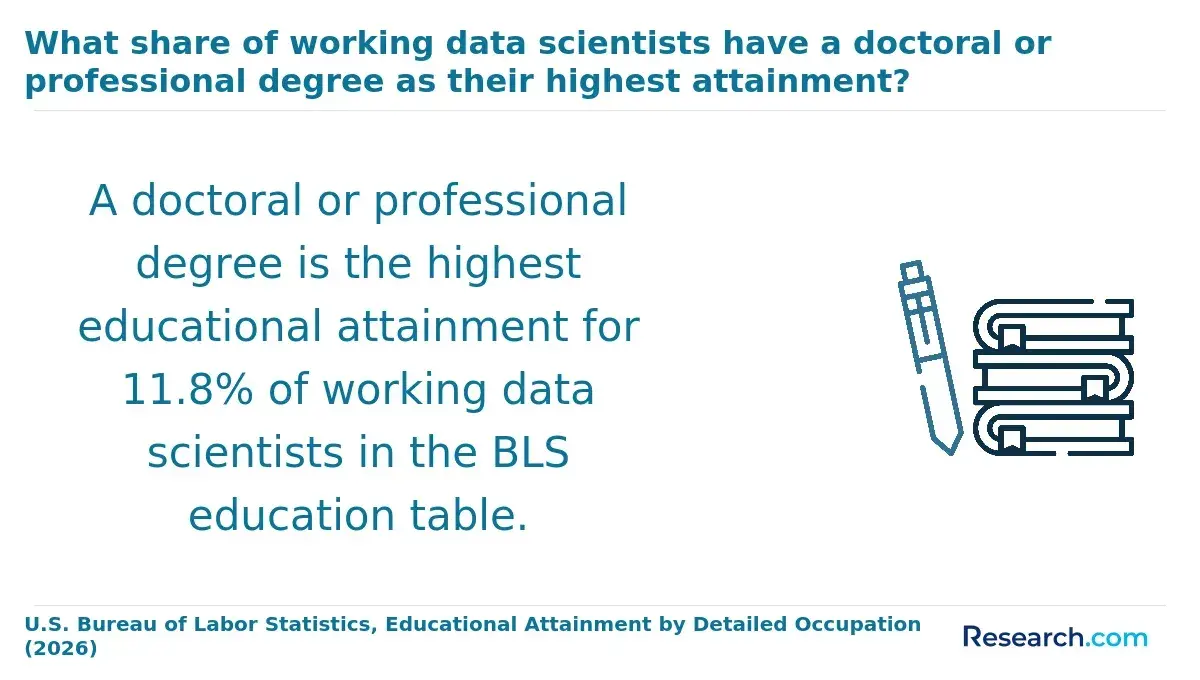
The US Bureau of Labor Statistics reports that the median annual wage for data scientists was $120,230 in May 2025. It projects 35% employment growth from 2025 to 2035, with about 24,800 openings annually on average. Those figures describe a national occupation, not what a Berkeley or GCU graduate will earn or how quickly they will find work.
For a personal return-on-investment calculation, compare your likely next role and local pay with your current compensation, then subtract the complete degree cost and any income you would forgo. Prior experience, industry, location, and job responsibilities all matter. Data science compensation across industries can help frame that comparison, but an industry salary should not be treated as a degree-caused raise.
Which Online Data Science Program Best Fits Your Career Goals?
Choose Berkeley MIDS if its confirmed required courses, live-class schedule, applied work, and complete cost fit the skills you want to build. Choose GCU's online MS if its confirmed curriculum, scheduling, and full price meet those same needs more effectively. Neither recommendation follows from a school name or degree label alone.
Before accepting an offer, get both programs' current degree plans and itemized cost estimates. Compare the courses you must take - not just attractive electives - then test the class schedule against a normal workweek. Finally, ask for concrete examples of recent student projects relevant to your target role. If both prices exceed your budget and your goal is more specifically AI than broad data science, affordable online artificial intelligence degrees may be worth comparing as alternatives, subject to the same curriculum and total-cost checks.
Other Things You Should Know About Data Science
Do not assume they will. Ask the receiving program to evaluate specific courses in writing before relying on transfer credit to reduce your cost or time to graduation.
Possibly, but obtain your employer's permission first and check the course rules. Confidentiality agreements, privacy requirements, and restrictions on sharing code or results may make another dataset more suitable.
Do not assume it does. Visa eligibility depends on the student's circumstances and the institution's authorized arrangements; consult the school's international-student office before enrolling for that purpose.
Yes, subject to each certification provider's eligibility rules. A certification can document a particular tool or platform skill, but it is not a replacement for checking what the degree teaches or showing work you can explain.
References
- Measuring Student Success In IPEDS: Graduation Rates (GR), Graduation Rates 200% (GR200), And Outcome Measures (OM) https://nces.ed.gov/ipeds/use-the-data/measuring-student-success-in-ipeds
- School-Determined Requirements | 2024-2025 Federal Student Aid Handbook https://fsapartners.ed.gov/knowledge-center/fsa-handbook/2024-2025/vol1/ch1-school-determined-requirements
- Department Expectations: Curriculum | New York State Education Department https://www.nysed.gov/college-university-evaluation/department-expectations-curriculum
- What is a Capstone Project in College? | snhu.edu https://www.snhu.edu/about-us/newsroom/education/what-is-a-capstone-project
- Reader's Guide to the Catalog | University of Oregon Academic Catalog https://catalog.uoregon.edu/readersguide/
- How Online Courses Work & Resources - ASU Online https://asuonline.asu.edu/students/courses/
- in Data Science - MS Admissions Requirements https://www.gc.cuny.edu/data-science/ms-admissions-requirements
- How Do Asynchronous Classes Work? | Hopkins EP Online https://ep.jhu.edu/news/how-do-asynchronous-classes-work/
- Application Requirements - Graduate Admissions https://graduate.admissions.gwu.edu/application-requirements
- What's the Difference Between Asynchronous and Synchronous Learning? | Ohio State Online https://online.osu.edu/content-hub/blogs/whats-the-difference-between-asynchronous-and-synchronous-learning/