
2027 Applying to Multiple Online Data Science Master's Programs: A Comparison Spreadsheet Guide

Co-Founder and Chief Data Scientist
Applying to several online data science master's programs is easier when every school is evaluated against the same requirements. A spreadsheet can keep an attractive tuition rate from obscuring mandatory fees, or a flexible-looking format from hiding required live sessions.
This guide is for prospective students building an application shortlist: it shows what to record, how to verify changing details, and how to choose which programs merit an application.
Key Things You Should Know
- Use one row per program and separate verified requirements from unanswered questions; do not treat missing information as a favorable answer.
- Compare estimated degree-wide cost, not just tuition per credit, and record the source and date for figures that may change.
- Use career fit and scheduling as pass-or-fail checks before ranking schools; the Bureau of Labor Statistics projects 35% growth in data scientist employment from 2025 to 2035, but that does not predict an individual applicant's outcome.
What is an online data science master's program?
An online data science master's is a graduate degree delivered primarily through online coursework in areas such as statistics, computing, and applied analysis. The degree title alone does not establish its technical depth: programs may emphasize statistical modeling, software development, business decisions, or a combination. For a multi-program application, record the actual degree awarded, required courses, and project requirements rather than sorting schools by name alone.
If your interests lean more toward building AI systems than analyzing data, compare the curriculum with artificial intelligence graduate study for non-CS students. That distinction can prevent applications to programs whose prerequisites or learning goals do not fit your background.
How do you compare online data science master's programs?
Build a spreadsheet with one row per program and columns grouped by eligibility, academic fit, delivery, cost, and application status. Give each changing claim a "source checked" date and an "unconfirmed" status when necessary. The table distinguishes figures that are easy to confuse; keep these as separate columns rather than collapsing them into a single price or flexibility score.
| Spreadsheet field | What it represents | Why the distinction matters |
| Tuition rate | Published charge per credit or term, with applicable residency category | A low rate does not establish a low degree-wide cost. |
| Estimated degree cost | Required tuition plus known mandatory fees at your planned pace | Comparable only when the same cost categories are included. |
| Live-session requirement | Required scheduled classes, meetings, or exams | "Online" does not necessarily mean self-paced. |
| Project requirement | Required capstone, thesis, practicum, or course-based projects | The type and scope of work affect portfolio fit. |
| Evidence status | Verified, pending confirmation, or not publicly reported | A blank cell should not be mistaken for "none." |
The comparison works best as a short sequence of decisions, not a ranking of every advertised feature.
- Set nonnegotiable filters: enrollment eligibility where you live, a workable schedule, required preparation you can meet, and a realistic budget ceiling.
- Enter the same fields for every school: degree and credits, prerequisites, required courses, electives, projects, live attendance, pacing, tuition, fees, deadlines, and application materials.
- Record each figure's official source, the date checked, and any question for admissions or the bursar; confirm unclear terms before treating a cell as verified.
- Shortlist programs that pass the filters, then compare curriculum and support against your target work. Submit applications based on fit, not an overall score that lets a strength cancel a deal-breaker.
When affordability is a primary filter, explore affordable online data science programs to develop a shortlist, then verify each school's current charges and requirements directly. Avoid comparing one school's tuition-only estimate with another's tuition-and-fees total.
Is an online data science master's worth it?
It may be worth pursuing if the coursework closes a specific skills gap, the format lets you complete it, and the likely benefits justify the full cost and time commitment. In your spreadsheet, add a brief "reason to apply" field: the target role, skills you need, and evidence the curriculum will help you build. A degree is less compelling when you already have the required skills and need only a focused project or course.
For a financial comparison, distinguish tuition and fees from materials, financing costs, and time away from paid work. Do not assume that a future salary was caused by the degree. If you are choosing between data science and AI, cost comparisons for artificial intelligence master's degrees can help frame the alternative, provided you compare equivalent cost categories and career goals.
How do you verify accreditation for online data science programs?
Check the institution's accreditation through the accreditor and the U.S. Department of Education's accreditation records, using the institution's current name. Record the accreditor and verification date in your spreadsheet. Institutional accreditation is not the same as a claim that an individual data science program holds specialized accreditation; confirm the precise claim being made.
Separately, ask whether the program can enroll students in your state of residence and whether any required in-person activity creates a location constraint. Accreditation and permission to enroll are different checks. Treat a vague "accredited" badge without an identified accreditor, or an unanswered state-eligibility question, as unresolved rather than passing your eligibility filter.
What courses are included in a data science master's curriculum?
Common areas to examine include statistics, programming, databases, machine learning, data visualization, and responsible data use. Programs vary in which subjects are required, which are electives, and whether students apply them in substantial projects. Record those distinctions in separate spreadsheet fields: an elective you cannot fit into your schedule is not equivalent to a required course.
Read course descriptions and project expectations when a skill matters to your goal. An AI topic mentioned in a survey course offers different preparation from an advanced elective plus an applied project. For healthcare-oriented work, compare data science options with AI graduate programs for healthcare-related careers, paying particular attention to relevant projects and how programs address sensitive data.
What are the admission requirements for online data science master's programs?
Requirements differ by institution. For each program, record the stated degree and transcript requirements, prerequisite subjects, application materials, and any test or experience policy. Put an uncertain prerequisite in a "confirm with admissions" column instead of assuming professional experience or self-study formally substitutes for coursework.
Separate eligibility from competitiveness. Meeting published minimum requirements does not guarantee admission, while a missing preferred skill may not make an applicant ineligible. If your background is outside computing, ask whether a proposed course would satisfy a formal prerequisite before paying for it; preparation for graduate work and fulfillment of an admissions rule are not necessarily the same thing.
How long do online data science master's programs take and cost?
Both depend on credit requirements, course availability, enrollment pace, tuition rules, and fees. Capture each school's published minimum or typical completion period, but calculate a personal timeline from the courses you could actually take while working. Ask whether required courses run every term and whether there is a maximum time to finish.
For cost, start with required credits multiplied by the applicable per-credit rate when that is how tuition is charged, then add mandatory program and university fees. Keep books, technology, travel, and borrowing costs in separate fields so the total is transparent. If tuition is charged by term, use the school's term rules instead of a per-credit formula. Explore data science graduate study funding options, and record only aid or employer support you have confirmed is available to you.
What careers can you pursue with a data science master's degree?
Possible targets include data scientist, machine learning practitioner, analytics specialist, and data-focused roles within a particular industry. Titles and duties differ by employer, so compare job descriptions with the program's required skills rather than assuming a degree title maps to one occupation.
The U.S. Bureau of Labor Statistics projects data scientist employment to grow 35% from 2025 to 2035. That indicates demand for the occupation overall, not that every graduate will enter it. A useful spreadsheet field is "target-role evidence": note the courses and projects that would help you demonstrate skills required in jobs you would actually apply for.
How much do data scientists earn after earning a master's degree?
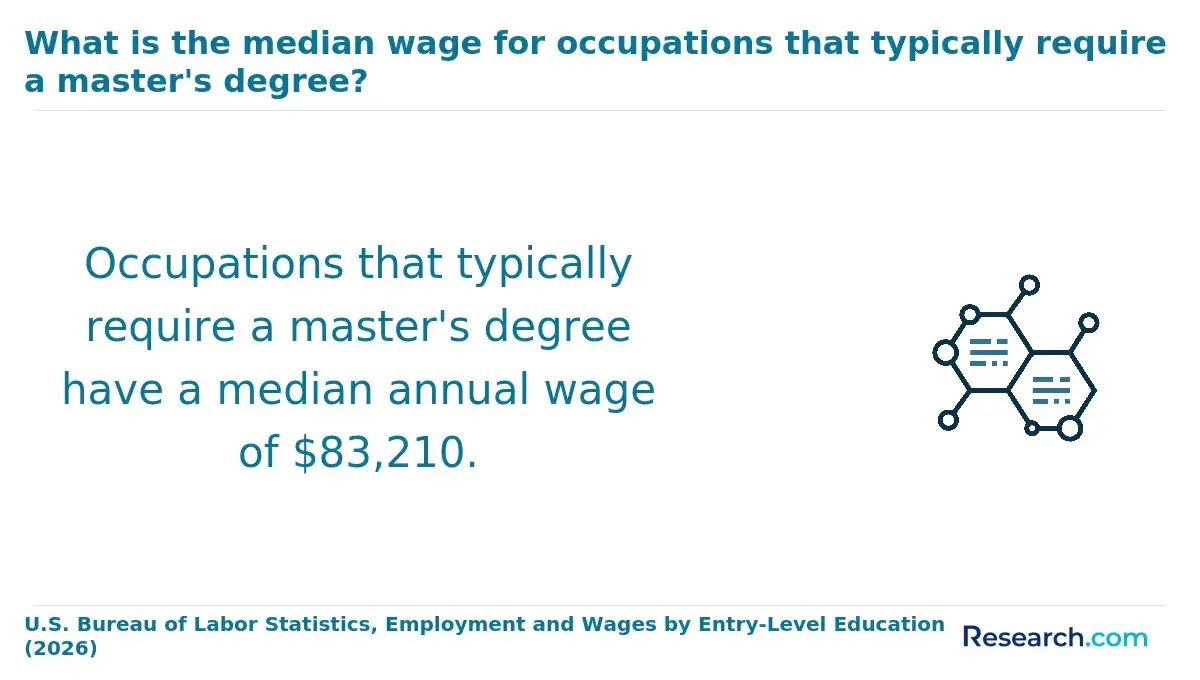
The Bureau of Labor Statistics reports a median annual wage of $120,230 for U.S. data scientists in May 2025. This is an occupation-wide median, not a salary for new master's graduates or an expected raise from earning the degree. Experience, employer, location, responsibilities, and prior salary all affect an individual outcome.
If a program publishes graduate salaries, record the survey period, number of respondents, response rate, prior work experience, and whether the figure is a salary level or an increase. If those details are unavailable, leave the outcome unverified rather than using it to justify a larger education budget.
What certifications and professional standards apply to data science careers?
There is no single certification to assume every data science applicant needs. Employer expectations differ, and a tool-specific credential may be useful only when it matches the work you intend to do. In a program comparison, give more weight to demonstrable practice - such as reproducible analysis, sound evaluation, and responsible handling of data - than to an unsupported promise that a certificate will improve hiring prospects.
If a program advertises preparation for a particular certification, record the certification's name and issuer, then check whether its requirements and costs are included in the degree. Also examine how required coursework addresses privacy, bias, and communication of uncertainty; those standards matter when analytical results inform consequential decisions.
Other Things You Should Know About Data Science
A separate, limited view can help recommenders track programs and submission requests. Share deadlines and relevant program goals, but keep financial details and private admissions notes in your own copy.
Check each school's stated time zone and submission rules. Prioritize materials requiring other people's action, such as recommendations, and aim to submit before the deadline day.
You can reuse accurate background information, but tailor the explanation of fit to each program's actual curriculum and prompt. Check school names and word limits before submitting.
Compare the written offers, aid terms, acceptance deadlines, and any deposit rules. Request clarification before committing if a material cost or enrollment condition remains unclear.
References
- Tuition and Fees Data - Texas Higher Education Coordinating Board https://www.highered.texas.gov/legislative-appropriations-overviews/tuition-and-fees-data/
- What's the Difference Between Asynchronous and Synchronous Learning? | Ohio State Online https://online.osu.edu/content-hub/blogs/whats-the-difference-between-asynchronous-and-synchronous-learning/
- Tuition & Fees - Office of Finance | University of Dallas https://udallas.edu/offices-services/office-of-finance/student-account-services/tuition-fees.php
- Syracuse Online Master's in Applied Data Science https://onlinegrad.syracuse.edu/information-science/applied-data-science/
- MS in Data Science | Online | $9900 | Eastern University https://www.eastern.edu/academics/graduate-programs/ms-data-science
- M.S. in Data Science, Online | virginia.edu https://datascience.virginia.edu/degrees/msds-online
- MS in Data Science | UConn | Online & On-Campus Programs | Master of Science in Data Science | University of Connecticut https://masters.datascience.uconn.edu/
- Tuition & Fees | University of Texas at Arlington University Catalog https://catalog.uta.edu/academicregulations/tuition_fees/
- Admission Requirements | Illinois https://predictive-analytics.illinois.edu/admission-requirement/
- Cost of Attendance - Financial Aid and Scholarships | The University of Utah https://financialaid.utah.edu/tuition-and-fees/cost-of-attendance.php


