2027 A Second BS in Business Administration After a Bachelor's in English: Credits, Cost, and Alternatives
Audited and Verified:
Our Editorial and Data Verification Process
Research.com uses government datasets, official education statistics and primary institutional information to support its career and degree guides. Our review process checks factual accuracy, occupational definitions, source dates and the requirements associated with the credentials discussed.
How This Article Was Fact-Checked
Our editorial team verifies salary estimates, employment projections, education requirements and program information against original data providers and official organizations. Salary figures are checked against the relevant occupational definitions and reporting periods. Information about licensure, accreditation and required in-person training is reviewed separately.
Fact-checked and verified on:

Co-Founder and Chief Data Scientist
An English bachelor's degree gives you substantial college credit and valuable communication skills, but it may not cover the accounting, finance, and quantitative courses in a business major. If you are considering a second BS in Business Administration, the deciding questions are how much coursework remains, what it will cost, and whether the credential helps you reach a specific role. This guide shows career changers how to obtain a reliable degree audit, compare the full cost with shorter alternatives, and judge whether a second bachelor's is worth pursuing.
Key Things You Should Know
- Your English degree may satisfy general education requirements, but only the receiving school can determine which credits satisfy its business core, concentration, and residency rules.
- Price the remaining required courses, not the advertised cost of a full bachelor's. Federal Pell Grants generally are not available to someone who already holds a bachelor's degree.
- A second degree is most useful when a target role calls for undergraduate business coursework and you can gain relevant experience alongside it; it does not automatically qualify you for management.
What Is a Second Bachelor's in Business Administration After English?
A second bachelor's is another undergraduate degree awarded after your English bachelor's. You complete the new institution's requirements for a business administration major, along with any remaining general education, elective, and in-residence coursework. It is not a graduate degree, and your first diploma is not converted into a business credential.
A BS in Business Administration generally combines broad business subjects with quantitative coursework, but a BBA or BA in Business may serve a similar goal at another school. Compare the actual curricula rather than assuming the degree labels dictate course content. Your completion time depends on the official credit evaluation and when required courses are offered - not simply the length of an advertised accelerated program. Lists of the fastest online business bachelor's programs in the US can help identify schools to investigate, but request an individualized plan before relying on a published timeline.
How Many Credits Transfer From an English Bachelor's to Business Administration?
There is no reliable universal credit count. A school may accept much of your English coursework while still requiring most of its business major. Accepted credits appear on your record; applicable credits actually fulfill requirements for the second degree. That distinction determines your remaining time and cost.
The categories below show what an English graduate should look for in a written degree audit. They are possibilities, not promises of equivalency.
| Prior coursework | Possible application | What to verify |
| English, humanities, and writing | General education, communication requirements, or electives | Whether the school waives or reuses general education for second-degree students |
| Mathematics, statistics, or economics | Quantitative or business prerequisites | Course equivalency, minimum grade, and any recency rule |
| Prior business electives | Business core, concentration, or electives | Whether the department approves a direct substitution |
| Remaining institutional coursework | Residency and second-degree requirements | Minimum credits that must be earned at the new school |
Send official transcripts and, for disputed courses, syllabi to the transfer-credit office or registrar. Then ask a business adviser to mark each remaining core, concentration, prerequisite, and residency requirement in the audit. Policies can differ even across related fields; examples of human resources bachelor's residency and transfer rules are useful comparison points, not substitutes for the business school's decision. If a course is classified only as an elective, ask about a documented substitution or appeal before enrolling in its replacement.
How Much Does a Second Business Administration Bachelor's Degree Cost?
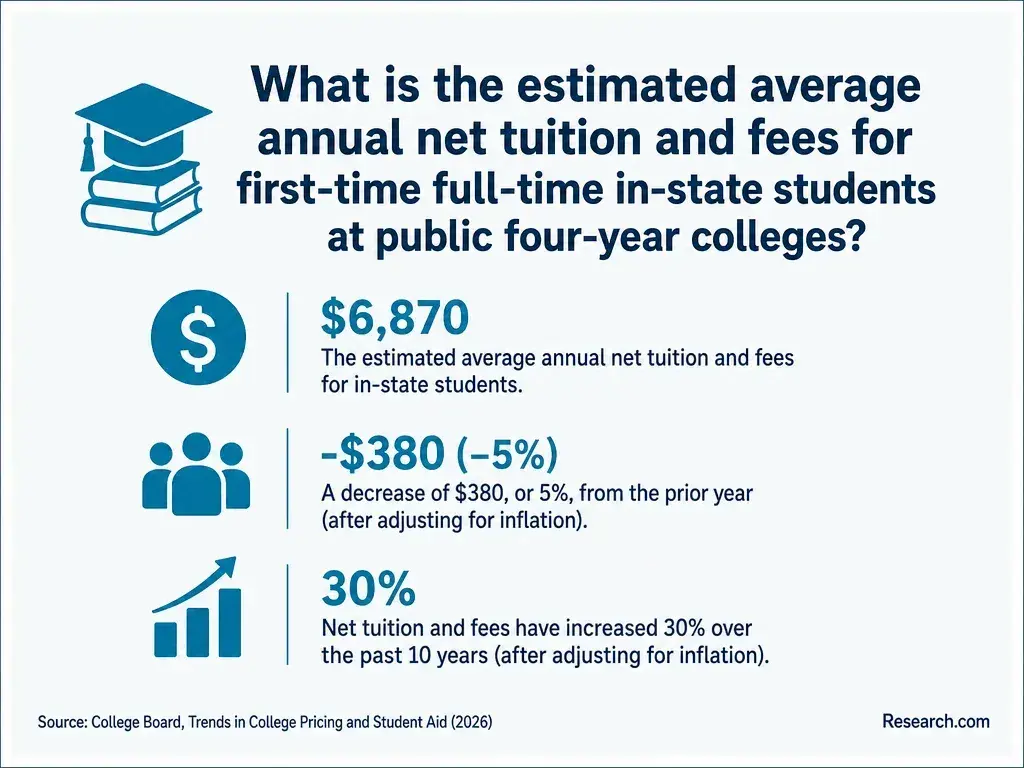
Your meaningful price is the cost of finishing your audit, not the tuition for a student starting with no college credit. Calculate remaining billable credits or terms under each school's pricing model, then add mandatory fees, books, software, travel or proctoring expenses, and the cost of any prerequisite courses. A required class offered infrequently can add living expenses or delay your return to full-time work even if its tuition is modest.
Request a term-by-term estimate from each school and use the same assumptions when comparing offers. A guide to business administration tuition and FAFSA eligibility can help you identify questions to take to the financial-aid office; FAFSA participation does not mean every applicant receives grant aid.
Because you already hold a bachelor's degree, you generally cannot receive a federal Pell Grant for a second undergraduate degree. You may still be eligible for federal student loans, subject to applicable rules and borrowing limits, or for employer assistance or institutional aid. Ask the financial-aid office to check your individual eligibility, including prior borrowing and satisfactory academic progress. Compare net cost, cash needed each term, and potential borrowing separately: employer reimbursement, for example, may arrive only after you pay tuition and pass the course.
Start with the work you want to do. If you have an English degree and want to move into marketing operations, human resources, or project coordination, identify the missing skills and the qualifications in actual job postings. A second bachelor's can provide a structured business foundation and access to undergraduate recruiting, but it may repeat coursework without solving an experience gap.
These pathways address different needs; compare their required courses and hiring relevance before paying for another degree.
| Pathway | Stronger fit when | Principal limitation |
| Second BS or BBA in business administration | You need a broad undergraduate business foundation or a specific employer requires business coursework | Remaining core and residency requirements may be substantial |
| Targeted courses or a certificate | You need defined skills such as accounting, spreadsheets, or digital marketing | May not meet a formal degree requirement |
| MBA or specialized master's | You qualify for graduate admission and your target role benefits from graduate-level study | Cost and admissions prerequisites vary; it is not automatically a better entry route |
| Relevant work, projects, or employer training | You can enter an adjacent role and document business responsibilities | May not address a firm credential requirement |
For a project-management goal, compare the business degree with function-specific study rather than assuming the broader credential is necessary. An accredited online project management tuition guide offers another cost comparison, but neither degree alone replaces evidence that you can coordinate schedules, stakeholders, and deliverables. If you are unsure, a relevant entry-level role plus targeted coursework may be the lower-risk first move.
Expect to provide transcripts from every college attended and proof of your completed bachelor's degree. Schools may also specify a minimum GPA, application materials, and prerequisites for entry to the business major. Admission to the university and admission to a restricted business major can be separate decisions; neither establishes which old courses will satisfy graduation requirements.
Ask admissions whether second-degree applicants receive different general education treatment, whether mathematics or introductory accounting must be finished before major admission, and which catalog will govern your degree. If an application charge matters to your budget, free application options at accredited online schools can narrow an initial search; verify that the specific business program accepts second-degree applicants. Do not take a prerequisite elsewhere until the receiving school confirms its equivalency in writing.
Most programs build from accounting, economics, business communication, and quantitative preparation toward finance, marketing, management, operations, business law, and a strategy or capstone course. The exact mix, course sequence, and math requirements belong to the school's catalog. Your English training may strengthen research, writing, presentations, and stakeholder communication, but it should not be assumed to replace accounting or statistics.
Examine concentration requirements only after the core is clear. A marketing, HR, analytics, or operations concentration may give you more relevant assignments, but check whether it is formally recorded, whether its courses add credits, and whether required classes are offered when you need them. For project coordination, compare operations and project coursework with budget-conscious project management degrees; a general business elective is not the same credential as a specialized degree. Ask whether the capstone permits an approved workplace project, and obtain permission before using employer records or customer data.
Choose the format that lets you complete the remaining courses and build relevant experience. Online delivery may make commuting unnecessary, but fixed deadlines, live presentations, group projects, proctored exams, and required internships can still conflict with work. Campus study may offer easier access to local recruiting and face-to-face teams, provided its class schedule is feasible.
Request sample course schedules and ask whether the remaining requirements are available online every term. Also confirm live-session times, exam arrangements, internship rules, and whether part-time enrollment affects aid or course sequencing. Work-compatible business administration education options are a starting point, not proof that every required course will fit your job. An online program that extends completion while offering no practical experience may be a worse career-change fit than a less flexible program with usable employer connections.
First, verify the institution's recognized accreditation through the school's accreditor and the U.S. Department of Education's accreditation records. Then check separately whether the business school or the specific degree is covered by AACSB, ACBSP, or IACBE accreditation. These are different questions: institution-level accreditation does not establish business-program accreditation, and a school's accreditation claim may not cover every program or location.
Quality for a second-degree student also means reliable advising and a realistic path through remaining courses. Request the current catalog, a written audit, course rotation information, and details of career services available to online or returning students. You can compare nationally ranked online business programs to develop a shortlist, but assess each candidate against your own audit and target role rather than using a ranking as a graduation or employment prediction.
The combination can be useful where clear writing, research, and stakeholder communication meet business tasks. Depending on experience and demonstrated skills, plausible entry or transition targets include marketing coordinator, HR assistant or specialist, sales operations associate, administrative specialist, and project coordinator. Those jobs are not interchangeable: marketing work may require campaign measurement, HR work may involve personnel processes, and project coordination often involves schedules and reporting.
Choose one target and build evidence for its tasks. An English graduate pursuing marketing operations, for example, could pair business analytics coursework with an authorized campaign report or a clearly labeled practice project. An aspiring project coordinator could document scheduling and cross-team work already performed, then seek supervised experience. If you need a faster academic schedule to make that transition while employed, investigate bachelor's degrees with compressed schedules alongside actual course availability. A faster calendar does not remove the need for relevant work samples, employer connections, or experience before taking on managerial responsibility.
What Are the Salaries and Job Outlook for Business Graduates?
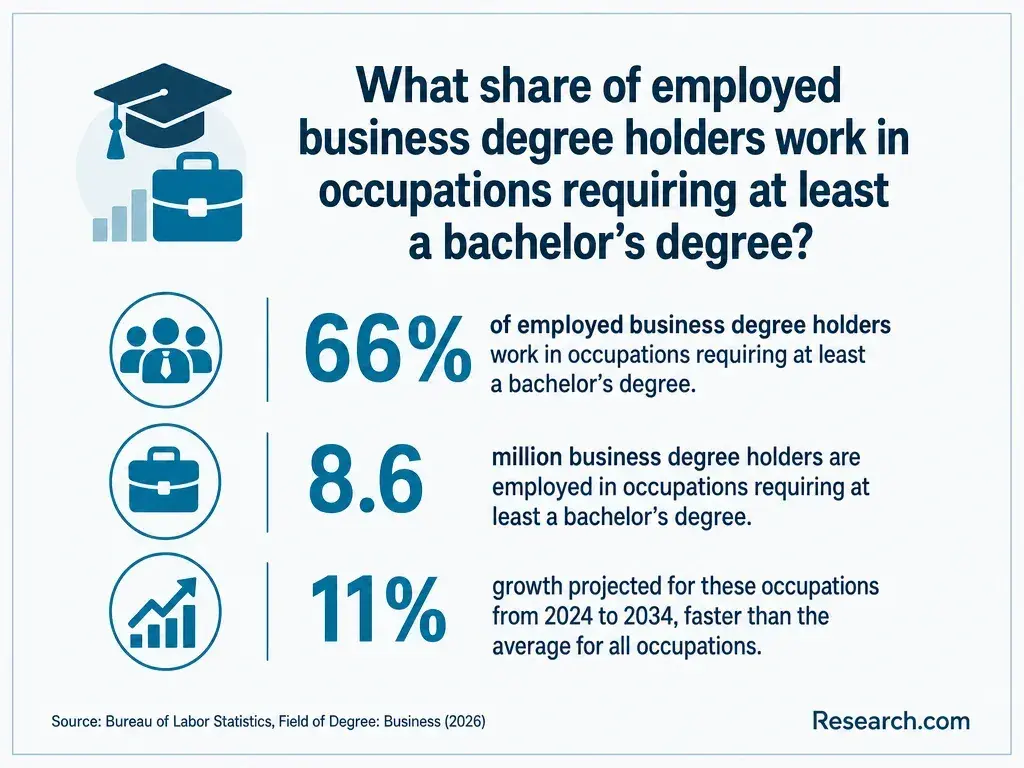
There is no single salary or growth rate for people who hold a business administration degree. The U.S. Bureau of Labor Statistics reports a May 2025 median annual wage of $75,940 for human resources specialists and projects 6% employment growth from 2025 to 2035. Those are occupation-wide figures - not starting pay for English graduates, second-degree students, or newly hired HR assistants. Location, industry, experience, and the duties of the particular job matter.
Use occupation data to test whether your target field offers opportunities, not to calculate a guaranteed return on tuition. Compare local postings and pay ranges with your current earnings, likely entry position, total education cost, and time away from work. If your alternative is a specialized project-management degree, account for its financing separately; information on financial aid for online project management bachelor's degrees cannot establish what aid you would receive for a business program. The strongest financial case for a second BS is a credible route to a specific role that your existing degree, shorter training, and experience cannot serve as well.
Other Things You Should Know About Business Administration
No. Your first bachelor's remains a separate completed credential. Ask the second institution how it records and issues the new degree.
Do not assume so. A business capstone normally has its own learning objectives and approval process. Ask the department whether any prior work can inform a new, approved project.
Often you can, but the change may alter required courses or your graduation date. Request an updated degree audit before switching.
Not necessarily. Many MBA programs consider applicants with bachelor's degrees in other fields. Check each program's admissions and quantitative-preparation requirements against your career goal.
- Student Eligibility for Pell Grants | ed.gov https://fsapartners.ed.gov/knowledge-center/fsa-handbook/2024-2025/vol7/ch1-student-eligibility-pell-grants
- General Education and Common Curriculum Requirements | UConn School of Business https://undergrad.business.uconn.edu/academics/cc-gen-ed/
- What kind of aid am I eligible for as a second-degree student? | unc.edu https://studentaid.unc.edu/faq/what-kind-of-aid-am-i-eligible-for-as-a-second-degree-student/
- Second baccalaureate - UC Admissions - University of California https://admission.universityofcalifornia.edu/counselors/preparing-transfer-students/second-baccalaureate.html
- Undergraduate Degree and Program Requirements | CSUSB https://catalog.csusb.edu/undergraduate-degree-programs/undergraduate-degree-program-requirements/
- Second Bachelor's Degree | csuchico.edu https://www.csuchico.edu/admissions/second-bachelors.shtml
- Apply for a Second Bachelor's Degree | csueastbay.edu https://www.csueastbay.edu/admissions/second-baccalaureates.html
- 2.43.07 Post-Baccalaureate Certificate Programs; Guidelines | Board of Governors https://bog.wayne.edu/code/2-43-07
- AACSB vs. ACBSP vs. IACBE: Business School Accreditation | Pittsburg State University https://degree.pittstate.edu/online-programs/mba/general/aacsb-accreditation-explained/
- Graduate Certificate in Business Administration | Caldwell University https://www.caldwell.edu/business-administration-certificate/