
2027 Social Workers and Public Defenders: Team Roles, Information Sharing, and Preparation
Audited and Verified:
Our Editorial and Data Verification Process
Research.com uses government datasets, official education statistics and primary institutional information to support its career and degree guides. Our review process checks factual accuracy, occupational definitions, source dates and the requirements associated with the credentials discussed.
How This Article Was Fact-Checked
Our editorial team verifies salary estimates, employment projections, education requirements and program information against original data providers and official organizations. Salary figures are checked against the relevant occupational definitions and reporting periods. Information about licensure, accreditation and required in-person training is reviewed separately.
Fact-checked and verified on:

Co-Founder and Chief Data Scientist
A defense team may need to understand a client's housing, health, family responsibilities, and service options without compromising the client's legal case. Public defenders and social workers bring different expertise to that task, but effective collaboration depends on clear roles and careful information sharing.
This guide is for social work students, early-career practitioners, and human services professionals considering public defense. It explains what the work involves, how to prepare for it, and which degree or credential questions to resolve before choosing a program or applying for a job.
Key Things You Should Know
- Defense social workers assess needs, coordinate services, and help develop mitigation or release plans; attorneys direct legal strategy and make legal arguments.
- Sharing information within a defense team is not automatically privileged. The attorney and agency must establish who may access records, why, and under which confidentiality rules.
- There is no single national credential for this job: employers may seek a BSW, MSW, relevant human services experience, or a state license, depending on the duties.
What do social workers and public defenders do on a defense team?
A public defender represents a person who cannot afford counsel in a criminal case. A defense social worker contributes social work assessment and service knowledge to that representation. The partnership is especially useful when a client's circumstances affect pretrial release, plea discussions, sentencing, or the feasibility of a proposed community-based plan.
The division of work matters because a social worker's assessment can inform legal advocacy without becoming a legal opinion. Responsibilities vary by office, but this comparison shows the usual boundary.
| Team member | Primary contribution | Key boundary |
| Public defender | Advises the client on legal options, directs case strategy, negotiates, and advocates in court | Does not delegate legal judgment to the social worker |
| Defense social worker | Explores client-defined needs and strengths, coordinates referrals, and may prepare social-history or mitigation material | Does not promise a legal result or independently decide what to disclose in the case |
| Investigator or other specialist | Develops evidence within an assigned investigative or expert role | Coordinates with, rather than substitutes for, social work assessment |
A useful collaboration starts with a specific question from counsel: for example, whether a proposed release plan has a willing service provider and realistic transportation. The social worker can verify availability and describe barriers without claiming that treatment is guaranteed or that a court will accept the plan. People comparing defense work with other settings can use exploring professional opportunities after MSW study to put the role in context.
How do social workers and public defenders share client information confidentially?
Confidentiality is both an ethical obligation and a legal, operational question. Attorney-client privilege, attorney work-product protection, social work confidentiality duties, record-access rules, and agency policy are related but not interchangeable. A social worker's presence on a defense team does not automatically make every conversation or document privileged. Whether protection applies can depend on the person's role, the purpose of the communication, jurisdictional law, and how the material is handled.
Before collecting or circulating sensitive information, the team should agree on a workflow that serves the client's representation while limiting unnecessary disclosure:
- Have counsel identify the case-related purpose of the assessment and who is authorized to participate.
- Explain the social worker's role and the relevant limits of confidentiality to the client; seek any consent or authorization required for outside records or contacts.
- Request only information needed for the assigned purpose, and check special rules that may govern particular records.
- Use approved case-management systems and access controls; distinguish internal working material from documents approved for release.
- Consult counsel and agency policy before sharing material with a court, prosecutor, treatment provider, school, or other outside party.
Mandatory-reporting obligations, immediate safety concerns, subpoenas, and records such as substance-use treatment information can present conflicts that require prompt, jurisdiction-specific guidance. Neither an informal promise of secrecy nor a routine release form resolves every issue. Students should also establish what may be discussed with a school field instructor and how case details will be de-identified; MSW field placement support and student responsibilities are worth checking before accepting a defense-office placement.
What degree do you need to become a public defender social worker?
There is no universal degree requirement attached to the job title. Some offices hire BSW graduates for generalist support or case-management duties; others prefer or require an MSW for complex assessment, mitigation work, supervision, or positions classified as social worker. Related human services roles may accept other degrees and relevant experience. The job posting and any state rules governing use of the social worker title determine what qualifies.
A BSW offers generalist social work preparation. Someone with a bachelor's degree in another discipline can generally investigate a traditional or foundation MSW rather than assume they need a second bachelor's degree. Advanced-standing MSW admission generally requires a qualifying social work bachelor's degree and the particular program's approval; a psychology or criminal justice degree alone does not establish eligibility.
For this work, compare a program's justice-related field opportunities, policy and assessment training, and placement supervision before paying for an additional credential. A DSW or PhD is not a standard entry requirement for defense-team practice. Experienced practitioners considering leadership or scholarship can separately assess accelerated doctoral social work study planning, but a doctorate is not a substitute for the experience an employer seeks.
Relevant preparation combines interviewing and assessment with knowledge of criminal legal systems, social policy, behavioral health, housing, disability, and community resources. Research literacy helps a social worker evaluate claims made in a mitigation plan; writing instruction helps distinguish documented facts, client reports, professional observations, and recommendations.
Look for supervised practice in client engagement, culturally responsive assessment, boundaries, and concise documentation. A public defense placement is especially relevant, but placements in reentry services, community behavioral health, housing, or court-connected programs may also build transferable skills. Ask what the student may actually do, who provides field instruction, how confidentiality is taught, and whether the school has approved the site. Volunteering or holding a paid job does not automatically satisfy curricular field requirements.
Clinical coursework may be valuable when a role involves behavioral health assessment, but it is not the same as learning defense-team procedure. A clinical MSW education and professional development guide can help applicants evaluate that component without assuming a clinical concentration is required for every defense position.
How much do public defender social workers earn, and what is the job outlook?
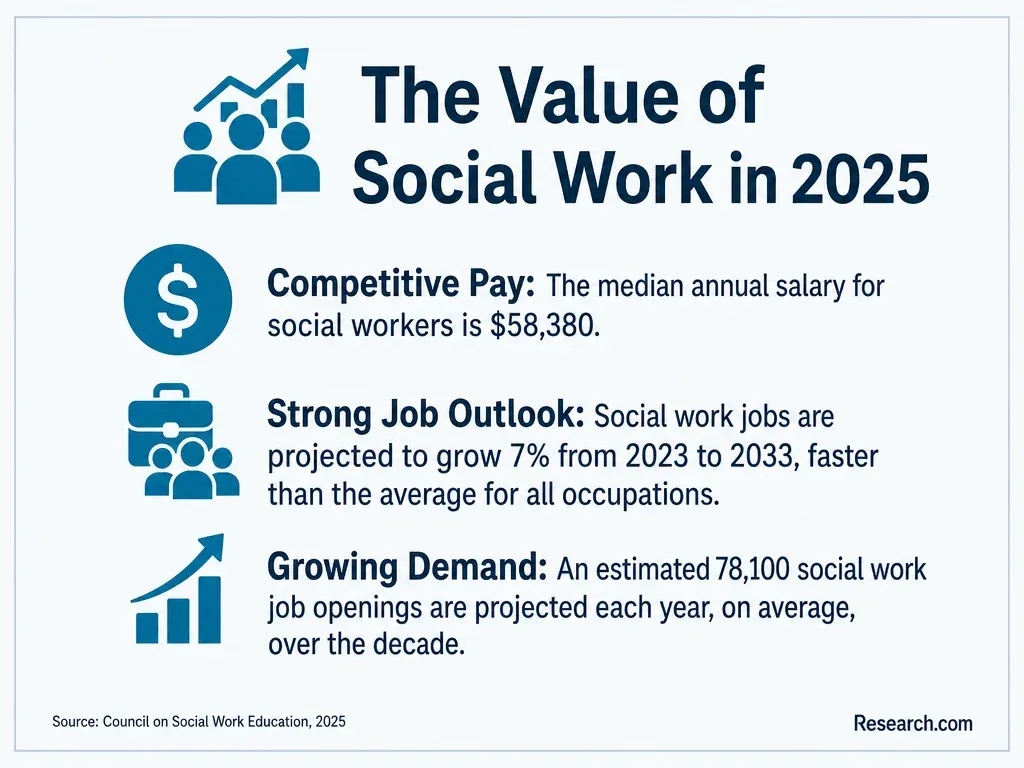
The U.S. Bureau of Labor Statistics does not publish a separate national wage or growth series for "public defender social worker." Its broader social worker category had a May 2025 median annual wage of $61,780, with employment projected to grow 6% from 2025 to 2035. These figures describe occupations across many settings - not a defense-office pay offer or a forecast for mitigation jobs specifically.
Public defender compensation may instead be set by a county, state, or nonprofit pay scale and affected by classification, location, experience, and license requirements. Look up current openings and published pay bands for the offices where you would work; compare benefits and advancement steps as well as base pay. social work earnings across different state markets offers geographic context, but local defense-office postings are the stronger evidence for this particular career decision.
Other Things You Should Know About Social Work
Sometimes. A court may hear testimony or receive a report, depending on the case and the person's role. The attorney should determine the purpose and prepare with the social worker under applicable court and agency rules.
Generally, a client should be told the social worker's role and involved in decisions about participation. Counsel can explain how declining a particular assessment or referral might affect available defense options.
Report the waitlist accurately and discuss feasible alternatives with the client and attorney. Do not describe a referral, application, or tentative conversation as confirmed admission.
Ask prospective employers about regular supervision, manageable caseloads, consultation, and procedures after difficult events. Individual coping strategies help, but they do not replace workplace support.
- Section 502. Attorney-client privilege | mass.gov https://www.mass.gov/guide-to-evidence/section-502-attorney-client-privilege
- Mandatory and permissive reporting laws - PMC - NIH https://pmc.ncbi.nlm.nih.gov/articles/PMC7493571/
- NASW Standards for Social Work Case Management | nycourts.gov https://www.nycourts.gov/reporter/webdocs/nasw_standards_socialwork_casemgt.htm
- a case for social workers as investigators in public defender | ua.edu https://ir.ua.edu/bitstreams/c812807e-cdbd-4aad-8f50-d9956226f585/download
- Sample Public Defender Social Work Job Descriptions | unc.edu https://cjil.sog.unc.edu/resource/sample-public-defender-social-work-job-descriptions/
- attorney work product privilege | Wex - Cornell Law School https://www.law.cornell.edu/wex/attorney_work_product_privilege
- Social Workers' Ethical Responsibilities to Clients https://www.socialworkers.org/About/Ethics/Code-of-Ethics/Code-of-Ethics-English/Social-Workers-Ethical-Responsibilities-to-Clients


