
2027 Social Workers and Psychologists in Hospitals: Assessment, Services, and Collaboration
Audited and Verified:
Our Editorial and Data Verification Process
Research.com uses government datasets, official education statistics and primary institutional information to support its career and degree guides. Our review process checks factual accuracy, occupational definitions, source dates and the requirements associated with the credentials discussed.
How This Article Was Fact-Checked
Our editorial team verifies salary estimates, employment projections, education requirements and program information against original data providers and official organizations. Salary figures are checked against the relevant occupational definitions and reporting periods. Information about licensure, accreditation and required in-person training is reviewed separately.
Fact-checked and verified on:

Co-Founder and Chief Data Scientist
A hospital admission can create two different kinds of need: help coping with illness and help arranging a safe life after discharge. Social workers and psychologists may address both, but their assessments, responsibilities, and qualifications differ. For students and career changers, those differences should guide the choice of degree, field placement, and licensing path.
This article explains what each professional does, how they work together, and what to verify before preparing for either hospital career.
Key Things You Should Know
- Hospital social workers assess practical, family, and psychosocial needs and coordinate services; psychologists typically provide specialized psychological assessment and treatment. Duties can overlap, but credentials and hospital privileges determine scope.
- A BSW may qualify someone for certain hospital support roles, while clinical social work generally requires an MSW and state-specific licensing steps. Psychologist roles generally require doctoral psychology training and licensure.
- U.S. healthcare social workers had a May 2025 median annual wage of $67,880, with employment projected to grow 8% from 2025 to 2035; neither figure predicts pay or openings at an individual hospital.
How do hospital social workers and psychologists differ?
Hospital social workers focus on how illness interacts with a patient's family, resources, safety, and ability to obtain care. Depending on the position, they may provide counseling, crisis support, discharge planning, benefits guidance, and referrals. Hospital psychologists focus on psychological functioning and may conduct specialized evaluations, provide psychotherapy, and help patients manage behavioral or emotional aspects of medical conditions.
The distinction is not "practical help versus mental health care." Appropriately licensed clinical social workers can provide psychotherapy, and psychologists may address family circumstances and barriers to treatment. The useful career question is which duties you want to perform most often - and whether a hospital's posted position requires a particular degree, license, training history, or clinical privilege. For a wider view of where an MSW can lead, see MSW education and career pathway connections.
How do social workers and psychologists assess patients and provide services?
A social worker's psychosocial assessment may examine support at home, housing, transportation, insurance or benefits concerns, caregiving capacity, safety, and the patient's goals. The resulting services might include counseling, a family meeting, coordination with community agencies, or planning for care after discharge. A psychologist's assessment may focus more closely on mood, behavior, coping, cognition, or a question requiring psychological testing; services may include psychotherapy or behavioral interventions. The reason for referral, available time, and hospital privileges shape both roles.
Neither profession should be treated as a substitute for the other in every case. For example, a patient might need a psychological evaluation and help arranging transportation to follow-up care. Students should seek supervised opportunities to observe assessment, documentation, and referral decisions rather than assuming that classroom exposure confers clinical authority. Those pursuing clinical social work should separately investigate social work clinical hours and approval questions: an MSW placement and post-degree supervised experience are not interchangeable.
How do social workers and psychologists collaborate in hospitals?
Collaboration works best when the team shares a clear question. A physician might ask a psychologist to evaluate a specific behavioral concern while a social worker identifies barriers to the proposed care plan. With appropriate consent and within applicable privacy rules, both can contribute to discussions with nurses, physicians, case managers, rehabilitation staff, patients, and families. They should document their own findings and clarify who will follow up on each recommendation.
Good teamwork also means recognizing limits. A discharge plan may be clinically sound but unworkable without accessible housing or a caregiver; a community referral may not resolve a concern that needs specialized psychological evaluation. For students seeking this experience, ask whether a placement permits participation in interdisciplinary rounds and provides qualified supervision. Questions about how a school arranges and supports such sites are covered in MSW practicum site coordination questions.
Requirements vary by state and position. Some hospital social work jobs may accept a BSW or MSW without an independent clinical license; others require a state social work license or specifically an independent clinical license. State boards determine license categories, examinations where applicable, qualifying post-degree supervision, and permitted practice. Hospitals may impose additional credentialing or supervision rules. Graduation, exam passage, license issuance, and independent clinical authority are separate steps.
Psychologists must meet their state psychology board's requirements for licensure, which generally include qualifying doctoral education, supervised training, and examination requirements. Before enrolling, compare the exact job postings you hope to pursue with both boards' current rules. For an online MSW, check online MSW program eligibility by intended state; a school's general claim that graduates can seek licensure is not an individual eligibility determination.
What are the salaries and job outlook for hospital social workers and psychologists?
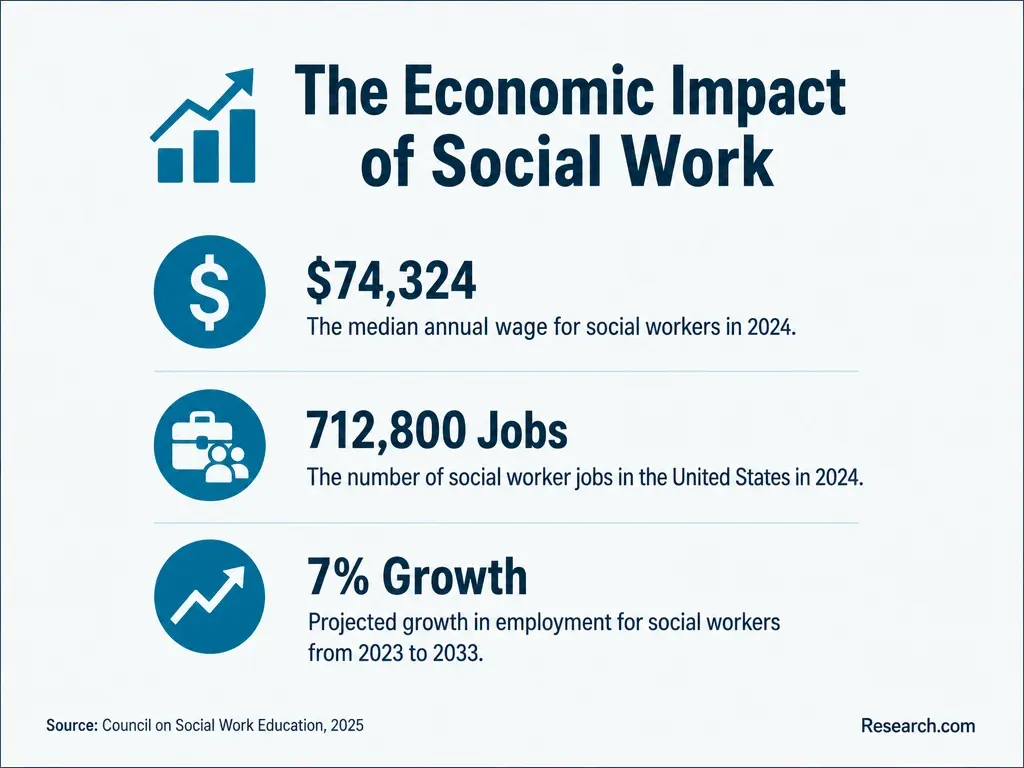
The closest U.S. Bureau of Labor Statistics category for many hospital social work jobs is healthcare social workers. Its May 2025 median annual wage was $67,880, and employment is projected to grow 8% from 2025 to 2035. These are occupation-wide figures, not hospital-only salaries or forecasts for a new BSW or MSW graduate. Location, license, experience, employer, and assigned duties can change an offer; exploring regional pay patterns for MSW careers can provide additional context.
Psychologist pay and outlook should be evaluated using the BLS category that matches the intended role - such as clinical and counseling psychologists - rather than treating every psychology position as a hospital job. Compare local postings for salary and required qualifications. A higher advertised salary may accompany a longer doctoral route, additional supervised training, and different day-to-day work, so it should not alone determine which profession fits.
Other Things You Should Know About Social Work
Yes. Ask a nurse, physician, or care team member how to request social work services. Availability and referral procedures vary by hospital.
They can ask to be involved, but clinicians must follow the patient's wishes and applicable privacy rules. A family member's involvement does not automatically permit access to confidential information.
No. Depending on the role, they may help during admission with distress, family concerns, resource access, or care decisions as well as discharge planning.
Tell the care team which language and communication accommodations are needed. The hospital can explain its process for obtaining appropriate interpreter or accessibility services; patients should not have to rely on an unqualified family member for a sensitive assessment.
- Addressing Social Needs in Health Care Settings - PMC - NIH https://pmc.ncbi.nlm.nih.gov/articles/PMC8240195/
- Psychotherapy for Crisis | cms.gov https://www.cms.gov/medicare/payment/fee-schedules/physician-fee-schedule/psychotherapy-crisis
- Screening and Referral Care Delivery Services and Unmet Health-Related Social Needs: A Systematic Review | cdc.gov https://www.cdc.gov/pcd/issues/2021/20_0569.htm
- Psychosocial Assessment by Hospice Social Workers | sciencedirect.com https://www.sciencedirect.com/science/article/pii/S0885392416303669
- Tests, Measures and Instruments: Clinical Assessment | Library Guides at UC Berkeley https://guides.lib.berkeley.edu/c.php
- The Differences Between a Social Worker and a Psychologist | University of Nevada, Reno https://onlinedegrees.unr.edu/online-master-of-social-work/social-worker-vs-psychologist
- Movement to include mental health providers on health care teams is coming into its own | apa.org https://www.apa.org/monitor/2025/10/integrated-care-psychologists


