
2027 Social Work Private Practice Revenue vs Take-Home Income: Understanding Business Expenses
Audited and Verified:
Our Editorial and Data Verification Process
Research.com uses government datasets, official education statistics and primary institutional information to support its career and degree guides. Our review process checks factual accuracy, occupational definitions, source dates and the requirements associated with the credentials discussed.
How This Article Was Fact-Checked
Our editorial team verifies salary estimates, employment projections, education requirements and program information against original data providers and official organizations. Salary figures are checked against the relevant occupational definitions and reporting periods. Information about licensure, accreditation and required in-person training is reviewed separately.
Fact-checked and verified on:

Co-Founder and Chief Data Scientist
A private practice can collect more in session fees than an employed social worker earns in wages, yet leave its owner with less spendable income. Rent, software, insurance, unpaid administrative time, taxes, and self-funded benefits all affect the comparison.
This guide is for licensed clinical social workers considering independent practice and students weighing that long-term goal. You'll learn how to build a realistic revenue forecast, identify costs that are easy to miss, and compare the result with an employed position before making a financial commitment.
Key Things You Should Know
- Revenue is not pay: In an illustrative practice with 16 paid sessions a week at $120 for 46 weeks, annual collections are $88,320; after illustrative business expenses of 25%, $66,240 remains before personal taxes and benefits.
- P aid sessions drive the forecast: At the same $120 collected per session, each additional paid session per week over 46 weeks adds $5,520 in annual revenue, not $5,520 in take-home income.
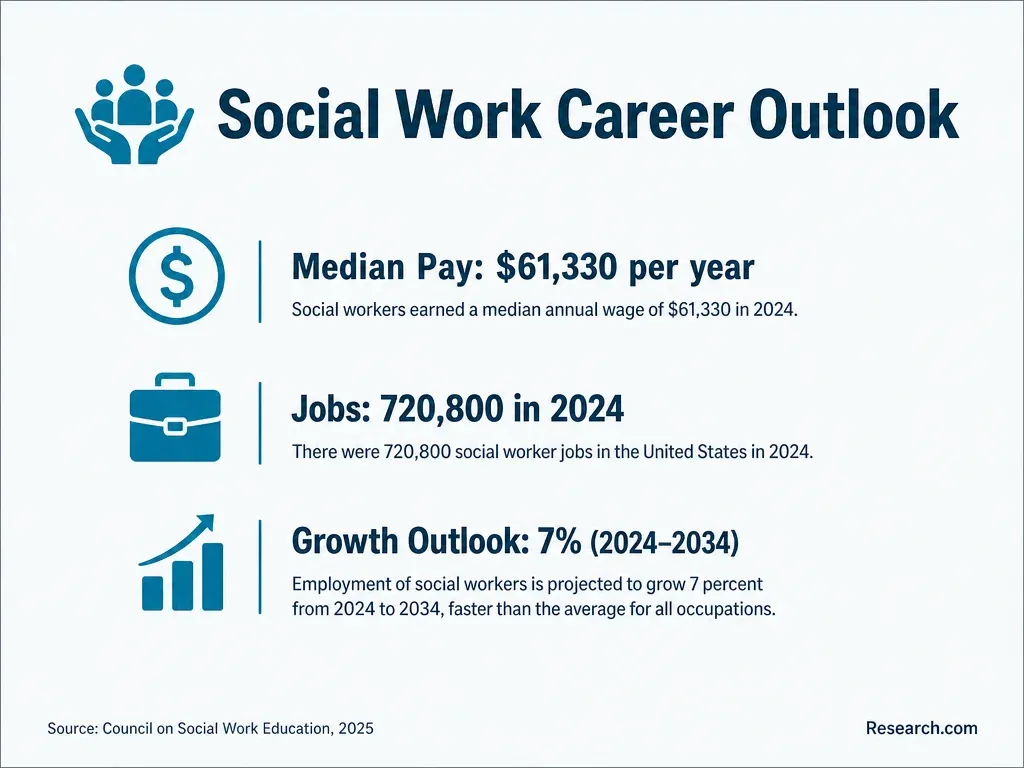
- Compare the whole package: The U.S. Bureau of Labor Statistics reports a May 2025 median annual wage of $60,280 for mental health and substance abuse social workers, but that employee wage is not directly comparable with a practice's gross collections.
How does private practice revenue differ from take-home income?
Revenue is money the practice collects from clients and payers. Business profit is revenue minus operating expenses. Take-home income is the amount the owner can use personally after applicable taxes and the amounts they set aside for benefits such as health coverage and retirement. A submitted insurance claim is not collected revenue until it is paid.
For example, 16 paid sessions per week at an average collected rate of $120, sustained for 46 working weeks, produce $88,320 in collections. If operating expenses total $22,080, or 25% of collections, profit is $66,240 before personal income taxes, self-employment taxes where applicable, and the owner's benefit costs. The 25% expense share is an illustration, not an industry benchmark.
This distinction also matters when evaluating education as an investment. A projected practice's gross billings should not be treated as a graduate's salary when using an MSW affordability duration and career outcome guide.
How much do social workers take home in private practice?
There is no dependable national take-home figure for an independent clinical social worker. Collections vary with local fees and payer contracts, while expenses, taxes, benefits, and the number of paid appointments vary by practice. The most useful estimate is a forecast built from your likely collections and costs.
The table holds the collected rate, working weeks, and illustrative 25% operating-expense share constant. It shows why a modest change in paid sessions can materially affect profit; none of the figures is a salary prediction.
| Paid sessions per week | Annual collections at $120 per session for 46 weeks | Profit after illustrative 25% operating expenses, before taxes and benefits |
| 12 | $66,240 | $49,680 |
| 16 | $88,320 | $66,240 |
| 20 | $110,400 | $82,800 |
To turn the last column into a personal budget, subtract an estimate of applicable taxes, health coverage, retirement contributions, and other owner-funded needs. Test a slower start and a lower-reimbursement scenario before relying on the middle case. If you are still deciding whether to pursue the qualification, comparing affordable social work master's degrees can help keep education costs separate from the practice's future operating costs.
What business expenses reduce social work private practice income?
Costs depend on whether the practice is virtual, office-based, solo, or part of a group. Separate recurring costs from setup purchases, and distinguish expenses paid by the practice from personal benefits the owner must fund.
These categories form a starting point for obtaining actual quotes and reviewing contract terms:
- Clinical and administrative operations: professional liability coverage, electronic health records, secure communications, billing support, and payment-processing fees.
- Space and technology: office rent and utilities when applicable, equipment, internet, and appropriate telehealth tools.
- Professional and business support: license renewal, continuing education, consultation, accounting, legal advice, registration, and marketing.
- Staffing and access: administrative help, interpreter or accessibility services, and any applicable employer-side payroll costs.
A new degree is not a routine operating cost of an established practice, and a BSW alone does not confer independent clinical authority. Someone still exploring online social work bachelor's education pathways should budget education and the later licensure pathway separately from a future practice's expense forecast.
Forecast paid appointments at the amount actually collected, not available calendar slots multiplied by a posted fee. Insurance contracts may pay less than a self-pay fee, claims can be delayed or denied, and vacancies and cancellations reduce the number of paid sessions. An online booking calendar showing 20 appointments does not establish 20 paid visits.
At an average collection of $120, one additional paid appointment every working week adds $5,520 over 46 weeks before its associated costs and taxes. Conversely, two fewer paid appointments per week reduce annual collections by $11,040 under the same assumptions. Raising a posted fee does not produce the same result if payer contracts set reimbursement or clients cannot sustain the price.
Build a caseload forecast using separate estimates for self-pay and each insurance payer, then account for likely collection delays and time spent on notes, coordination, billing, and referrals. For a prospective social worker, MSW programs with shorter study schedules may shorten the education phase, but no program schedule establishes how quickly a later private-practice caseload will fill.
Both online and campus-based MSW programs can provide relevant preparation through social work coursework, observed skills development, and supervised field education. Delivery format alone does not determine licensure eligibility. Check the program's applicable CSWE accreditation status, the licensing board's educational requirements, clinical learning opportunities, and whether the school can arrange approved field education in your location.
Online coursework does not eliminate placement schedules, live skills activities, or in-person agency learning. Ask who identifies placements, how field instructors are qualified, and what happens if a site cannot offer appropriate clinical learning. Field education support for distance MSW learners is particularly relevant when comparing programs across locations. Graduation prepares a candidate to pursue the next steps; it does not itself issue a license or confer independent clinical authority.
How long does an MSW take, and what does it cost?
Duration and cost depend on the entry route, credit requirements, tuition and fees, enrollment pace, and field schedule. Traditional or foundation MSW programs accept eligible applicants with bachelor's degrees in other disciplines and include foundational study. Advanced-standing tracks are intended for applicants with a qualifying BSW under the program's rules and generally omit portions of that foundational sequence. Neither route removes state post-degree clinical licensing requirements.
For a private-practice goal, calculate total educational cost - not just advertised tuition - including fees, books, placement travel, and paid work forgone during field education. Then add the time and cost of any required supervised practice before assuming independent-practice earnings. A guide to MSW education and state licensing expectations can help organize questions for programs and boards. If you already hold a qualifying MSW and the appropriate license, another degree may offer less financial value than targeted business training and a carefully tested practice budget.
Other Things You Should Know About Social Work
A separate business account can make bookkeeping and tax records easier to manage. Ask an accountant or attorney what your business structure and state require.
Often, yes, if your license permits the work and your employment agreement allows it. Review conflict-of-interest, referral, scheduling, and recordkeeping obligations before seeing clients independently.
That is a practice and access decision, not an automatic requirement. Decide in advance how many reduced-fee slots your budget supports, apply a consistent policy, and check any payer-contract restrictions.
Closing does not end record-retention and confidentiality obligations. Plan for secure custody, required notices, and lawful access under the rules that apply in your jurisdiction.
- Fact Sheet 13: Employment Relationship Under the Fair Labor Standards Act (FLSA) | U.S. Department of Labor https://www.dol.gov/agencies/whd/fact-sheets/13-flsa-employment-relationship
- 42 CFR Part 447 -- Payments for Services | ecfr.gov https://www.ecfr.gov/current/title-42/chapter-IV/subchapter-C/part-447
- Break-even point calculator - Small Business Administration https://www.sba.gov/counseling/plan-your-business/break-even-point-calculator/
- Self-employment tax (Social Security and Medicare taxes) | Internal Revenue Service https://www.irs.gov/businesses/small-businesses-self-employed/self-employment-tax-social-security-and-medicare-taxes
- Social Workers Private Practice: Starting Your Own Practice | Regis College Online https://online.regiscollege.edu/online-masters-degrees/master-of-social-work/resources/social-workers-private-practice
- How to Pay Yourself in Private Practice | Angelo & Associates CPA https://angelocpafirm.com/resources/articles/how-to-pay-yourself-in-private-practice
- Social Work Salaries | socialworkers.org https://www.socialworkers.org/careers/career-center/kickstart-your-job-hunt/social-work-salaries
- Gross Pay vs. Net Pay: What's the Difference? | adp.com https://www.adp.com/resources/articles-and-insights/articles/g/gross-pay-vs-net-pay


